11 November 2010

Something happy

So said the bass player: “Please can you write something happy”. And Peta Gammie wrote a lovely jazz-influenced ballad that swung lightly and with pathos rather than joy. But this was the only tune I heard that I recognised as jazz. Not that that’s a problem. She’s a good composer of soul or rock or funk songs on very personal issues of love and its consequences (if with a twist, like morning and non-morning partners living together). And Peta can carry the style off, with a strong mid-range voice that she uses capably and with evident and satisfying jazz-trained precision in pitch and note values. It was a friendly and sometimes amusing concert, if just a little nervous. The high heels that found the hole in the floor were an unexpected surprise. The relief felt by travellers returning home was evident in comments on the Aussie pronunciation of water (d for t)and the audience’s understanding of her patter between songs. Peta’s been in Geneva for the last 6 or 7 years, but comes from around Kiama and studied at the Jazz School here in Canberra, so this concert was somewhat a gathering of friends. The band was fitting, too. Mark beating such apt, flailing grooves and fills. Jason laying down busy, finger-funk bass lines with that middy, woody Warwick tone into a man-sized bass rig. Greg mostly strumming light, funk styles on strat but letting go for some devastating guitar solos culminating in sequences and sweeps. Ya have to love it! John leading on melody and soloing with some bluesy lines, but then insinuating sophisticated dissonances into busy grooves. And Luke on edgy Nord piano tones sweeping over the keyboard, and just one time at the end, introducing organ (I wished I’d heard more of this).
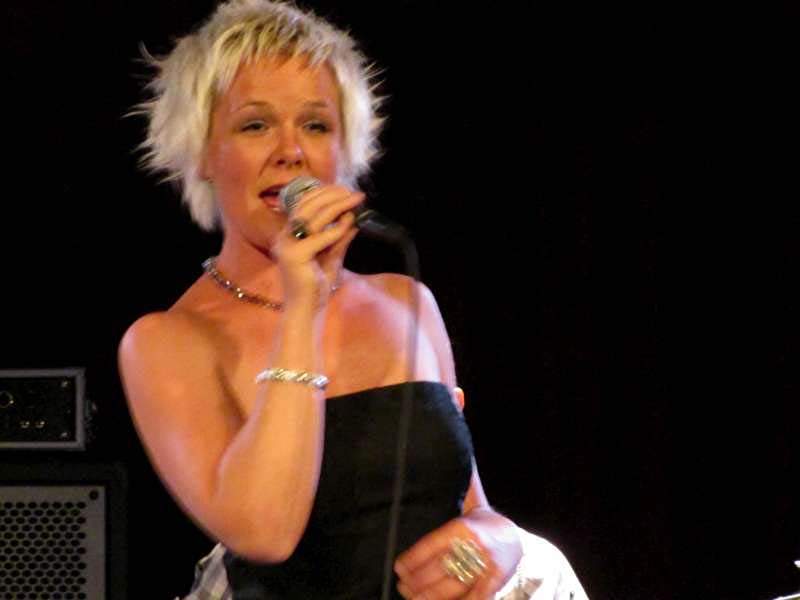
But it was more than just a concert. CIT is a training ground for video and audio engineers, as well as musicians and the music business. So we had a mega production, with big PA, big lights, big screens. I loved the sound of the PA, running well below its capacity and totally unstressed. I didn’t always like the mixing. I found it sometimes too edgy and cluttered and unbalanced for my ears, but I’m the backseat driver here. Mixing is harder than it looks. I enjoyed the video. It gave a different view of some things, and I found myself watching it several times, even with the live act only metres away. But one thing was disconcerting: there was a slight but noticeable delay between the PA sounds and the projected video. I know they delay sound for speakers at different distances from stage at big stadium gigs. That wouldn’t have been feasible here, where we were seeing the life performer just metres away, but it was strange to observe.

Peta’s songs were all originals, other than one Elvis Costello tune, I want you. Annabelle Jones sat in with acoustic guitar and nice harmonies for one tune. Utopia Collective played the first set, with their highly capable fusion, finishing with a tune John had introduced to the band only 5 minutes before. As I remember, it had a rock groove, a busy but constant bassline, one or few chords, a devilish melody that John must have known, and otherwise five very capable musos who pulled it off with ease (if a few nerves).

I enjoyed the night, enjoyed the sound and the experience, and especially enjoyed Peta’s soulful music and personal lyrics with such a capable backing band. Peta Gammie (vocals) sang with the Utopia Collective. The Utopia Collective is Greg Stott (guitar), John Mackey (tenor), Luke Sweeting (keyboard), Jason Varlet (bass), Mark Sutton (drums).

09 November 2010

Life on the outside

It was a pensive sound that was wafting through Woden Town Square as I emerged from shoppers’ paradise into fresh air and reality. Jazz had finally supplanted the buzzing rockers. Mick Elderfield was playing tenor under the bridge next to the Soul Bar. The bridge is an apt location for a solo tenorist: for the wonderfully rich and echoing sound under the massed concrete, but also for the reference to Sonny Rollins’ Bridge. I listened a while. That sound was so big and smooth, and the slow but sturdy statement of the underlying harmony was satisfying. I wondered if the lunchtime crowd, mostly brought up on fast pop or staid country lines over 3 chords, would think of this complexity. Would they hear the more intricate harmony? Would they hang around long enough to recognise a standard? Really, I shouldn’t expect so little: this was a well-educated public service crowd at lunch, and they probably listen to Miles and classics at home. Like me. They were probably rushing back to work for a meeting. But it was lovely weather and that sound was so nice. I commented to Mick and he confided he was playing a Selmer Mark VI, so there was good reason for the sound. I noticed tarnished metal and fresh-looking pads, so this was a cared-for vintage instrument.

Much of our public life now happens in commercial private spaces sporting agreeable charities and piped music and well-presented people and informed by eminent business sense. It’s all safe, ordered, efficient and comfortable, but it’s soulless. It was lovely to emerge into the rag-tag of public life in a public space and hear such sweet and thoughtful sounds. Thanks to Mick Elderfield who busked Selmer tenor under the bridge at Woden Town Square.

07 November 2010

CosmoCab

What a fascinating night it was! The Cosmopolitan Cabaret was a fundraiser for two development projects in Timor, one for micro finance in West Timor and another for sustainable farming in East Timor. The audience was committed, friendly, intelligent and the performers were diverse, local and interesting. It was not your normal display of jazz chops. This show covered folk, rock, classical song and cabaret-jazz. My band, the Gossips, started up with the cabaret-jazz playing ‘40s-era tunes with a cabaret bent: Ellington, bop, latin, even war-time singalongs. Great fun and some decent soloing all round. Congrats, guys … and our Darling Sister Leanne. Then Drew Walky with punk-cum-mod singer-songwriter songs of Canberra. This was interesting lyrics, strummed strat and a great line in dry vegetal stage humour and some amazingly capable number guessing from the audience. Then soprano Kristen Mann singing several songs by Debussy accompanied by Gossip Mike Dooley on piano: a change and a delight. A wonderfully strong and serene soprano voice filling a reverberent hall; no PA wanted or needed. Delicious! Then the fabulous Cashews. The Cashews are Pete Lyon and Alison Procter and are a Canberra alt institution. Famed for guerilla gigs (I dream of this, but it doesn’t work quite as neatly with double bass), clever, humourous, sometimes touching lyrics, easy and pleasant stage patter, these are a gem. The harmonies are so sweet, the ambience is light and humourous, the playing is capable and the songwriting is relevant and intelligent. Don’t miss their “acoustic-brain-pop”. Then more rock-influence with Andrew Holmes and Naomi Milthorpe performing songs of Ryan Adams. Not nearly so humourous. [Wikipedia notes that Ryan Adams recorded one album called the Suicide Handbook which was rejected on the grounds that it was "too sad". Hardly Cashews territory.] The end of the night was Gossips for our second set. So, a great night. Lots of varied sounds and emotions and a good cause.

The Gossips are Leanne Dempsey (vocals), Richard Manderson (sax), Mike Dooley (piano), Eric Pozza (bass) and Brenton Holmes (drums). Drew Walky played guitar and sang. Kristen Mann (soprano) sang Debussy with Mike Dooley (piano). The Cashews are Pete Lyon (vocals, guitar) and Alison Procter (vocals, guitar, accordion, supermum). Naomi Milthorpe (vocals) and Andrew Holmes (vocals, guitar) performed songs of Ryan Adams.

06 November 2010

Loft, as in NY

Carl Morgan played at The Loft the other night with his Quintet. I haven’t been to New York, but Carl has, and this seemed to me to be just what I’d expect in that aggregation of little bars with players from around the world experimenting at the forefront of the art. I loved it and it’s probably unique in Canberra; very special.

But this is not music for the fainthearted. It’s demanding for both performers and audience but it’s also engaging and satisfying for both. The rhythms are complex, the melodies are contorted and busy and the flow of the compositions is none too clear at first glance. I was trying to count the first tune of the night: I thought maybe 14 but there seemed to be occasional extra beats here and there. There were. Talking to James the drummer afterwards, he told me it was a 4/4 (I was floored by this) played in 5-7-4 totalling 16 (this sounds more likely). Likely, but none too easy to fathom or to play. The grooves were syncopated-modern with just one or two walks that take on a delicious quality amongst the broken beats. James was just playing around the groove and implying the rhythm with skills and subtlety aplenty. Bassist Alex had some ostinato lines or was playing on 1-2+, a common latin-like beat, but in the contemporary jazz idiom, and embellishing with fills and long intervals. I suppose all this is classified as polyrhythm, but it’s certainly rhythmically complex. A drummer next to me noted pianist Steve played rhythmically, but I noticed more his solos that were obscure to my ears: closely spaced lines that repeated, regular but not quite sequences, busy and constant, not flourishes but a moody activity that buzzed and bent the underlying harmonies. Again, I’ve heard this before but on recordings, not locally, and my ear places it somewhere around the bleeding edge. The front line of Carl on guitar and Mike on tenor were more clear in relationship to harmony, although both were melodically challenging and had expert chops. Carl and his constant overdriven guitar tone were solid and even, framing lines that were smooth, although phrased and intervallically jumpy, and making lovely use of fretboard positions to move through modes, and throwing in those occasional devastatingly fast flourishes (that had me laughing in elation) or just plain modestly fast lines (still gems). Mike was more constant in melodic concept, often using sequences to move around the tonality, and with a physical presence that reminded me of Jamie Oehlers, bending knees into the low tones and arching back for higher runs. Alex was similarly physical, bending into the bass for the thumb positions and sometimes remaining crouched into the body, and thinking back, Steve was well bent over the keyboard too.

The tunes were originals, several by Carl but also by Mike and Steve, and just one by a US sax player, Dave Binney. Not all tunes had such a difficult conception of time; one seemed a 32 bar tune (or thereabouts); one was a walking swing. I thought I noticed development between a few of Carl’s tunes. I think it was Wheel that was an earlier composition, and relatively (I do mean “relatively”) sedate and less complex. Whatever, this was a brilliant evening of challenging compositions and playing at the forefront of contemporary jazz, at least here in Canberra, and heard in a nicely intimate environment. That pretty much adds up to bliss to my ears.

Carl Morgan (guitar) led his quintet comprising Mike Rivett (tenor sax), Steve Barry (piano), Alex Boneham (bass) and James Waples (drums) for a session at the very intimate new venue, The Loft.

05 November 2010

Restoring our history

Modern life is very much lived in the fast, unrelenting present: we forget our history, which also means that we forget our dues to the past. I don’t come at the argument that jazz ended in the ‘60s but I value history. Leigh Barker’s Quartet obviously do too, and I found their recent gig at the Gods was refreshing and different because of it.

Leigh with his acoustic bass (truly acoustic: miked, no pickup) and slapping technique and gut sound led the outing, but Mark fitted admirably with older-style grooves (sometimes strange and clumsy to my modern-influenced ears but which just fitted) and always sharp rolls and accents and rimshots and hihat sizzles and the solos from Sarah and Eamon were talking with a blues accent. One mate spoke of the piano solos as “gritty”: a nice metaphor and it fitted often enough. I was initially hearing hard bop: strong tonal lines and solid swings with that blues background. But as the night wore on, I started hearing more styles, more influences. Piano and trumpet both broke from consonance for lines that spoke clearly with dissonance and substitutions, and even touches on modal styles and more linear improvisations, rather than locking to the chord changes. But then, back to the past, with lovely gentle swings and vocals from Sarah on an old song, Please be kind, as played by Sinatra/Basie, that reminded me of the current wave of female jazz singers. And a historically apt interpretation of What is this thing called love, sung by Eamon and finishing the night with a touchingly distant and devastating interpretation. Just last weekend, Eamon won the Wangaratta National Jazz Award, this year for brass, so I wasn’t surprised by his fluency and command. His was a masterful performance: a forceful tone, clearly enunciated; melodic, structured, fast solos with growls and bends and releases; wonderfully present and in command. These were not long solos but they spoke clearly and authoritatively.

I think it was the phrasing and rhythms that determined the band as located so much in history, despite the dissonance and modal freedoms that appeared throughout the night. This was harking back to pre-bop, but influenced by many generations after. Or was it the other thing I noticed, that the lines were just right: apparently simple because they were so unjarring. I noticed that first with Sarah’s solos: apparently simple, mostly arpeggiated, and so right. Musicians know this is no easy achievement. It takes work to play simply and inevitably: it’s not something you can fake. James LeFevre was there, and in true jazz bar style, he sat in for the last tune. James played very well, but differently: a longer solo, more modern-challenge, more ecstatic, less classical. It was an interesting juxtaposition and so appropriate for a band that exuded jazz history in bars and bordellos to invite in the local.

I very much enjoyed and was refreshed by Leigh Barker (bass) with Eamon McNelis (trumpet), Sarah McKenzie (piano) and Mark Sutton (drums), and James LeFevre (tenor) sitting in for the last tune.

31 October 2010

Ladies’ day

It was pretty much a ladies’ day: a clothing exchange called We’ll wear again to raise funds for Frocktober and the Ovarian Cancer Research Fund. Certainly, the audience was mostly female, but at least there were a few guys, even if they were mostly in the band. Not sure if we entertained the women as much as the second-hand clothes did (I jest; we did perfectly well), but we got a few claps and it was a very enjoyable, 40s-era theme and it was the Irish Club so there was Guinness on tap. James LeFevre helped out on tenor with some authentic bluesy growls and Lester style appropriate to the gig. I am a bit closer to a decent amplified double bass sound, so I was enjoying it. Leanne was the dignified but entertaining front person that a Darling Sister must be. Brenton played some of his best solos: busy but still relaxed, tumbling rolls and fills. Mike was sniffelling a cold but pulled through another impressive, professional performance. And I found myself a perfectly nice shirt: the grrrls can’t have it all their own way.

I just caught another band on the Irish Club deck playing Pogues and more traditional Irish music: Humbug. Here’s a pic. I haven’t written up Irish music, although their fiddle reels and the like can be insinuating and entertaining.

The Gossips are Leanne Dempsey (vocals), Mike Dooley (piano), Eric Pozza (bass) and Brenton Holmes (drums). Saxist Richard Manderson was not available on the day, so James LeFevre (tenor) sat in. Thanks James.

29 October 2010

Glances

It was a busy night, with several good gigs that I just visited. Gig 1 was Fiona Boyes and Debbie Davies. Fiona is genuine hot Aussie blues singer/guitarist with significant US recognition who has recently settled in Canberra, so we can expect to hear more of her. She was playing with blues guitar master/mistress, Debbie Davies. Debbie has a string of successes with multiple albums and awards and experience playing with the blues greats. I only caught a few tunes and it was early in the night, but this was lively 12-bar blues with Fiona’s involved singing out front and some very capable guitar from Debbie. The women played with locals Niels Rosendahl, James Luke on double bass and Chris Thwaite. I presume this is the band that will play at Wangaratta this weekend. It was a lively scene with a large, busy, noisy audience. Thinking back, I wish I’d stayed for more. True blues.

Gig 2 was the ANU Commercial Band for its final outing in the current incarnation (several significant members are leaving the School this year, and membership is by annual audition anyway). This was funky and committed, but the sedate space of the Band Room bled some of the verve and fun that I heard at Moruya in the Monarch garden a week ago. I heard again that beautiful tune I mentioned at Moruya, with lush, gently changing chord textures and a lyrical overlying melody, sometimes from alto, otherwise from trombone: Looking glass by Matt Harris. Lovely. The rest was less cerebral and more funky, from stables James Brown and Prince and others.

Gig 3 was just a listen at the door to the CSO playing Elgar’s Enigma Variations at the Llewellyn. I couldn’t really make it out, so off to more mundane matters, like Gig 4: supermarket [no pics].

Fiona Boyes (guitar, vocals) played blues with Debbie Davies (guitar, vocals), Niels Rosendahl (tenor), James Luke (bass) and Chris Thwaite (drums) at the National Press Club. The ANU Commercial Band played in the Band Room.

27 October 2010

Thoughts of passion

It’s not jazz but these are great musical experiences. Earlier this week I was standing over the shoulder of a mate, Mike, as he played Chopin’s Fantasie Impromptu on another mate’s Yamaha grand piano. Last night it was visiting Finnish concert pianist, Paavali Jumppanen, performing at the Finnish Embassy. I was not quite standing over his shoulder, but I was close and enjoying the power and passion (passion fits here, but more on that later) of another Yamaha grand, lid up and only a few metres away, in full flight.

The program was nicely balanced. It started with Mozart’s Sonata no.3 in Bb major. This was often pretty but mostly effusive, effervescent, overflowing with life. The concert notes spoke of a love duet in the second movement, of joyous outcomes and timid entreaties, and certainly the birdsong tweets and the sweet parallel sixths (mentioned in the program and I’m pretty sure I heard them) fit this theme. I heard it as Mozart and his young, toying, youthful personality, the one we are told of. One of the greats, certainly, perhaps a child-genius: vibrant and alive (and very possibly petulant). Paavali played this with generous dynamics and tempo changes verging on a romantic sensibility, and on a piano which sounded stolid in midrange and lively in the highs, and in a very lively acoustic space.

Next was Four Preludes Op.77 by Jouni Kaipanen. Jouni is a modern Finnish composer. This work was commissioned by Paavali and premiered in 2006. How different! The notes comment that Jouni is avant-garde but later influenced by a new awareness of tonality. We got dissonance and polyrhythms and intense rubato and music free of a time signature and mutating arpeggiated runs and dynamics that moved from the lightest of high tinkles to ponderous chords and low notes, but also delicious tone-images. I heard slivers of ice and regeneration of flowers and bushes and expressions of a harsh but seasonal environment that I imagine must be Finland. Certainly this fit the fourth prelude called Tempo Terrace with its poetry theme and perhaps the third called Waiting for the wind with its contrasted explosive outbursts and spring fountains. I was less certain of the sound images in the second, a prelude called Erik, wondering who was this man and what the music said of him. I heard anticipation, which might fit a personality, but also thunder and rubato and some very heavy chordal statements. Still thinking.

Last on the program was Beethoven’s Sonata Op.57, the Appassionata. This is fiery classical excess, all emotion. Long repeated scales over the full range of the keyboard, major-minor key changes, denouements and resolutions and relief and rapture. This was passion undiminished, under some control at times but open and declared, exalted, even indulgent. The second movement was more subdued, ordered, almost courtly and delightful, if not so exceptional and certainly more restrained. But that was interim only. I was laughing as the final movement ended in terrible excess, loud and rabid attacks over the whole range, huge chords and an end. It’s sad that to some degree the effect has been lost as popular culture has appropriated the celestial for the popular soundtrack. But in a concert situation the Appassionata retains its presence and power.

Paavali returned for an encore with another F minor work, Mozart’s slow movement from the Second Piano concerto. What a change again: this was courtly, steadied, intellectual clarity rather than passion, but still emotive and beautiful. More a connection to Mozart’s musical past, with ornamentation and dignity and presenza. I wondered if this was a mature Mozart; it was composed 30 years before Beethoven’s extremes.

I enjoyed that I experienced the music rather than the performance. I talked to Paavali afterwards, and he spoke of enjoying the music, not just the playing, so it fitted. It was not just me who heard it as youthful and vigourous playing, rich in dynamics and pauses, strongly emoted but also respectfully and thoughtfully presented. Otherwise, I can just wonder at such musicianship, the skills of hand and mind and heart, the immersion in the music that makes for the feats of memory, the awareness that allows the structure to impel itself and make the works the inevitable things they are.

Thanks to Paavali Jumppanen (piano), to the Finnish Embassy and to Henk van Leeuwen of Australia Northern Europe Liaisons who brought Paavali to Australia for his third visit.

22 October 2010

Adored once too

Neither Megan nor I were in particularly good form to take on an Australian interpretation of a Shakespearean plot in Elizabethan English made more obscure by a limited cast playing multiple roles, but we attended Twelfth Night presented by Bell Shakespeare and enjoyed it well enough. “Adored once too” has little relevance here, other than that I was surprised by some delightful quotes. I shouldn’t have been because the stock quotation books are pretty much just Shakespeare and the Bible. This is comedy, so “But be not afraid of greatness: some men are born great, some achieve greatness, and some have greatness thrust upon them” was pretty unexpected. It seems too serious for this context, but S littered his plays with changes from light to lofty. Some other clever observations were delightful, like “Love sought is good, but giv'n unsought is better” or the famed “If music be the food of love, play on”, but then this is a romantic comedy so not so out of place. On the other hand “Many a good hanging prevents a bad marriage” was dark if revelatory.

We enjoyed the second half better, but then I find I take some time to settle to the language and the plot. The stage was odd, being a pile of clothes and a few cardboard boxes and a tellie that localised the disaster of Twelfth Night’s drownings with the Victorian bushfires. I found that a tad insensitive. The cast of 7 (1 woman, 6 men) seemed to be on stage all the time, although sometimes hiding (or changing) behind that pile of clothes. There were men dressed as women, and of course the confusion of woman for man which is at the heart of the play. Poor Malvolio misses out and is embarrassed in the process, but the brother and sister, and even the maid, get their loves’ contents. I was a bit surprised by the (admittedly delicate) man playing Olivia, but I can see it fits a tale of sexual confusion. I had a problem with his voice which was the weakest of the cast. I liked Andrea Demetriades as Viola, and also Max Cullen as the fool Feste, but his part was pretty minimal while the rest of the cast slaved away as multiple characters. The Canberra Times review commented on the Canberra mentions, like the PM with a hairdresser as consort and a reference to missing Floriade. I was more interested in whether the Elephant pub still trades in London (“In the south suburbs, at the Elephant / Is best to lodge”) and the mention of “midsummer madness” (did this originate here?) and the po-mo self-referencing that shows that there’s nothing new in culture (“If this were played upon a stage now, I could condemn it as an improbable fiction”). I’m still pondering this mention of food “I am a great eater of beef, and I believe that does harm to my wit” and giggling at “A plague o' these pickle herring”. The final greeting of brother and sister as they meet was satisfying, even if Orsino’s change of love object was more difficult to accept. And the cast played it all with visual gags and slapstick that I guess would have been in the original. But it’s the forlorn “I was adored once too” that will stick with me. That was touching.

Shakepeare’s Twelfth Night was directed by Lee Lewis for the Bell Shakespeare Company at the Playhouse. The cast was Max Cullen (Feste), Ben Wood (Malvolio), Andrea Demetriades (Viola), Kit Brookman (Olivia), Brent Hill (Maria/Antonio/Valentine), Elan Zavelsky (Orsino/Sir Andrew Aguecheek) and Adam Booth (Sir Toby Belch/Sebastian).

20 October 2010

Pilgrimages (Moruya 2010)

It must have been a weekend for pilgrimages. Obviously, the big one was for Mary McKillop at the Vatican, but for me it was my annual jaunt to the Moruya Jazz Festival. It’s usually a bright, sunny, warm outing, but this one started with unseasonably wet and cold weather. By the end, it was pleasant despite a gentle but cool breeze in the Monarch Beer Garden. The usual contingent from the ANU Jazz School was there, as well as lots of names that appear most years. (It’s not just a pilgrimage for me, it seems).

Eric Ajaye noted that this was the tenth straight year that the Commercial Ensemble played at Moruya. They were hot and one of the festival stars for me, but then I like the harmonies of a larger ensemble. It was a different band this year with Liam Budge out front with his youthful vigour and visage (and male voice) and searching approach to singing the melody, and the addition of percussion from Namchoon Kim, (who has studied in Cuba, no less) enlivened the tonality. Percussion is not a common instrument at the Jazz School. Eric Ajaye noted that many bands he’d played with in the US had percussion, and certainly it adds a patina to the sound and complexity to the rhythm that greatly enhances many musical outings, and it sat well with a funky outfit like the Commercials. They do a nice cover of Steely Dan’s Ricky don’t lose that number with constant changes of style, rock, swing in the B section. That was interesting. But my favourite was a deliciously intoned ballad which they played at the first performance only. The horn-line intonation was spot on, so this just sang, and amongst the other lively numbers, it was a big contrast. Beautiful.

The stars of the show (at least for the followers of more modern styles) are always the faculty of the jazz school. This year it was Mike Price, Eric Ajaye and Col Hoorweg performing as the longstanding Mike Price Trio. They performed fabulously smooth and rich treatments of a few standards. How interesting were these renditions: a listening audience in a dedicated but casual venue makes a big difference. They played two sets, and both were well attended and closely followed. I was particularly taken by Eric’s strong and determined fingerboard work and I’m perplexed at the moment by that stroking right hand action, but then I’m a bassist new to double. Miro’s band was in the program, but couldn’t make it one the day, so Luke Sweeting performed Miro’s sets with Eric Ajaye and Aidan Lowe, and with some students occasionally sitting in. I caught just a few tunes, but the uncanny ability of Luke to stray from the straight line was inspirational.

Another band that impressed and entertained was the little big band funk/reggae outfit called Mahooud. Lots of laughter and display and obvious joy on stage, and it was infectious for the audience. Rachel Lole led the band from the mic stand, interestingly with another female singer, Sophia Christoper. Six horns out front, and a strong rhythm section I particularly noticed Caleb Wearne, e-bassist (also appearing in another outfit on acoustic) who set down some eminently funky and solid rhythms on Cissy Strut and the like and guitarist Victor Rufus. There were screams of delight when funk turned to reggae at one stage, but the feature was the final polka-cum-klezma paean to drink, with indulgent lyrics and punctuated playing and starts and stops and Eurofolk changes of tempo. The band was loving it and so was the audience. This was a winner.

Otherwise, there was a font of interesting stuff. DJ Gosper with her entertaining professionalism, great voice and relaxed swing. Jan Preston with hard core boogie-woogie blues. Matt Thompson with his very cool accompaniment. Dirk, Graham and Lachlan presented their normal smooth, mellifluous sax-based performance as As Famous as the Moon. Liam Budge in his own band with emo presence and busily inventive vocals, and always a great collection of fellow travellers around him. Not sure with whom, but I remember guitarist Joe Panucci letting go with some extraverted, screaming, sweeping solos. The Recording Ensemble were more introspective and minimalist this year. The Ax Long Quintet presented some early Miles-cool playing. I was quite fascinated by some developing but intriguing soloing by Tom Fawcett. Peter Henderson’s Turner’s antidote was there as usual, playing Tom Scott and similar '70s funk. They obviously enjoy this outing. Kooky Fandango were playing their lighter funk style, sharp and practised, and with Cam Smith’s classically trained trumpet playing some very nice and authentic jazz solos. There was more, of course, some of which I saw, and some I missed, bands and even venues and they are obviously coloured by my mood and interests. After years of attending Moruya, it feels like a family affair with the assortment and affiliations and changes over the years as the kids grow up and leave home. Maybe family picnic fits better than pilgrimage.

And BTW, I was there with a new band, but I have indulged myself elsewhere about that.