16 January 2016

Free like the wind


Canberra lucked out this time. Kaze were in Australia for a summer jazz festival in Melbourne and we got this experimental quartet to play for an intimate session at the Ainslie Arts Centre. Kaze are a quartet comprising two Japanese members and two French. Also, no bass, but two trumpets with piano and drums. The second set was more abstract, essentially a personal improvised free solo from drums then trumpet, trumpet and piano before a loud final flourish to sandwich the quiet with volume. They started with charted lines and shared solos from the two trumpets then through various mixes of compositions and free for the first set. I enjoyed the comparison of approaches by the two trumpets, the intrigue of finding sounds on all the instruments, the cymbal screeches and piano mallets and, something I'd not seen, a cord singing a piano string, the various tiny percussions, the continuous breathing (from both trumpeters) and even stranger techniques like the balloon mouthpiece. I like that it wasn't only free. The composed sections were a fitting palette to enhance the free parts. Leader and pianist Satoko said they prefer the free improv and the second set was essentially that. This was intimate and as serious as your life, to borrow a jazz quote, and a friendly event where you could talk to the musos. Some really capable free within a larger structure. Nice. And BTW, we were told that Kaze means wind.

Kaze is a Japanese/French collaboration comprising Satoko Fujii (piano), Natsuki Tamura (trumpet), Christian Pruvost (trumpet) and Peter Orins (drums).

15 January 2016

Career advice: study maths


Career Advice were a madly demanding mix of counts and permutations. So that we remember to count, John Gould, my Maruki conductor, jokes that everyone he's ever met knows how to count to four. Career Advice is full of much odder counts and permutations and repeats and rabid syncopations and unexpected unisons and it was spectactular and mesmeric. Think this against a solid rock drum groove, admittedly often adorned, a fat low octaver bass, richly embroidered, and electronically enhanced Rhodes. Leader Lewis composed the music and led from his piano and it sounded electric but also floating and airy. Coloured and changing, the product of echo, overdrive and ring modulation, so the piano functions not just as percussive chords but modulates rather than just decays. I mentioned low octaver on bass, and it was mostly deep and fat, but there were other effects there, too, and on cornet (Zoom something) and tenor (TCHelicon for echo, harmoniser, perhaps more). So this is a quintet with Rhodes and two horns but nothing like acoustic post-bop. This was processed, rich, full, ringing, contemporary. The insistent permutations and changes were trance-like despite the overlaid solos. The cornet took at least one quiet, meditative passage, virtually alone, and the playing was spacious, but mostly this was heavily grooved, expected but not due to simplicity. The set was a 30-min tune (perhaps a medley) then two more. "That got a little more hectic than we were expecting" said Lewis after the second tune, "I feel like slowing things down". The final was Deep expectations which started with a relaxed but searching unison line with bass harmony and cymbal colouration, but ended with a alternating twisted syncopations with swapped solo passages between tenor and cornet. Deep, heavy and absolutely involving in the way metal can be for its adherents. I was taken. Just fabulous.

Career Advice are Lewis Moody (Rhodes, compositions), Ben Harrison (cornet), Luke Minness (tenor), Marty Holoubek (bass) and Jacob Evans (drums). They played at Hippo.

14 January 2016

Pleasurable beer on a hot day


What a good night was promised at Hippo and how good was it? It was a double bill, sharing a few players, all out of Melbourne. First up was trad from the Lagerphones. Cornet, trombone, clarinet for the concurrent soloing and various others. These three also sang, sometimes leads, sometimes in three-part harmony. Chordal accompaniment was the chuck-chuck of banjo, with bass and drums. I don't hear too much trad, but it can be a ball. This band moved over the years, I think. There were 2-feels with polyphonic solos, various solos with backing from instruments or perhaps voice, lines that were harmonically simpler, more arpeggiated than linear, four-on-the-floor kick and snare rudiments, cheesy lyrics, several originals. But there were also some touches of the modern: walking bass, a reggae tune, even Paul Kelly's song, Darling it hurts. Now, that was unexpected, but this is a Melbourne band and it's working and they mention "a desire to get out of the dimly lit jazz club and onto the sticky carpets of their favourite pubs". The swing dancers were around, at least for the more tradie or swinging tunes. But Hippo was full and people were smiling and the band was pumping. I didn't mention the capable playing all round. I particularly liked Ben's cornet and James' trombone and Jon had a particularly nice voice. But I took this as fun and it was that in spades. Great stuff and particularly great as a change for a died-in-the-wool modernist.

The Lagerphones comprised Ben Harrison (cornet), James Macaulay (trombone), Jon Hunt (clarinet), Louis King (banjo/ resonator guitar), Marty Holoubek (double bass), Jacob Evans (drums). The played at Hippo.

12 January 2016

AYO(NMC2016)2

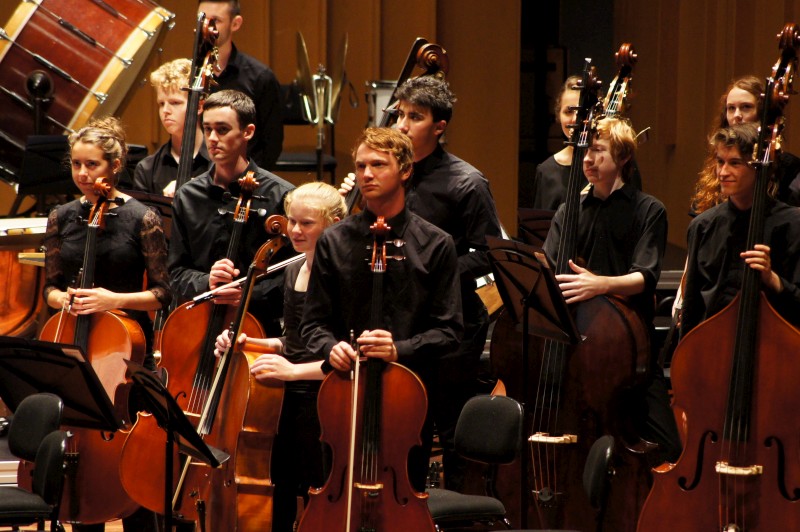
James Crabb commented on the energy backstage before the gig, that all concerts should be so alive. It's something that I've noticed before and that makes the AYO's National Music Camp something special. These girls and guys are young and committed, working hard and having a ball. They are also very capable and well trained and it's all obvious and a key to the pleasure which is this series. The second concert was another orchestral outing, again with the chamber and two large symphony orchestras. The Alexander Orchestra under Erik Nielsen opened with Weber's Oberon overture. I've played it so could follow closely and I admired the series of rapid bass lines. Megan asked had I played all that. Yes. Perhaps not quite so fast; I'll have to return to the recordings to confirm that. What got me was the clarity of lines at that speed. Playing fast is not so difficult, but fast and clearly with no faking is the test. These notes were all there and distinct. Then the Smalley Chamber Orchestra playing Elgar Introduction and Allegro. I liked the composition and the performance. I found the piece superbly attractive for strings and can only hope to play it sometime. James Crabb joined both symphony orchestras to lead and feature on Piazzolla Acongagua. This is a concerto for bandoneon and orchestra, played here on chromatic accordion. Typical Piazzolla, enhanced tangos, simple harmonic movements, attractive and mobile. JC did a nice job leading and a very impressive job on the accordion (much enjoyed for delicacy and speed and phrasing). Strangely, the Bishop Orch played the first movement, then gave way to Alexander for the next two. Weird and interrupted but it worked well enough. Then, after interval, the Bishop returned under Brad Cohen for the exhilaration of John Adams Short ride on a fast machine (apt given Summernats is on just up Northbourne Ave) and Ravel Daphne and Chloe which was, to me, feeble after the excitement of Adams. I guess it deserves another listen in a different environment. The whole went out live on ABC Classic FM and the other orchestral concerts will also be broadcast over coming weeks. All lively and capable and exciting and a great first afternoon and evening for the AYO.

The second concert of the Australian Youth Orchestra National Music Camp 2016 was orchestral, with the Smalley Chamber Orchestra, Bishop Orchestra under Brad Cohen (conductor) and Alexander Orchestra under Erik Nielsen (conductor). They played Webern, Elgar, Piazzolla, Adams and Ravel.

10 January 2016

AYO(NMC2016)1


It's a long wait between drinks (beers) for the Australian Youth Orchestra to return to the Wig & Pen, or should I say Llewellyn Hall. Their National Music Camp is annual, but shared on alternate years between Canberra and Adelaide. 2016 is the year for Canberra. Canberra is strangely devoid of people at this time, seemingly more-so this year. I walked a possible ANU student-to-be through a very, very quiet campus (other than for an occasional youth in concert hall black). I'm told she's since chosen Melbourne, and given a campus and town so devoid of activity, I may have done the same. But I know Canberra's actually more interesting than that, being national capital, home of 5 universities, highly educated, seat of the federal bureaucracy and Summernats. Despite the sonambulance, Llewellyn was alive. The first AYO concert was orchestral. The performers were just a little wary at first, but gained confidence by the bar. First up was the Smalley Chamber Orchestra with Handel Concerto grosso in C minor then Veress Four Transylvanian dancers. That second was new to me, with even the movements having strange names, Lassa, Ugros and the like. This was a very large chamber orchestra, playing in a large space and it worked a treat. Then the Bishop Orchestra under Brad Cohen with Ravel Rapsodie Espagnole. I realised how satisfying and big sounding can be an orchestra of 100-or-so players (eight double basses). It's bigger than any orchestra I've heard since some Mahler in London many years back. It was an immense pleasure to feel Ravel's swells fill the space so copiously. And such good playing from such a young cohort on these Spanish scales and rhythms. Then the Alexander Orchestra, under Erik Nielsen and similar sized, came back after interval with Schumann Rhenish symphony no.3. These guys are good, not just energetic and keen.

The first concert of the Australian Youth Orchestra National Music Camp 2016 was orchestral, with the Smalley Chamber Orchestra, Bishop Orchestra under Brad Cohen (conductor) and Alexander Orchestra under Erik Nielsen (conductor). They played Handel, Veress, Ravel and Schumann.

08 January 2016

Lugging it easy


Here's a post that any muso will appreciate. We played again at the Tradies and it was a very pleasant gig. Obviously the playing and companionship are one aspect of this. Another is the lug. Someone was telling me of the hard lug at Hippo (I still haven't played there). He even hires a roadie for that tortuous stairway. The worst lug I remember was a country hall that was accessed up several flights of external timber steps with plenty of heavy bass gear and PA, puffing and dreading that a rotted might give way. Gear is lighter now but we are commensurately older and the lug remains an issue. Tradies is a single lug with a hotel luggage trolley for PA and bass gear and the rest (including my tongue-in-cheek micro-light show). It's a pleasure, even more so with a grand piano on stage to save James his lug. Add Dave's drum kit and we are go. How easy is this!

Tilt lugged at the Dickson Tradies and will do so again over coming months. Tilt are James Woodman (piano), Eric Pozza (bass) and Dave McDade (drums).

02 January 2016

Curtailed in Curtin


It's the Christmas-NY period and Canberra is like a country town again ... like when I arrived 30years back. Lovely, if temporary. The down side is a lack of events happening. The audience is at the coast or visiting rellies and the remains, in town, are bereft and otherwise sleeping. We had visitors and I found some music at Beyond Q Bookshop, that strange, little venue that presumably gets free performers. No way they could pay. Whatever, John Black was there and he was a great pleasure, stride, easy feels, thoughtful improvs and clear melodies, even with a piano that's slightly suss. The adults are always the pleasures in this game, and John is just that; well experienced and mellow and every chord and every theme nicely voiced. A pleasure. Ellington, Basie, Django, Booker T, NOLA feels. Very nice. And before was renditions of the folk/singer-songwriter repertoire that we know so well from the '60s and '70s, mostly. Fred Pilcher played 12-string guitar, with vocals, with finger picking and capo, with talk of kazoo but I didn't hear one (did I?). Leonard Cohen, Bruce Cockburn ("at least as depressing") and a string of lighter tunes, not least a folk-humour take on Teddy Bears picnic. Nicely done and lots of memories but not so much my scene, this being being CJ after all. They may not have been paid too well, but this was a pleasant arvo in that singular basement that is Beyond Q.

John Black (piano) and Fred Pilcher (guitar, vocals) performed solo acts at the Beyond Q Bookstore.

24 December 2015

Advent


Musicians coming home to visit the family. Old ANU bands getting together to play their greatest hits. Some great jazz from musos that we hear developing further year by year, in Canberra or elsewhere. Same Hippo. Such a pleasure to be part of all this at this time. The latest was Reuben Lewis & the Snake Charmers. Reuben was back from Melbourne. Aidan for a second recent concert in recent days, was back from Berlin. Both dropping in for Christmas cheers. Both with old sparing partners, Simon and Matt, in a format they have all played frequently. Tunes by the band, Reuben and Simon, with occasional covers. Bjork Hyperballad for one. Otherwise, I recognised old favourites through the set: a groove in 3 with just 2 chords, tom-heavy drums and fingerpicking guitar accompaniment and simple but gorgeously effective melody; a rock groove with four falling chords over 16 bars; a reggae; a rural theme that reminded me of horse-riding, lazy, with A and B sections; a medium -up latin. All so nicely played. Simon holding exemplary, simple bass lines that just work. Great guitar solos from Matt and unaffected variations from Aidan and clarity of melodic purpose from Reuben. Such a pleasure. Original tunes; modern yet firmly planted in a sweep of musical history; relaxed but complex and satisfying. At Hippo for the 23rd day of Advent.

Reuben Lewis (trumpet) led the Snake Charmers at Hippo. The Snake Charmers were Matt Lustri (guitar), Simon Milman (bass) and Aidan Lowe (drums).

21 December 2015

Enabling the indie song


These guys are all jazz trained but I had no expectation to hear Jazz. That's how things are these days. I like it like that. There's a catholicity in music and especially amongst young trained jazzers and it shows. This was Matilda Abraham with Carl Morgan and, at the last moment, as he was in town from Berlin and his other gig was called off, Aidan Lowe. I also like this like that. Jazz trained performers are, well, trained, so Aidan could get called in to do an indie-pop set with complex written syncopations, some of which he'd have to introduce, and do a perfectly capable job. But this was Matilda's show. They were mainly her originals, in a Triple-J style that I call indie or maybe experimental pop. This was underlying sequenced instrumentation and even harmonies with voice and additional keys and bass or guitar and drums overlaid for the immediacy that make live music live. Matilda's writing is personal, often venting emotions, clear in intent although I didn't catch all the lyrics. One told of annoyance after a bad party; another a feminist line against Abbott as Minister for Women; (aside: Abbott's gone so recently but I can hardly frame the ignorance of slogans and attacks on the weak that he represented - and his complete lack of self-awareness suggested by his recent claims to good government; a dangerous man beyond an idiotic manliness); another feminist song entitled Fill the sink; an intimate love song to a Monk tune (I wonder how singers can so expose themselves through the intimacy of love songs). There were some more complex tunes, some covers - The Bird and the Bee Lifespan of a fly, Nate Wood Ocean floor, Julia Holtor When the sea calls me home (nice line this: "I can't swim, it's lucidity / so clear"). There's both an evenness and honesty in the music that Matilda writes and also in the covers she selects. There were odd times and odd beats and time changes and even a few slowish disco grooves. There was some great playing in accompaniment and just one solo each from Carl and Tom Fell, who sat in for a fat bluesy solo on the final tune. Both solos were beautifully stated, superbly developed and neatly released at the end. Aidan was just stunning to take on just a task at such short notice. And Matilda spoke to us with truth and purpose and some great song-making and an even, clear voice. A poorly tuned piano was a disappointment, but she soldiered through this. I'm enamoured by the moves of well trained jazzers into popular fields, with indie like this the most authentic. This was short songs of the 3 minute variety with intelligence and purpose and deeply attractive beats and some refreshingly twisted melodies. I may stick to RN and BBC for my radio but I loved this live.

Matilda Abraham (voice, piano, compositions) led a trio with Carl Morgan (guitar, bass, keyboard bass) and Aidan Lowe (drums) at the Ainslie Arts Centre for the Confluence jazz series. Tom Fell (tenor) sat in for a solo on the final tune. BTW, Confluence Jazz returns in 2016 monthly from 14 January.

19 December 2015

Esterhazy at Albert


It was the dynamics that most impressed me about Australian Haydn Ensemble this time. I've seen them as a smaller group, perhaps 6 players, and once or twice in a larger format. This was probably the largest I've seen: 22 players. But I know how difficult it is to concentrate on dynamics when you are struggling to catch the notes but it's essential and it worked gloriously here. Detailed, gentility, gentleness, the quietest of passages, the frequent glances that make all this happen. I could see this, up close. There's no conductor, of course, so those glances go to the concertmaster, in this case Canadian Marc Destrubé, or to the co-director, Eric Helyard on harpsichord for the night. The other thing I melted over was Jacqueline's bass lines, rapid and clear as they were demanded, disturbingly easily played. But I'll give you that that's a concern of a fellow bassist. Perhaps not just me. Bass is a strangely popular instrument and I noticed several people eyeing off Jacqueline's aged bass in the breaks. But the fast lines in the final presto movement of Haydn's Le soir, Symphony no.9, were stunners and she played them out with aplomb. It wasn't just bass, of course. Bassoon was wonderfully expressive at times, even once in a duo with bass; the baroque horns were mightily satisfying, so much more than modern brass, if only for this outing. Marc Destrubé's subtle and delicate phrasing was a telling lead. And the flute of Melissa Farrow for her parts. All delicate, detailed, precise, understanding, dynamic. I loved this concert: one of the best of the AHE. The period tones right for this music; the place right, being Albert Hall, our oddly monarchical place that hosts carpet sales and mineral displays and any fine music that warms to the rich reverb. So, what did they play? A string of pieces from the orchestra of the Esterhazy Palace. I'm told they were originally played with a smaller ensemble but expanded here. All Haydn: Symphonies 6,7,8 (Le Matin, Le Midi, Le Soir) and the Harpsichord concerto in D major featuring Erin Helyard. The harpsichord was a somewhat lost in this space, despite Erin's always vibrant and immediate performance (at least from where I was sitting, although not in the recording I made form a more central location). All on period instruments, of course: gut and valve-free horns and different bows, all soft and tender in tone. This outfit will be recording soon, I think for ABC. Expect a well developed and nicely understood performance. These are mates of mine but also greatly admired.

Australian Haydn Ensemble performed Haydn at the Albert Hall. Performers were Erin Helyard (harpsichord, co-director), Marc Destrubé (violin, co-director), Skye Mcintosh (artistic director, violin), Matthew Greco, Simone Slattery, Anne McMichael, Catherine Shugg, Raphael Font (violins), Shelley Sorenson, John Ma, James Eccles (violas), Daniel Yeadon, Anton Baba, Anthony Albrecht (cellos), Jacqueline Dossor (bass), Melissa Farrow, Mikaela Oberg (flutes), Amy Power, Julia Bauer (oboes), Simon Rickard (bassoon), Darryl Poulson, Doree Dixon (horns).