Showing posts with label Alexandre Bloch. Show all posts

23 January 2014

AYO2014/8 (Orch 4)

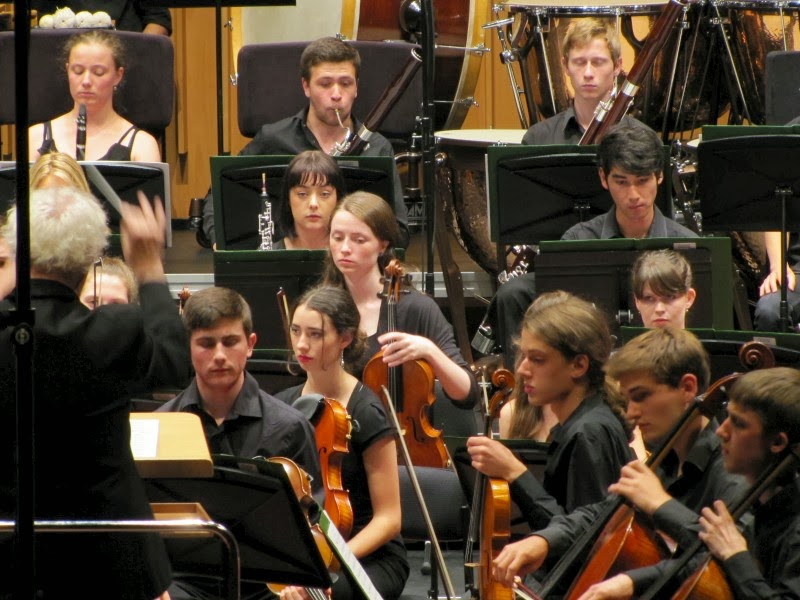
The final concert of the AYO National Music Camp for 2014. We can hope for 2016, providing the ANU comes good with its support. I hope they do. The quality of music continues. The Hopkins Chamber Orchestra under Geoffrey Lancaster opens again, this time with Beethoven Creatures of Prometheus excerpts. This is Beethoven so the changes are inevitable and clear but it's also a ballet, so this serves a different master and also serves a classical mythical theme of civilisation replacing ignorance. They played four movements, different in style, strings buzzing with rapid movement at mf volume, flutes and oboes and harp and a solo cello cadenza. Then the Alexander Orchestra under Richard Gill performed Rachmaninov Symphony no.2 in D minor. Apparently it's his first symphony, and Rachmaninov never granted it a number, just left it with the moniker Youth. A nice romantic work with a big end. After interval was the final work, Alexandre Bloch leading the Bishop Orchestra in Stravinsky's Petruschka. It's another ballet work. I'd expected demonstrative and it started that was, but passed through so many sections and emotions. By the end I felt I'd attended a theatrical work, telling a story through scenes and actions and repetitions. It's a murdered puppet's love story for a ballerina (mmm). Perhaps more a product of the era, but I heard Gershwin and West Side Story and some intriguing piano harmonics. The program notes talk of this and the Firebird featuring "two unrelated major chords, played simultaneously and separated by the interval of a tritone". For the jazzers, this is tritone substitution. The program notes also say it's "hitherto unknown before in Western music" and called the "Petrushka chord". Apparently another segment has two trumpets playing melody, one in C major, the other in B flat. Tritone substitution and sidestepping (although that's usually by a semitone). Jazz improv, anyone? Then a truly deserved standing ovation and the cutest of encores. Alexandre Bloch is also a cellist and composer. He put together a classical-themes-best-of medley called "On board the music camp" for this encore. About 6 or 8 renowned themes jointed together quite neatly. Megan recognised Brahms and Tchaikovsky. Then the melancholy joy of the end, at least for the participants. Congrats to AYO again. Magnificent and an eye-opener for what a week in time can do.

The Hopkins Chamber Orchestra under Geoffrey Lancaster performed Beethoven Creatures of Prometheus excerpts. The Alexander Orchestra under Richard Gill performed Rachmaninov Symphony no.2 in D minor. The Bishop Orchestra under Alexandre Bloch performed Stravinsky Petruschka.

22 January 2014

AYO2014/07 (Orch 3)

This was AYO's second weekend of orchestral concerts. What a revelation! I'd attended the first weekend and admired the skills but there were some faults, entirely understandable given these musicians had been pulled together for a short time and were not a regularly performing outfit, and were young and perhaps with some nerves. But what a difference a week makes, at least at this level of intensity. I could close my eyes and follow this music with immense pleasure, and this was my experience throughout the final two concerts. These orchestras had matured markedly in one week, thanks the intensive experience, the committed and obviously popular tutors and the rest. My hats off to the AYO.

The early concert started with the Hopkins Chamber Orchestra under Geoffrey Lancaster performing Mozart Symphony no.31 in D, Paris. Three movements, admirably presented, starting with big chords and devilish flourishes, then classic delicacy and tunefulness, then an unassuming waltz for the second movement, and a final movement of buzzing strings, four time, lighter, with more flourishes and canonic movements. Lovely. Second was a world-premiere, Philip Jameson's Dunsinane. PJ is only 20 and could not attend as he's studying at Yale. Performed by the Bishop Orchestra under Alexandre Bloch. AB introduced this work by saying that Dunsinane is Gaellic for "hill of ants" then talking of his images of tones, woodwinds as crickets, strings as snakes that move slowly and bite. He suggested we use imagination to picture music, especially modern music. The work started with a woodwind rhythm overlaid with a slow strings melody. It seemed to split into two parts, firstly weighty then lighter or more jumpy. AB's "hill of ants" metaphor fits perfectly with Great Birnam wood coming to high Dunsinane Hill. Then to end, Alexander Orchestra under Richard Gill performed Brahms Symphony no.2 in D. This follows last week's performance of Brahms' 4th. RG spoke later to ABCFM saying why this pair was chosen. Every performer should play a Brahms symphony; he was a great musicologist; he was seen in light of Beethoven; he's in the centre of the classical music history and the music camp is performing major works throughout this history. RG's quote that "Until Australia has every child in musical education from Kindergarten to Year 6 we will remain barbarians" was well received. Another interesting quote was when asked why there's no instrumental popular music: "you can learn everything through singing". I wonder if there may be more to consider for each of these quotes, but it's interesting to hear them. But back to Brahms. Interesting to see the basses at the back, with the percussion. There's pastoral here but also mechanical, lullaby and some strangely prominent leading notes that aught my ear in the first movement. Then a more melancholy second movement. I'm enjoying some very responsive and powerful passing swells through the strings and accompanying swaying performers: nice, involved. Then the final movement, livelier, morning-like, looking optimistically forward to a new day. I still feel a little uncomfortable with some Brahms' changes but who am I to question? Then a big ending. This is sounding wonderful, professional, worthy. Most impressed.

The Hopkins Chamber Orchestra under Geoffrey Lancaster performed Mozart Symphony no.31 in D, Paris. The Bishop Orchestra under Alexandre Bloch performed the world premiere of Philip Jameson's Dunsinane. The Alexander Orchestra under Richard Gill performed Brahms Symphony no.2 in D.

14 January 2014

AYO2014/2 (Orch 2)

Later that evening, after a picnic dinner. The AYO reconvenes for orchestral concert no.2 for the day and for the week. Same three orchestras. This time the Bishop Orchestra under Alexandre Bloch goes first, performing Tchaikovsky Romeo and Juliet Fantasy-overture. I'd read in preparation for this and the others, so I was waiting for the characters and scenes of Shakespeare's love tragedy. The love scenes of Romeo and Juliet and the fights of Capulets and Montagues were obvious; the death scenes with the heart-beating tuba was a stunner; I missed Friar Lawrence. How accurate is this as a portrayal of young love, and enveloping passion, pure and melodious! Are we too cynical in our times to accept this, or too grown-up? Musing further, do we confuse cynicism with maturity? The orchestra performed with panache, although I felt dynamics were a bit tight a few times. Here's where professionalism and confidence and constant performance make all the difference. Even more impressive after hearing that 80% of the Music camp participants are new this year. I expect there's a turnover revolving around the triennial international tours. Second was the Hopkins Chamber Orchestra under Geoffrey Lancaster playing Haydn Symphony no.104 in D, the London Symphony. This was the last of 12 symphonies he wrote in London, but the one with the "London" nomenclature, and the work of a mature composer. Majestic and stately but very cerebral after the romanticism of Tchaikovsky. Sadly, a mic stand collapsed in the last movement, first onto the conductor and then to the floor, which must have come over live ABC-FM as a knock and subsequent unbalanced orchestra. Too bad for the performers who will lose a good memory. Then to Copland Third Symphony by the Alexander Orchestra under Richard Gill. It's got the memorable Fanfare for the Common Man. A wit said it had the fanfare in 5 keys. Certainly, the later movement is permutations on this theme, but it's an impressive theme. The earlier part, though, seemed aimless to me and Megan and Grissoula and Geoff. I thought of the movies and the choppiness of their scenes and camera angles. This is a work devised in the era of movies. Has frame and scene flipping changed our musical conceptualisation and even our intelligence and awareness? Maybe it was just the end of a lengthy session and we were a bit wrung out and concentrating less. Two wonderful concerts in one day and several more coming over the week with another two orchestral outings this coming Saturday. Great. And you can't get better value. Truly excellent entertainment: committed, intelligent, attractive and youthfully vibrant. Fabulous. Hanging out for the rest.

12 January 2014

AYO2014/1 (Orch 1)

It's January and the Australian Youth Orchestra are back in town for their National Music Camp. It's a biennial event here in Canberra, and I hope it remains that way. It's a two week event with a series of free concerts in week 2. It's a young group, aged from teens into the mid-twenties, well trained and keen. There's real excitement at these concerts and real skills. You can hear a few rough edges, from lack of experience or nerves, but to be expected. Yesterday was concert day 1 with two orchestral concerts each presented by three orchestras.

The Hopkins Chamber Orchestra conducted by Geoffrey Lancaster opened with Mozart Symphony no. 29 in A. Mozart is obvious a mile off. This was written after 28 other symphonies while he was a still a teenager. It's light and breezy music with inevitable melody. The performance was stronger on some more forceful passages and a bit nervous at the start, but these guys had the unenviable role of going first. Next was a world premiere. The Alexander Orchestra under Richard Gill performed a nine-minute commissioned work that had its first outing at the NMC, Andrew Howes' Ichiros. This interested me. Andrew explained the work is written around the length of an instrument to perform a fifth, the ratio of Pi and Pythagoras' golden mean. So the work builds as crescendo and cacophony at a point around 2/3 of the way to the end and uses mallet hitting train track cut to the mean. I heard a filmic mash of swells and bells, mysterious and fluid. Tones passed between instruments and occasionally one played a melody. A trumpet featured later, playing tonally but intervallic not scalar. Eventually, it returns to the start, a rubato-like agglomeration of sliding strings and unison trombones and an ecstasy at the end. Most interesting. And also interesting, Andrew advised he'd spent 450 hours composing this 9 minutes of music. Third was the Bishop Orchestra under Alexandre Bloch (Assistant Conductor, London Symphony Orchestra) performing Brahms Symphony no. 4 in E minor. Brahms was called labelled one of the three great B's (with Bach and Beethoven) but the program notes mention that Tchaikovsky called him a "giftless bastard". There were times I felt the music sagged, struggling for purpose or direction. I liked the flowing, legato first movement; the third is irrepressible and popular; the fourth had some amazingly long string lines, including for bass. The performance of all was impressive, tight with decent intonation, better on some louder passages. I would have liked more dynamics sometimes and other times more projection, but this is a first concert by a young group only getting in its stride. Hugely impressive.