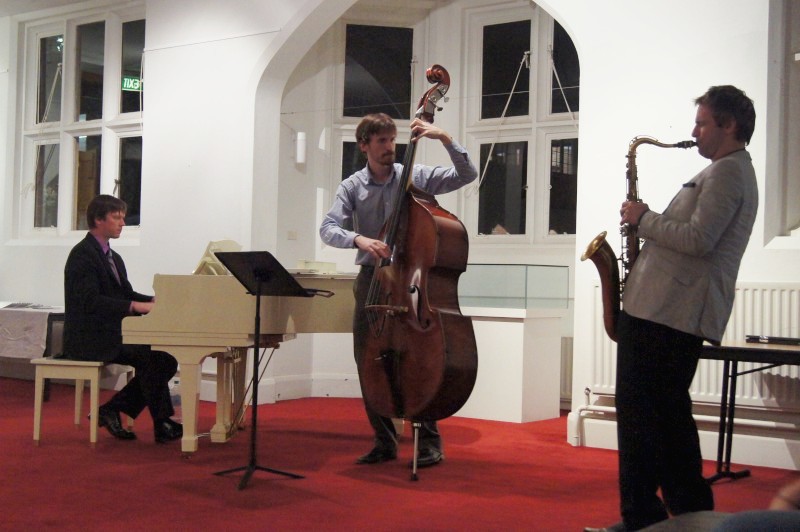
Our world can be pretty small. I thought of this at the Matt Boden gig at the Loft. Matt is back in Melbourne from Paris and is touring his new CD. He was playing with Leigh Barker, ex-Canberran now in Melbourne, and with Mark Sutton, our local who a Sydney resident at one stage. So that’s already a small world. It became smaller when two faces arrived from NYC: Gordon Webster and Rob Adkins. They were over for a few weekend gigs playing for swing dancers. They tour the world doing just this. I’d seen them at a Grammar School gig when they performed with Adrian Cunningham (NYC ex-Sydney). I’d lent Rob my bass that weekend: wheels within wheels. I used to be involved at Mt Stromlo doing observation for the professionals. It’s a similarly small scene and I remember being surprised to hear there are only ~8,000 professional astronomers in all the world. Jazz is a bigger community but still small and also international. We think of the world as 7 billion people, but communities can be much more intimate.


 So what of the gig? I think of this as an old style of jazz, but even modern jazz (~1950s) is now 60 years old. Matt played Jelly Roll, bouncy early jazz, and Monk and standards in between. They were mostly played with the same sense of determined tonality and avid swing and a relaxed gait, with steps to double and half-time, lyrical and frequent solos and commonly swapped fours with drums. This is not the intellectual challenge of new music; we recognise the tunes and the changes are cycling fourths and the heads are attractive and the experience is pleasure. You just sink into the music, enjoying the tasteful beauty of it all, and foot tapping with pleasure and ease. I particularly enjoyed Leigh’s gut-strung bass which was surprisingly loud and present for an unamplified instrument. I think Leigh is the only jazz bassist I hear playing unamplified in a band context. And his lines contained long sequences that flowed easily and consistently. This was very nice playing. Mark was a master with his easy feels and sudden accents and talkative solos. Matt led with easy harmony and calm solo development. All very nice and very swinging. (I followed a few blog posts on swing recently. I think it was Sean Wayland who suggested that clear harmonic changes on the 1 (and 3 or other) enhance swing. That’s something I’m now pondering.) Further, if you don’t know your history, you are much poorer for it. This is our jazz history that’s too easily ignored. There was just one tune that surprised me with a modern presence, towards the end, a triple time tune with more meandering and sophisticated harmonies that may have been original and then the final take on Stomping at the Savoy with a modernist bass obbligato underneath. Nice. Gordon and Rob also sat in for a few tunes. Firstly, Gordon with Leigh and Mark on A kiss to build a dream on, which built from delicate piano to almost frantic. Then Rob joined in, then Rob with Matt and Mark. Someone said to me it’s amazing that jazz players can do this, after all, they only met over a beer at the interval. But jazz jams are like this: the standard repertoire taken for an outing.
The Loft is a particularly small part of the international jazz world, but it’s still a place for Paris to meet with NYC with the help of Melbourne. Very much like Stromlo, actually, at least before the fire. Matt Boden (piano) led a trio with Leigh Barker (bass) and Mark Sutton (drums). Visitors Gordon Webster (piano) and Rob Adkins (bass) sat in for a few tunes.