Showing posts with label Jamie Oehlers. Show all posts

01 June 2019

Blowouts


What of a CD release by Jamie Oehlers? He's a supremely exciting tenor player, renowned for prizewinning and now just extravagantly virtuosic and writing great material. He was joined by Ben Vanderwall, a deliriously fascinating, busy, intriguing drummer, always ready to explore percusson sounds and deeply polyrhythmic when he chooses that or rabidly funky too. The other three were unknowns to me (other than Ricki Malet who I'd seen in a big band context) but they were wonderfully satisfying. Bass Zac was all deeply funky syncopations on a PB, playing with fingers or thumbs for that thumpy dub sound. Ricki was a great pleasure on some demanding heads and satisfying solos. Harry was playing Nord but it was all Rhodes tones and perhaps ring mod, absolutely the part for this sound, widely different from the abandon of Jamie but also so suitable as a contrasting style, two hands widely spread across keys, chordal left hand and richly arpeggiated right. Not music for the fainthearted, though. This was very complex and hence demanding but a huge source of pleasure. Style and preferences differ but the best stands monumental. This was fabulous. Drummer Mark commented that Ben is the best and world-worthy (the drummers were obviously awe-struck) and that the difficulty in his playing is not obvious. Not sure I agree. I was basking in drums and sax and speculative keys and deep grooves and trumpet and intrigued by the ease of it all, those grooves, those intricate rhythmic embellishments, those odd syncopations that sat so deeply, those rich, delicate phrases that came so easily but demanded such harmonic wit. What else to say when you hear such stuff. A blast.

Jamie Oehlers (tenor) led his band with Ricki Malet (trumpet), Harry Mitchell (piano), Zac Grafton (bass) and Ben Vanderwal (drums) at Smiths.

05 October 2014

Getting real


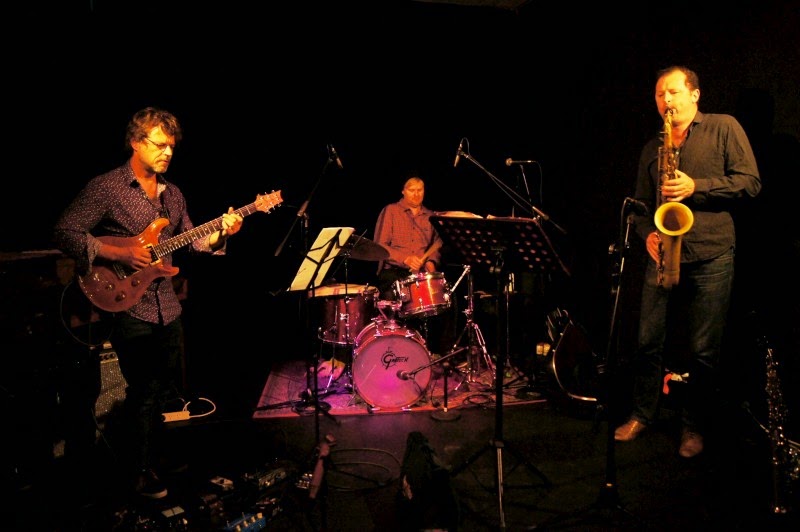
A friend posted to Facebook "Shit just got real" during this gig. She was right. This was the concert of Jamie Oehlers, Steve Magnusson and Ben Vanderwal. These are peak players in the Australian jazz scene. They were visiting Canberra to launch a new CD, Paper Tiger. There was no bassist (Bassless allegations was mentioned as a possible band name, probably in jest), but anomalous lineups are common these days. Steve played some bass lines or fingerpicked and the low notes did the job. Jamie also took an accompaniment role, behind Steve's guitar solos, and this is unusual but given his skills, wonderfully effective. This was choppy music. There was just one swing, as I remember, and one ballad. This was solid even-eights drumming that had me wondering what passers-by would be discovering. Few rock drummers will play with Ben's sharpness and invention. Jamie's solo lines were ever varied. These players were all this way: profoundly knowledgeable of options and thus fresh in their choices. Steve's technique, too, was choppy. Not smooth and distorted and searing but crisp, twangy, staccato and rabidly fast and endlessly varied. I guess these guys, too, have their habits and licks, but nothing seemed too obvious. Their new CD is 15 short tunes and this performance was pretty much that. The shortest was around 90 seconds and they obviously surprised themselves when it suddenly ended. Even the longest was perhaps 7 or 8 minutes. Jamie's known to play extended solos but this was a different experience. There were originals from all members and wit around the stories to introduce them. The music may be deadly serious, but this band's got the banter. Ben ran a commentary on left communitarianism ("We're all in this together") while denying any interest in politics. Was this banter for the Canberra visit? Ben wrote A song to parallel park to and he claimed to dislike it from the start, only to let it loose on his mates. A rocking chair on a carousel (on a cruise ship in choppy seas) was a song title and a story in itself. Then there were covers: Backhand by Keith Jarrett, Word from Bird by Ornette Coleman, Slow boat to China, Hard times come again no more. This was a challenging mix of contorted or pretty melodies that are developed with immense complexity. Jamie's Lament was a lovely ballad although never too obvious. Paper tiger was rubato, experimental with loops. Slow boat is a lovely old tune but was busily embellished. Hard times was in three and played with relative simplicity. This is a peak experience for jazz in Australia, three of the most capable and inventive players together and on record. It certainly got real; the final slice of the sandwich.

Jamie Oehlers (tenor, soprano saxes), Steve Magnusson (guitar) and Ben Vanderwal (drums) launched their new CD, Paper tiger, with a gig at Smiths.

18 August 2012

Olympians

Jamie Oehlers and his band were like Olympians in many ways: strength, training, poise with ecstatic release. This music was muscular and intense and played at the extremes and an incredible opportunity to see what best can be done. But comparisons with Olympics end here when we talk of jazz. $12m per medal says it all. Sport has bread and circuses enough. CJ acclaims the classic measures: beautiful, useful and true. But will the centre hold when the worst / Are full of passionate intensity? An informed and enthralled coterie attends the Loft for a gold-medal performance while billions watch their equivalent in sport and attendant spacey girls and fireworks. It’s two worlds out there and intellect is running for silver and only if its luck holds out. WAAPA under review and our own school given the treatment. But it’s much bigger, too. Not just culture, but climate and more. I’m currently reading an update to Limits to growth. The lion body with head of man is moving, but it’s we who slouch to nowhere. At least our Loft Olympians were naked in their purpose and expression.

Muscular it was. From the first notes, the volume and power of it floored me. Phil working the strings. It’s hard to tell on stage, but I noticed later he was a tall man. It fits. Tall men fit the acoustic bass. He’s strong. He works the strings. The fluency is there, but also the great tone, from a pristine looking bass with just a discrete Realist pickup. Truth in the timber. Jamie writhing with busy lines and some terrorising tempos. Jacob engaging skins with spurts of exact fills and rolls with jagged jazz responsiveness and fusion-toned punchiness. For some time, Tal seemed quieter, bent over keyboard searching for comping chords and denser, more dissonant harmonies, but then he’d lean back and watch the others, particularly Jacob, to match hits, or launch into another solo of perpendicular tonality and take on the tune head on. Several of the tunes were Jamie’s. Smoke and mirrors was the fast and furious opener. One new and as yet unnamed tune had the simplest call and response melody supporting rabid solos. A ballad called Open door was a workout in long intervals, 7ths, octaves and others, with the most delicate piano. Innocent dreamer was in 13/16, which Jamie helpingly described as ¾ with a stumble on the end. It’s the description of an experienced teacher and quite easy to follow with that hint. I tried to count Fun police but with less success; was there 5/4, maybe 15/8 counting as 4-3-4-4; probably other tempi. The borrowed tunes were Jobim’s Portrait in black and white, which was slow and sparse and punctuated by insistent, plucky bass. They played Little Willie leaps from the Charlie Parker bop songbook and it was suitably breakneck-fast and with touches of bop lines but mostly harmonised with a more modern ear. There was a Cedar Walton tune and a rabidly effective and fast take on Ornette’s Blues connotation. I thought I grasped something new by listening to his Polkadots and moonbeams. Now, this is a standard with chords and turnarounds and slow swing rhythm, at least how I’d play it. But Jamie’s take was distilled to a floating drone and Bb bass pedal with constantly mutating chords of varying dissonant colours rolling over. Closer to late Coltrane than Cole Porter and a lesson in contemporary reimagining of the standards. Suffice to say I found the whole gig thrilling with Jamie’s big and hard tone and fevered lines, Tal’s obtuse, disjointed, anarchic and (to borrow from Andrew Ford) illegal harmonies and sprays of notes and atonal chord sequence, Phil’s hard-edged tone and rapid-fire pizz and rock sensibility and Jacob’s rock/fusion attack and mix of openness and decaying rolls. This was muscular, ecstatic, gold-medal jazz from the first notes. But who’s to know? Everyone else is at the stadium for the circuses. Not much bread at this end of performance spectrum.

Jamie Oehlers (tenor) was touring with Tal Cohen (piano), Phil Stack (bass) and Jacob Evans (drums) and performed at the Loft.

22 May 2011

Git it in your soul

I’m still swinging 24 hours after the concert. Mingus is so infectious and I got a chance to hear a big band playing it today. The Jazz School has run a series of workshops and concerts this week for the Canberra International Music Festival Fringe. Given work, I only got to this one, the ANU Big Band led by visitor Jamie Oehlers and playing the music of Charles Mingus. Here’s the repertoire: The shoes of the fisherman’s wife are some jive ass slippers; Nostalgia on Times Square; Moanin’; Goodbye pork pie hat; Fables of Faustus; Boogie stop shuffle. Shoes was done by a smaller group and would have been the most demanding of the pieces. The others were played by the full band. Jamie’s feature solos were excellent. Andy Butler’s solo piano on Shoes was outstanding. The transcription of Nostalgia by Reuben Lewis and the arrangement of Fables of Faustus were impressive. But it’s the group work that mattered to Mingus rather than the featured solos. The sheer exuberance and vibrancy of a big band letting go on these swinging grooves and growling blues melodies is what I’ll remember. And it’s this that has me singing to myself now, hours later as Boogie Stop Shuffles around non-stop. He may have been a cantankerous character but he was also a genius. Long live the soul of Mingus; a much loved star in the jazz firmament.

  • Cyberhalides Jazz Photos by Brian Stewart
  • 21 May 2011

    Oh my gawd

    There were a lot of those “oh my gawd” moments when I caught Oehlers/Mackey/Magnusson/Zwartz at the Loft. It was a party for the local jazz community and everyone was there; standing room only in our oddly located and intimate venue. These are some of the cream of the Australian jazz dairy, and friends to boot. This was to be standards: easy and relaxed but also serious and with energy and life to spare. This is the instrumentalists’ life, ears and heart and exertion. It was interesting to see two top tenorists together; interesting to have heard two top Australian guitarists and two vastly different approaches to jazz on two consecutive nights. Wonderful.

    The band was Jamie Oehlers (tenor) and John Mackey (tenor), Steve Magnusson (guitar), Jonathan Zwartz (bass), Mark Sutton (drums) and Andy Butler (piano). There were two sets, just seven tunes, all standards, perhaps two hours of playing: All the things you are, My one and only love, Body & soul, Footprints, and a few others I recognised but couldn’t name. There were rabid, extended solos and taut accompaniment. There were contrasts in style and friendly challenges. These guys are playing for friends, but there’s a friendly rivalry like a footy team together in the muck. Suffice to say there were many Oh my gawd moments, and the response is little other than a chuckle at the seemingly impossible playing. Fabulously involved scalar movements and patterns from Jamie; blistering lines of quizzical uncertain pitch from Steve; outrageously dirty blues with atonal flourishes from John; firm tone, perfected intonation, melodic fluency, easily extended range and a unique line in single fingered scales from Jonathon; great energy, punchy kick and blushing cymbals from Mark; almost classical, overlapping scalar lines from Andy.

    It was just a blow but it was a window on the highest skills around. What a way to party.

  • Cyberhalides pics
  • 04 November 2009

    Vibes (Wangaratta 2009)

    There are vibes around a few players at every festival. Linda Oh gained vibes during the festival, but Ari Hoenig and his offsider, Gilad Hekselman, arrived with them and didn’t disappoint. You could guess they’d be stars, given the support band as Australian heroes of their instruments, Jamie Oehlers and Sam Anning. I new the names but my jazz school mates were ecstatic in anticipation. Best soloist ever; best drummer. I could see from the start the best drummer, but I’m still considering the best soloist category for Gilad. But there’s no doubt these are guys at the highest levels. New Yorkers, both, of course. Ari is a powerhouse. He can set grooves that are confident and true to type: rock grooves, jazz grooves, funk grooves. These are not approximations, but the real thing: heavy and solid and determined, or light and lithe and delicate; whatever’s required, I’m convinced he can do. He communicates with his fellow players in a way that make you feel you are imposing on a relationship, it’s so true. I felt this with Gilad, where accents and changes of dynamics were instantaneous and perfectly in synch. Then those solos. He’d take a concept and dissect it in numerous, ever inventive ways, with the oddest of parts, perhaps 7 or 11 or just 8, and the cleverest of rudiments, but always with precision to die for and endlessly moving to the next. The precision showed up equally in dynamics. One minute, he’d worked up to intensity and rock punchiness, then from beat four to beat one it was ppp and the gentlest and most perfect of lullaby rhythms to put your baby to sleep by. His face expressed it all. Ever mobile and in touch with his fellow players and signalling one thing or another, or just observing. For Gilad and Ari observed, frequently, regularly, and you could see the result in their playing.

    Gilad seemed firstly to me to be equally precise, but with a West Coast or ECM guitar clarity that I found too cool. And his early solos were tonal, fast but essentially folkish, I thought. My mates looked on in disbelief so I knew I had to think more on this. Through the next two concerts, there were solos that blew me away with complexity and speed and precision and alterations, so this was not just the simple melodies of folk, but I’m left still somehow unaffected. A master, of that there’s no doubt; but perhaps too cool, too precise. Strange, because I didn’t feel that with Ari.

    The pair played with local heros, Jamie Oehlers and Sam Anning. Both are stars of the Australian jazz firmament. Jamie was flying up and down the octaves with mellifluous and lightly formed notes, and Sam was solid and in touch and capable in his soloing. But there seemed a disconnect somewhere, and I felt it in the last set when they played a blues. Gilad played a basic blues-guitar style, which was very different from a jazz blues. Think that folk simplicity that I’d heard on the first day. I thought, this is not a limitation of technique (none there!) but an exploration of style. Ari’s readiness to move styles – funk, blues, rock, jazz – fitted with this toying with styles. Jamie played his solo, and it remained in a jazz, post-Trane style. Gilad was playing these big, ugly chords in rabid contrast and I was wondering why. He probably hadn’t articulated it, but I thought these ugly intrusive chords were a demand to play the other, to put on a mask, to enter this ironic world of styles and fashions and relativities. Now, I’m not denying anyone’s capabilities here, but I felt here was a mismatch, and it was not around technique, but musical conception. On one side, the earnest modernism; on the other, the ironic post-modernism. Perhaps not conscious, in fact probably not conscious.

    This evening before writing this piece, I looked at YouTube for a video of Ari. I found Ari and Gilad and a bassist, seemingly doing a workshop somewhere. The bassist was toying with his bass, spinning it, playing with it. Everything that an earnest jazz bassist doesn’t do. This was the giveaway to me. So, fabulous playing all around. Three eye-opening concerts, and drum solos to die for and to remember for posterity, and guitar lines that shred the octaves and harmonies. Similarly, sax solos of endless energy and capability. But essentially also a mismatch somewhere that limited the whole from being the great.

    I’d like to hear what you think, if you were there… Just add your comments below.

    Ari Hoenig (drums) led a quartet with Gilad Hekselman (guitar), Jamie Oehlers (tenor) and Sam Anning (bass).