Showing posts with label Nicholas Milton. Show all posts

09 September 2018

Everyone loves Bolero

Except musicians. And supposedly Ravel. It is involving but tedious. The basses play two notes then stand ready to miss the quick end. There's a joke on the Net that has the whole bass line (all 20 minutes or so) expressed in 2 bars. On the other hand, I still can't sing that oddly unexpected melody without a slipup. Even after hearing it numerous times. The CSO did it justice and I thought the alto sax soloist played it more convincingly than some others. He also played solos on Debussy Rhapsody for alto sax and orchestra and Milhaud Scaramouche suite. Apparently they are both standards of the alto classical repertoire (I guess it's not so big). He'd played the Debussy in various chamber combinations but never with a full orchestra. That was an interesting revelation. Then there was Copland Fanfare for the common man and the very substantial Berlioz Symphonie fantastique that was long, seemingly endless, with 6 movements. It seemed an odd piece to my ear and I was hugely surprised when Megan said it had been written just after Beethoven. So early; so inventive and different. And with some devilish playing requirements. The CSO did it with considerable panache. I was impressed. The latest in the CSO series.

Canberra Symphony Orchestra performed at Llewellyn under Nicholas Milton (conductor) with soloist Nick Russoniello (alto sax).

20 July 2018

What a blast


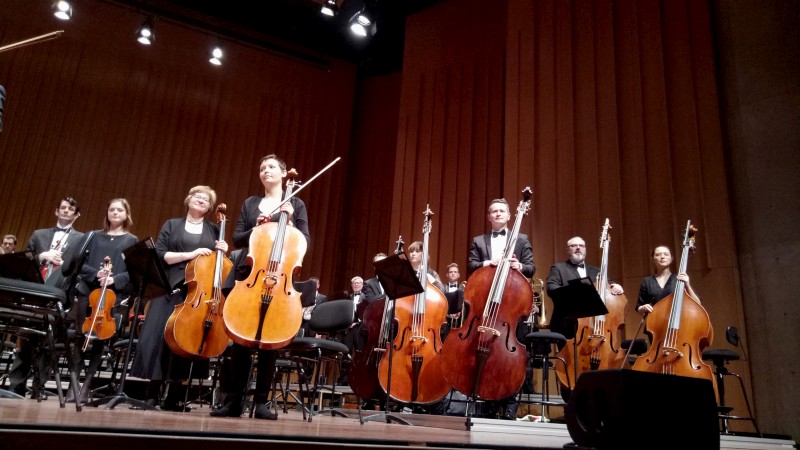
Another Canberra Symphony Orchestra concert but special. The music was accessible and well known and not too challenging, but it was special, at least for me. It was the first time I'd attended a concert where I'd played all the pieces before. I find my appreciation of a piece is immeasurably deeper when I've played it before: the structure becomes more visible; the lines (most prominently the bass lines) are expected and the harmonies and melodic and rhythmic plays with other parts are at front of mind. Nothing too surprising in that, but it's a revelation. The program was Brahms Academic Festival overture, Beethoven Triple concerto for violin cello piano and Elgar Enigma variations which I've played over time with Maruki and NCO. I'd played the Brahms twice, with Maruki and Brindabella. All exciting. And the soloists were Dimity Hall, Julian Smiles and Piers Lane. I'd played with Dimity and Julian at Llewellyn with NCO. All very exciting. The second half was on the program as just Enigma variations, so short, but the CSO encored with that English soul stirrer, Elgar Pomp & circumstance march no.1, also known for its lyricisation as Land of Hope and Glory. I'd played that too, with Maruki, one December. It took all my willpower not to stand and squat in rhythm as the upper class twits do in (London's) Albert Hall for the final night of the Proms (see YouTube). I was beaming and singing as I left. But what of the orchestra? BJ Gilby was missing from her seat and Maria Lindsay took that spot with Pop Thompson to her side. Lots of common faces but a few new and young ones too. Five basses this time, led by Kyle and Dave in the core of the back line. Nicholas Milton up front. I loved the program; I loved the playing. The Brahms is lively and fun; the Beethoven couldn't be by anyone else and Julian's cello playing was a revelation (my take of this was BJ Glby, David Pereira and Edward Neeman but I was too busy playing and too far from the sightlines to appreciate it like this night); the Elgar was really nicely done, dynamics, relaxation, intensity, variation, good all round. Then the final Elgar Pomp&Circ was just nicely played and is such an infectious blast. I just sat nodding time and grinning. So, suffice to say I really enjoyed this concert, not for intellect or adventurousness so much as for affinity and simple pleasure.


The Canberra Symphony Orchestra under Nicholas Milton (conductor) performed Brahms, Beethoven, Elgar and Elgar at Llewellyn with soloists Dimity Hall (violin), Julian Smiles (cello) and Piers Lane (piano).

11 November 2017

Stirring


I found the latest CSO concert hugely satisfying. First up, Glinka Ruslan and Lyudmila overture. It a lively thing and joyous thing with plenty of fast runs and the five basses handled it with ease, as did the other parts. I've played it, but it couldn't have been so fast. The next up was the feature, soloist Harry Bennetts playing Tchaikovsky Violin concerto Dmaj Op.35. HB is ridiculously young, early 20s, but scholarship material at the Berlin Philharmonic Academy, so no slouch. This was fiery with huge technical demands, harmonics into the stratosphere and the rest. It was a hugely impressive outing by a very young but capable player. I've played that, too, with John Gould as soloist in Maruki. Apparently Maruki had done the other, too, although I haven't. Sibelius Symphony no.2 D maj. It's a sprawling work with beastly timing for all, some stunning long, fast walks in the cellos, rich and vibrant and emotive, pastoral and melancholic and stirring. I loved this one not least for its exhilaration and the orchestra did it proud. So a hugely pleasurable evening.

The Canberra Symphony Orchestra performed Glinka, Tchaikovsky and Sibelius under Nicholas Milton (conductor). The soloist was Harry Bennett (violin).

19 August 2017

War out the door


It was the Canberra Symphony Orchestra playing another Llewellyn concert, this one nominated Horn and it was just a series of pleasures. First up was the crowd-pleaser, Borodin Polovtsian Dances from Prince Igor. Well, it's a rollicking thing with memorable themes, enough to make it into the popular repertoire as Strangers in paradise and it's got particular relevance for me. I'd heard it played very capably by choir and orchestra of the combined Canberra Grammar Schools in the wonderful CGGS hall when it was a revelation to me as a newcomer to classics. Easy listening, perhaps, but exciting and melodious and inviting. CSO did a great job. Then the matter of the horn. Hector McDonald played Richard Strauss Horn concerto no.1 Eb major. HM has been 27 years as a principal at the Vienna Phil amongst his illustrious career in Europe, but he started out here, in Sydney and later Canberra, playing in Llewellyn Hall and with the CSO. Some old band mates were playing behind him on this night. He's obviously not so well, as he explained later, but his playing is sweet and pure, so another pleasure. He encored with a bit of Vienna, playing Johann Strauss Sweet tears with harp accompaniment. Then the final pleasure, not at all a frivolous thing: Prokofiev Symphony no.5. Apparently it was written with WW2 outside the door, first performed with cannon in the background. It's big, unrelenting, mobile and flexible and tactical as war is and battles are. An overwhelming experience only enhanced by taking a seat in the front row, under the cello, in Dave's line of sight, not too successfully trying to follow Nicholas Milton. But what a work! I'd listened to some that morning and it seemed heavy and tortured but in life it was powerful, forceful, varied and, again, unrelenting. Fabulous and capably done by the orchestra. So, a wonderful concert with all manner of styles and all manner of receptions. Great stuff.

The Canberra Symphony Orchestra played Borodin, Strauss and Prokofiev, under Nicholas Milton (conductor) with soloist Hector McDonald (horn).

06 November 2016

Return to our local


It's a string of orchestras that we've seen recently but now back in Canberra and I was very pleasantly surprised by our own local CSO, Canberra Symphony Orchestra. They had tough competition: we had heard one work done by the Berlin Phil a few weeks before and the Conservatory orchestra in Singapore was very satisfying with its big size and a small space to give a massive sound. CSO held its own. They played a fascinating and attractive piece by Nigel Westlake, Shimmering blue. Lyrical, punchy, sometimes filmic. Then the Berlin Phil take (interestingly, Berlin Phil had played an Australian piece by Sculthorpe, first up for its concert), Rachmaninov Rhapsody on a theme of Paganini Op.43. They did a great job, capable, expressive, together if not so smooth and seamless as the Berlin Phil (the comparison is unfair, a casual outfit up against a professional selective world leader). I concentrated more on the variations this time, obvious enough in the early parts and towards the end. I didn't follow so easily in the middle. Then the main work, Tchaikovsky Symph no.4 Fmin Op.36. Again, a tour de force. It's a strange work, apparently with a theme of fate and self, swapping themes or overlapping. An overlaid polonaise over a waltz spells out these two ideas but I didn't catch that. I did catch immense loud, busy passages contracting with quiet lyricism. Four movements. The first is long and expansive; the final one is hard biting, starting with a single ff note and continuing with some devilish lines, not least on bass. I was proudly proclaiming our local orchestra as I left for some evident chops, considerable responsiveness and a surprising volume to fill the large Llewellyn Hall. Very well done and much enjoyed.

The Canberra Symphony Orchestra performed Westlake, Rachmaninov and Tchaikovsky under Nicholas Milton (conductor) with Kristian Chong (piano) performing the solo part in Rhapsody on a theme of Paganini.

20 August 2016

Latest locals with visitors


As I play more classical music I realise how little I know of it even as I'm getting better at playing it. But I'm enjoying the process of reading and bowing and revelling in the sound of an orchestra. Christian just confirmed this when he asked which encore piece the soloists at the CSO played on Thursday night. He suggested the Handel passacaglia arranged by Halvorsen for cello and violin and I'm sure it was. Christian joked it could almost be considered a fourth movement for the Brahms Double concerto that it followed because it's always played as the encore. I'd just noticed that the melody was familiar and enjoyed the rabid scalar runs on cello and descending chromatic harmonic accompaniment. Nice. The soloists were German husband and wife team, Indira Koch (violin) and Wolfgang Emanuel Schmidt (cello), holidaying/touring in Australia/NZ and invited by Nick Milton. I luxuriated in his cello, but as a principal violinist she was no slouch with some doubly quick descending lines. Maybe it's the nature of an orchestra, being collection of many musicians attempting to work as one, but I did feel the tutti segments of the Brahms were more indistinct, at least against the clarity of two soloists, excellent as they were. But I didn't feel that for the Dvorak Symphony 7, D minor. To my ear, that felt as if the orchestra was speaking with authority and confidence. The first piece of the night seemed an odd little one, Weber Der Freischutz overture, sometimes pastoral, sometimes ecstatic, dramatic then finally balletic. But I enjoyed it all immensely, our local orchestra with such a difficult task of infrequently pulling together for such significant concerts.

Canberra Symphony Orchestra under Nicholas Milton (conductor) performed Weber and Dvorak and featured soloists Indira Koch (violin) and Wolfgang Emanuel Schmidt (cello) on Brahms.

07 May 2015

A rare confluence


Now this was a strange one. The Canberra Symphony Orchestra performed something I'd heard just a few weeks earlier from the National Capital Orchestra. Such a concurrence is pretty rare but it gives you a particular view. The work was Rimsky-Korsakov Scheherazade and it was played post-interval by both orchestras. I had been mightily impressed by NCA but I felt CSO had an additional sheen. Not just because CSO had a full complement of basses (four not 1, and including a common player, David Flynn). I have played orchestral music now for a few months and performed two concerts and I find I am listening differently. The backline behind the strings - flutes, oboes, clarinets, bassoons, horns - are taking on more presence. I noticed the flutes with and without piccolo and how insistent the little thing is (and so easy to transport)! Same with some shaken percussion that strangely came at me from behind, bouncing off the back wall (just a row behind me). I really enjoyed the brass which was particularly competent this night, trumpet, trombone, tuba. And the timpani. And Barbara's solo violin. And, I think unusually, the two cello parts, where the principal cello bows and the rest play pizz. Scheherazade is attractive but it's not my favourite for the night. I find it rich and swelling but too simple and repetitive and the story is offensively misogynist.

The first set started with Matthew Hindson Boom-box. It was short but exciting, more fanfare than backstreet funk. I heard Africa and standards and West Side Story more than Harlem and break dancing, but I liked it lots. Then Tchaikovsky Piano Concerto no.1 B flat minor. This was my favourite, perhaps partly because I knew it well given we had a record in my childhood home. Great orchestral melodies, ecstatic and virtuosic piano, a startling touch of Gershwin or 20th century in a cadenza in the second movement, ratty key. Absolutely attractive and done very nicely by pianist and orchestra.

This was a great outing from the CSO and I never cease to be amazed that they do this with such a limited performance schedule. These guys don't play together daily like many professional orchestras. The Canberra Symphony Orchestra was conducted by Nicholas Milton. Hoang Pham (piano) played the Tchaikovsky.

07 April 2015

A Finnish sesquicentennial


A Canberra Symphony Orchestra concert is always such a pleasure. It’s our local orchestra, humble as it is, but like family with faces to recognise and visiting cousins who are new. Nicholas Milton was conducting, welcoming the audience in the informal way that orchestras now do, despite the black bowties. There’s good support from the Canberra community, too, with the CSO series being almost sold out on subscriptions, and often also support from foreign legations based in Canberra. Not that it’s highly funded by Federal sources (it’s very poorly funded compared to other major city orchestras) and it must be suffering from a lesser informal support after changes at the ANU School of Music. Nonetheless, the concerts are capable and well received.

This one had Finnish Embassy support and a Sibelius 150th anniversary theme. The major work was Sibelius 5th Symphony in Eb major. Nice key. The Fifth is life affirming and very different from preceding symphonies. It’s written through the years of WW1 so life-affirming seems an unexpected outcome but Sibelius was individual and methodical. I was interested to read of variations on rhythmic patterns rather than a melodic theme and the “swinging horn theme” and the six “adamant” final chords. Before the interval were Schubert Rosamunde overture which was actually performed for the Magic Harp, which remains classical despite occasional “Italian style” and Dvorak Cello concerto in B minor which was performed by New Zealand cellist Edward King. A single cello can be lost in this space and especially when seeking delicacy against a backdrop of fifty other players, but I enjoyed the Bohemian pentatonics and aaB phrases and an addition that pays sad tribute to his lost sister.

The Canberra Symphony Orchestra performed Sibelius, Dvorak and Schubert under Nicholas Milton (conductor) and with soloist Edward King (cello).

08 May 2014

Symphony or concerto?


This was another great success for the Canberra Symphony under Nicholas Milton. I wasn't so taken by the first half: Mozart Overture from Marriage of Figaro, a light and recognisable piece to start the night, and Beethoven 4th piano concerto with pianist Clemens Leske. I think I prefer symphonies to concerti: more democratic, more balanced and internally consistent, whereas a concerto, even with a 9' Steinway (which I presume they were using) is still unbalanced between solo instrument and the strength of even smaller orchestra, and essentially more an individualist, even competitive event. Maybe it suits the times. The Beethoven was all long chromatics and weighty left hand melody and the lines felt not so even and not too obviously resolved so this didn't so much appeal to me. Then interval, another wine and a return to Mahler Symphony no.1. The first notes were quiet and I wondered if this was indecisive. Not at all. Phrases were soon appearing, from different instruments, even from trumpets off stage, appearing then decaying. Hints. A passage of threat. Then busy, interacting, layered themes, pulling together for a joyous, outgoing, vibrant country fair. Flutes as birds; strings answering; single note harp tacking; deep slurred notes bowed on bass. Then on through layers of melody, and an explosion of percussion and horns and brass. This first movement was richly layered with a touch of rural idyll. The second movement was a strutting 3/4, a lone horn, into a smoother, seductive waltz, then a return to the strutting 3/4. The fourth movement started with a solo bass playing Frere Jacques (kid you not) then a canon through cellos, violas and the rest, melding in and out with another Yiddish-sounding folk song. Nicholas Milton is flailing; he's an effusive conductor, calling for dynamics that an orchestra of undemonstrative Australians is a bit loath to give him. I reckon he's good for the CSO; they could have a little more abandon. Then into the final movement, perhaps revisiting the first, explosive from the start, then through various rises and falls, of volume and intensity. Big with tubas and standing horns and timpani and brass; swingeing bass lines. I thought I judged the finale, but it came and went and came again. Perhaps for a first time, I followed the symphonic structure with some understanding, but I still don't know why the combinations of complex layers then that odd 3/4 second movement with the sandwiched waltz, then Frere Jacques and the folk tunes, then the complexity and energy of the finish. In such a big space, Mahler could have done with a larger orchestra and extra dynamics, but we loved this nonetheless. Very interesting and attractive and satisfying. The orchestra again did the night justice, Clemens Leske did an good job, the combination of works was impressive, even if I had a clear preference for the Mahler symphony, and Nicholas Milton was ever the fine host and vibrant leader. Congrats to our locals.

The Canberra Symphony Orchestra performed under Nicholas Milton (conductor) at Llewellyn Hall. Clemens Leske (piano) soloed in the concerto. The program was Mozart Overture from Marriage of Figaro, Beethoven Piano concerto no.4 and Mahler Symphony no.1.

11 May 2013

Big night out : the Russians


It’s pleasurable going to a CSO gig these days. It’s a like a big family. We don’t really know them, but we recognise so many faces, on an off stage. This was the second night of two for this program and the Llewellyn was sold out. That’s good. I imagine people are rallying around our musical assets with the changes at the Music School. The program was Shostakovich, Rachmaninov and Mussorgsky/Ravel. The Shostakovich was a light piece that the program advises had been churned out at short notice. Apparently he was a brilliant composer who could chat and write and deliver all at once. Certainly, they talked of couriers taking pages while the ink was still wet and the performance just days later. It may have also been an ironic statement and a protection from Stalin’s interests. I enjoyed it, but as I write this, a few days and concerts later, it doesn’t leave any particular image other than of pleasure. Not so the Rachmaninov. This was his Piano concerto no.2 in Cmin and it finished the first set. This is what I think of is Russian music. Three movements with a turgid start, dense and soupy, swells and discoveries and denouements, military marches and busy, full-handed playing and lots of notes. Busy and detailed and informative like richly painted Russian novels. It was amusing to recognise a pop song in the second movement (was it the Carpenters?) and the theme of the third would have done equally well. This was big and turgid and typical.

After the interval was Pictures at an exhibition by Mussorgsky and orchestrated by Ravel. I hadn’t realised it was exactly this: a tone poem about an exhibition. The core theme that we all know is someone walking through the exhibition (the Promenade) and it reappears in varying forms between most pics. I’m informed that the paintings are actually not particularly special, more drawings than paintings, but it interests me that we know exactly what paintings each tunes refers to. Interestingly, one features an alto sax and a glowing report of its role was quoted in the program, but I could only imagine that every saxist must be pleased that jazz came along. It was a pretty tame line to my ears. Otherwise, there are features for tuba and trumpet and others. I expected to find this too popular, but I must say I enjoyed this best of all the pieces on the night. It’s varied in colour and melody, it’s nicely structured and has that hugely memorable theme to hold it all together. And I felt it was well played by the CSO. I don’t imagine it’s the hardest piece in the repertoire, but the basses got some speed up a few times.

Nicholas Milton (conductor) led the Canberra Symphony Orchestra and Konstantin Shamray (piano) played the Rachmaninov concerto. The pieces were Shostakovitch Festive Overture Op.96, Rachmaninov Piano Concerto No.2 in C minor and Mussorgsky Pictures at an exhibition, orchestrated by Maurice Ravel.

13 March 2013

Happy birthday

In a nice little twist, at the end, after the premiere of our own Symphony for Canberra, the CSO/Centenary Choir sang Happy Birthday. It s a cute end to a big event, Canberra’s 100th birthday bash, and it's fitting for this town, intelligent but also suburban and homely as it is. But then I've always noticed how this city is bigger than its population suggests. Canberra is only ~360,000 - just 2 Commonwealth lower house MPs although representing the two largest electorates in the country - but it's got five universities and draws APS and defence staff from around the country and private sector to provide for it, and, despite all the cynicism, these are capable and pretty corruption-free. Australia is generally well governed (by both sides of politics with the support of a professional public service, although some annoyance is due at present) and Canberra plays a large part in that. A corny but self-confident happy birthday salute is fitting.

It followed the premiere of Andrew Schultz's Symphony no.3, Century. This is a work of ~45 minutes, composed for orchestra and youth and adult choirs. It's actually two interleaved works (a capella choir and orchestra) each of three sections with each paired section comprising a choral exposition and an instrumental movement on the theme. The theme is Canberra and its architectural design, with the choirs singing three passages from architects Burnham, Sullivan and Burley-Griffin about architecture and democracy from the time of the Canberra design competition of 1913. I enjoyed the work immensely: the choral counterpoint; the sweeping and passionate instrumental passages; the swells of pride. I’m not sure I really heard Canberra in it, but music is the most abstract of the arts. I’ll sound like a wine taster here, but I heard mostly drama and thunder and awe, spots of Scandinavia and even Wagner, especially in the first movement, and later English gardens and worthy explorers. This later was perhaps most in tune with the round roads and rolling hills and sheep plains of Canberra’s environment. Regardless of that, I loved it with its vibrancy and modern harmonies and lush and swelling presence. What a great work to honour the centenary and what a great decision to honour it with a symphony. Acclamations all round!

We didn't do the whole hog on the day. There were five or more stages, lots of food and events and migrating minstrels, even boating displays and Brass Knuckle Blues Band and others slouching on boats. We missed several other stages with worthies including The Church, The Gadflys, The Falling Joys, Paul McDermott, Mirramu Dance Company and William Barton - several of whom were from Canberra. Again, this was a homely affair. The big bubbly bar was on everyone's lips. We searched for Michelle Nicolle with no luck. But we did catch two modem classical outfits.

Firstly, Topology. They were my band to catch for the day and they were fabulous! I’d seen them before and had been mightily impressed. This was more than I’d expected or remembered. They are perfectly described on the Net as "Pulse driven contemporary Australian chamber music with cinematic energy. A quintet of violin, viola, double bass, saxophone, piano. Genre: Classical: Contemporary”. I’d add that they are relevant. There's a popular sensibility here, in rhythmic strength and in references to the Round roads of Canberra and to political events. Gough Whitlam was a piece that featured samples and loops of the voices of Gough Whitlam, Paul Keating and John Kerr that were cut and spliced to a waltz and interpreted as music. How apt, given that the performance was only metres from the steps of Old Parliament House where Gough spoke those immortal and bitter lines "Well may we say "God Save the Queen", because nothing will save the Governor-General". But it was the words of Keating about the “unprincipled act" that really made the argument. This was stunningly impressive and relevant music from Topology. Topology is led by Canberra's own Robert Davidson, bassist, out of Brisbane.

Secondly, the Griffyn Ensemble performing with astronomer Fred Watson. It seems a strange combination, but they were performing various constellations from a piece called Southern Sky by Estonian astronomer / composer Urmas Sisask. This piece was written by Sisask after a visit to Mt Stromlo and first performed with a dedication to Canberra only a week before the fires that destroyed the observatory and 450 houses around Canberra in 2003. This was less outspoken music than Topology. Again I found the music abstract and hard to relate to the theme (eg, constellation Mensa = table > music with theme of bushfire). There was melody from flutes and clarinets, gentle accompaniment from harp and vibes, some Wagnerian soprano voice (Volans) and some fading glory on mandolin (Dorado). A more interiorised music played mostly with softer tones and classical chops.

Then to finish, the mandatory fireworks and one or two fabulously lit skies, mostly with ruddy hue and overwhelmingly large vistas. It’s public art and entertainment, but this was classy stuff. Well done. The Canberra Symphony Orchestra with the Centenary Choir performed of Andrew Schultz's Symphony no.3, Century. They were conducted by Nicholas Milton. Topology are led by Robert Davidson (bass) with Christa Powell (violin), Bernard Hoey (viola), John Babbage (saxes) and Therese Milanovic (piano). The Griffyn Ensemble was led by Michael Sollis (composer, mandolin, bass) with Kiri Sollis (flute), Matthew O’Keeffe (clarinet), Meriel Owen (harp), Wyana Etherington (percussion) and Susan Ellis (soprano). Fred Watson (astronomer) provided commentary.