Showing posts with label Claire Edwardes. Show all posts

10 May 2024

Finals

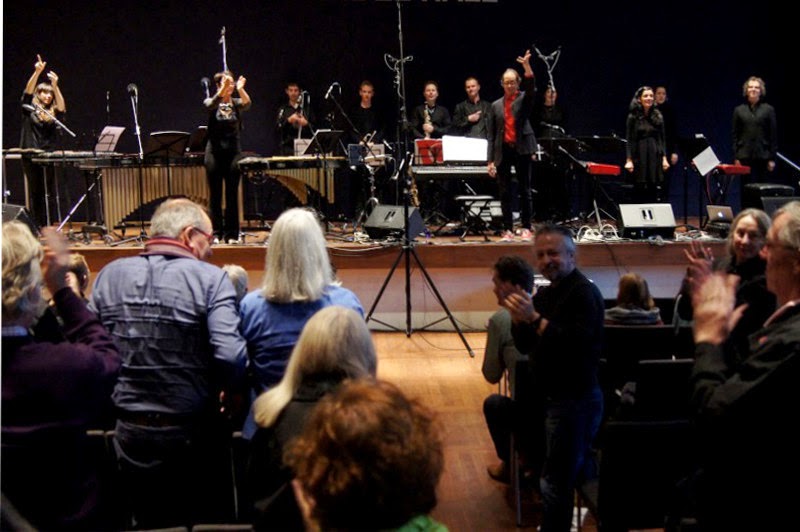
The final concert was a big one, long and plenty of performers and tunes.  It was called Mulanggari and was heavy on first nations themes.  First up was Stiff Gins with our mates Dudok and Kevin Hunt, perhaps others.  SG are entrancing, inviting, singing songs with gloriously correct voices and lyrics that I didn't catch, but I fully expect are worthy, bridging Euro and Aboriginal languages and themes.  Jonathan Zwartz had a role in developing, writing or orchestrating some of this.  A relaxing outing for our Dudok accompanists.  Then an interval a country, sometimes dissonant , often double stopped Ben Ward bass solo piece written by Brenda Gifford. And a ecstatically driving piece for three percussionists by Holly Harrison.  The players were Claire Edwards, Veronica Bailey and Niki Johnson and the piece was wonderfully powerful and rocky with a kick drum and a huge pleasure.  Then a larger group for Wadhu (skin), composed by Brenda Gifford and the solo played by Claire Edwards at Verity Lane earlier in this festival.  As I remember this featured violin Veronique Serret and didjeridoo William Barton.  Then another larger work, Burruguu (time of creation), by Nardi Simpson.  And a final work, again by Nardi Simpson and arranged by Jonathan Zwartz and Roland Peelman, with the further addition of Luminescence Chamber Choir.  The stage just keep growing.  Then a final few words, of thanks to Roland for a great third decade of CIMF and off to chat and drink outside the hall.  The final party, especially for CIMF staff and volunteers and performers and various associates is a well loved ending for the festival.

The final concert of Canberra International Music Festival this year featured first nations, European, reconciliation and related themes.  Works by Nardi Simpson, Holly Harrison and Brenda Gifford (composers) plus perhaps others were played by a cast of musicians featuring Claire Edwardes, Ben Ward, Stiff Gins Artist Stiff Gins Nardi Simpson and Kaleena Briggs (vocals), Luminiescence Chamber Singers (choir), Roland Peelman (piano), Kevin Hunt (piano), Dudok Quartet Amsterdam, Ellery String Quartet, Veronique Serret (violin), William Barton (didjeridoo) and more.

05 May 2024

Keys for all

The percussion section is so often little considered although they are not just like jazz drums, playing rhythm as important as that is, but they also play pitch with keyboard substitutes on vibes and marimba and pedals on timpani or tubular bells as well as the complexity on seemingly simple instruments like the triangle.  They have to count, too!  But this was Claire Edwardes of Ensemble Offspring fame and she played a solo gig so no sitting counting, but two keyed instruments, vibes and marimba, and the seemingly simple temple blocks, just 5 loud wooden blocks with the most complex of polyrhythms played.  The concert was another eye opener and musically joyous and virtuosic.  The melodies and harmonies and developments were immensely inviting and relatable to the most piano or other instruments, while the tone is relatively sharp and short, sometimes damped, otherwise ringing quietly.   I am thinking vibes and metallics more than marimba with its wood.  Claire played a quieter tune on vibes on coral bleaching called When it's gone by Julia Potter.  Thanks to Claire's inviting presence, we heard of the stages of bleaching from lovely blue to forbidding white.  Then Ross Edwards, those temple blocks, one from Amsterdam, a Brenda Gifford solo excerpt called Clan from Wadhu, and more Amsterdam contacts with Joyful melodies, a co-composition by Claire with Kate Moore.  Just a joyous and virtuosic outing on solo percussion.  Lovely!

Claire Edwardes (vibraphone, marimba, temple blocks, electronics) performed at Verity Lane for the Canberra International Music Festival.

06 May 2017

Female offspring

The concert was called Half the sky and the half was women. It was a CIMF event formulated around Ensemble Offpring and some ring-ins. EO plays music only by living composers, but this year they are playing music only by living women composers. I expect little difference in the music (I liked how Chen Yi, female composer in residence at CIMF, put it: "we happen to be women writing music"), but a great opportunity to level matters. The concert was at and about the National Portrait Gallery, in various locations over several hours. First up was a performance in the foyer, by the sextet, then by a trio. Then a "promenade": four mini performances by soloists or small groups. Then a choice (not an easy thing!) amongst four pieces in four places at one time. I happened on two by settled on third, Loo Sze-Wang playing sheng, a smallish, multi-piped free reed instrument, just to experience something different (not new: shengs date from 1,100 years back). Then the forum, about women composers and more broadly about women in music, with Chen Yi, Claire Edwardes, Sarah Kimball (CSO), Sally Greenaway and Laura Tingle, chaired by Karen Vickery (NPG) and a final two pieces performed in the foyer, one by the current composer-in-residence, Chen Yi; the other by next year's c-i-r, Mary Finsterer. What stands out? Firstly, it was all fabulously interesting, challenging, edgy, read contemporary. The playing was mightly, but as a string player I particularly noticed Blair Harris on cello and was fascinated by the score he was responding to with all manner of new written techniques; Claire E's deeply satisfying rhythm and the pentatonics in her later solo on merimba had me feeling jazz, although another later work was more obviously classical-sounding; an impressive trio including some blissful playing on horn from Darryl Poulson; Loo Sze-Wang's cheng because it was just so new to me. And some interesting comments in the forum caught my ear: what did we miss about Julia Gillard's time amongst "all that noise"; CSO's programming of 9 women with 6 commissions in a smaller group series curated by Matthew Hindson; Sally G observed that being a composer is "fraught", also that she'd come to love music by female composers she'd met (I guess she means some familiarity helps in music and otherwise: I feel that too); Chen Yi observed that action is most important (she spoke of the SF Women's Philharmonic and a competition for female composers); Claire's suggestion that women may not be "as bolshy" as male composers, calling on others to "listen to me"; it was generally recognised that history has left a male bias to the repertoire (not hard to think this!) and a "repair [is] all we can do now". A great afternoon of intriguing contemporary music played with wonderful skills and with a political edge. Great!

Half the sky was a CIMF concert at the National Portrait Gallery. Performers were Ensemble Offspring comprising Claire Edwardes (percussion, musical director), Jason Noble (clarinet), Zubin Kanga (piano), Veronique Serret (violin), Lamorna Nightingale (flute), Blair Harris (cello) with Ben Hoadley (bass clarinet, bassoon), Loo Swe-Wang (sheng) and Darryl PoulsEn (horn). The forum comprised Chen Yi, Claire Edwardes, Sarah Kimball, Sally Greenaway, Laura Tingle and Karen Vickery. Composers on location were Chen Yi, Joyce Tang and Mary Finsterer (perhaps others).

12 May 2015

g-l-a-s-s

It was an afternoon of (Philip) Glass. We were in the Gandel Hall at the National Gallery, not at the Fitters Workshop, next to the Glassworks. This was a mammoth outing. Three hours of Philip Glass. Ensemble Offspring and associates were playing a string of formative works by Philip Glass. He's somewhat notorious for his minimalism and apparently caused considerable stirs when his works were first presented at various locations in NYC. While listening, I became aware of how we are now acclimatised to this approach, even if I've had some questioning comments since. But it's fifty years back now. The works were dated 1968 to 1976 so the early ones are from the Summer of Love, 1968, high Hippy, but this is not Hawkwind or psychedelia. They are out of the fine music tradition (Glass studied with Nadia Boulanger in Paris) even if they are outside it. This is music reduced to a minimum, based on repetition and alternation of melodic cells. I wondered if it's prefigured by change ringing with its permutations of bell rings. The effect of the moving cells has a similar effect. But references are more to India and drumming and that fabulous percussion singing called Konnakol. Glass' music is intense, unforgiving, unrelenting, fairly loud; then it stops. The introduction suggested those in the know were the ones at the back lying on pillows, but then this is no longer the '60s (and the audience was no longer in its 20s). Audience could come and go through the performance. All very much of the period. The beats were intense and satisfying and the crossing rhythms were fascinating and forming their own mutating sub-rhythms. In one piece that I consciously tapped, I felt 6/8, noted three-note patterns and also quaver pairs (quaver pairs in 6/8?) but I couldn't easily tap to 5. I wondered about how it's written, then realised (again for this one piece but the approach seemed common) there was a cell pattern separating varying repeats of another pattern. I could guess how that might be written. The performers often nodded heads, no doubt identifying changes. There were a few slipups where someone stopped to await another nod.

We heard a string of works of varying degrees of complexity. Claire Edwards started with 1+1, a very simple work tapping a timber board. It reminded me of rhythm exercises I used to practice with a drummer mate. This was very early. Then Music in similar motion, played on two vibes and keyboard containing only ~6 notes. They played Music in contrary motion later, on two vibes, e-piano and 2 keyboards. The contrary motion was more complex and demanding of concentration but just as devoid of respite. I thought there was a drone there, too. Tough on the musos: have a moment's doubt or flinch and you're lost. The percussive pitch of vibes and the organ tones of keyboards were key, but Glass later expanded with instruments for overlaid pitches and alternative rhythmic patterns. Music for fifths was played on e-percussion, keyboard, clarinet and soprano sax but here the wind instruments just seemed to add tonal variation, playing the same unyielding lines. Knee plays 1-5, from Einstein on the beach, was the latest work (1976) and it's a big departure. A single simple three note line on e-piano, a string of singers with simple, beautifully enunciated voices singing 1-2-3-4/1-2-3-4-5-6/1-2-3-4-5-6-7-8 sometimes missing a number and a violin that is Einstein playing a devilishly difficult extended solo line, then again later. Just glorious, uplifting, fascinating. It must have been a devil of a work to play. Graeme Jennings (a CIMF2013 houseguest!) took it on, but I think it's something you'd have to live with for considerable time: no break, wild bowing and totally unforgiving. I was deliriously loving this all, although at 2 hours I was flagging. But then the finale, another highly developed work, Music with changing parts, dated 1970. The style was like the early ones, but beyond. I'm not absolutely sure of this (some musos were obscured in the back line) but I think this was played by 2 keyboards, e-piano, vibes, marimba/percussion, trumpet, alto/soprano sax, piccolo, bass clarinet and two female singers. The repetition of cells was there, but accompanied by long tones and various rapid repeated melody snippets. Someone said after that it was a NYC soundscape: ships on the Hudson, taxis, police sirens and the rest. I could believe this. This performance was limited to just 45 minutes (it can go on for hours) and I could have enjoyed more.

I loved this gig. I'd been bathed in beats and crossing rhythms of few, repetitive notes and tapped my foot dry (most just sat still, this being a classical audience, but how could you not move to those deliciously abstruse beats), absorbed some beautiful tone and voices and meditated on this all. And put tissues in my ear for the unrelenting volume: the volume wasn't so loud, but it came constantly. Great gig and another CIMF revelation.

A World of Glass was performed by Ensemble Offspring and associates. EO are Claire Edwardes and Bree van Reyk (vibes, percussion), Jason Noble (clarinet, keyboard) and Jim Nightingale (saxes). Their friends were Graeme Jennings (violin), Gabi Sultana, Alister Spence and Roland Peelman (keyboards), David Shaw (flute) and the Song Company with YAFF vocalists.

04 May 2015

Revelations


Bach's universe was the opening gala concert for CIMF 2015. It's not the first concert, residing as it is after the second concert of a series of the complete Beethoven piano sonatas. I found this a hugely refreshing outing. We all love JS - he's central to our conception of the Western musical canon these days and everyone's fave - but this intermingling of his pieces with contemporary works was a revelation. The Bach was a full violin partita (Partita no2 D minor BWV1004; not sure this was expected, but it was welcomed), a trio sonata variously with harpsichord and baroque organ (Trio sonata G major BWV530) and a cantata (Jauchzet Gott BWV51). Intermingled in the program, although tellingly performed from a second stage at the other end of the longish hall, were Steve Reich Vermont Counterpoint, Alister Spence Time is time enough and Kate Moore The Dam (a Beaver Blaze commission). I loved the Bach, of course. I especially noted Rebecca Chan, who did a great job on the lengthy and virtuosic violin partita from a spot in the middle of the hall. The hall was unexpectedly laid out in two long but shallow rows of seating facing each other with a stage at each end, to right and left of the seated audience. Strange, but it worked, allowing quick transitions, varied instrumentation and a differing and more democratic experience of placement. We were right up against the southerly stage, so the Bach was distant and echoey. Interesting. Also noted, if distant, were Rosanne's Hunt's baroque cello and Alex Oomens' apt soprano and the ringing pleasure of Leanne Sullivan's occasional baroque trumpet.

It helps that we were close by, but on the night I was more excited by the contemporary music and this was a reminder to me after lots of recent, relatively earlier music. Contemporary is harder to sell so less common but when it's as good as this, it's exciting and vibrant and intimately expressive of our era (not that Bach and Beethoven have nothing to tell us; good is good, after all). The three works were that. Firstly, Stave Reich Vermont Counterpoint played brilliantly by Claire Edwards. She really was a star of my experience of this concert. Then a duo with Claire and Amy Dickson playing a work by Alister Spence on gongs and marimba and a busy and not overly jazz-influenced soprano sax. Then a finale with Kate Moore's The Dam which was commissioned for this festival. This was played by two ensembles, baroque and contemporary, one at each of the hall, led by Roland Peelman in the centre and Kate at the contemporary end. This was somewhere around minimalism, richly varying rhythms and time signatures beating in and out, regularity amongst change, conversations between eras and tones and colours and localised with William Barton's didj. I'm looking forward to a peek at the score, but suffice to say, lots of mutating counting required. Our experience was influenced by placement, but that's all part of it and it fits. But it's all relative and that's Einstein and the festival's theme.

JS Bach, Kate Moore, Alister Spence and Steve Reich were performed at the CIMF Gala concert entitled Bach's universe. At the south end were Kate Moore (conductor, composer), William Barton (didgeridoo), Amy Dickson (alto, soprano sax), Claire Edwardes (vibes and other percussion), Pete Harden (baritone guitar) and ??? (piano). In the middle were Rebecca Chan (vioin) and Roland Peelman (conductor). At the north end was the Festival Bach Ensemble comprising Alex Oomens (soprano), Leanne Sullivan (trumpet), Matt Greco (violin, director), Annie Gard (violin), Heather Lloyd (viola), Rosanne Hunt (cello) and Anthony Abouhamad (harpsichord, baroque organ, director).