Showing posts with label Paul McMahon. Show all posts

09 July 2019

Our fave Beethoven

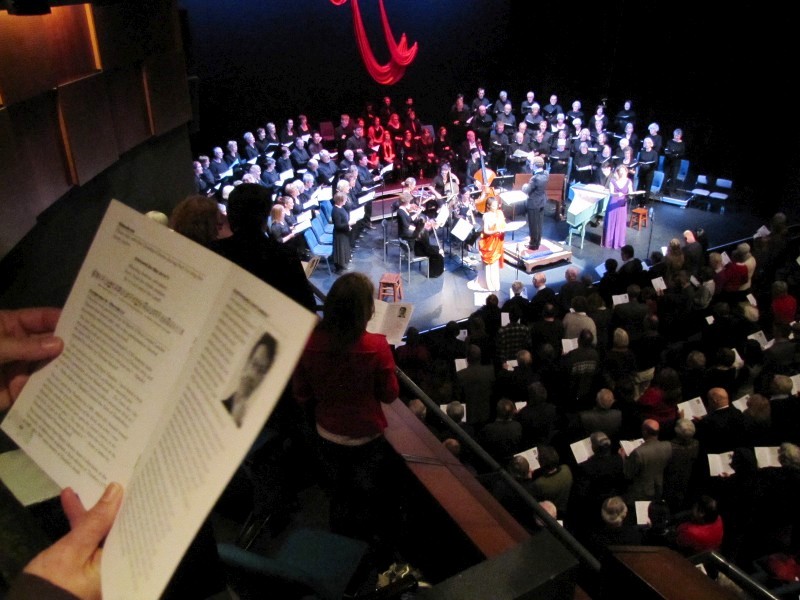
ABC ClassicFM has its annual Classic100 awards and this year it was for favourite composer and Beethoven won it. Probably you could have guessed the outcome, but Bach (no.2) and Mozart (no.3) were always runners, too. So it was opportune for the Llewellyn Choir to stage a Beethoven program. The main work was his Mass in C major; the others were Egmont overture and Choral fantasy. It was a great program and wonderfully performed. I hadn't heard the mass, but a mass is inevitably recognisable and thus familiar comprising the same run of titles, and, I guess, text. After all, the Catholic mass is a standardised and repetitive thing with a long history. The Egmont overture is well known but perhaps my least favourite on the night despite the effective performance. The Choral fantasy was new to me and a strange thing harking to the ninth symphony. It's solo piano for the first adagio movement, then into piano accompanied by orchestra and the choral section with two vocal soloists for the last few minutes. Odd and somewhat amusing but with some nice lines and several passages that clearly lead to the choral symphony. Renowned local piano accompanist Anthony Smith appeared as a piano soloist and did a great job. Four soloists appeared in the mass and their voices and interweaving harmonies were a great pleasure. I especially enjoyed Greta's soaring soprano and Paul's firm and strongly enunciated tenor. The Llewellyn Sinfonia was a nicely capable outfit and a great pleasure, obviously brought together for this program but featuring a string of CSO and such players. Nice to see the bass section of Max McBride and Dave Flynn. So, this was a great performance and a huge pleasure and, from the drinks and congratulations after, widely seen as a success. Wonderful and inspiring.

Llewellyn Choir and Sinfonia performed a Beethoven program including his Mass in C major in Llewellyn under Rowan Harvey-Martin (conductor) with soloists Anthony Smith (piano), Greta Claringbould (soprano), Jennifer Bennett (soprano), Ellen Malone (mezzo-soprano), Paul McMahon (tenor), Peter Ellis (tenor) and Christopher Richardson (bass). Lisa Stewart (violin) was concertmaster and Max McBride and David Flynn (basses) filled the bottom end.

27 November 2017

An advent custom

It's an advent event most years. It's Handel Messiah performed by Canberra Choral Society and friends under chorus master Peter Young conducted by Leonard Weiss with soloists Greta Claringbould, Tobias Cole, Paul McMahon and Jeremy Tatchell. All locals or thereabouts and an array of recognised faces on stage. That's part of the fun, of course, to recognise faces. And the music, which I am coming to understand and follow and appreciate: how and when soloists appear and the Christian Christmas story of joy and despair and the busyness of the orchestra because the soloists and even the choir appear on and off, but the orchestra is at it throughout, at least the strings and keys. I missed the woodwinds playing and the percussion and brass are impressive and essential but infrequent. What a thrill to stand for the Hallelujah chorus, it being so big and rousing that it involves you even if just by standing - sitting for classical concerts is satisfying but also staid. And there were a few singalongs from the audience for this chorus. I also felt like singing some other choruses but was responsible (or elbowed by Megan) when I felt the sing-along urge coming on. No it's not kosher. Sad that I can't get to the real open singalong of the Messiah next week (Wesley, 6-8pm, Sat 23 Nov, $10/5, singers must register). Good feelings abounded in the audience, too, this being a great favourite, and played so capably. I loved the high sops when set free and the complexity of the fugue choruses and the strength of the mid-range tenors and also tenor Paul's voice which filled Llewellyn so easily. And the bouncing baroque music that's so endearing. The orchestra was busy and often flightingly quick. They were perhaps too loud under Greta (they may have just played first desk behind some soloists, restraining the ppps to strengthen the fffs) but small matters. They did an excellent job under Pip Thompson. As for our standing, a man in front of me was a refusenik and it's probably an upper-class-twit custom, but it's fun and involving and all part of Christmas celebrations. As is the Messiah itself. Very well done and very much enjoyed.

Canberra Choral Society performed Handel Messiah at Llewellyn Hall under Peter Young (chorus master) and Leonard Weiss (conductor) with soloists Greta Claringbould (soprano), Tobias Cole (counter tenor), Paul McMahon (tenor), Jeremy Tatchell (bass) and the Canberra Choral Society orchestra under Pip Thompson (leader)

27 July 2015

Not just at Christmas


Handel's Messiah is a piece for all seasons. Why just Christmas? An expanded Coro with chamber orchestra performed it over the weekend and it was a thing of wonder. These are great voices with some of the best musicians around town. Performed with just two rehearsals and a full day workshop. And that's for a performance extending to 3 hours (including an interval). Reading this? I was overwhelmed by some of Kyle's quiet but certain bass playing, although he admitted some struggle in playing and just seeing it without a light during the darkening afternoon performance. It's not easy; it's not at all short or repetitive. What a reading job it was! And not just for Kyle, of course. The singers all had their charts and read the semi-quaver lines (a chorister mate in the audience commented on Coro's renown as sight singers), as did other strings and Calvin on harpsichord. The trumpets and timpani mostly sat, but when they let go, the roof lifted with life and the heavenly tone of baroque trumpet. Just not so often. Messiah is has over 50 numbers in three parts. There are choral segments and solos, recitatives and airs from sopranos and alto, male and female, and tenors and basses, telling the story of Christ, of birth then death then resurrection. So this is not just a thing for Christmas. These are more secular days (even if we still stood for the Hallelujah Chorus) but the work remains a thing of immense satisfaction and Coro did an immensely satisfying job on it. Not the huge 300-voice thing it often is, but a chamber take (1742 Dublin version). Just occasionally I missed the immensity but there was plenty of capability. The strings were strong; I strained to hear Calvin's harpsichord; the trumpets and timp were infrequent. There were various soloists, often from within Coro. I particularly enjoyed Emma Griffiths (soprano) and Andrew Fysh (bass) from the two ends of the pitch spectrum, and Paul McMahon (tenor) in between. The whole was led with plenty of energy by Joseph Nolan, visiting from St George's Cathedral, Perth. I can just wait in anticipation for Christmas when someone else will be taking it on again. I met a follower of Wagner Ring cycles (she's attended a dozen or so around the world) and one of the choristers had sung in 15 Messiahs. I could see myself attending a few more of these.

Coro presented Handel Messiah in the 1742 Dublin version at St Paul's Church, Manuka. Principals were Joseph Nolan (conductor), Barbara Jane Gilby (violin, orchestra leader), Calvin Bowman (harpsichord continuo), Greta Claringbould (soprano), Emma Griffiths (soprano), Rebecca Alexander (alto), Veronica Thwaites-Brown (alto), David Yardley (counter-tenor), Paul McMahon (tenor), Andrew Fysh (bass), Peter Tregear (bass) and Tobias Cole (choirmaster). Too much to list all the others, but for my bass comprehensiveness, Kyle Daniel (bass).

06 October 2013

Thanks to our friends

The ANU put on a big free show last year when it was under the hammer and they returned with another this year. The intention is different, presumably to showcase the continued existence and success of the School, but the context of massive change at the School is the same. Head of School, Peter Tregear, introduced this year’s concert as a gift to the Canberra Community and friends and he plans to make this an annual free gig. Great. The School of Music clearly has many supporters in Canberra. Many were horribly disappointed by changes last year, but Peter and others have been working valiantly to rebuild the School and they need the support of friends.

This was another mix of styles and ensembles, if not the extended potpourri of last year’s event. First was DRUMatix with soloist Sean Connaughton performing David Mancini’s Suite for solo drumset and percussion ensemble. How can you not love this? Infectious grooves, intervallic rubatos, rich tapestries of tone and even harmony and melody from the vibes and marimbas. And tubular bells, various latin percussions and timpanis. This was all convincingly performed, joyous and infusive, and Sean’s drum solo was interesting and of a nice length and surprisingly rocky in this classical percussion context, but that’s the nature of a group like this. DRUMatix presents a catholic array of sounds and rhythms. I’m sold. Then a welcome to country. Then the Jazz Ensemble playing an arrangement of Stolen Moments by Miro and Miro’s For Woody. These are two great tunes. Stolen moments was a surprise with a few added bars which stretch and settle this already cool tune. It was good to hear John’s tenor again and El’s violin (which is ever more satisfying) and guitar hidden in the back row. For Woody is a burner and the solos were shared widely: tenor and violin again, then trumpet, alto, drums, percussion. I don’t find Llewellyn is a generous acoustic for jazz, but this was enlivened and harmonically sweet in the heads. Nice.

The fine music followed the interval. The ANU Chamber Orchestra played and the ANU Chamber Choir sang under Peter Tregear’s baton. Calvin Bowman joined them for sinfonia and chorus from Bach’s Wir danken dir, Gott, BWV29. This is classic Bach oratorio material. Peter Tregear introduced it as written for the inauguration of the Leipzig Town hall and lamented our current alternatives. It didn’t seem hugely complex but it’s totally satisfying. I found strings and organ a bit unbalanced and the instrumentals somewhat lost in this large space, but it grew as the voices joined in. Bach is nothing but a pleasure. Then Handel’s Ode to Saint Cecilia’s Day, HWV76. Saint Cecilia is the patron saint of music, so this was also an ode to music. It was performed by Chamber Orchestra and Choir with singers Rachael Thoms (soprano) and Paul McMahon (tenor) and instrumentalists Rachel Beesley (orchestra leader), Virginia Taylor (flute) and Julia Janiszewski (cello). Handel combined text from Dryden with his dignified and sometimes majestic orchestration. This is a larger piece with numerous movements, variously dance-like, expectant, undemonstrative, joyous, stately, majestic, in three and four. Nicely done and especially involving at the end.

It’s been a very demanding year for the staff of the School of Music, even if it was quiet one in public. I’m hoping for a more publicly visible school over coming years. Ode to Music was performed by staff and students of the ANU School of Music. Performers were DRUMatix, ANU Jazz Ensemble, ANU Chamber Orchestra, ANU Chamber Choir, Calvin Bowman (organ), Rachael Thoms (soprano), Paul McMahon (tenor), Rachael Beesley (orchestra leader), Virginia Taylor (flute) and Julia Janiszewski (cello) led by Peter Tregear.

24 June 2013

Triumphs of the blessed


I was going to take this quote from Handel’s Theodora, “Pity suing / Mercy wooing” but Triumphs… seemed to fit. When I checked the libretto I found it’s actually “Triumph o’er her boasted chastity” but I’ll use Triumphs … anyway. I like it.

We saw a performance of Handel’s Theodora by the Canberra Choral Society with various guests and with period instruments. It’s dignified and neat and even touching later in the work, when the Theodora and Didymus, the Christian couple, are sentenced to death by Valens, President of Antioch. Didymus is a Roman soldier who’s fought with friend Septimius, but he’s fallen for the beauty of Theodora and converted for her purity. Valens has declared that all citizens should offer sacrifice to some Roman goddesses to honour Diocletian's birthday. Theodora refuses and is sentenced to a brothel. Didymus goes to Theodora and allows her to escape in his uniform and helmet. Didymus is sentenced to death. Theodora returns, they each offer their own death to save the other and of course they are both sentenced. It’s all strange classical stories which mean so little to us these days and stories of saints and worthy Christians suffering at the hands of heathens and that goes over my head. This performance was a one-off. It felt it started a bit unsteadily, although it was comfortable by the end. The voices were very satisfying, and I could follow most of the story other than Theodora’s words. Soprano training is like that and it’s a weakness when there’s a story like this to follow. I loved the CCS when they sang, all rich and full and smooth, but they were the Christian chorus, after all. Kampactus was the chorus of heathens who chuckled at the promised rape of the pure Theodora and they seemed to have some more intricate lines to sing. I lost a few. I also didn’t particularly notice the period instruments other than the baroque oboe and harpsichord and chamber organ. I assume the strings were gut and perhaps the violins were milder, but I didn’t find it particularly noticeable. I particularly watched cello and bass, partly for the different physical approaches to the instruments: cello is more lightly strung and Anthea attacked it with raised fingers; Helen on double bass was smoother and seemed to be natively conserving her strength given its heftier demands. I admired both their playing. The whole ensemble was warmed up by the end and the end also has some of the best music: the final duo of the lovers and a choral segment that finishes it off. A worthy and satisfying finale.

The musicians did a great job, even if I would have preferred to hear it after half-a-dozen more performances. Oh, and the audience sang. CCS apparently has a habit of introducing singalongs. This time is was three lines of a hymn over four bars that were repeated. The words and music were in the program; the lights came up, we stood and sang, everyone smiled, and we sat down. Nice twist and nice work.

Handel’s Theodora was performed at the Playhouse by Canberra Choral Society with Brett Weymark (conductor), Greta Bradman (Theodora), Tobias Cole (Didymus), Christina Wilson (Irene), Paul McMahon (Septimius), Stephen Barnett (Valens), Kompactus Choir (Heathen chorus), Canberra Choral Society Chorus (Christian chorus) and Evan Kirby (messenger). The ensemble on baroque instruments were Bianca Porcheddu (violin, leader), Lorraine Moxey (violin), Heather Lloyd (viola), Anthea Cottee (continuo cello), Helen Cosgrove (double bass), Kirsten Barry (oboe), Peter Young (chamber organ), James Huntingford (harpsichord).