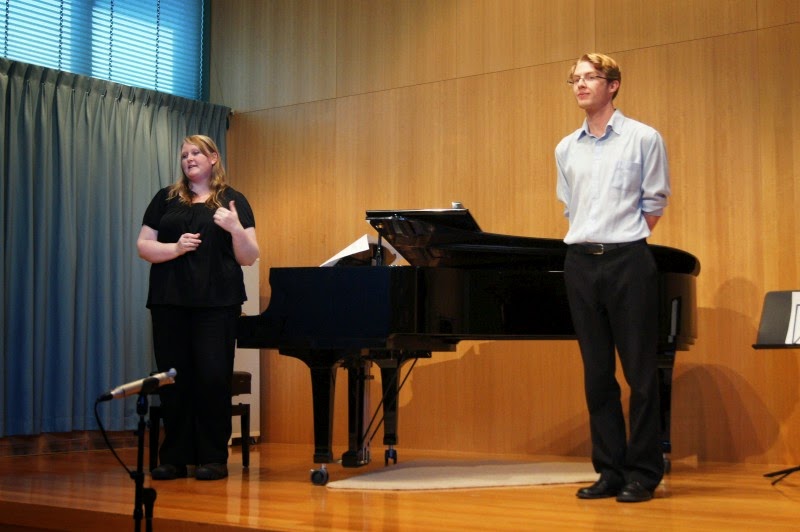
I was refreshed by the attractive music that Sally Greenaway presented at the AYO National Music Camp some months back. It was melodic, I might say "musical" if I didn't accept a whole range of musics and argue for all manner of dissonance. This day, Sally spoke of her own music in context of "Swoon", the ABC FM meme and radio show but, at the same time, she argued for all composers. She highlighted Australian composers, saying that they may write with texture or atmosphere or even uneasiness as an intent, but it all deserves the listen. Good on Sally for presenting the argument. Her preference is easy and melodious and very attractive. This performance was mainly of works composed by Sally (I think one wasn't) and performed by Sally with a few friends in various combinations.


Firstly, Dawn of evening, a "reflective nocturne" that was eminently filmic, as is lots of Sally's music, and dedicated variously to her new grand piano and to Sally Whitwell. The cellist Emma Rayner joined Sally for three poems by Pierre Louys put to music by Sally; a short first movement; a very identifiable second movement (I don't think I've heard it; has Sally mastered the art of the perfect melody?); then the last movement. Then bass/baritone Patrick Baker joined for two songs: The exquisite hour, by poet Reynaldo Hahn, again put to music by Sally, and Look to the day, a poem by Kalidasa, again to Sally's music. Then Sally solo again for At the start of the day, a tango-cum-jazz piece, Elizabeth Biggs, solo harp, playing Sally's Liena and then a duo with Sally on a Rhumba by Salzedo, and an end with Sally playing a pair of compositions written for guitar, Sin luz and De la luz. She explained they were written for guitar but played piano style, and it was obvious when you were aware of the nature of the composition, or at least the arrangement, with limited chords, scalar runs and intervals that sit under a hand on a fretboard. There's more to composition/arrangement than just the chords and melody. This was consistently pleasant and attractive music, but never mawkish or bathetic. You can hear the film in it, setting scenes and emotions but never brash or presumptuous. Words like lovely or nice are denigrated but there's a just place for being delightful, agreeable, pleasant. We need more of it. Congratulations to Sally and looking forward to hearing this very music on her new CD.
Sally Greenaway (compositions, piano) performed at the Wesley Music Centre with three friends, Patrick Barber (bass/baritone), Emma Rayner (cello) and Elizabeth Biggs (harp)


 First concert of the day was a Lunchbox concert at the ANU School of Music. These are students, presumably at different stages of their training, performing a varied repertoire on diverse instruments. What's not like. Aaron Chew (piano) started with Fantasia Baetica by Manuel de Falla. This was a substantial work, virtuosic, exciting, passionate. He mentioned the sounds of guitar, footstamps and female vocals (this is Spanish music). Aaron played with confidence the waves of notes with crossing hands and several passages of a quizzical dissonance. I loved this piece and I thought he did an excellent job on it. Then Jelena Mamic (soprano) sang four Canti di lontananza by Menotti with accompaniment by Anne Ewing (piano). This was intense, vibratoed high notes (