Showing posts with label Anton Wurzer. Show all posts

10 October 2024

Clarity

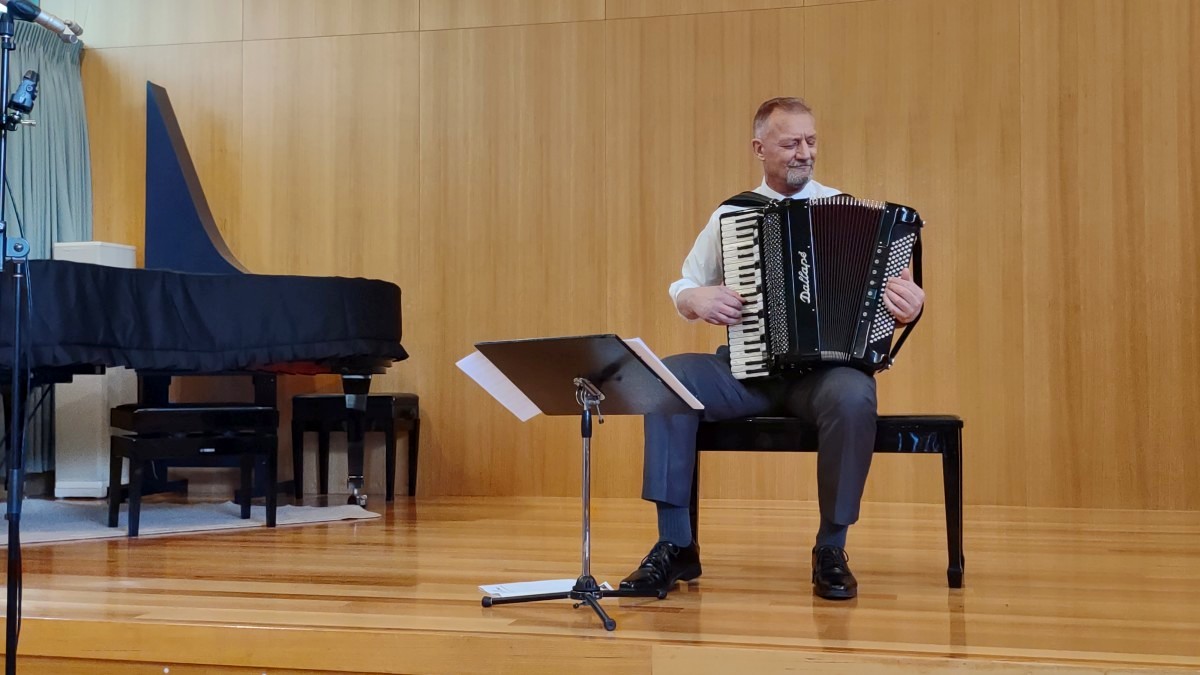
It's not the most common instrument in Canberra or at least I don't see it too often, but I seem to have a few mates taking it up.  Perhaps because of the influence of a (the?) local master, Anton Wurzer.  I've watched Anton over the years, playing jazz, improvising, classical, with harpsichord or even my jazz band at one stage.  A return as a huge pleasure.  Anton played for a Wesley lunchtime concert, all his own music, all sharp and sweet and superbly accurately played, ranging over samba, cha-cha, waltz, bal-musette, through a groove written to promote improv amongst local accordion players, about relatives and tragic events and even Red samba beans.  Pieces written over time, on piano, some up to 18 years ago, so they have a long life.  I noticed a lovely balance of parts, a nifty left hand bass breaking into a life of its own at times, lithe right hand passages, chordal or melodic or lovely improv lines, perfectly spelling out the tune with some chromatics around arpeggio notes and mobile arpeggiated lines and long runs over the 3.5 octave keyboard.  Even some alternative techniques, tapping in various spots or finger snaps with audience participation, and all within attractive original tunes that referred well to the title, perhaps Waves of Mallorca or Madrid to Paris or Groovy man walking.  It's not often I hear the piano accordion like this, or ever, but I am convinced.  In hands like this, this is a hugely attractive band in a box.  Just a lovely outing.  And to top it off, Anton handed out gratis CDs of solo baroque pieces (Bach et al), his third album.  Generous in more ways than one.

Anton Wurzer performed his original music at Wesley.

01 September 2022

And now for something different and not

Akkordeon is different but the original tunes that Anton Wurzer played had real connections to jazz and latin and more.  Anton is our our local virtuoso piano accordionist.  I've heard him play classical and all manner of modern and cultural styles.  He played a string of original tunes at Wesley and they had connections with jazz and French and sambas and German folk and gypsy jazz and blues.  And his style of writing is not at all simplified.  These are complex arrangements, changing time signatures and lots of dynamics and tempo movements.  And all played with the sharpest touch, so his semiquavers (would he say 16th notes?) were just spot-on-perfect.  They can be sloppy in many hands, but not on Anton's keyboard.  His left hand, of course, played buttons, chordal-cum-bass accompaniment, and again sharp and correct and nicely distinct from the right hand embellishments and melodies and solos and both hands stopped occasionally for a tapping percussion, again apt and precise.  This is clever music, played with precise fingering and with writing that shows clear awareness of style.  And stories.  So one tune was Lachlan's mood, given a request form co-performer Lachlan Coventry, and Manouche Emma referred to student Emma and Tathra Pub gig referred to a session obviously at the Tathra Pub.  Empress Theadora's dance was a bit further from home, being about Byzantine monarchy and Red samba beans, well, just about food.  So every tune tells a story and all nicely written and quite complex and sharply played.  Not too many really obvious lengthy solos, but the final number, Tathra Pub gig, showed off some classy bluesy improv with quotes from Summertime and American in Paris.  Clever and all round very nicely played.

Anton Wurzer (accordion) performed original music at Wesley.

28 January 2022

Multitudes indoors

Again it was at the Harmonie German Club and the event was called Australia in Harmonie : Collaboration of Cultures.  But these were the indoors acts.  It's different, indoors.  It's darker, cooler, there's a bar in the corner and people scattered at tables, seated.  The stage is big and the sound system impressive.  Noone on the dance floor, unlike some previous visits to this venue.  It's Covid, after all.  First up was a Maori Cultural Group, but I must have arrived at an odd time, for I only saw one guy talking.  Then a bit later, The Famouis (sic).  Pretty sure the spelling is correct, given the introduction.  This was a trio, all three males singing with two playing guitar and the core singer on cahon.  These were some truly lovely harmonies, most impressive, on pop tunes.  Then Anton Wurzer, our local exceptional piano accordionist.  I've heard him at CIMF, playing jazz and classical, solo and in groups.  He's a very capable player.  This day he proudly displayed his background wearing Bavarian lederhosen but his performance was more popular tunes done with wonderful authority.  All the hits, from Hey Jude to Sesame Street and Hava Nagila and then into a string of Aussie day hits, not least Waltzing Matilda and Still call Australia home, and a finish on Pier Gynt Hall of the Mountain King and Still talking about a revolution.  Now that's telling: a muted commentary played with authority and good vibe.  Great stuff!  Then a break and a return to Nancy Bates, solo artist, guitar and vocals, leading a string of singalongs (at least when we knew the lyrics), a strong voice and strummy guitar and wonderful presence with Aboriginal references.  Songwriter and singer with Archie Roach for several years, so there's experience here.  It shows in a genial presence but also a telling story.  That's one thing I am noticing of contemporary indigenous arties: the personal stories, not carping but honest and open and welcoming.  Then to a mate of Nancy's although they may have just met singing together on Aust Day stages in Canberra over recent days, Monica Moore and her blues band.  Well, I love the blues and I know these characters from Blues Society jams over the years and this was a blast (and I must admit my fave for the event).  Authentic, tight, loud blues.  What's not to love?  Sharp Strat solos, reliable, solid blues bass and drums.  The guitar gets the show here along with vocals; it's not a music of conspicuous virtuosity for bass and drums, as necessary as they are.  I liked how just bass and drums could hold the groove when guitar sat quiet and no vocals.  Then Monica with her firm and strong voice and telling interpretations.  All blues standards - Take me to the river and slow blues and Sweet home Chicago and the like - not originals that I noticed.  But so much a driving whole.  Great stuff!  It's a difficult act to follow but it was a different act that did follow.  Dale Huddlestone and the Riverbank Band was a big outfit, guit/voc, bass/voc, guit/voc, guit, drums.  Dale sang his own songs, stories of family and place, of his first nation parents moved from NT to Narrabundah for cuclones and more, about fishing with his grandfather (as I remember).  These are good and true stories as is wont with country music, and the band was tight and clean and satisfying, even if country is not a field I've yet discovered.  It was amusing that I noticed some warmup drum rolls that floored me, but they didn't appear in performance.  Not apt.  Neat and true and clear and again, telling.  So the indoors was a different world in some ways, more a listener's stage with more settled audience.  Even if the singalongs and joving in seats hinted towards other.  But an interesting way to while away some hours for Australia/Survival/Invasion Day.  Much enjoyed.  Thanks all.

Performers on the indoor stage at Australia in Harmonie at the Harmonie German Club were: Maori Cultural Group, The Famouis, Anton Wurzer, Nancy Bates, Monica Moore Blues Band and Dale Huddlestone and Riverbank Band.

23 April 2021

Sandwiches

It was a double decker: Anton and Ariana had sandwiched Bach between two Vivaldi sonatas and I had sandwiched my recording between Melbourne and Adelaide.  So we could expect an unusual and slightly rushed affair.  On my part, it was rushed: I managed the audio processing but no time for video.  That takes time.  As for the music, it was a little singular, at least in that combination, but it worked very nicely an in a pomo way that opened our ears to new possibilities.  Ariana was playing harpsichord and it could be lost behind the relatively firm, unrelenting tone of Anton's piano accordion.  They were aware of it but it still was a little issue.  The akkordeon, as named by Anton, was organ-like in its firmness.  Not at all like a violin which it mostly replaced.  And the fingering was probably an issue for Anton, but I loved how he would work the fluid phrasings and how the keys bounced in the fast lines and how he'd punctuate phrase ends with left hand notes or chords.  And it was interesting to talk to him after, with his jazz training and harmonic awareness, talking of chromatics and 1-4-5s and cycles of fourths.  Bach is lovely in his colourations and so often jazzy in his harmonic movements.  And you could hear the richness of Bach highlighted betweens the Handels.  Handel is lovely but Bach is God.  There's a reason for the 3-Bs in fine music.  So, another lunchtime interlude at Wesley with some serious musical musings.  Too bad I missed the real cheese and biscuits outside.  That would have been sandwich no.3.

 Anton Wurzer (piano accordion) and Ariana Odermatt (harpsichord) played Handel and Bach at Wesley.

23 June 2016

A time for silence


The title and the theme were sacrifice and the sub-title was Lost songbirds of the Somme. This was another of Chris Latham's investigations into WW1 with the support of the Australian government (100 years of ANZAC) and various other embassies and institutions and departments. All part of the Flowers of War project. This one explored a string of composers from both sides who partook at the Somme and who mostly died there. There were songs, of lost fellows, of girls left behind, of memories of home, elegies and laments and war sonatas and death. Not too much of valour in battle; perhaps the piper came closest to that, given a piper's role in those days. There were pieces well known by Australians and others and many lesser known. There were instrumentals amongst several songs. The concert itself lasted 90 minutes and the request for no applause between tunes lent it a pensive air which suited well. The British High Commissioner recited the Ode of remembrance with some emotion. The Ode is longer than the commonly cited Australian version ("They shall grow not old, as we that are left grow old / Age shall not weary them, nor the years condemn / At the going down of the sun and in the morning / We will remember them"). The HC narrated two of seven verses from the original, excluding some specific references to England. Then a minute of silence, the Last post sung by tenor and a final bugle call. With the piper and the lofty Cathedral-like space and following over an hour of tragic memories, the room's mood was palpably affected. The musicians were impressive, intoning and bowing with lovely precision. Just 3 violins, viola, cello and accordion, sometimes with voice, so the music was clear and open. My favourite was FS Kelly Elegy, but only because I know it well, and his Somme lament. The whole was bathed in pathos which most showed in some songs. Like Suzette, presumably an ode to a lover, but displaying little joy amongst its dense Edwardian romanticism; or Gurney singing that "I'm homesick for my hills again"; or Gurney again by a bierside "It's most grand to die / most grand"; or Ibert's strained attempt at recall of home and hearth in his Noël en Picardie. Then to end, the walking piper coming down the High Court ramp growing louder as he approached, and the Ode and the Last Post. It was touching and quiet and beautifully presented and some superb performances (including some thoroughly impressive piping). And a printed program that was a work of both history and art. Congrats to all.

Sacrifice was coordinated and much music was arranged by Chris Latham (violin) and performed by the Sculthorpe String Quintet comprising Anna McDonald, Rose Kavanagh and Chris (violins), Tor Fromyhr (viola) and Zoltan Szabo (cello) with Andrew Goodwin (vocal tenor), Anton Wurzer (accordion), Jason Craig (bagpipes) and an unnamed bugler. Menna Rawlings (British High Commissioner to Australia) recited the Ode of remembrance.

17 June 2012

Trio A Gog & Magog makes six

Al Kerr came to town with his Trio Agogo and friends, so his trio had six performers. Apparently ABC radio has commented on this too, but let’s not be too prescriptive. Trio Agogo plays Brazilian music and it comprises Australian musicians with Brazilian experience and knowledge and with a history of visits to the soul of the music. We all love bossa nova, of course. This was broader although I could hear the bossa sensuality in the sax melody of one tune out of Rio de Janiero. That tune actually sounded to me like Euro/Latin melancholy: smooth, sexy, romantic, somewhat desperate. But there was also lots of dance party music out of NE Brazil that was described by Al as jazz fusion. It was close. I heard cycles and descending chromatic chords and modally descending chords, so the structures weren’t all so difficult, and the soprano solo on one all the world like fusion. The grooves were rich and the arrangements were busy. But the rhythms were essential: deeper, more African, than fusion’s rhythms. One of Al’s solos had me realising their malleability. On drum kit, his limbs were playing different and unconnected rhythms that floated over the groove and came together at the end of a phrase. Who knows how difficult that must be. It’s wildly free in a rhythmic sense and I can imagine dancing to it would be strangely liberating. This was richly danceable music in a loose-limbed African way. I also loved the sound of two nylon-strung guitars which, with drums/percussion, formed the Trio, as they played unison lines or harmonies or solos against chords. The melodies were joyous things, bouncy, busy and consonant. This is sensuality with intelligence but without intellectualisation. Ben told me afterwards that they’d been playing the top 100 of Brazilian music. Their promo had talked of samba, choro, bossa nova, forro and Brazilian jazz. Suffice to say I knew of a few of these, but there’s variation in these forms that eludes my knowledge but not my pleasure. This was wonderfully infectious music and strongly foot-tapping. Much enjoyed. And congrats to our locals, Phill and Anton, who did all this with just one practice under their belts.

Trio Agogo are Alastair Kerr (drum kit, pandeiro, percussion), Paul Carey (guitar), Adam May (7-string guitar, cavaquinho) and their friends were Ben Carr (saxes), Anton Wurzer (accordion) and Phill Jenkins (bass).

15 November 2011

Cosmo2

Gossips played over the weekend at the 2011 Cosmo Cabaret fund-raiser for Timor. Other returnees were soprano Kirsten Mann and The Cashews. Newbies this year were Anton Wurzer and the K-Motion dancers presenting a display on Argentinian tango. A busy night of varied entertainment and goodwill and chatter.

Gossips opened with a short set. We touched on the ‘40s theme of last year, but there was more a sweep of the 20th Century. Leanne even got to revisit a Goth past when we played Love cats. Most fun was the set with Anton, but more on that later. Kristen was again accompanied by Mike, but she sang a more earthy set this year. Firstly an Erik Satie song, obviously in French and more folksome than last year’s Debussy, but later a Celtic-sounding song of a barmaid who makes some extra money on the side from disreputable activities. The soprano technique does not make for lyrics that are easy to understand, but we got the message. The Cashews followed with their wonderful, sometimes touching, always clever songs of Canberra life presented with smiles and wit and exemplary interaction with the audience. Alison and Pete have the sweetest of mingling voices and unobtrusive harmonies and match it with a decent folksy instrumental technique. And was that an 8-string uke that Pete played?

The K-Motion dancers came after the break. The tango is a thing of some interest in jazz circles, but I only see the dance in films. It started with four couples that form from an inner circle surrounding the dance floor. The male, red jacketed, seeks a female and the sultry, seductive encounter begins. This is tightly framed, closely moving dance, bodies close and suggestive, even if faces are distant and formal. Anton followed with a solo set of lively, flexible tunes from fleeting fingers. There was some humour to end with a medley that included Stairway to Heaven, but mostly it was busy, enlivened improvisation. Anton plays a hot accordion, and I love that sound. It’s not one that we often hear in jazz, and perhaps the only one that we hear in jazz in Canberra, but it deserves more popularity. Perhaps it’s my Italian background but I love that sound and Anton plays with vigour and fluency and improvisational skills that makes it such a pleasure. Gossips returned for a few final tunes with Anton, and this is where I particularly noticed. One was a boppy 5/4 original by Anton, another was a hot bop blues, but it was Bluesette that particularly fitted. It’s a composition of Toots Thielemans so the tone fits perfectly with the snappy wind tone of the accordion.

So a very pleasant night of considerable variation and some new exposures. Much enjoyed. The Gossips are Leanne Dempsey (vocals), Mike Dooley (piano), Richard Manderson (saxes), Eric Pozza (bass) and Brenton Holmes (drums). Kirsten Mann (voice soprano) was accompanied by Mike Dooley (piano). The Cashews are Pete Lyon (vocals, guitar) and Alison Procter (vocals, guitar, accordion). In individual K-Motion dancers are unknown to CJ. Anton Wurzer (piano accordion) performed solo and with the Gossips. And this all happened at the Second annual Cosmopolitan Cabaret in Curtin.

21 December 2008

Sweep of history

Jazz@Folkus ended the year yesterday with a trio of bands across the sweep of jazz history.

I’m not a frequent listener to the century-old styles, but I enjoyed the Brass Monkeys Dixieland Band. The Monkeys are led by Cam Smith, with a few tunes even sung by Cam (along with a fleeting appearance by Courtney Stark). It’s such a different experience from the modern styles. The bass is that hormone-enhanced brass instrument, the sousaphone. Peter capably played the I and V square on the 1 and 3, with some simple scalar connections. It works, and it’s big and fat, and you can even walk (a short distance) with it, as in a funeral march. The drums play square, too, with the kick on the 1 and 3, the hi-hat on the 2 and 4, and a rudiment-rich syncopation on the snare, and just an occasional cymbal to mark the end of a line. It’s square, and very pre-ride, but it works nicely, and the two rhythm section instruments set up a bouncy and steady, if square, groove to support horn lines in harmony or unison and individual or group soloing. Anton’s excellent accordion weaves around, somewhat like a keyboard role (isn’t there usually a banjo in this style?), as does Tom’s clarinet, backing or integrating with various solo statements. And Cam’s cornet was bright and sweet and authoritative as perhaps the key melody instrument. They even started the show by walking in from the back of the room playing When the saints come marching in. Just like a funeral march. Nice one: very entertaining and much enjoyed. By me, and by a decent audience from the Canberra Jazz Club.

The Brass Monkeys Dixieland Band comprise Cameron Smith (trumpet, cornet), Nathan Sciberras (tenor sax), Tom Manley (clarinet) and Rod Harding (trombone), Anton Wurzer (piano accordian), Peter McDonald (sousaphone), Mark Levers (drums).

Frequently Asked Questions was actually the third band on the day, but was intermediate in jazz historical terms and they shared some players with the monkeys, so I’ll write them up next. FAQ took us back to the mainstream of jazz with a set of known standards and mid-century pop tunes. Theirs was a working-muso style: swinging, light, presentable, sellable, presumably developed by the band in regular performances at the Casino. Sarah Byrne leads on soprano vocals, with a classic cabaret songlist: This can’t be love, Bye bye blackbird, Blues in the night, Spring fever, They can’t take that away from me, and the like. But they are working players, so I wasn’t surprised by a venture into Route 66, although they played it more as jazz blues than R&R. My favourites were Secret love and that masterpiece of jazz humour, Makin’ whoopee. James Groves plays capable piano, in solos and comping and Peter McDonald reappeared from Brass Monkeys, this time on electric bass and tuba. FAQ are in essence a trio, but they added Mark Levers on the day on drums. This is light music for restaurants and bars and background, but lovely tunes and comfortably swung. The songs are insinuating so there’s a reason for their permanence, and any band that sings and swings them is a natural winner. You can find more on FAQ at their website. But add a few words (eg, canberra jazz) or you’ll be lost in millions of website FAQs.

Frequently Asked Questions are Sarah Byrne (vocals), James Groves (piano) and Peter McDonald. They were joined on the day by Mark Levers (drums).

17 August 2008

Slower cooking, many cooks

Joe Lloyd’s Quartet appeared as host band at a very busy Jazz@Folkus jam session this weekend. Busy with an array of different players, and sadly even a band that didn’t make it on. Very honourable of Cam who runs the show, because it was his band that missed out. The turnout was nothing special this week, so come to support Folkus so we maintain this open session.

Joe set the scene with a wonderful set that took us back to the early 60s and shades of Coltrane through a series of original compositions. Joe presented three movements of a suite he is writing, and which we may expect to hear recorded sometime next year, as well as Slow cooker, a response to the John Mackey tune, Pressure cooker. I could hear Trane in Joe’s phrasing and sense of dissonance, but apparently his major influence is Kenny Garrett. Luke accompanied with a matching style of the era: I heard phrasing and fourth chords reminiscent of McCoy Tyner, so the image was set. Hannah was strong on bass lines and steady rhythms, and even led with some melodic playing at one time, and joined Luke for some interesting duo passages. Matt was solid and responsive and occasionally explosive. He obviously enjoyed these outbursts, and I noticed several smiles on his face with the more brash crashes. Matt also provided two tunes which fitted neatly in style and presence with Joe’s, one called River and the other called Fleeting. Truly an agreeable set, and one which set a demanding level of performance for others to match.

Round Midnight followed. RM are a pair of players from Bateman’s Bay: Ian (missed his surname) on guitar, and Keith Joliffe on bass. I know Keith through emails as one of the organising committee for the Moruya Jazz Festival. RM played a set of jazz and popular standards with midi accompaniment. Nice to have out of town visitors.

Anton Wurzer followed with three tunes. Anton is a wonderfully competent piano accordion player. Now, that’s not an instrument you expect at a jazz session, but Anton has been a student at the Jazz school, and plays a truly solid, inventive, occasionally out style of playing. There’s always the hint of bandenonean and French street scapes, and the tonality of a piano accordion seems a bit thin to me, but he plays fabulously rich interpretations of the standards repertoire with rock solid rhythms, and even sat in comfortably on a Wayne Shorter blow later in the day. Anton is a powerful, solid, inventive player, even if on a jazz instrument of less common stature. Check him out. Highly recommended!

My jazz band Toucani got to present four tunes, all originals. We played pretty well, and better than last time, but still can develop. But I’m proud that we can do whole sets of original compositions of some interest and complexity. Daniel wrote two: a solid post-bop piece, That call, and straight eight, Bill Evans style, Maxim. I debuted a piece which is to be played very tongue in cheek, Snakes alive, and we played a favourite of mine in 5/4, Fifty four. All a bit rushed and unsettled, but OK.

The day ended with a short blow. Joe Lloyd and crew were the mainstay for a blues with Anton. Next was Blue bossa with Hugh Deacon sitting in on drums, Daniel Wild on piano, and Eric Pozza playing acoustic bass (my first public performance on the big bass ... thanks again, Hannah). Next I suggested Wayne Shorter’s Prince of darkness, and it went off a fast post-bop treat. To end, Hannah and Luke returned for a final tune.

It was a pleasant outing with some very interesting music at times, and a great range of styles. Get along, and support Jazz@Folkus on the third Saturday of each month. Free for musos.

Joe Lloyd Quartet comprised Joe Lloyd (alto sax), Luke Sweeting (piano), Hannah James (bass), Matt Sykes (drums). Round Midnight comprised Ian … (guitar) and Keith Joliffe (bass). Anton Wurzer played piano accordian. Toucani comprised John Baczinski (tenor sax), Daniel Wild (Piano), Eric Pozza (bass) and Brenton Holmes (drums). Hugh Deacon sat in on the jam.