Showing posts with label Song Company. Show all posts

06 May 2016

Camino


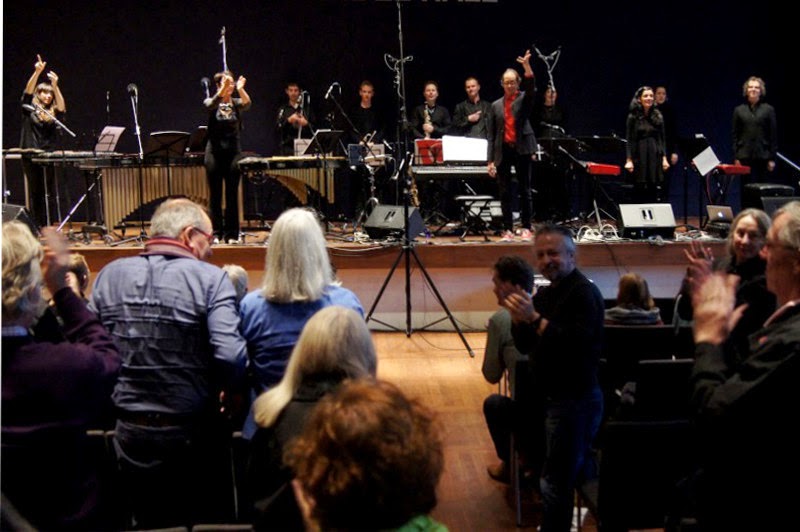
We will only make a few concerts at this year's Canberra International Music Festival. The program seems strongly thematic this year. The title of this concert was El Camino, recalling the Camino de Santiago, the Christian pilgrimage to the remains of St James, from the border of Spain/France to Santiago de Compostela in Galicia. It's now a famous and commercially-supported walk done by many intrepid, not necessarily religious travellers, but it's been a religious experience since the Middle Ages. This take was presented by the Song Company led by Roland Peelman (with addition of some local young vocalists) with guitarist Jose Maria Gallardo del Rey and several percussionists from on drums, cajon and vibes. The mix of artists changed for the various pieces. I love the Song Company for their wonderful voices, superb harmonies, clarity from solo singers doing single line parts. It is such a great vocal ensemble. That said, the first tune, Three cantigas by Alfonso X el Sabio was my favourite. This was mediaeval vocal chant with occasional claps accompanied by two simple period drums. In some ways primitive, but involving and humane and just fabulous. I could imagine this was just what the pilgrims were singing around the campfire at night and I meditated that they must have been able to sing while we leave it to the professionals. Sad, that, but a function of a busier, richer life with great division of labour. Then guitar with cajon accompaniment. I met Jose next day and he explained this as Spanish guitar, opne to sound like Flamenco or classical guitar in style. The playing was wonderfully sharp and toned and largely played without music (I can only imagine the number of dots on a guitar chart, presuming every chord and arpeggio is annotated). This is one I enjoyed watching, for the impressive left hand technique. Then guitar accompanying the Song Co for Rautavaara, again a composition about Spain (Cordoba is mentioned) and travel and dangers. The final work was a commission for the festival, Gerard Brophy Canticles. More modern, sparse, performed by Song Co with two vibes and guitar accompaniment, and using the words of Psalm 13 ad Ecclesiastes 3 (you all know this one: "a time for every matter under Heaven / a time to be born, a time to die..."). All about journeys, dangers, faith with a marked inclination to Middle Ages religious Europe. Nice.

The Song Company was led by Roland Peelman. Jose Maria Gallardo del Rey and several percussionists, presumably members of the group Tambuco, also performed.

12 May 2015

g-l-a-s-s

It was an afternoon of (Philip) Glass. We were in the Gandel Hall at the National Gallery, not at the Fitters Workshop, next to the Glassworks. This was a mammoth outing. Three hours of Philip Glass. Ensemble Offspring and associates were playing a string of formative works by Philip Glass. He's somewhat notorious for his minimalism and apparently caused considerable stirs when his works were first presented at various locations in NYC. While listening, I became aware of how we are now acclimatised to this approach, even if I've had some questioning comments since. But it's fifty years back now. The works were dated 1968 to 1976 so the early ones are from the Summer of Love, 1968, high Hippy, but this is not Hawkwind or psychedelia. They are out of the fine music tradition (Glass studied with Nadia Boulanger in Paris) even if they are outside it. This is music reduced to a minimum, based on repetition and alternation of melodic cells. I wondered if it's prefigured by change ringing with its permutations of bell rings. The effect of the moving cells has a similar effect. But references are more to India and drumming and that fabulous percussion singing called Konnakol. Glass' music is intense, unforgiving, unrelenting, fairly loud; then it stops. The introduction suggested those in the know were the ones at the back lying on pillows, but then this is no longer the '60s (and the audience was no longer in its 20s). Audience could come and go through the performance. All very much of the period. The beats were intense and satisfying and the crossing rhythms were fascinating and forming their own mutating sub-rhythms. In one piece that I consciously tapped, I felt 6/8, noted three-note patterns and also quaver pairs (quaver pairs in 6/8?) but I couldn't easily tap to 5. I wondered about how it's written, then realised (again for this one piece but the approach seemed common) there was a cell pattern separating varying repeats of another pattern. I could guess how that might be written. The performers often nodded heads, no doubt identifying changes. There were a few slipups where someone stopped to await another nod.

We heard a string of works of varying degrees of complexity. Claire Edwards started with 1+1, a very simple work tapping a timber board. It reminded me of rhythm exercises I used to practice with a drummer mate. This was very early. Then Music in similar motion, played on two vibes and keyboard containing only ~6 notes. They played Music in contrary motion later, on two vibes, e-piano and 2 keyboards. The contrary motion was more complex and demanding of concentration but just as devoid of respite. I thought there was a drone there, too. Tough on the musos: have a moment's doubt or flinch and you're lost. The percussive pitch of vibes and the organ tones of keyboards were key, but Glass later expanded with instruments for overlaid pitches and alternative rhythmic patterns. Music for fifths was played on e-percussion, keyboard, clarinet and soprano sax but here the wind instruments just seemed to add tonal variation, playing the same unyielding lines. Knee plays 1-5, from Einstein on the beach, was the latest work (1976) and it's a big departure. A single simple three note line on e-piano, a string of singers with simple, beautifully enunciated voices singing 1-2-3-4/1-2-3-4-5-6/1-2-3-4-5-6-7-8 sometimes missing a number and a violin that is Einstein playing a devilishly difficult extended solo line, then again later. Just glorious, uplifting, fascinating. It must have been a devil of a work to play. Graeme Jennings (a CIMF2013 houseguest!) took it on, but I think it's something you'd have to live with for considerable time: no break, wild bowing and totally unforgiving. I was deliriously loving this all, although at 2 hours I was flagging. But then the finale, another highly developed work, Music with changing parts, dated 1970. The style was like the early ones, but beyond. I'm not absolutely sure of this (some musos were obscured in the back line) but I think this was played by 2 keyboards, e-piano, vibes, marimba/percussion, trumpet, alto/soprano sax, piccolo, bass clarinet and two female singers. The repetition of cells was there, but accompanied by long tones and various rapid repeated melody snippets. Someone said after that it was a NYC soundscape: ships on the Hudson, taxis, police sirens and the rest. I could believe this. This performance was limited to just 45 minutes (it can go on for hours) and I could have enjoyed more.

I loved this gig. I'd been bathed in beats and crossing rhythms of few, repetitive notes and tapped my foot dry (most just sat still, this being a classical audience, but how could you not move to those deliciously abstruse beats), absorbed some beautiful tone and voices and meditated on this all. And put tissues in my ear for the unrelenting volume: the volume wasn't so loud, but it came constantly. Great gig and another CIMF revelation.

A World of Glass was performed by Ensemble Offspring and associates. EO are Claire Edwardes and Bree van Reyk (vibes, percussion), Jason Noble (clarinet, keyboard) and Jim Nightingale (saxes). Their friends were Graeme Jennings (violin), Gabi Sultana, Alister Spence and Roland Peelman (keyboards), David Shaw (flute) and the Song Company with YAFF vocalists.

24 March 2015

Existential


It's a challenge to an atheist in the 21st century that this music of Haydn, written in the seventeenth century and a recitation of the words of Christ on the cross may be amongst the best music ever written. Certainly I thought that as I was listening to this thing of immense beauty, but I think it often enough for other music, too, so confusion can be just be put down to existential angst. Whatever, this was beautiful. The work is called Seven last words. Haydn composed it for string quartet on commission from Cádiz in 1786 and it was initially performed, unexpectedly for Haydn, in a small, bare chapel. The seven phrases were initially spoken between the sonatas, but eventually got written into an oratorio version. This performance was a rare one by four voices individually singing parts with string quartet on period instruments. The performers were stunning: an instrumental quartet from Australian Haydn Ensemble with a vocal quartet from the Song Company. First class. The movements are Introduction, seven sonatas and an ending Terremoto (earthquake). The words (=phrases) are: Father, forgive them, for they know not what they do; Today you will be with me in Paradise; Woman, behold your son; My God, my God, why have you forsaken me?; I thirst; It is finished; Into your hands, Father, I commend my spirit. The sonatas move through various major and minor keys in various tempos, from Largo and grave to maestoso, adagio and presto con tutta la forza (Terremoto). Just stunning and immensely beautiful in a way that bridges the baroque. The whole lasted about 90 minutes. Projected text located the listener. The text was sung in German. I thrilled at Anna's carrying soprano; enjoyed the high tenor voice and lusty bass and harmonising alto. Skye took most melody lines on first violin, with viola and second violin accompanying and giving presence; Anthony's period cello spelt crochets or counterpoint. There's a perfection in this small ensemble of one voice per part. Apparently it hasn't been recorded in this format and someone suggested that they might. I hope they do. In a studio, with no coughs and the perfection it deserves. Stunning.

The Australian Haydn Ensemble and the Song Company performed Haydn's Seven last words (of Christ). The instrumentalists were Skye McIntosh (first violin), Catherine Shugg (second violin), James Eccles (viola) and Anthony Albrecht (cello). The singers were Anna Fraser (soprano), Hannah Fraser (alto), Richard Black (tenor) and Andrew O'Connor (bass).

27 October 2014

Due applause


The applause for the Song Company and Ironwood performing Bach's Mass in B minor at St Christopher's went for an unrelenting 5 minutes. I know; I recorded it. It was obvious on the night that the audience was quite ecstatic. I've since discussed with several others who attended and the comments were remarkably similar. Everyone was blown out. The work is a thing of wonder, of course, and the performance did it admirable justice. I loved the fabulously capable voices, and particularly melted over one soprano who cut through especially high and pure and a similarly strong tenor. Our own Tobias Cole made an appearance. Roland Peelman was conducting or perhaps dancing to the music, with the musicians. No baton but expressive hands and body; all involvement and invitation to performers and audience. The bass and cello seemed to have an unrelenting task and presumably also the organ (but this was not quite so visible). The obbligato features of violin, oboe d'amore, flutes, bassoons, horns, were intriguing. The duos and solos displayed voices as features. The drums interested me, sounding very differently from modern timpanies despite looking similar (not too sure here; I couldn't see too well). The baroque trumpets rang admirably restrained but still imparted great exhilaration and joy. This is the Mass, with Crucifixus and Resurrexit and Credo, all the stuff of Christian suffering and salvation and belief, so there was hope and loss and commitment spelt with the most wondrous of endless baroque counterpoint and canon. Beyond the expression of belief, it's a clear pinnacle of art. There were some quibbles. The balance was not perfect: the 20-or-so musicians, even with gentler period instruments, sometimes overwhelmed the singers; Song Co were just 10 singers, which highlighted the parts but sacrificed some power. The space, too, was quite reverberent so the sound was just a bit mushy. Maybe it's how it would have been first heard, in a church in Bach's days (it is a Mass, after all) but we are pampered now with acoustically pristine concert halls and I would have liked to have heard (and recorded) this in one of them. But the size and intimacy was there, and that's something sometimes lost in pristine spaces. I can only admire the performers, and the work is unquestionable. A fabulous performance to remember.

The Song Co presented Bach's Mass in B minor in collaboration with Ironwood at St Christopher's, Manuka. Roland Peelman introduced and conducted. The names are too numerous to transcribe, but for the techies, the organ was tuned to A=415hz.

12 May 2014

Just perfect music


There's so much that goes through your head after a decent concert. This was the Canberra International Music Festival and the concert was Bach (with some ring-ins) and we could only leave with beaming smiles and a rollicking gait. Firstly, we were talking of the Albert Hall as a concert venue, and how it's so good for chamber work of this size with an audience to sop up the reverb: live but not soppy; clear voices and ringing baroque trumpets; perhaps a little bass heavy (Max McBride was alone but filled the bottom end). And the experience is so European concert hall with an architectural experience that is so out of place in our new metropolis, with the large windows and suggested columns with Ionian scrolls and hinted flowers. Then the music. A jazzer said to me in passing that "he sure can write", meaning Bach can compose. It's an ironic throwaway line, of course.

I'd read that the Magnificat was originally written in Eb (the current version is D major). It was first performed at Christmas 1723 with two other new works. Bach had arrived in Leipzig in May that year and had already written 30 cantatas by Christmas. Genius. Magnificat (D major, BWV243) is ~27 mins in 11 movements for 5 voices and 5 instrumental parts. It starts with a joyous, vibrant canon on "Magnificat anima mea Dominum" (My soul magnifies the Lord), through various solo sung parts; two very different sopranos, perhaps over oboes or strings; bass over a ponderous but amusing accompaniment of cellos and double bass; countertenor and tenor with lyrical melody over violins with pizz bass and short cello. Always the lanky but sinuous Roland Peelman conducting by feeling every nuance. I can understand the value of a conductor when I see this man. Through more choir with a sudden stop (on 1+?) and an end with baroque trumpets and timpani; a 3/4 introduced with violins and cello responses, and again that neat, square and brisk bass; then countertenor with pure flute tones; three females singing over one cello and organ; a vocal canon starting elephantine and rising through male to male to female to female, dignified, then into an exultant final Gloria with trumpets and timp. This is not all, but an impression. Half an hour of the most perfect of music. I'd first thought this is the most perfect music during the final movement of the previous work, Bach Concerto for violin and oboe in Cmin BWV1060. This is three movements, instrumental with two solo melody instruments, with a middle movement in 3/4. It is fabulous and beautiful and unrelenting and sequenced, but it's also a piece I've heard a billion times on ABC RN LNL so it has the advantage of being ridiculously familiar. Elizabeth Wallfisch was to solo, but had fallen off a bike so was replaced by Matthew Greco at short notice. He did a great job, although he was often a bit quiet for the oboe. A fabulous work and very well done. I'm thinking European familiarity with this music, now. Albert Hall suited the baroque with intimacy and acoustics, but also the informality, reminding me of unexpectedly casual canteens at the Amsterdam Concertgebouw and the Berlin Concerthouse.

What else? Before the interval was a short fanfare, Handel Battaglia from his opera Rinaldo, all trumpets and timpani and suggestions of battle (I missed this) and agitation and ferment. Then a change to the program due to Elizabeth's bike accident. Another Bach was replaced with an oddly unexpected but fascinating duo playing 900yo Armenian music of Gurdjieff and the Silk Road. These were two tunes played on duduk and organ: Grigor Naretski Fowl of the air was a mutating scale over a single note organ drone; Khatchatur Taronetsi Mystery profound had a more complex duduk melody over small organ chords. I heard lots of long notes; (I guessed) flat 3s and 6s but the scales changed; slithering legato and strangely Mid-Eastern vibrato. Lovely, diverse and meditative. Then one more Bach, his Cantata Es erhub sich ein steit (There arose a war) BWV19. It's magnificent but I don't hear the war reference without reading the German. As for performers, I couldn't help but love the baroque trumpets and timpanis when they let fly. I admired all manner of instruments - strings, oboes who had several featured passages, the lovely baroque organ, the cellos and bass that also had their features. But most of all I loved the voices. This was the Song Company presumably with a friend or two and they were glorious, as solo voices or intertwined in a canon. Precise and beautiful voices, both men and women. So, this was a huge pleasure and more coming.

The various Bach and Handel were performed by the Song Company with guests Sonya Holowell (soprano), Susannah Bishop (soprano), Tobias Cole (counter tenor) and Richard Butler (tenor). Musicians included Elizabeth Wallfisch (violin, unexpectedly not soloing) and the Wallfisch Band, Elizabeth's replacement Matthew Greco (violin) and Leo Duarte (baroque oboe). All around Roland Peelman (conductor). The Armenian players were from the Gurdjieff Folk Instruments Ensemble: Emmanuel Hovhannisyan (duduk) and Levan Eskenian (?) (baroque organ).

24 May 2013

The faith of one homeless man

“Jesus’ blood never failed me / yeah, never failed me / yeah Jesus’ blood never failed me / yeah, just one thing I know / for he loves me so”. Gavin Bryars conducted his own composition of Jesus’ blood. It wasn’t the only thing he performed, but it was the notable and controversial piece. The concert was called Jesus blood. This was the concert from hell for organisation – every festival must have one of these – but the music was quite otherwise. Firstly, the last, Jesus blood. It was performed by an orchestra with choir; the stage was full at the Albert Hall. It runs for 40 minutes in this full version. The 26 seconds of a homeless man singing this line is repeated, endlessly. Gavin was generous with his introduction and explanations. He’d recorded it twice, in London in the ‘70s when members of a major orchestra refused to have their names on the CD cover as it might ruin their careers. Then again in NYC in the ‘90s when brass from another famed orchestra rang to confirm the spelling of their names. The second was with Tom Waits as a second vocal. Always good for sales. But he also said he treats music with respect, first seeking to do no evil. That was sensible and the result, of Jesus Blood and the rest, was both beautiful and respectful. JB’s orchestra grows, slowly, almost imperceptibly, behind this repeated voice. Everyone asks, quizically, what you thought. Plenty have problems with it. I found my mind wondering a few times. But the effect is powerfully emotional. It brings tears to your eyes. Especially when the xylophone rings then comes to a steady 1-2-3-4- beat. Or when the tubular bells ring through. Especially when the voices come in behind the rough singing. They are supremely touching. Then it fades, the orchestra finishing with the palest of violin notes. Technically it’s 12 bars of 3/4 time (split 8-4) repeated and developed; the orchestra rests of bar 12. Emotionally, it’s a stunner.

The rest was as good but very different. Jesus’ blood was actually the last piece performed. First was a small string group with two guitars and the Song Company voices interweaving in Laude. These are five short pieces with a mediaeval style, two or three voices interweaving over varied orchestration, one with jazz pizz double bass, another with tweeting viola and other strings. But the voices took it for me. A full sounding soprano with counter-teror, or a pure soprano with tenor and baritone, or whatever. Such glorious voices with mingled melody lines. Bliss. Then more vocal bliss. I’m stuck on the singers. This time, Susannah Lawergren, one sole soprano, pure of voice and raising to the stratosphere. Then percussion from Synergy, playing Bryar’s One last bar, then Joe can sing, and Synergy and two pianists playing Percy Grainger’s Blithe bells.

Great composition, fabulous voices, touching simplicity, even jazz bass and Gavin as stand-up comedian covering for some breaks in the program. He seems an amusing Brit. If you meet him, ask him the one about the cricked neck and the celebratory scotch. Another success.

Gavin Bryars (bass, composition) was one composer-in-residence at the CIMF. His group performed his Laude, Adnan songbook, One last bar then Joe can sing and Jesus’ Blood as well as Percy Grainger’s Blithe bells. The Song Company, Synergy Percussion, Roland Peelman and other helped out.

16 May 2013

Hiding amongst the bustle

There’s a bustle of people before an orchestral rehearsal. It seems a whirlwind to a jazzer who’s used to quartets and quintets. We were at the Albert Hall for a rehearsal of Bach cantatas to be performed for the Canberra International Music Festival. We are billeting one of the viola players and driving a cellist so we had entré. I was amused by the busyness and the activity, but then the music pulled me up as I was writing this. Bach cantatas are superbly beautiful, dignified and majestic. It wasn’t sounding so sharp and the horns sounded a bit cold, but the glory shines through. This is a reading gig, of course. The practice doesn’t repeat choruses. This is lengthy runs of bars, then stops for advice from the conductor, then perhaps comments from the singers. These are mature players so there was discussion, expansion on themes to clarify understanding. Perhaps some questions on stage layout. Twenty players and eight singers, all sitting as discussions continue. Some were injecting comments and suggestions. I guess, like a captain, the conductor directs, but this seemed pretty chummy and collegiate. Then back to Bach’s perfect balance.

A bit later I realise the other side of the bustle is the need for patience. It takes time for groups of people to do things. Conductor Roland Peelmann moves the singers and players around: singers in pairs, up front and in the wings; the trumpets standing behind; the strings spread out and pulled back. The playing is still relaxed and a little rough. Feeling out the band. This is the necessary, preliminary business, not the performance. Casual. T-shirts not skirts, although there’s still some black. There’s a fair bit of time spent just sitting around. Then back again, singers to a row behind, back to standard configuration. Then a line of classic Bach and it’s sounding great. What’s the change? This has livened. It’s more challenging, perhaps more practised at home. Rolling swells of strings, then counter-tenor and gathered voices. These are only eight singers – not a choir – but they are four clear lines.

“No French ballads: da da da DA”. So said Roland when the baroque lost just a little of its formal elegance. This is not music to emote even if it’s of great grace. There’s intellectual rigour and protestant propriety here: masterful and ordered. I doubt he’d present this way on stage, but Roland is a physical and profoundly spelling out the piece.

It goes on like this. Two hours, no stop. The orchestra gradually settling into a whole. There were some terrific individual performances. The singers were wonderful. Max McBride was rock solid as sole bass. Paul Goodchild excelled on the piccolo trumpet and got some gentle applause from his colleagues. Then the larger orchestra ends to give way to a delightful quintet, but before the orchestra leaves the stage, Roland has another gem about Bach: “Did you notice? It finishes on a chord with three sharps … three crosses. Bach’s never short on symbolism”. How much can there be in this music? I’m floored.

Roland Peelman (conductor) was rehearsing the Song Company with guests Rachael Thoms (alto), Tobias Cole (counter-tenor) and Andrew Goodwin (tenor), and the Canberra Festival Camerata with Calvin Bowman (chamber organ) and Clare Tunney (continuo cello).