Showing posts with label Andrew Fysh. Show all posts

05 April 2026

Good Friday

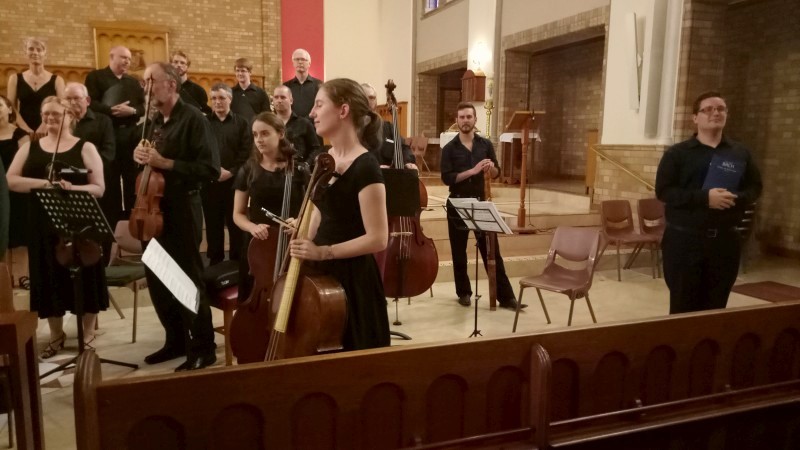
It's Good Friday and thanks to a request from the venue, there is no applause after these Holy Week concerts.  Absolutely apt, although the music was delicious.  This was a larger order than the Lamentations: SATB vocals with 6 instruments, although we only heard 5 given absence due to sickness.  The composer was Christoph Graupner, prolific and a contemporary of JS Bach.  Apparently, his cantatas (1,400+) are well preserved and his reputation has grown through recent decades.  We heard "Where is Jesus going?" (GWV1119/39) on Christ's departure and faith and trust in divine guidance, and "We know that tribulation brings patience" (GWV1121/44) on suffering as a pathway to spiritual endurance, character and hope.  I quote from the program, of course, given the German was not obvious to my ears.  But lovely four part singing, occasional solos from all parts, enticing counterpoint and harmony and effective interplay of vocals and instrumental parts.  The instruments were two violins, viola, bass and harpsichord.  The missing instrument was cello, which certainly would have added  considerable embellishments in the mid-range, but the solo bass took on a clear, effective presence which also responded with and to vocals.  Fascinating to the ears of this bassist.  Then the quiet and pleasure after the two cantatas and perhaps some dissonance with the Easter story.  Thus is history and modernity.

Singers Greta Claringbould (soprano), Maartje Sevenster (alto), Will Millard (tenor) and Andrew Fysh (bass) performed two Graupner cantatas at Wesley with accompaniment from John Ma and Lauren Davis (violins), Brad Tham (viola), Isabella Brown (bass) and Marie Searles (harpsichord).

19 January 2026

CIV26

The mysterious title refers to the 72nd Intervarsity Choral Festival held in Canberra over the last week or so.  Shilong put out a call for orchestral players to play with the choristers for the final concert in mid-January to end the 2 week festival.  Given the main work was Brahms German Requiem, I was a ring-in.  It was all brought together over those 2 weeks with the final concert of ~150 in Llewellyn on Saturday, no doubt preceding a celebratory pub party thereafter.  Thus is the way of intervarsity events, at least from what I remember.  It was a long program.  The main work was the German requiem under Olivia with Andrew Fysh and Evangeline Osborne soloing; delicate and desperate and driving over 7 movements totalling ~1 hour.  What a thrill to revisit this work in the luxurious surroundings of Llewellyn Hall.  Then a second half with Phantom of the opera, Slavonic dances, Sabre dance and Brahms again with his playful but still challenging Academic Festival Overture, all under Shilong, and a final work, Everything sings, with the choir and Anthony Smith accompanying.  The first week was only 2 calls for strings while the second was busy with 1 for orchestra, 3 for orch & choir and the final concert.  But the thrill of Brahms stays and this was memorable and concentrated and interestingly with an orchestra thrown together from several local ensembles.  And to top it off, we were recorded by an engineer with 40 professional releases to his name.  Looking forward to hearing that.  A worthy performance of several great works.

Vita et Mors was the final concert of the Canberra Intervarsity Choral Festival 2026 (CIV26).  Shilong Ye and Olivia Swift (conductors) various led the choir and festival orchestra through Brahms x2, Lloyd Webber, Dvorak, Khachaturian and a final song by TC Takach accompanied by Anthony Smith (piano).  Soloists for the Brahms German Requiem were  Andrew Fysh and Evangeline Osborne (vocals).

14 November 2025

Inventiveness

I had the inside goss as tenor Jack Jordan was staying with us for a few days to prepare and perform the first Living Collection session at the National Library, this one for the music of Aussie/Brit composer Luke Styles.  Luke was in house for the event; it was his archive that had been accessioned into the collection of the NLA and we were here to hear of it and to sample some of his music.  The event opened with a children's choir in the Library foyer, then a move to the NLA Theatre and several further performances and discussions.  Marie-Louise Ayres, NLA DG, opened the session.  We saw images of hand-written manuscripts on screen.  We heard discussion back and forth between Luke and Toby on Luke's history at Glyndebourne, the Foundling Museum, Covent Garden and more; his donation, his music and how he thinks on creation and composition; his first instruments (flute> e-bass>double bass); the joy both Luke and Tobias have in working on music with kids; the importance and implications of vocals; Shakespearean sonnets and the work we were to hear, Vanity, setting Sonnets 2,18,137,138.  The music in the theatre was some young-themed songs from the children's choir (out of Vocal Fry and Canberra Children's Choir) under Tobias, vln/vla duo and vln solo (Slogan 1 and Bound) from Brad and Pippa, and those 4 sonnets (Vanity) from Canberra Singers, tenor Jack and bass Andrew with accompaniment from violin Brad with Tobias conducting.  The youth pieces were amusing and playful and not at all rollovers.  The other pieces were hugely challenging to learn, to hear, to understand, at least at first hearing, but fascinating for a prepared, informed audience.  Suffice to say, part of the event was playfully child-centred and influenced, part was a difficult adult listen and a demanding performance, part was a fascinating discussion around this significant addition to the NLA collection.  And you can see all this: it was streamed live and is on YouTube with the title "Living collection: The music of Luke Styles".

Luke Styles (composer) and Tobias Cole discussed Luke's donation and history. Tobias Cole (conductor) led several groups in performance of some music of Luke Styles.  Performers were Canberra Children's Choir, Vocal Fry (choir), Kimberley Steele (piano), Canberra Singers (choir), Brad Tham (violin), Pippa Newmann (viola), Jack Jordan (tenor) and Andrew Fysh (bass).

  • Living collection : The music of Luke Styles
  • 26 May 2025

    Time travels

    I do wonder how many towns the size of Canberra are supplied with musicians like this town.  Concerts just seem to roll in, frequently, during the week or conflict over the weekend.  And so I managed to fit a Canberra Bach Ensemble sets of four oratorios into the Saturday evening between a final rehearsal and a Maruki concert.  More on that next.  But it's busy.  And CBE concerts are not lightweight.  Four cantatas featuring ~50 performers comprising choir and soloists and period instrumentalists, some visiting from Melbourne or Sydney for the event, but mostly local.  That's 2 hours of performance with an interval in the middle.  Not shirking.  And each cantata preceded by a presumably related motet by another composer, all cantatas for the Jubilate Sunday, once the Third Sunday after Easter.  True to form, the baroque instruments were wooden and detuned and of considerable interest and some rarity or at least uncommonness.  We got a long necked Theorbo from violinist Shaun Ng, a sixth flute (essentially a descant recorder in D) that had been borrowed by Robyn Mellor from Melbourne, oboes d'amore and baroque bassoons and the like.  And plenty of gut for the tone.  The choir sounded glorious, the vocal soloists informed and clear, the whole a glorious and generous indulgence in the period and quite a learning proposition.  Thanks once again to Andrew and CBE.

    Canberra Bach Ensemble performed under Andrew Koll (director) with Stephen Freeman (concertmaster), Greta Claringbould (soprano), Maartje Sevenster (alto), Timothy Reynolds (tenor) and Andrew Fysh (bass).

    19 April 2025

    Contemplating the body

    These days of modernity and medicines we protected from so much, but Easter remains a brutal story from ancient/mediaeval history.  I felt this with a jazz gig on Good Friday evening but primarily with a concert for Holy Week at Wesley in the afternoon.  The music was Buxtehude Membra Jesu Nostri, a great powerful work of early baroque (I guess) with five voices and accompaniment with a theme of Christ on the Cross expressed in 7 short movements totalling ~60 minutes: ad pedes; ad manus; ad genua; ad latus; ad pectus; ad cor; ad faciem.  That is, an immersion in the horrors of crucifixion, specifically this one: contemplations on the feet, knees, hands, sides, breast, heart and face.  Not at all modern, but powerful, not least in Latin.  Each movement started and ended with a SSATB "concerto" then arias by various individual voices or parts.  Accompaniment was mainly violin, viola, cello, harpsichord, but for some time, adding organ and viola da gamba 1,2.  All period instruments.  And this was a stunning experience, so well sung by several of our local luminaries, and similarly accompanied.  Just a work of power and beauty seldom experienced.  Stunning.

    Buxtehude Membra Jesu nostri was performed at Wesley Church on Good Friday.  Performers were Greta Claringbould and Jade McFaul (sopranos), Maartje Sevenster (alto), Dan Walker (tenor), Andrew Fysh (bass), John Ma (violin), Lauren Davis (viola), Clara Teniswood (cello), Rachel Walker and Caroline Downer (violas da gamba), Marie Searles (harpsichord) and Ariana Odermatt (organ).

    23 February 2025

    A matter of will

    I hadn't realised the extent of Andrew Koll's programming until after this latest Canberra Bach Ensemble concert at St Christopher's.  We chatted after and he told us of the theme, the will of God.  I had been amused by a translated line, Lord, as you will! (Herr, wie du willt!, apparently by extension, the Mind of God) but it's a clear statement of religious trust and faith especially of the time and place.  These cantatas covered this issue, mostly be being written for the same weekend of the religious year (third Sunday after Epiphany on consecutive years 1724,1725,1726), other than one written a week later (Septuagesima 1725).  I guess I could have read the program.  But from the start, I just closed my eyes to experience the rolling harmonies in repeated lyrical lines, through the various voices, all clear and precise and deeply beautiful.  The start was a quote from St John Passion on the same topic, God's will, presented as choir without backing, leading into BWV 111, then BWV 92, then an interval and BWV 73 and BWV 72.  Throughout this was openings and closings of choruses with arias and recitatives within variously from soprano, alto, tenor and bass.  It's a formula that's repeated in this these cantatas, once written each week for Leipzig churches.  To conceive of the intensity of this work, a cantata a week, is overwhelming but Bach did it and we have the pleasure of it.  The choir was 36 through SATB and the accompaniment was 16 between strings, winds and continuo.  There was a segment with two solo violins and Andrew highlighted that it was similar to Bach's double violin concerto and that's just indicative of his sharing themes in the whirlwinds of producing all this music.  And there were segments of quick, non-stop cello from Clara and delightfully precisely articulated and fast contrabass (not really a violone) that floored me.  I had my eyes closed for the baroque horn but heard baroque oboe and bassoons often enough.  But these are just things noticed amongst a night of glorious Bach religious cantatas played and sung with real love and considerable understanding.  A great, great pleasure.

    Andrew Koll (musical director, conductor) led the Canberra Bach Ensemble at St Christopher's Cathedral in a choral excerpt from St John Passion and BWVs 111,92,73,72 on the Will of God.  Key performers were Stephen Freeman (Orchestra Leader), Greta Claringbould (soprano), Maartje Sevenster (alto), Timothy Reynolds (tenor) and Andrew Fysh (bass) and some favourite bottom-enders of mine, Clara Teniswood (cello) and  Kyle Ramsay0Daniel (bass).

    26 November 2024

    A shorter vigil

    It should be heard in an all-night vigil while standing.  We were luckier than that.  This was Rachmaninov All-night vigil, loosely called Vespers from the main part of the work.  Actually Vespers makes up movements 1-6 of 15 with Matins 7-11, Lauds 12 and Prime 13-15 and this whole would be heard in the traditional Orthodox service from sunset finishing in the morning of the next day.  Oriana Chorale learnt and sang the Russian text a capella in the ANZAC Memorial Chapel at Duntroon, no less, under Dan Walker with soloists Maartje Seventer, Andrei Laptev and Andrew Fysh.   It was a different thing.  I had just heard complex modern harmonies with Kompactus.  This was much denser and darker, partly from the larger choir, but I guess also from many parts.  It's also SATB but each section can be split into 2 or 3 parts through the work.  It's heavier, more serious perhaps, certainly more religious.  Sometimes an introductory solo to start a movement (what is this called?) or a quiet vocal tone after a tuning fork to a skull.  After hearing this and Kompactus in one week, I remain in awe of our local choral scene.

    Oriana Chorale performed Rachmaninov All-night vigil at the Anzac Memorial Chapel at Duntroon under Dan Walker (musical director) with soloists Maartje Sevenster (alto), Andrei Laptev (tenor) and Andrew Fysh (bass).

    08 October 2024

    Ridiculous, sublime, whatever

    So, my second musical outing after Japan and following SoundOut was Canberra Bach Ensemble.  How can you not love Bach?  He's so much a great love of our era and his cantatas are big choral works which inevitably thrill and his counterpoint is sublime.  This was CBE's triumphant return concert after performing in Leipzig, Bach's most famous home, for this year's Leipzig Bach Festival.  It must have been thrilling for those who attended.  I know they picked up bass and keys there and maybe others.  These are not instruments to easily travel with.  But then this is the home of Bach and also apparently the oldest orchestra, from the Gewandhaus, and plenty of players who play Bach cantatas regularly, so no particular problem.  This concert was back to Canberra brick rather than German stone but the thrill was still there.  Four cantatas over two hours of performance.  I can enjoy the interludes, the recitatives and arias, the singers with solo or small accompaniments, but nothing does it for me like the choruses, with blaring period trumpets and blurting oboes da caccia and driving gut bass playing with oddly grouped lines that double up unexpectedly and carry on releantlessly.  Thrilling and exultant.  Loved this one as all!

    Canberra Bach Ensemble performed BWV119,148,192,137 and an encore of a wedding cantata BWV195 at St Christopher's, Manuka, under Andrew Koll (director).  Singers were Greta Claringbould (soprano), Maartje Sevenster (alto), Timothy Reynolds (tenor) and Andrew Fysh (bass).  Stephen Freeman (violin) led the orchestra and Kyle Ramsey-Daniel (bass) performed on Dave's gut 5-stringer.

    17 March 2024

    Calm and storm

    It's coming close to Canberra Bach Ensemble attending the Leipzig Bach Festival mid-year.  But this is Easter so a Bach passion was in store, this time St John.  But the program referenced Leipzig and advised that the CBE program will be three cantatas, BWV 9,107, 178 and interestingly that they were assigned.  I checked with Andrew afterwards and, yes, they are assigned, partly for some consistency in performances at any one festival.  I also asked who was going.  About 50-75% of the group will be attending and the others will be replaced by local players.  Given the Gevanthaus and students, that should be easy enough.  So again St John Passion, again the glorious big choral sounds and the pensive recitatives and the varied solo voices and the period instrumentation.  Also again the infectious opening that keeps reappearing thoughout.  Dave was on bass and playing beautifully on a 5-string gut strung instrument.  I noted the twisty lines and odd intervals and unexpected harmonies and sometimes followed the bass line on IMSLP and I think I found the opening theme recurring through all manner of rhythms and accompaniments, not just in the obvious recurrences in obvious form.  If I am right, it just extremely extends my understanding of Bach and his brilliance, to pass through these quite unexpected harmonic movements and to hide them throughout in all manner of forms.  Am I right?  Dunno yet but I am intrigued.  As for voices, I must highlight the Evangelist, Richard Butler, who had the most wonderfully expressed, wide ranging voice for some complex lines.  Just a stunner.  And maybe mention the lute which I don't remember hearing in Bach before but here it was (literally) central.  But again this was a huge and successful endeavour by a large group of capable musicians and singers.  And very sensible of them to stage a long interval just when Canberra's recovered Skyfire to  light the local sky and add to the noise of Canberra Ave just outside St Christopher's.

    The Canberra Bach Ensemble presented Bach St John Passion BWV245 at St Christopher's Manuka.  Key performers were Andrew Koll (MD, conductor), Bianca Porcheddu (concertmaster), Richard Butler (Evangelist), Sitiveni Talei (Jesus), Grata Claringbould (soprano), Maartje Sevenster (alto), Christopher Warren (tenor) and Andrew Fysh (bass).  David Flynn (bass) held up the bottom end.

    06 December 2023

    Back to Bach

    My little wedding gig meant I was late for Canberra Bach Ensemble with their latest string of Advent cantatas.  It's obviously a nostalgic return for me to the cantatas at home in Leipzig and this group will be playing at next year's BachFest so it's virtually the same thing.  I just caught the second half and some lovely song, notably several appearances from a visiting Sydney tenor Thomas Hallworth and a duet from Greta and Maartje and some bass recitative from Andrew as well as a few features from Bianca and friends in the instrumental  section and a feature on the curved oboe da caccia.  And always Dave's very unrelenting bass part played on a gut 5-string with baroque bow.  Also noteworthy and parallelling the common role of organ in Leipzig was the final, thundering organ piece to finish the show, played by James Porteous on an instrument sequestered in the adjacent chapel.  I was not the only one looking for the source of that sometimes big sound.  Organ had a prominent role in the cantata services that I saw in Leipzig so it fitted wonderfully.  I was taken, too, but the voluminous strength of the SATB chorales when they took flight.   Loud and boisterous and not at all delicate, even if perfectly correctly performed.   This felt to me like the visiting Australian cousins with their outspoken ways, and it worked a powerful treat.  So I caught some, not all, and enjoyed it and look forward to our Canberra presence next year in Bach's town.

    Canberra Bach Ensemble performed advent cantatas (BWV61,62,36,1) at St Christopher's Cathedral in Manuka.  CBE was directed by Andrew Koll (conductor) with Bianca Porcheddu (violin) as concert master and solo singers Greta Claringbould (soprano), Maartje Sevenster (alto), Thomas Hallworth (tenor) and Andrew Fysh (bass).

    04 September 2023

    Early prep for Thomaskirche

    I rushed off from one practice (Mendelssohn, Bruch, Tchaikovsky) to feed the dogs and then assist Tim to set up his recording of Canberra Bach Ensemble in St Christopher's.  It was quite a change of scene and musics.  CBE was playing three cantatas and a mass by Bach and a few smaller pieces by Schein and Schutz who had influenced JS.  So this was gut string intimacy and choral exuberance and vocal passion with early, even curved winds of all styles.  Something period and truly lovely.  I watched the various instruments and the frequent soloists and the milling of the choir entering and leaving for not too many choral movements.  The inherent sound of Bach was evident against Schein and Schutz, but they were worthy none-the-less and indicative of musics of the time, I guess.  There was not a lot of patter.  Andrew writes generous notes for his programs but remains fairly quiet on stage.  I particularly watched Dave on bass, as I am wont to do, and mostly it was easy reading other than a few quick and unrelenting and richly varied passages.  I could appreciate his concentration there.  So CBE is on track once again to visit Leipzig and its Bach Festival next June 2024.  Covid prevented the last expedition.  Let's hope they make it this time.  And good on them.  So wonderful to hear Bach with authenticity, and it can only grow in Bach's own venue, Thomaskirche.

    Canberra Bach Ensemble performed at St Christopher's, Manuka.  Andrew Koll (musical director) led a choir of 25 and an orchestra of 18 with concertmaster Bianca Porcheddu (violin) and vocal soloists Greta Claringbould (soprano), Maartje Sevenster (alto), Richard Butler (tenor) and Andrew Fysh (bass).

    21 April 2023

    Bach back

    Great to see Bach back again.  Our local Canberra Bach Ensemble had a fairly short concert to reemerge after Covid and to start preparing for BachFest in Leipzig, now in 2024.  CBE is the first Australian group to be invited to BachFest.  We luxuriated in these great sounds, these fabulous baroque fugues and songs and instrumentals at that reduced pitch.  The orchestra was a bit smaller than previous outings, with 2 x violin, 2 x viola, 1 x cello, organ, 1 x flute and 2 x recorders although much was reduced to single seats and even just organ and cello for some pieces.  Bianca did a great job, but perhaps Clara was the defining instrument for the night, as the bass end (here cello) tends to be.  And she played for every piece, along with Anthony.  The choir could be blissful, especially in the Schutz with just organ and cello accompaniment, with the vocals were so, so clear and insistent.  The sopranos rang and soared and I was on the side of the stage with the tenors and basses and I heard them so clearly in their interplay.  The night started with a larger choral work with orchestral accompaniment, then through a series of arias variously for soprano, alto and/or bass, then a final three works by Bach antecedents, Heinrich Schutz and Andreas Hammerschmidt.  Then a drinks and nibbles in the local hall.  This was a fund-raiser and well attended and the musicians played for nix so not a full bore concert of cantatas.  Looking forward to the bigger outings in due course.  Bring it on!

    Andrew Koll (conductor) directed the Canberra Bach Ensemble at St Christopher's in Manuka.  Instrumentalists were Bianca Porcheddu and Lauren Davis (violins), Lucy Carrigy-Ryan, John Ma and Elizabeth Chalker (violas), Clara Teniswood (cello), Anthony Smith (organ), Jennifer Bryan (flauto traverso), Robyn Mellor and Olivia Gossip (recorders).  Vocal soloists were Greta Claringbould (soprano), Maarte Seventer (alto) and Andrew Fysh (bass).  The choir was 24 (including Greta, Marrte and Andrew) comprising 6 for each SATB part.

    12 December 2021

    Of a martyred Roman and her slave

    I've known Mike for quite a few years and it seems his compositional daring and chops just keep expanding so even though I was overwhelmed to think a mate had written an oratorio, I was not really surprised.   And I've heard his music.  The jazz is melodic with nice chords and satisfyingly witty lyrics.  Then his classical.  He put out a few albums of classical in the style of the greats, Mozart and Bach and the rest.  I first heard workings at our digs for a Moruya Jazz Fest.  Then I played in the NCO behind his piano concerto.  Now this.  An oratorio.  Think Messiah and the like.  Big works of song and choir and orchestration.  They presented religious themes at times when secular themes were not acceptable or suitable for performance in church.  It's a big work.  I was impressed by Mike, again.  It's big and costly to stage, so Mike presented a few public iterations of a video of the recording sessions.  21 or so players, from CSO and Coro and the cream of local vocal soloists; 9 hours recording over 3 days at Canberra Girls Grammar School concert hall, acoustically treated if still with some residual noise issues; 35-or-so mics.  And a religious story, of saints and martyrs from ~200CE, the Roman noblewoman Perpetua and Felicity, perhaps her servant, and several other free men martyred for their Christian faith.  Mike used her first person narrative, some Biblical quotes and some Latin from Ambrose for the text.  The music was variously influenced: Mike suggested baroque and early music and film music (he has also composed for several films).  I melted with the first introductory piece with a theme that recurs to end and sometimes during.  I was enamoured by the vocals, the clear soprano of Emma Griffiths as Perpetua, but her soloist offsiders were similarly impressive, Veronica Thwaites-Brown and Dan Walker and Andrew Fysh.  All hyper-known names in this field in Canberra.  They were chorally accompanied on some tunes by Coro, a blissful vocal collection of harmonists, and instrumentally supported by a string of CSO and related Canberra players.  Bassist Kyle was in line of sight with Emma/Perpetua so I got so watch him often, but there were lots of familiar faces to observe.  Suffice to say the music and singing really was of wonderful quality and often-enough spine tingling.  The whole work is one CD length, ~1 hour, 24 pieces.  Some were short and sweet, a father's imploring or a mother's lamenting or a martyr's injuries or a dream of Heaven and angels or a maid's protection given birth.  Interestingly, there are two key women and both have children here: Perpetua is 22 and breast feeding and miraculously loses her milk prior to her death and Felicity is with child, then gives birth, thus avoiding some form of death or other.  This is a story from 203CE Roman Empire in Carthage, of course, so we can observe how some things change and some things are forever the same.  The core martydom for emperor story may be of another world (although a speaker before the presentation would deny this) but the humanity of belief, family, conscience is common.  Mike has written a fabulous musical work and, as always, done it with love and purpose.  I am hugely impressed and often touched.

    Mike Dooley (composer) presented his new oratorio called Perpetua as a video presentation of the recording session.  The performers were Emma Griffiths (soprano), Veronica Thwaites-Brown (mezzo), Dan Walker (tenor), Andrew Fysh (bass), Coro (choir) and members of Canberra Symphony Orchestra and others.

    25 July 2021

    Chasing

    It's been a long road to my Brahms German Requiem.  I missed recording it here in Canberra years back, then heard it days later in Amsterdam, at the Concertgebeouw, no less, under Mariss Jansons, sitting in the back row and entering very informally with the choir, then heard it in English as an Australian Requiem at CIMF2014.  But I finally got to play it.  Despite Lenny's video intros and the rehearsals, I still feel it's a mystery, strangely complex.  But it was a huge pleasure to play at Llewellyn with the Canberra Choral Society and a total of 100+ performers on stage.  There are passages to die for, deeply satisfying, exultant or depairing.  For bass, it's mostly the odd mingling of passages that I find in Brahms. He's nothing like the cerebral order of Bach, or playful neatness of Mozart and still beyond Beethoven.  Not beyond as better, just different.  I had to sit out one movement at rehearsal on the Llewellyn stage and it was such a thing of beauty and profundity.  I expected it, but when playing you are a bit focussed on your part, even though aware of others.  Just to listen was a delight.  So, now it's done.  On stage with Lenny leading, although given Covid/Sydney, he could only rehearse the last week.  Otherwise, Louis Sharpe and Lizzy Collier took sessions for the orchestra alone.  The soloists also were Covid affected, so the Sydney-based advertised singers were replaced by locals Rachel and Andrew.  Regardless, it's a thing of wonder, even if still of mystery.  But I guess that's how a requiem should remain.  Nice, too, to play with a member of the SSO who sat in for the day.  Congrats to the many all.

    National Capital Orchestra performed Brahms German Requiem with the Canberra Choral Society at Llewellyn Hall.  Leonard Weiss (director) conducted.  Dan Walker (chorus master) sang with the choir.  Soloists were Rachel Mink (soprano) and Andrew Fysh (bass-baritone).  The bass section (see pic) comprised Geoff Prime, Troy Davey and Eric Pozza (basses).

    • Thanks to Kat for the post-concert sectional pic with Lenny


    13 October 2019

    Elation


    Elation is an apt response to a Bach cantata in full flight so no surprise that I felt it at St Christopher's with Andrew Koll's Canberra Bach Ensemble. Andrew's been running these performances for a few years, each time with a chamber orchestra (23) and a decent choir (32) and some solo singers (4). This time it was Bach Magnificat and Meine Seelerhebt den Herren and Tonet ihr Pauken, Erschallet Trompeten. I know at least some of the last as a favourite, Christmas Oratorio. Bach repurposed this one. The works start and end with, and perhaps feature in the middle, a choral work of volume and exultation. In between, the soloists sing of Mary or Maria or other as the theme states. There was one solo organ passage with hidden organist that had the performers looking at a loss, but otherwise, it's an impressive sight. 50+ performers playing works of elation and depth and busy, sequenced familiarity. Bach is familiar to the modern ear even if one work isn't. The instruments are all baroque (so bassist Dave was on a 5-string with gut and baroque bow) and they got workouts. I heard the busy-ness for Dave and frequently cellist Clara so was not surprised to see Dave's part, but it was forboding none-the-less. And endless stream of a moving pattern, crochet-2 quavers, over the page with Da Capo to mark an end of sorts. They did great jobs with considerable concentration. The whole group sounded great, if just a little washed out in the reverberant environment. The winds were from Australian Baroque Brass with their odd trumpets and troms; the choir was lovely, nicely strong with preponderant sopranos; the featured soloists take a great load and did it with panache and I remember a particularly fascinating piece for massed females, three in concurrent, contrapuntal song; the orchestra just sat and spelt out the support with ease and sometimes features, several times from Aaron on Oboe d'amore; the continuo was delightful from Ariana; the leadership was joyful from Bianca, although I don't remember any solos. Too bad. I'd like to have heard her featuring again. The group is booked for the Bach Festival in Leipzig in June next year, so it's not just me who recognises they are doing something right. Just lovely.

    The Canberra Bach Ensemble performed at St Christopher's, Manuka. Andrew Koll (musical director, conductor) convenes the group. The Australian Baroque Brass under John Foster (trumpet) assisted. Vocal soloists were Greta Claringbould and Karen Dalzell (sopranos), Maartje Sevenster (alto), Richard Butler (tenor) and Andrew Fysh (bass). Bianca Porcheddu (violin) was concertmaster, Ariana Odermatt (continuo) accompanied, Aaron Reichelt (oboe d'amore) soloed and some mates, Clara Teniswood (cello) and Dave Flynn (bass) worked hard down the bottom end.

    27 March 2018

    A blessed Easter 1


    This is a blessed Easter in Canberra: we can hear both Bach Passions. The first was a grand affair, St Matthew Passion at St Christopher's at Manuka with 31 musicians in two orchestras and ~140 singers from two choirs. The musicians were from Canberra Symphony Orchestra and the like with BJ Gilby and Pip Thompson as the two orchestra leaders. The choirs were Canberra Choral Society and Australis Voices (one of the Woden Valley Youth Choir family). The whole was conducted by Andrew Koll of local Canberra Bach Ensemble fame with solo vocalists Robert Macfarlane, Jeremy Tatchell, Greta Claringbould, Maartje Sevenster, Christopher Roach and Andrew Fysh and a series of choir members playing smaller parts (identified when in character with a coloured scarf). St Matthew's is big regardless, but this was unabridged, totalling 78 movements, variously chorales or recitative or aria, in two parts with an interval. 3.5 hours in the original German. There was a script and translation projected but it wasn't always easy to read. Impressive and demanding, even for audience. But the time went. I loved the returning choruses, the voices were sometimes startling, always reverent, relevant. The Evangelist holds it together by telling the story, but what a job. Robert McFarlane was hugely impressive in this role. It's a story we know well enough, although spread over 3 hours there were features and references that I didn't know so well, so educational too. Other than the basses on stools or Pip or Barbara who occasionally stood, or a peak at the solo Viola da gamba down the aisle, I could see little. But then I mostly watch the bassists anyway. They were Kyle Daniel and Isabella Brown, both of CSO. Mostly it was delicious Bach contrapuntal fare but just once I was aghast, well into the first part with reference to Hell. It was bass hell: a very long fretful passage of semiquavers. But they pulled it off. Otherwise, I noticed how cleverly Bach expressed the plot or theme of a chorus in his writing. Somewhere in the second part I realised how effective it was then I heard it ongoing. And that haunting chorus that recurs, sung by both choirs (is it Wir setzen uns mit Tranen nieder or part thereof?) that just has your skin squirming with its simple beauteous melody and deep intimacy. Just a stunner. A fabulously successful outing for this work of great genius. Congratulations to all. Now for Bach's other survived passion on Good Friday...

    JS Bach St Matthew Passion was performed at St Christopher's Manuka Canberra Choral Society and Australis Voices, two orchestras led by Pip Thompson and BJ Gilby with solo voices Robert Macfarlane (Evangelist), Jeremy Tatchell (Jesus), Greta Claringbould (soprano), Maartje Sevenster (alto), Christopher Roach (tenor) and Andrew Fysh (bass) under Andrew Koll (conductor).

    17 December 2017

    Mary and more


    We caught L'Enfance du Christ at Wesley, performed by the Llewellyn Choir. It's one of Megan's favourites, although she knows it in the original French. This was in English. I could understand some more, of course, but it's never easy to catch lyrics. Reading some, I'm not sure it mattered. What I read was a strangely domestic thing, just a passage of St Matthew's gospel, in Berlioz's own words, in three parts, telling of Herod's and his massacre of the innocents and the flight into Egypt by Mary and Joseph with the baby Jesus and the arrival at Sais. It lasted a little over 90 minutes, with a shorter middle section, apparently written first and expanded for the final work, comprising the most famous tune, the Shepherd's farewell. In addition to the large choir of 80 SATB singers, conductor Rowan Harvey-Martin led five singers (one woman as Mary and four men) and the Llewellyn Sinfonia of 19, mostly made up of CSO players. The work was very attractive and admirably performed so the time went easily and we were treated to three final carols for Christmas, including Silent night where our sing-along was invited. So, a lovely work that I'm very glad I caught, well presented in an intimate venue. Even from the back, we could see enough to be involved even if the choir was offside in the stalls for some of the time. Wonderful.

    The Llewellyn Choir and Sinfonia performed L'Enfance du Christ at Welsey under Rowan Harvey-Martin (conductor) with soloists Rebecca Collins, Rohan Thatcher, Andrew Fysh, Michael Wilson and Michael Martin (vocals).

    09 February 2017

    A=440>415

    The Canberra Bach Ensemble returned with a program of Nunc dimittis cantatas. I had to read the informative program and a little more to understand the history of all these, of the Canticle of Simeon (Nunc dimittis) and the Feast of the purification of the Blessed Virgin Mary (Candlemass) and Martin Luther's reworking of Nunc dimittis as Mit Fried und Freud ich fahr dahin (in peace and joy I despair). Suffice to say this was nothing like the joyous series of advent cantatas that made up the last CBE concert. All four cantatas were restrained cantatas and one or two seemed to have just one chorus. But this is Bach so there were memorable passages none-the-less. I particularly noticed one with pizz strings in a tenor aria. The program says this "despicts the passage of time like a ticking clock, anticipating the 'allerletzten Glockenschlag' ('very last bell-strike')". Also different is the tuning: CBE had moved from A=440 to 415, standard baroque pitch. Not all instruments were gut, but plenty were, and same with the associated baroque bows. I particularly noticed Dave's huge- but downy-sounding gut-strung bass. A pair of viole da gamba appeared for the first cantata and I was surprised how hushed they were: sounding well under the cellos who were well under the single bass. The first cantata (BWV106) was supposedly written for a funeral; the next two (BWV125&82) were written two years apart for the Purification feast (Did Mary need to be purified? Apparently so.) The final cantata (BWV95) featured those authentic period instruments, cornetto, baroque oboes and the like, and finished with a chorus. Ah, there's a touch of that exhilarating joy that Bach cantatas are known for. The singing was wonderful throughout although I especially noticed the males, not least one duet for bass and tenor. And in some ways, it was a feat of endurance, being a very hot afternoon in Canberra. So a different series of cantatas, a learning experience for those who followed the Nunc dimittis connections, a concert of transition for the CBE and, as ever, a wonderful outing.

    Canberra Bach Ensemble performed four Bach cantatas (BWV106,125,82,95) at St Christopher's, Manuka. Andrew Koll (conductor) directed, with Leanne Bear (violin, leader) and singers Keren Dalzell (soprano), Maartje Sevenster (alto), Robert Macfarlane (tenor) and Andrew Fysh (bass).

    23 November 2016

    The eternal glory of JS


    This being the run-up to Christmas, these were for Advent and again we were regaled with a generous program of four Bach cantatas. It was Andrew Koll's return with his rebirthed Canberra Bach Ensemble and it was several hours of great beauty and order and often of spine-chilling thrills. I can only hear the choral segments as a thrill, especially at the end of a cantatas, after the more subdued recitatives and arias. For when the chorus releases, all hell breaks loose. No, that's certainly the wrong metaphor, for Bach composed for the glory of God and these are clearly and transparently glorious, as well as gorgeous. I don't bother to follow the text (sung in German with an English translation). Perhaps I should. Just once I did, when soprano Emma and bass Andrew were singing to each other with quizzical smiles. I discovered he was Jesus and she was the Soul and they were pledging that their love would never part and committing to graze together amongst the roses of Heaven. Apparently, this cantata associates with a Gospel reading (Matthew 25:1-13) of virgins awaiting the arrival of the bridegroom. These are celebrating a central Christian feast, after all, and it is of a different era, even if the music doesn't sound out of place for modern ears. But I just listened. Enjoying the interplay of solo voices, the engulfing chorus parts, the structure and counterpoint of instruments with their ever-forward baroque motion. And it all sat so well. Andrew has drawn together a wonderful cast of performers so there was so little to query. I loved that double act of soprano and bass towards the end of the performance. I admired Leanne's busy violins and Dave's excellent bass part, sometimes doubled by Kristen on bassoon or Anthony on organ or Gillian and Clara on cello. I enjoyed the solo arias but especially the sparse, spacious recitatives, where story is told with minimal orchestration, just one or two instruments, continuo organ with cello or perhaps violin. And the choir of 27, occasionally featuring the tenors alone, or a soloist who walked out front for a role. They performed four cantatas, BWV 61,36,62 and 140. Someone commented that a concert of one composer is to be preferred. I'm not sure (I don't mind Beethoven with Mozart or even Glass). But this was just Bach and it was wonderful. Congrats to Andrew for a successful outing and for the renewed CBE. A great pleasure to be enveloped in several hours of such glory.

    Andrew Koll (musical director) conducted the Canberra Bach Ensemble playing four Bach advent cantatas at St Christopher's Cathedral. Leanne Bear (violin) led the orchestra. Vocal soloists were Emma Griffiths, Chloe Lankshear and Keren Dalzell (sopranos), Maartje Seventer (alto), Paul Sutton (tenor) and Andrew Fysh (bass).

    08 November 2016

    Uplifting and downcasting


    It was a small space for a decent audience and even a smaller one for SCUNA and orchestra and soloists to perform three majestic Handel Coronation anthems and Mozart Requiem. It all deserved more. The Handel is irredeemably satisfying and grand and uplifting. The Requiem is hugely intriguing as well as touching and a little confusing. The confusion is around how much is original Mozart and I've been amused to find out how many people have tried to remedy this. The original completion was by Mozart's young student Sussmeyer and that's the one we generally hear; this completion was by extant US musicologist Richard Maunder; Wikipedia lists 13 others. Maunder removes a few Sussmeyer parts and adds a rediscovered Amen fugue and makes some other changes. The added fugue was obvious enough, but the removed sections weren't. There were also changes to Lacrymosa which were obvious enough. But the overall work was similar and the early movements appeared unchanged (including to the note level for the bass line that I mostly know). So, interesting and occasionally surprising but essentially familiar. This is a big program and choir, orchestra and soloists did a good job on it if there were some little discomforts. Sometimes, this was interpretation, like when I felt the pace was a bit slow, a function of the audience's recall of a piece. There were some glorious passages in the Mozart. I especially enjoyed the two soloist extremities - soprano and bass - on this outing, and the very neat and capable bottom end of the orchestra - cellos and basses. Again, my attention coming to bear. I also particularly enjoyed the brass, which had such a role in this outing, and the timpani which seemed particularly effective and prominent in this small space. But what a great night of truly great music with the intellectual rigour that Lenny brings to his craft. Wonderful outing.

    The ANU Choral Society (SCUNA) with orchestra and soloists performed Handel and Mozart at Wesley Church under Leonard Weiss (conductor). Anthony Smith (organ) accompanied and soloists were Rachael Duncan (soprano), Janene Broere (alto), Charles Hudson (tenor) and Andrew Fysh (bass).