Showing posts with label Taglimit. Show all posts

07 February 2024

SoundOut 2024 / 5

Then the second half of Saturday session 2.  First up an interesting session perhaps led by Jim Denley.  Unlike others, this was a series of "tunes", each with a theme or approach, seemingly prepared to be led by one or other performer.  It had me wondering if this was a CD launch!  Performers were Elizabeth Jigalin, Helen Svoboda, Jean-Sebastien Mariage, Jim Denley and Laurence Pike.  Feels variously changed and were led by or centred on instruments and instrumental techniques.  Thus I noted: rippling piano with distorted guitar; pining feel with guitar and brushes; bowed guitar with bass harmonics and unison vocals; busy frantic distorted guitar and slammed piano; rubber mallet on bass with damped guitar notes; harmonics, guitar e-bow, mallets on cymbals, bowed bass, sparse piano, flute vibrato, build to finale.  Fascinating, unexpected and well received.  Next was mainly electronics with projections performed by Hannah de Feyter, Danny Wild (Lowflung), Yichen Wang and Nicci Hayes.  Hannah had a viola but mostly played effects and presumably loops in the effects chain.  Danny played a complex looking suitcase of a synth and Yichen a tiny but surprisingly powerful (and costly) Teenage Engineering OP-1 synth.  The whole was electronica, groove and metallics with some effective projections behind.  Nice.  Then the Clayton Thomas Large Ensemble.  Rules, structure and guidance were discussed in another post.  Clayton introduced it as a political action as any group activity is (interesting thought) and highlighted the horror of Gaza and related and committed the performance to this stand.  It was an intelligent, thoughtful, quite radical and informed presentation.  Much admiration for that.  Then we played.  I stood centre with basses right and left wing, behind Miro so I was particularly well placed to luxuriate in a glorious tone and subtle melody.  This moved into our community improvs with rules and ultimately to a drone from Helen, a piano solo from Novak (again a stunner) against a growing crescendo of moving all-in drone until it dwarfed the piano and Clayton signalled a stop.  The whole was ~30-minutes as these sets are.  The solos from Miro and Novak were stunning, I felt the improv segment was better in practice but still OK, the crescendo was a stunner and very loud at the end.  The audience was small but the reception was strong.  So a success.  Much enjoyed.

Performers for set 4 were Elizabeth Jigalin (piano), Helen Svoboda (bass), Jean-Sebastien Mariage (guitar), Jim Denley (winds) and Laurence Pike (drums).  For set 5 were Hannah de Feyter (viola), Danny Wild (Lowflung) (synth), Yichen Wang (synth) and Nicci Hayes (projections).  Set 6 was the Large Ensemble led by Clayton Thomas (bass) and featuring Miroslav Bukovsky (trumpet), Helen Svoboda (bass) and Novak Minojlovic (piano).

06 February 2024

SoundOut 2024 / 4

I feel more informed in this SoundOut festival and maybe understand it better.  I peruse the program and realise (I think I'm correct) that day 1 has the performers playing in their normal combinations and later session mix and match for more new combinations.  And like people who have played together for a time, you see the comfort of the known and the challenge of the new.  All interesting.  I often find I prefer the known, but I respect and the new.  Next session for me was Saturday session 2.  First up was Ellen Kirkwood, Guylaine Cosseron, Maria Moles, Mark Cauvin and Richard Johnson. This started with voice and voice remained a major lead throughout.  Guylaine is seriously expressive and capable with her voice, so numerous sounds, vowels, groans, whistles even multi-pitch harmonised, running through highs, climaxes, recoveries.  Then nice ears for harmonies from bass and sax, even with surprisingly similar solo concepts, occasional percussion then trumpet tones later on and a final note that sounded of air raid sirens.  Whoah.  Next up was Bonnie Stewart, Guillaume Gargaud, Novak Manojlovic, Rhys Butler and sit-in vocals form Tony Osborne.  An immediate start from piano and vocals, leading to guitar with even country twangs.  Then waves of intensity, sudden explosions, with perhaps percussion or gentle alto or vox in between, rolling strings from piano and damped guitar plucks through extensive solos.  Another discovery?  That this music is more about dynamics than harmony let alone melody or even rhythm.   Then Jodie Rottle, Josephine Macken, Jamie Lambert and Peter Farrer.  Opening with a bell, then more mild, meditative, pensive, flautic (is there such a word?) with flutes of various sizes from Jodie and Josephine, bell-like guitar and bowed and even some violin from Jamie and alto and percussion from Peter.

Peformers for set 1 were Ellen Kirkwood (trumpet), Guylaine Cosseron (voice), Maria Moles (drums), Mark Cauvin (bass) and Richard Johnson (tenor).  For set 2 were Bonnie Stewart (drums), Guillaume Gargaud (guitar), Novak Manojlovic (piano), Rhys Butler (alto) and Tony Osborne (vocals).  For set 3 were Jodie Rottle (flute), Josephine Macken (flute), Jamie Lambert (guitar) and Peter Farrer (alto).

12 November 2023

It rains and pours

It never rains but it pours, they say, so next day we are in Leipzig and we hear commotion and chase the source and it's a noisy stream of people with placards and chants and an opposing stream moving parallel but kept separate by police and much commotion and emotion and just a little joviality I reckon, not least for the woman I was chatting with who was explaining that this has become an annual event, first run by a group marching against masks and vaccinations at the start of Covid a few years back and now become annual with the local lefties out in response. We were somewhat amused but the cops didn't look it and I wouldn't like it to develop further but at least it's good to see a community with political concerns that will bring people out some time. Not that this was a sensible cause, but. So another little unexpected vision of this country. But this is Leipzig and people have told us it's a young city (metro population 1m [city 600K; nicknamed "Hypezig" or "The better Berlin"), ex-East Germany with a centre -eft government (Social Democrats [SPD] with Greens and Left parties (?)) but what it's really known to us for is JS Bach (but also Mendelssohn, JC&CPE Bachs, R&S Schumanns, Fabricius, Leibniz, Mayer, Wagner, Reineke, Beckman...) and we got in a first concert very soon after arrival. It was at famed Thomaskircke which is just 5 minutes walk from our stay. It was a Saturday afternoon, the church was teaming, the entrance charge was €2, this was a Lutheran service but mostly just a sermon and no applause, the performers were no less than the Thomanerchor and Gewandhausorchester and organist and soprano, alto, bass and conductor, it was called a Motette and included a grand organ piece by Mendelssohn, song by Kaminski, JC Bach, Reger, two songs the audience could sing along with (Gemeinderlieden "Zich an di Macht, de Am des Herrn" and "Dona nobis pacem") and a final JS Bach cantata (Wasa sol ich aus machen, Ephraim). The opening Mendelssohn was a big, noisy, powerful organ outing. Then a choral numbers with organ continuo accompaniment. The choir, mostly boys but with a sprinkling of girls these days, came down to stand in the aisles, perhaps to assist with the more complex Dona nobis pacem. The final JC Bach cantata was was bass aria, alto recitative and aria, soprano recitative and aria and the final choral summary all accompanied by a chamber group of historical instruments with continuo. Suffice to say the singing and playing was consistently spectacular and the choir had a different quality of voice, at least amongst the highly pitched boy voices. Just a stunner and we have another due in a hour or so as I write this. Must go...

Performing a Bach cantata and more at a Lutheran Service at Thomaskirchke were Johannes Lang (organ, continuo), Hanna Zumsande (soprano), Jolia Boehne (alto), Julian Dominique (bass), Thomanerchor Liepzig, Gewandhausorchester Leipzig comprising Henrick Hoschild (concertmaster, violin), Jan Wessely (horn), Susanna Wettemass and Thomas Hipper (oboe), David Petersen (bassoon), Nicolas Defranoux (cello), Henning Rasche (double bass) and Cornelia Osterwald (harpsichord) under Thomaskantor Andreas Reize (conductor).

24 October 2023

Bach close to home

Concert day today. First up is Bach, specifically a cantata "Ach! Ich sehe, itst, da ich zur Hochzeit gehe" (= Oh! I see now that I'm going to the wedding) BWV162. This was embedded in an Evangelical church service at a church I knew but had not seen inside. Telemann Ensemble Frankfurt were the Bach performers, but there was an organist and of course the cleric. I had never attended an Evangelical service, but I recognised plenty from my Catholic days. But we never got Bach! The Telemann Ensemble was SATB singers out front with vln1, vln2, vla, flute, clo, violone and organ/director. The cantata had most sitting out most of the time, but they came together for the chorus movement 6 to finish it all. Otherwise there were snippets of organ and three songs for the congregation to sing with organ accompaniment and a psalm (36:6-10). And a recitation of Matthew 22:1-14 (wedding feast) with accompanying sermon and communion and out. The Bach was lovely. All period instruments so soft gut tones and those four lovely voices up front, mostly individual, but coming together for the final chorus. Bach, of course, was so ingenious, irrepressible, intelligent and other adjectives. The group were a little wavering at first, but settled to comfortable and sweet for long notes and triplet-feeling 12/8 and quick recovery semiquavers throughout. Hearing Bach in Germany just seems right. So to celebrate, I had a local beer in a local, old pub just next door with wattle and daub construction but laid on beer taps and TV and even disco lights. This is how you live with history, I guess.

Telemann Ensemble Frankfurt and Andreas Kohs (organ) performed at a Cantata service at Evangelical Dreikonigskircke (Two Kings church) in Frankfurt. The Telemann Ensemble comprised Simone Schwark (soprano), Anne Bierwirth (alto), Georg Poplutz (tenor), Konstantin Paganetti (bass), Leanne Hinnicks (transerse flute), Nebuko Yamahuchi (violin 1), Kerstin Fahr (violin 2), Keiko Suginaka-Munshgesang (viola), Petra Kohs (cello), Christian Zincke (violone), and Andreas Kohs (organ, director). Pfarrer Jurgen Seidl (liturgy, sermon) led the service. The local pub next door was Zur Glocke.


20 August 2023

From NYC, the event

I'm never harsh in my writings here as I feel anyone taking on the task of jazz is committing to a demanding artistic pursuit with little obvious remuneration.  So I am not harsh with the Jazz at Lincoln Center Orchestra with Wynton Marsalis.  They presented a fabulously capable concert here in Canberra with skills of a high level and with a hint at modernity.  But I felt somewhat underwhelmed.  I can feel that way given expectations of huge names and concert halls full of people I don't see at Smiths (although some of them were there too, but not all of them) and the very thing of jazz in a concert hall also has this effect on me.  So how did I find the group?  Some very capable playing and some solos bordering on inspirational; some superbly sweet harmonies and colours in support.  We don't often see a jazz big band, and it felt more that than jazz orchestra for much of the concert, so I found it quite educative, too, in understanding the roles of the sections, the saxes and trombones and trumpets and what colours were which and how they worked together and why and how the intensity would grow from reeds to lower brass to trumpets, not to mention the lovely harmonies inherent in the sections.  Both are obvious but not something I'd too much not put my mind to before.  I was also intrigued by how often the band would be just the rhythm section and a soloist.  It's obvious when you think of it, but so glaringly obvious when on stage in front of you.   I guess it happens in orchestras, too, with unused players looking distant even uninterested, whereas (mostly) they are counting and following.  But I was taken by the glorious colours nonetheless.  I found the audio balance a bit odd at times.  I was not so sure of the mix but there were mics on each instrument and it was obviously mixed.  I could mostly identify an instrument when I thought of it but not always with the presence I expected.  And the playing?  Very nice, as you would expect.  I was amused by some solo plays between instruments and admired some more dissonant lines at times and the chops were clearly always there.  Wynton's solos were immensely capable and always lyrical.  I think my fave was one I heard from him in the rehearsal, a bit more intriguing in timing and melodic turns while still eminently tonal.  And the repertoire?  Two sets, each of 5 tunes, and one stangely muted encore.  Set 1 was Monk, Laura, a fascinating latin outing on Jelly Roll, then a ballad and a baseball theme; set 2 was Wayne Shorter for Art Blakey, Ellington/Strayhorn, nicely African feels with Man from Tanganyika from MaCoy Tyner, a very early Mingus love song with vocals (!?!: nothing like the Mingus I know and admire), an interesting modern 3/4 from trombonist Vincent Gardner; for encore, a mild blues, Ellington Blues form orbit.  I was also amused by Wynton's educative commentary, I guess introducing the jazz-unwashed into the essence of improv, chuckling while suggesting he'd missed phrases and the like (not that we noticed!), and giving some background on Jelly Roll and Art Blakey and Mingus and more.  So this was wonderfully capable, distant being in a concert hall, somewhat of an era, quite informative and classy.  Any more?  In these days of identity, I'll mention one woman amongst the men and a colour-blind mix of white and black.

The Jazz at Lincoln Center Orchestra with Wynton Marsalis performed at the new Snow Concert Hall at Canberra Grammar School.   The orchestra comprised Wynton Marsalis (host, trumpet), Obed Calvaire (drums, tambourine), Carlos Henriquez (bass), Dan Nimmer (piano), Ryan Kisor (trumpet),  Kenny Rampton (trumpet), Marcus Printup (trumpet), Chris Crenshaw (trombone), Vincent Gardner (trombone), Elliot Mason (trombone), Victor Goines (tenor sax, soprano sax, clarinet, bass clarinet), Ted Nash (alto sax, soprano sax, clarinet, flute, piccolo), Sherman Irby (alto sax, soprano sax, clarinet, flute), Nicole Glover (tenor sax, clarinet), Paul Nedzela (baritone sax, bass clarinet).

07 May 2023

3x8

This concert was called Magic Eight because each of the three pieces were by an octet, two instrumental and one choral.  Most people just drooled over the Schubert Octet, well known and long (6 movements, ~1 hour) and interesting to me as I played my first chamber concert on two movements of the piece.  So I like it and they played it with immense capability and hugely satisfying interpretation, but it was just a little unadventurous for me, standard, ordered, of that era as works usually are, but of an era that just seemed a bit tame.  But what to say?  Max McBride was playing bass and he was inspirational, 5 strings, eyes up and around, glorious soft  tone, explosive semiquaver lines.  I was amused to see the cellist smile at Max's parallel lines to his.  I mainly watched Max and the strings, and the strings seemed to lead it all, mainly from first violin.  Quatuor van Kuijk were inspirational in how they communicated although first violin tended to watch less, but I caught a big smile between the violins at one stage and they were very obviously pleased.  That was after the interval.  Just before the interval was Per Nörgard Wie ein Kind (Like a Child) by Luminescence with Roland conducting, and that was odd, using lyrics and noises from Adolf Wölfli and Rainer Maria Rilke for all manner of fascinating musics.  I enjoyed it immensely, following some strange lyrics projected above.  This was very much not your everyday baroque outing; it was obvious why a conductor was required.  Really impressive and great singing and various noise making.  But by fave was the opener, Igor Stravinsky Octet, all jumpy and playful and totally a work for winds.  I delighted in the brass, not least the high, pure trumpet tones and the interpay of flute and clarinet and the bass-y bassoons and was struck by the long breaths demanded of Zoe Pepper.  This was my fave of the night although all was a huge please for whatever reason.  Nobody I spoke to agreed with me: they all preferred the Schubert.  So be it.  Just a bit too comfy a choice for me.  And one final observation.  The Stravinsky reminded me of Fellini and the dates align, so my guess is that Nino Rota (b.1911) was greatly influenced by Stravinsky (Octet 1923).  But that's just a bit of amateur musicological investigation.

Luminescence Chamber Singers, Quatuor Van Kuijk, Sally Walker (flute), Oliver Shermacher (clarinet), Ben Hoadley and Zoey Pepper (bassoons), Fletcher Cox and Joel Walmsley (trumpets), Jackson Bankovic (trombone), Aidan Gabriels (horn), Max McBride (double bass), Paolo Franks (trombone) and Roland Peelman (conductor) variously played Stravinsky, Per Nörgard and Schubert at the Fitters Workshop.

04 May 2023

Rustic folk

Of faeries and fools was the title of this concert and I could see the reference clearly in at least 3 pieces.  The sounds were different as the musical combinations were different and to some degree as the styles were different, but the performances were consistently impressive.  The works dated from after Grimm's Fairy tales (1812) and carried on some of the influences.  First up as Schumann with a clarinet trio (Oliver Shermacher, James Wannan nad Roland Peelman on clarinet, viola and piano) just stunningly sharply played all round.  Then piano (Roland again)and two vocals (sopranos Susannah Lawergren and Anna Fraser ) for Dvorak Moravian duets.  Now this reminded me of Schubert songs and that's a strange style to my ears, dated both in musical form and lyrical themes.  The lyrics were translated to English and projected behind.  I could only chuckle at the dated love songs.  But that's that style.  The singing and piano were great though.  Perhaps better without the meanings?  Then an interval and a ridiculously funny Janacek Nursery rhymes in Czech language.  Again lyrics translated and projected and and the absurdity was a delight.  Luminescence played this with James Wannan and Ronan Apcar.  Then to finish, a much larger ensemble playing Katz-Chernin Village idiot, a work in 5/4 variously 3-2 and 2-3 and a collapse of time at the end.  This was a much larger group with a Alma Moodie string quartet and Jacques Emery on bass and others including e-pno and e-guitar and piano accordion and percussion.  So a very different , more modern and humourous take.  A great finish.

Schumann, Dvořák, Janáček and Kats-Chernin were performed at the Fitters Workshop variously by James Wannan (viola), Oliver Shermacher (clarinet), Susannah Lawergren and Anna Fraser (soprano), Roland Peelman and Ronan Apcar (pianos), Theo Carbo (electric guitar), Fletcher Cox (trumpet), Jackson Bankovic (trombone), Aidan Gabriels (horn), Veronica Bailey (percussion), Alister Price (accordion), Jacques Emery (double bass), Luminescence Chamber Choir and Alma Moodie Quartet.

06 March 2023

Mod, cool

Carnaby Street was the famous fashion street for '60s London and it was represented with a mock street sign on stage.  I was wondering about the other street sign, for Denmark Street.  I just looked it up and it turns out that it's famed for music and instruments and I actually remember visiting a bass shop there.  Small world!  The Queanbeyan Players presented Downtown! The mod musical at the Belconnen Community Theatre.   It had caught my attention months earlier for the great '60s female-sung songs that formed its core.  Downtown, of course, but others like You don't have to say you love me, Those were the days, To Sir with love, I know a place, Signs of the times, You're my world, James Bond theme, and perhaps two dozen others, not least several from Burt Bacharach, a personal songwriting hero.  The plot is five women friends and their experiences in love and the like in that era, linked with the song themes, eventually moving into the '70s and ultimately satisfied with their lives and memories.  Simple and satisfying and good natured with a fabulous sound track.  The five women appeared in colours, so Orange girl, Red, Blue, Green and Yellow.  They all read Shout magazine and variously asked advice from columnist Gwendoline Holmes, who mostly just appears as a voice over the PA.  There are 5 other women, "alternate colours", who appear on stage in black as dance accompanists and maybe cover for absences.  Yellow is an American over in London to chase Paul McCartney; Orange is married but with a cheating husband; Blue is gorgeous and wealthy and unhappy in life and love; Green is the goer; Red is young and hopeful but hopeless.  Their resolutions are stories of our times.  The instrumental music is provided by a band of drums/percussion and 2 keys.  I don't ever expect the supreme professionalism of pro-musicals but QP always do a great job and they did here.  I'd highlight some wonderful harmonies even if some high notes were a stretch at times.  Otherwise, the theatre of it was wonderfully effective.   I loved this show!  I must get to more musicals, but they are not all quite so pertinent to Megan and me.  As one cast member states at towards the end, this is the story of your wives or mothers or even grandmothers.  Too true.  BTW, this musical first appeared off-Broadway as Shout! The mod musical and is listed in Wikipedia under this title.

Downtown was presented by the Queanbayan Players at Belconnon Community Theatre.  At least this night, it featured Alaxandra McLaughlin (Orange), Kay Liddiard (Red), Emily Pogson (Blue), Hannah Lance (Green), Sarah Hull (Yellow) and Tina Meir (Gwendoline Holmes, voiceover).  Anita Davenport (director), Tara Davidson (musical director) and Laurenzy Chapman (choreographer) were backstage, and literally backstage were the band, Andre Le (keys 1), Adam Bluhm (Keys 2) and Jarrah Palenthorpe (drums, percussion).

20 November 2022

Local is international

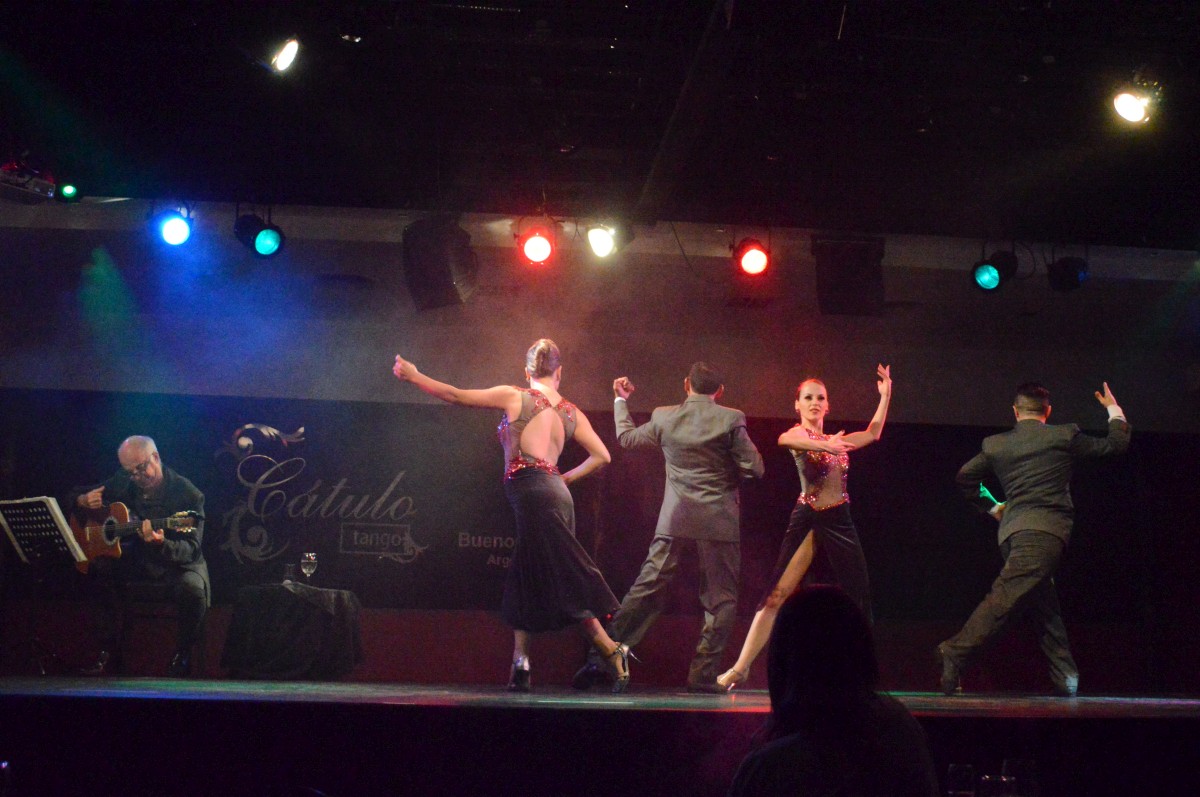
One thing I had to see was tango in BA and Mono, our bass mate, was playing just that the next day.  This was a performance venue rather than a Milonga dance-cum-school so we had a band, dancers and singers: a veritable story-telling, all singing, all dancing show.  The club was Cátulo Tango.  We were told it's a traditional venue, frequented by locals.  A decent space, plenty of set tables with red tablecloths matched by red uniforms of staff.  A big raised stage in the centre as well as a curtained band stage nearby.  We all arrived at 7pm for seats and to start the pics and eating, then show at 8 running on to 10, then again that community mingling after.  Plenty of talk which we didn't get, of course, some jokes, introductions to composers and themes.  And always that intense, intimate music.  The band was violin, guitar, bandoneon, bass with solos and moving features.  The guitar sounding sharp and acoustic like classical; the violin all phrases and rhythmically places notes and tones and squeaks and slides and taps, like the bass, rich in effects to spell the accents.  Sometimes playing as feature, sometimes backing dancers or singers.  We didn't catch the lyrics, of course, but you could feel the overt passion, as clearly also the dancers.  We think of love and sex and the themes of tango and they are there, but there are also amusements and playfulness, as in two women dancing with one man, or the simple joy of dancing of two women together or the overt sexual rivalry of two men at one time.  We'd been told this was a classy night.  The dancers (three women, two men) included three internationals, one a world champion form Holland, no less.  And again the interactions with audience to announce birthdays and to welcome a famed tango composer.  And ultimately, an end with Piazzola Libertango and all manner of community pics and chatter for the next half hour or so.   For this is something I enjoyed immensely, how everyone would congregate after, chatting, laughing, meeting, selfy-ing.  Like at our jazz the night before.  So a fascinating and unique and relevant local experience that nonetheless expressed a very international style, tango, known by many, not least the jazz scene.  But the real thing was different from the jazz interpretation that I know; more intense, more immediate, deeply sensual.  A wonderful find.  Thanks to Mono for the invitation to this one.

The tango performance was at band was at Cátulo Tango in Buenos Aires.  The band comprised Estebon Morgado (guitar), Quique Condomi (violin), Augustin Gil (bandoneon) and Mono  Hurtado (bass).  The singers were Leandro Ponte and Rosana Fontan (vocals).  The dancers were Maricel Giacomini, Katherine Laytón, Guillermina van der Linden, C Jose Carlos and Romero Vedia (Carlinho).

04 May 2022

Diversity

Well I dropped my phone and cracked its screen as I waited to enter The Great Divide, a CIMF concert at the Fitters' Workshop, but I came around in the end.  It was an intriguing mix of styles and they shouldn't really work but they did.  First up was Luminescence Chamber Singers directed by Roland Peelman singing mediaeval Spanish cantigas and Portuguese motets.  Six singers, 3 men, 3 women, occasional percussion and foot stamping, religious themes of Mary and women variously as saviours and whores, so clearly unwelcome in today's thought.  I was amused or maybe concerned with women singing this stuff, even as we realise the diverse times and thinking, this being a very earthy and religious age, but the historical denigration of woman's role was pretty obvious.  Strange and confronting to our ears and yet would have been unquestionable in those days, I guess.  Then an interval and a wine and I could forget the phone for a few minutes and I was intrigued by Jason Noble playing Steve Reich New York Counterpoint on clarinet.  I wondered how it would be accepted in this crowd, given he was plugged in, effected, multitracked, whatever.  I asked him later; if I got it right it was 8 clarinets plus two bass clarinets, all multitracked and no effects, just the rich resonances of the space.  I enjoyed that.  Then Orava playing Shostakovich String Quartet Gmaj no.6.  Again I felt some discomfort around me at the quite difficult melodies but I enjoyed it immensely.  Nicely expressed, accurately intoned, earthily bowed and intriguing as a composition ("a masterpiece of Soviet optimism post-Stalin" / CIMF concert program).  So a fascinating and satisfying concert if the lead-up was less pleasing.

The Luminiscence Chamber Singers under Roland Peelman (director), Jason Noble (clarinet) and Orava String Quartet performed at the Fitters' Workshop for the Canberra International Music Festival 2022.  Luminescence comprised AJ America, Veronica Milroy, Dan Walker, Lucien Fischer, Jack Stephens and Roberta Diamond.  Orava comprise Daniel Kowalik and David Dalseno (violins), Thomas Chawner (viola) and Karol Kowalik (cello).

04 February 2019

Out 2


It's SoundOut day 2 and I got to the evening session. Both days have been evening sessions for me. I arrived as Brigit, Millie, Pierre-Yves and Richard were about to play. The nature of this event is a mix of people who play together regularly and interactions with new others. It makes it interesting for all and is the essence of the collective nature of the event. Then into Superimpose featuring Berliners Christian and Mattias, drums and trombone. This is energy and noise with some tones and considerable chops. I was particularly impressed by Matthias with his rapid flap tonguing which served a real rhythmic purpose and Christian is clearly sharp on stick techniques. But it was my house-guests who opened new doors for me in this contemporary experimental music: Hannah on flute and Brodie on trombone. They played noise, slapped keys and dismantled instruments and smacking sounds at various times but they were virtuosic in tonal and atonal note play and it made up, perhaps, most of their performances: beautiful tones; unexpected intervals; suggestions of melody and rhythms; intriguing harmonies, implied or otherwise, tonal or otherwise. It's an area where I feel more comfortable. Hannah's appearance was firstly with piccolo playing a rapidly moving birdsong. Brodie took a busily firm control with virtuosic noteplay against Marlene's sympathetic and glorious bass clarinet tones before playing with noises and a CD mute and a return to tones. I mentioned this to Hannah and her comment: that's how we were trained. I guess others have similar training. Certainly Marlene who played bass clarinet with Brodie had a similar approach and perhaps Laura and Millie. There were times Jim played this way, too, and Pierre-Yves. I heard snippets from Clayton the day before. Tonality/atonality is powerful amongst the noise plays. It expands and beautifies, at least to my ears. I felt it in Lenny's drumming too: not tonality but relatively some standard rhythmic concepts. Then ongoing to Jim inviting Millie, Matthias and Birgit to his solo spot. I was amused to watch their discussions beforehand and the synchronising of watches. They were to pass back and forth, Jim to others, every 60sec. Then Brodie and Marlene leading into the final Collective improv. The final group improv is always a feature as this one was. Richard was particularly pleased. Then the pack ups and partying that is essential to such an event. SO2019 was another challenge for the ears but also a diversion into C20th atonality and the mix was great. It's not often we get such a gathering of experimentals in Canberra. Hopefully Richard will manage to revisit it as an 11th anniversary next year for this one was a great success.

SoundOut 2019 final day 2 was at the Drill Hall Gallery. Performers at the evening session were Superimpose featuring Christien Marien (drums) and Matthias Muller (trombone); Birgit Uhler (trumpet), Millie Watson (piano), Pierre-Yves Martel (viola da gamba), Richard Johnson (wind), Hannah Reardon-Smith (flute), Laura Altman (clarinet), Lenny Preston (drums), Rhys Butler (alto), Jim Denley (flute) with others, Brodie McAlister (trombone) and Marlene Radice (bass clarinet) and the SoundOut Collective.