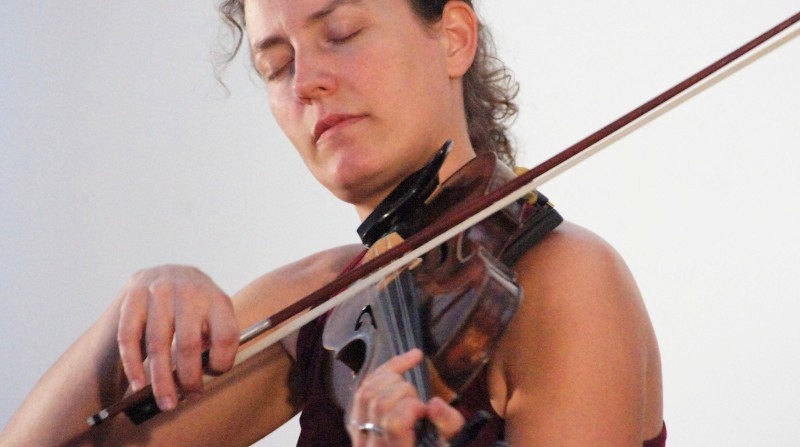
The ACO was performing Tognetti’s Mozart in Llewellyn Hall. I dread to think how the ACO audience would have taken to SoundOut, the experimental music and free jazz festival in progress just the other side of the car park in Theatre 3. SoundOut is now in its fourth year. It’s a weekend festival of experimental music and free jazz organised by local reedist Richard Johnson. And all praise to him for the effort. This thing is growing; it’s international; it’s well provided with gear in a fitting venue. And this event was being multitracked for likely ABC broadcast.
This is not music of Mozartian popularity. It’s a strange world of noise and exploration and alternative techniques and small audiences. There were about 25 performers from Australia and NZ, but also from Germany, Austria, UK, Canada and Brazil, here with the help of various embassies. It’s controversial and a thought challenge. It’s certainly unconventional, and to some degree that’s its purpose. It’s rethinking about sound, exploring and expanding the palette of noise that we call music and sometimes venturing into associated arts. There was a dancer and an experimental film performer this evening, along with an electronics performer and 20+ musicians on traditional instruments. They were not necessarily played traditionally, of course. I wonder why they bother with traditional instruments for some noise explorations (like spinning clarinet parts or timber floors or the metallic clicking of clips against saxes) but they are perfectly relevant for others (like bows on cymbals or clucking on sax mouthpieces) and, anyway, they are on stage with these instruments in their hands. There are various degrees of traditional skills, too. This is where I found my preferences. I could clearly see traditional training and harmonic awareness in the Barcode Quartet from Austria/UK. I found them my favourite outing for the night. The forthright stand by Alison Blunt was worthy of the ACO next door, and although she dabbled in alt techniques, her fingering and bowing were exemplary. So were the wonderfully expressive and tonally varied vocals of Annette Giesriegl which sounded all the way from beak clicks to Nordic languages. The piano of Elizabeth Harnick was slabs of dissonance and delicacy of directly plucked strings and thoughtful search for harmony. And the male of the group, Josef Klemmer, played these popular light sticks, laid down authentic rhythms and touched on Nintendo drums, sounding all electronic and heavy and processed. Given their basis in trad skills, they may fit more in the free jazz than experimental field, but whatever, I found these thrilling and thoughtful and authentic.
Tony Buck played drums with Magda Mayas, a German pianist. I felt similarly for Tony as he took from more traditional forms. They had some initial technical problems, but after this, the set developed strongly. I’d lent my bass to Luiz Gubeissi of the Abaetetuba Collective, and I’d heard some impressive skills when he was warming up and checking out the bass in the morning, some forceful pizz and manly bowing. I liked it when he dropped into a short segment of pizz in their set. I felt it collected the instruments, formed a groove of sorts, brought things together more. But they mostly explored the experimental field of unfettered emotional expression and prepared instruments. There were fiddles and shamisens and guitars but in this context they are removed from cultural references. It’s noise as art. I often find it valid and engrossing when I close my eyes, but it is also culturally distant to my ears.
The major work of the night was Composition for 25 artists by Jon Rose. This was interesting. A full stage of musicians, one dancer, one video artist, four pianists on two pianos, three drum kits and several other drummers, and front and centre, a screen displaying minutes and seconds. The work commenced with 1 minute of silence, then 40 minutes of sound, and the end. Each minute was guided for each player, with instructions for volume, short/long notes, chords, perforkm or not. Otherwise, players listened and melded by chosing notes of a chord, phrases and rests, crescendos and whatever. All eyes, including the audience, were on the seconds as they ticked to the minute, anticipating new sounds. Jon took part, mid-right on stage, not leading but participating. This is communal composition. I found it fascinating and satisfying and skilful, and visually interesting, with so many busy musicians, as well as dancer and video and that mesmerising clock.
This was the Saturday evening session. More to come with Sunday’s session. The musicians at SoundOut 2013 are: Adam Sussman (Guitarist /electronics [Brisbane]), Alison Blunt (violin [UK] Barcode Qrt), Alison Plevey (sound manipulation, dance [Canberra]), Andrew Fedorovitch (sax [Canberra]), Annette Giesriegl (vocals [Austria] Barcode Quartet), Antonio Panda Gianfratti (percussion, ABAETETUBA collective, [Brazil]), Elisabeth Harnik (piano [Styria/Austria] Barcode Quartet), Hermione Johnson (piano [New Zealand]), James Waples (percussion [Sydney]), Jeff Henderson (Alto & baritone sax [NZ]), John Porter (tenor sax [Canberra]), Jon Rose (violin, multi-instrumentalist ([Sydney; Berlin]), Josef Klammer (drums, electronics [Austria] Barcode Quartet), Louise Curham (experimental film, performer [Canberra]), Luiz Gubeissi (double bass, ABAETETUBA collective, [Brazil]), Luke Keenan-Brown (drums [Canberra]), Magda Mayas (piano [Germany]), Matt Earle (multi-instrumentalist, Stasis Duo - [Brisbane]), Michael Norris (electronics & feedback [Canberra]), Mike Majkowski (composer, improvisor, double bass [Australia/Berlin]), Reuben Ingalls (guitar, electronics [Canberra]), Rhys Butler (alto sax [Canberra]), Richard Johnson (wind instruments [Canberra]), Rodrigo Montoya (shamisen, guitar, ABAETETUBA collective [Brazil].), Thomas Rohrer (Brazilian fiddle, sax, ABAETETUBA collective [Brazil]), Tony Buck (drums, percussion [Berlin and Sydney]).
Cyberhalides Jazz Photos by Brian Stewart


 Next day at SoundOut, part way through the late session. First up was a quintet with Luiz and a series of locals, Chloe, Sonya, Gail and Miro on bass, toy piano and other toys, vocals, electronics and trumpet. Again, this was a meeting of musicians, an experimental jam, and it started with some hesitation, leaving space to hear each other. Until Miro spelt some melody and this was cathartic. Miro later said he's a melodist. It seems to me that trumpeters are: it seems to be a function of the instrument. But here were clear notes, spacious, with some relationship one to another. Luiz picked up on this, bowing, plucking, then alternative techniques of tapping, slapping timber and strings, reaction from Sonya, with vocalisations that filled and swelled around them, again Miro's bell-like notes. Lovely. Chloe and Gail were more subdued and ambient, encompassing this with various noises of various toys on the one hand, tapping or sliding or clacking, or using electronics to meld and twist and revisit, or to add processed voice and glass clinks and pats and thumps. Luiz Gabriel Gubeissi (bass), Miro Bukovsky (trumpet), Sonya Holywell (vocal), Chloe Hobbs (toy piano, toys) and Gail Priest (electronics) performed.