Showing posts with label Carl Dewhurst. Show all posts

03 July 2026

Guitars

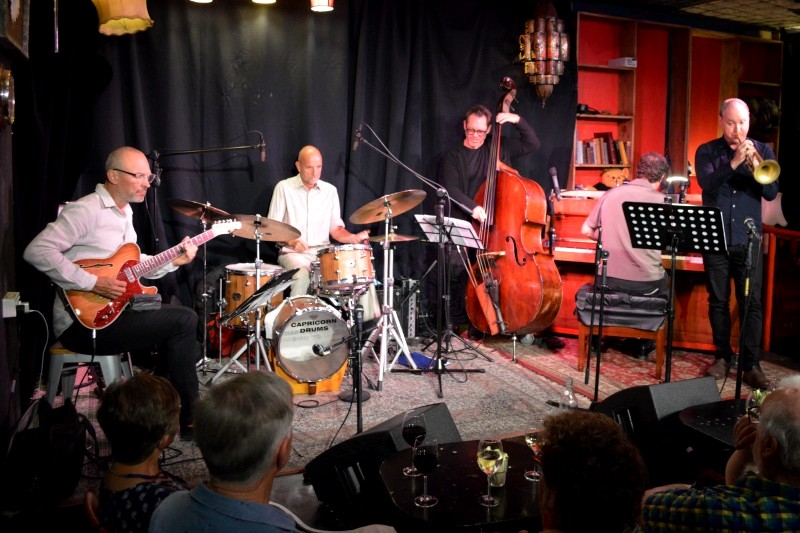
Mike Price talked of a band with two Carls, Dewhurst and Morgan, sometime in the past and I've got reports on CJ of various combinations of the 3 guitarists.  Mike was teaching and leading the jazz scool while the Carls were there, although at different times and has got together with them at various times.  It's all part of an ongoing jazz experience.  This gig was another incarnation.  Mike Price and Carl Dewhurst with James Luke and Nick McBride: a formidable combination.  The two guitarists remain diverse in presentation and approach: Mike more smooth, quick, scalar; Carl more dirty, loud, unanticipated.  The tunes were a very modern guitar bunch, from Scofield, Metheny, Stern, related sax Michael Brecker and Horace Silver Lonely woman and the uber-classic Bright size life (originally Metheny with Jaco Pastorius and Bob Moses) and a contrafact (strange word that) on The night has a thousand eyes.  To top it off, a guitar duet on Wichita Lineman: strange in this context but still a beautiful and touching tune and very fitting but different with the two guitars.  So a night of superb guitar artistry with quite different approaches, supported by top brass of the local bass and drums community.  Wonderful and 2,4 foot tapping and just a huge pleasure of many solos throughout over some testing tunes.

Mike Price Guitar summit featured Mike Price and Carl Dewhurst (guitars) with James Luke (bass) and Nick McBride (drums) at Smiths for a Geoff's jazz session.

25 May 2019

Returns


I first encountered Carl Dewhurst when he was a student at the School of Music, then at Manuka, playing around town with Cameron Undy at bars and even a plant nursery. He was impressive even then; he's mammoth now. That's getting on 30 years ago. He left Canberra in 1990, stabled mostly in Sydney, but with time in London, perhaps elsewhere. He plays all manner of musics. I've heard experimental from him in the Opera House. This night was clean and clear and fabulously inventive with the standards repertoire, like All the things or Wes Montgomery or Out of nowhere. Of course, he was with the best, Brendan and Mark, so it was a shared inventiveness. Solid swings with crystal clear and hugely varied and easy improvs; melodies that spell themselves but easily extended; chordal play with melodies interpersed; just one time that I remember as dissonant, laying back with minimal notes; plenty of accompanying solos, especially from bass but drums in there too. All easy and rich while still tonal and clear. It's a mark of knowledge and experience. Masterful. Just a huge pleasure.

Carl Dewhurst (guitar) played standards with Brendan Clarke (bass) and Mark Sutton (drums) at the National Press Club.

14 March 2019

Glory in restraint


Jonathan Zwartz was in town for Geoff Page at Smiths and the room was full with Geoff's coterie and the music was to die for. Jonathan is renowned for his writing: three albums to date, superbly written, intriguing, rich and complex, nicely grooving and touching on real social concerns. But it's not just the writing, for the band was also to die for. Was it Geoff or Jonathan who introduced them as amongst the best in Australia? Doesn't matter: they were. So unforced, relaxed, tight, never an accent out of place, every embellishment a pleasure, a fabulous bass tone (a personal interest, but relevant), excellent solos nicely merged into heads. Some amusing banter between tracks, and that's worthy, too: "Being a bass player, you always do everything with one hand. It's a ... drag" (another thing I understand) or "It's kinda that vibe ... singalong it you want". Not that there was any singing to singalong with, but the groove was light and bluesy for that last tune. And generally the styles were varied. Emily was the one swinger, played medium tempo with walking bass, and dedicated to a friend's new child. Dollar Brand was a reference to Abdullah Ibrahim using his early name as the tune was originally called Dollar and "it's kinda that vibe". Milton was a bossa for Nascimento. Julien Wilson's sound of love was in the style of Ellington/Strayhorn and genuinely sounded that way, not least for one lovely, classic repeated turnaround. The tunes were mostly from JZ's latest/third album, Animarum. Phil took most lead and solo roles and blared in classic chordally-enunciated style. Hamish was varied in style and studio-sharp in interpretation. Carl was devastating from rapid runs to blues-rich bending. John joined for the second half: he used to play with these guys in Sydney before coming to Canberra for the ANU. He can be devastating but played fairly restrained and tuneful on this night. Always fabulous, either way. Matt McMahon can take tunes and explore them with rich calculations and investigations although I found him just a little distant on that piano on that night. Jonathan is restrained but big and strong with the greatest of jazz tones and fabulous sense of time and rhythms and grooves and some glorious runs when he lets go. But he remained the overseer and fairly restrained. And the music was just that: purpose before excess; art before skills. One of the best.

Jonathan Zwartz (bass) led his band at Smiths. The band Jonathan with Phil Slater (trumpet), Matt McMahon (piano), Carl Dewhurst (guitar) and Hamish Stuart (drums) and John Mackey (tenor) joined for the second set.

13 June 2016

Suite life


A suite is a big view and not very common in jazz, but Stu Hunter does them. The migration is the third that he's composed and recorded and the first that I've heard on tour. We were lucky enough to catch the final night here in Canberra, after performances as far afield as Perth and as illustrious as the MIJF. The final night mostly has the best awareness of the music and the most delirious pleasure in playing and that's what it seemed to me this night. Not least aided by the Canberra connections, through frequent gigs or teaching or studying at our School of Music in its illustrious past. I assume there's also family here for some of them. I could only admire and wallow in the deep, often minimalist grooves, the sometimes raucous horn parts, the heavy rhythms or detailed drums or essential, busy, feathery e-bass, or Stu's directorial piano segments or Tina's blues-infested voice that stepped through lyrics in three component songs of nine tune/movements. I couldn't catch all the words and these would be essential for the theme; reading them after from the CD cover I'm still not hugely more confident in my interpretation. The migration seems a broad story of life, a "celebration, conversation, a comment and a wish ... my own life process put to music ... questions instead of answers ... movement of ideas and beliefs ... and growth and sharing of culture and ideas". That's a broad palette for the theme. The music was broad too, as well as virtuosic (although no surprise on the virtuosity given the lineup). Bass was core to the work. It started with a wah bass solo then a driving dirty bass with overlying yearning horn themes. Then a heavy groove with Afrobeat horns; a short pensive section; the theme laid out with voice on Twelve stages of freedom. Requiem for belief was a written four part horn tune (including tuba) with drums accompaniment (think Nino Rota). There was a piece outlining flowing water then a piano-heavy ballad speaking of love; an ecstatic blues/funk song with words of moonshine but themed of the joys of life lived. Finally a klezmer-like ending called Land of Gypsies, instrumental and outgoing and open to the world. Nice to see the migration was ultimately well-received by the composer. It was certainly well-received by the audience. I hugely enjoyed the grooves, head-nodding for long passages (there's a lot of music here to dance to), the horns were great, the rhythm section was wondrous, especially Cameron Undy (local origin, now Sydney), very busy on a uniquely lithe bass (short scale Fender Musicmaster with split pickup?), and Simon's insistent drumming, Tina's voice was intimately bluesy and powerful with heavy vibrato. And Julien's bass clarinet, amusingly sometimes sounding of didj, Matt's much restrained solo lines breaking into flurries, James' playful virtuosity on tuba and everything else he touches, Phil's calmly explosive precision, Carl's occasional guitar (I remember just one larger solo this night, mostly lost in the mix to my ears) that can plumb real musical depths, Declan's insistent rhythms that established more than one tune, and Stu's guidance and oversight from the piano stool and sharp solos and penetrating comping. 80 minutes that entranced and involved and passed with ease. In the wake of the like of Mingus and Carla Bley, Stu Hanter has produced his third large format compostion and it was a wonderful, engaging success.

Stu Hunter (piano, composer) led the band in performing his suite, The migration, at the Street Theatre. The band was Stu with Phil Slater (trumpet), Matt Keegan (saxes, clarinet), Julien Wilson (saxes, clarinet), James Greening (trombone, pocket trumpet, tuba), Carl Dewhurst (guitar), Cameron Undy (bass), Simon Barker (drums, percussion), Declan Kelly (percussion, drums), Tina Harrod (vocals).

03 November 2014

One Parrott

I was always confused by the Parrotts – Australians in NYC, bass or horns? Alto/baritone saxist Lisa Parrott mentioned her sister bassist Nicki and all was explained. Lisa performed with old mates at Wang, mostly reforming her band of twenty years before with Cameron Undy and Carl Dewhurst, now playing with Simon Barker. This was a pretty daunting outing. It opened with a head all heavily syncopated hits, through several energetic opening bass solos, dedications to Charlie Haden with a great rendition of Ornette’s Lonely woman which is still mulling in my head, with a little sidestepping into Pixinguinha and a tune about a soccer score (for the record, it was 1-0). I felt a strange NYC presence in Lisa’s alto playing: not all flash but conceptually consistent, sequenced, reasoned but ironic. Not sure if I’m imagining things here. Her alto was also nicely open, woody and softly toned. Baritone is more big and clumsy and Lisa played it in a more simple, bluesy style, but how beautiful was this deeper simplicity on the ballad that Lisa had written with Nicky in response to a Banjo Patterson poem, Do you think that I do not know. Her sidemen were nicely in synch. Simon considerate and detailed; Carl fluent and crisply toned; Cameron energetic and very busy on bass. It’s sometime since I’ve seen Cameron in performance and he’s as impressive as ever. This was a set of much seriousness that verged on the avant-garde and it was a pleasure to hear it.

Lisa Parrott (alto, baritone sax) led a quartet with Carl Dewhurst (guitar), Cameron Undy (bass) and Simon Barker (drums).

06 February 2014

Doyens


Jonathan Zwartz used the word to describe his band, that they were doyens of the Australian jazz scene. No doubt! This was a display of such excellence and skills. I was flabbergasted. There were time I sat back in wonder. The music was composed and structured, although not so complex. The harmonies from the front line horns may move with tiny steps, minimally. what that did at times.
Or they could site with whale calls or breathing but never forced of uncomfortable. There were solos and they glowed, but what I noticed was that they never jarred. Every line was just right, whether blaring with notes or just laying out a substitute melody. These guys all played together frequently, I guess, in different incarnations, but this was more: intonation, intent, interplay always just so right. And this band could just sit. It's actually hard to just sit with purposes. It can seem uninteresting or unresponsive but this glowed because it just sat when it should, never jarring although maybe playing madly with tension. Some drum fills just went on forever and welled with tension and its release. Then the piano would drop chords of unwavering precision. But then all this was just that: unwavering precision with taste to embellish. There were solos but this was more the compositions than the solos to my ears. The sustained perfection, the lengthy crescendoes and endless last fade were like a recording although with the immediacy of live music. It may come from the goodwill: Jonathan was smiling lots and the others too. Or from the seriousness of the compositions: all had a story behind them, of family or feelings. There were varied influences: everyone mentioned Bitches Brew for one tune where the horns explored seemingly free and there was a Donny Hathaway soul tribute with a blistering guitar solo that moved through free and screams. There were some ballads that had trumpet speaking with delicacy and another with a delicious combination of trombone and bass clarinet. And another that was free over a sustained but malleable bowed bass ostinato. This is about as good as it gets, Australian or otherwise. Music that's wise and emotionally informed played by doyens of the art. Spectacular. Gasps are in order.

Jonathan Zwartz (bass) led a sextet with Phil Slater (trumpet), Richard Maegraith (tenor, bass clarinet), James Greening (trombone), Matt McMahon (Rhodes piano), Carl Dewhurst (guitar) and Tim Firth (drums).

14 October 2011

Stoic and unrelenting

My week of free improvisation continued with a concert of Showa44, again at Smith’s. Showa44 is a renowned outfit with two highly regarded players: guitarist Carl Dewhurst and drummer Simon Barker. Simon is known for his studies of Korean percussion (there’s even a film made about this) so I wasn’t surprised to find Korean vocalist Bae Il-Dong sitting in, and another Korean, percussionist and WonkWang University Professor Dong-Won Kim, voicing just a bit of harmony. A larger band based around Simon and his Korean colleagues is about to tour the Middle East of coming months and we got to see a small part of this. And what a fabulously involving performance it was. I’ve heard Japanese drumming before, but not Korean, and it’s powerful and relentless. Simon suggested Korean drumming is even more unremitting: he mentioned performances lasting 3-days. Even I could pick elements of this in Simon’s playing: the matched grips, the resonant chimes, the delicate cymbals, the sustained but moving soundscapes, the persistent, vigorous, elemental matched sticks on skins, the sheer volume. Carl was an easy partner. I overheard Simon agreeing with a listener that they sought resonances between guitar and drums. I hadn’t particularly noticed that, at least not real audio-resonances, although there were obvious connections in the playing. I’d heard guitar as a soundbox, tapped, prodded, hammered, slided, amplified, vibratoed and tremoloed, echoed and distorted and modified to create repeating patterns of sound and little tonality, although with just a few occasions of chord shapes or some delicious wind-chime-sounding lines of arbitrary rhythm but repeating pitch. There were times I heard Asian gardens in all this: dripping water and rustling leaves. There were also storms of power and overwhelming, sustained intensity, but intensity with discipline and rigour and Stoic dignity. Then, occasionally, from the quiet, or leading or confronting the volume, came vocals with microtonal scales at intervals oddly chosen against the guitar’s tonal centre, at least for a Western ear, and screams and strong vibratos and gurgles and wide, open-mouthed vocalisations from deep within the body. Rich and expressive and elemental, and very, very different from Western-trained voices.

Thus it went for the first set of 60 minutes, and another of 50 minutes after the break. Two long and unnamed and presumably free improvisations (although I thought I heard what must have been a Korean song in there once). Two sets of variation, of relentless intensity power and delicate repose, of indefinite tonality and detailed Asian microtones. I, for one, was thrilled.

Showa44 are Simon Barker (drums, percussion) and Carl Dewhurst (guitars, effects). They were joined by Bae Il-Dong (vocals) and for just a touch of harmonies by Dong-Won Kim (vocals).

06 October 2010

Crazy guitarists (proof!)

Mike Price promised us no long sax solos, but then guitarists aren’t innocent creatures. Instead, we got lots of guitar solos and volume, but it was some wonderful and informative playing from a front line of three guitars (jazz Doobies?): Mike with two ex-students, Carl Dewhurst and Carl Morgan. They were supported by Eric Ajaye and Mark Sutton who took some lovely solos at the end, but this was a guitar night and it was educational. Mike and the two Carls took us on a tour of guitar styles from Charlie Christian to current. The names are all quite well known, and even the styles, but hearing them together always clarifies the mind. It was the same with the playing. Hearing these three guitarists together was an ear-opener, making evident the different styles and habits and approaches of each player. So this was a fascinating and satisfying night out.

Firstly, the history. Charlie Christian: born 1916; played with Benny Goodman; died aged 25; first major amplified guitarist, allowing him to switch from rhythm guitar to soloist; played a Gibson 125 (no cutaway) with a single coil pickup; mate of T-Bone Walker, the revolutionary blues guitarist. The Crazies played 7 come 11, a 32-bar tune with cut time A section and swinging bridge. Wes Montgomery: started playing guitar at 19; died aged 46; fluent style using flesh of thumb (no plectrum), block chords and octaves. [I’ll add that he had an early electric bass-playing brother, Monk Montgomery]. The Crazies played a common Wes standard, Full house. George Benson: Wes M protégé who later moved into pop; again octaves, chords, thumb styles; first guitarist to play with Miles; influenced by an early career in R&B and soul. The Crazies played Thunderwalk, a hard-swinging blues with that moves up a semitone on bar 5. Antonio Carlos Jobim: the great bossa composer. The Crazies played the languid Triste. Pat Martino: born 1944 in Philadelphia; influenced by Coltrane; played with chromatics, lots of notes and passion, lower register playing, chord hits; suffered a brain aneurism in 1936, was operated on and lost all memory including how to play the guitar then re-learnt from his old recordings; still playing. The Crazies played 3 bass hit.

History set 2. Steve Swallow: bassist. The Crazies played Falling grace, a complex tune that was apparently his second composition. Not sure how this got in, given Steve S is a bassist, but he does play electric. Kurt Rosenwinkel: god of a new generation of guitarists; born Philadelphia; left studies to tour with drummer Paul Motion. The Crazies played Zhivago in 3/4. Pat Metheny: born 1954 in Kansas; plays with effects, chorus, reverb; melodic playing influenced more by pop than blues; creator of “New Americana” with Bill Frisell. The Crazies played a lovely waltz from the classic album that he recorded at age 21, Bright Side Life. John Scofield: born 1952; blues-funk player who’s passed through several stages; renowned soloist who’s played widely. The Crazies played a gentle, lyrical tune with multiple guitars and no bass or drums, The Beatles, which Mike noted had “certainly nothing to do with the Beatles”. Jim Hall: born 1930; one of the all round great jazz guitarists; a melodic chord player. The Crazies played a driving groove tune with great bass which was originally recorded with Bill Frisell on the album, Dialogs.

Secondly, the guitarists. It’s instructive that you can have a teacher with students but three such different styles. To me, they sound this way: Mike is bluesy, sometimes scalar but relatively arpeggiated. Carl M is flowing, scalar, sweeter and consistently faster than the other two. Carl D is hard, angular, unexpected with diverse intervals and lines searching for resolution, not always fast but sometimes blistering. A fascinating experience to hear them together. What a great night! Education and entertainment and enlightenment. I certainly learnt about the jazz guitar. I’d known of all the historical guitarists, but one just as a name, and even then hadn’t put them together, especially the earlier ones. At one stage Carl D excused the three of them for their guitar passions, but I say give us more. Much enjoyed.

Mike Price (guitar) led the Crazy Guitar Ensemble at the Gods with Carl Dewhurst (guitar), Carl Morgan (guitar), Eric Ajaye (bass) and Mark Sutton (drums).

17 May 2010

Under the House

Text by Daniel Wild; Pic by Sisiely Wong

Nestled in the bowels of the Opera House is The Studio, the perfect venue for variety show Late Night Lounge. Comedy, cabaret, death defying stunts, magic and good wine is the order of the night. Eclectic music accompanies many of the performances – folkish music, tongue in cheek rock and modern lieder with a gothic twist keeps the audience challenged and smiling. Intriguing for music lovers is the House Band – read whoever’s in town. Tonight we were treated to jazz musicians Matt McMahon, Jonathan Zwartz, Carl Dewhurst and drummer Evan Mannell. I wasn’t expecting to see so many top-flight musicians earning their crust in such a variegated fashion. Mannell certainly had the best view for a number of notorious acts – he kept the beat while stockinged buttock cheeks flapped in his peripheral vision during a voluptuous rendition of Turn Back Time. His concentration and courage should not go unrecognised.

The House Band under the direction of McMahon accompanied guitar duo Dog Trumpet – Peter O’Doherty and Reg Mombassa, founding members of Mental as Anything – as they plied their original material from 2007 album anti-social tendencies. Zwartz executed a rollicking bass line while Dewhurst added texture on the third guitar. McMahon has great dynamic sense, knowing when to bring the piano into prominence and when to fade it into that zone where it can just be heard.

In the interval the intimate cabaret action turned jazz club; while patrons procured more champers and beer, the house band played Nostalgia in Times Square. How many people in the audience knew what they were listening to? Such is the nature of jazz that it can add atmosphere, class and communicate directly with people who prick up their ears at such moments. A sharp nine chord can draw the attention of someone waiting at the bar, while a pentatonic run can just as quickly sooth them back into complacency. This laid back style of jazz is perfect for encouraging the audience to mingle, chill and prepare themselves for another descent into heavenly seediness.

If you want to be surprised, shocked and lulled by the beauty of midnight song, get tickets to Late Night Lounge – they sell fast – and be entertained by the sheer (literally) variety of song, dance and provocation that takes place every month under Sydney’s iconic ‘House’. You never know who will turn up, and it’s a good place to see what musicians do best – getting a pile of sheet music and told to play, swing and rock.

05 May 2010

Very alternatively playful

The Drips were the backing band for Ahmad Jamal. Drips? I’d noticed the name in emails or on Facebook recently, and immediately recognised Carl Dewhurst, Cameron Undy and Evan Mannell when they stepped on stage.

It was a strange concert, in line with the band’s self-demeaning name, and no doubt a challenge to all, even if it was strangely apt for the AJ support. Apt because they were taking AJ’s rhythmic contortions to logical and extreme conclusions. There was groove here, but the band was expertly avoiding the beats to create the strangest of twisted, contorted patterns. Not easy, perhaps not even pleasant, but fascinating and very difficult ot perform. There were occasional chromatics and harmonic contortions, too, but I felt the key was the rhythmic perversity. What else? A parallel self-demeaning (although confident) introduction about this being their biggest gig (for The Drips, perhaps, but these are capable and busy players otherwise); some very capable guitar solos, although again twisted; bass pleading and leading and sometimes bleeding, with massive distortion and richly effected tones and odd chords and even thumb positions (on e-bass?); perverse and delayed rhythms, which provided an essential drumming context. Suffice to say, all very strange and perverse, but also fitting and expertly done. Feel up to it? Check out what the Canberra contingent (Cameron and Carl are local Canberra products) is doing these days on the edge in Sydney.

The Drips are Carl Dewhurst (guitar), Cameron Undy (electric bass) and Evan Mannell (drums).

19 March 2009

Revisiting

Just a few pics of Carl Dewhurst playing with Dave Rodriguez trio at the Belgian Beer Cellar tonight. Another exciting outing before Carl returns to Sydney. BTW, Carl was telling me he graduated from the Canberra School of Music (Jazz Faculty) back in 1990, with a slew of notable players. And strangely, the group had gone through the same school: Phillip College (now Canberra College). It must have been a memorable era at the Jazz School.

Carl played with Dave Rodriguez (guitar), Bill Williams (bass) and Ed Rodriguez (drums).

18 March 2009

Di-vers-atility

I was about to comment on the many styles that Carl Dewhurst plays, when I overheard someone say just the same thing: “How versatile. He plays everything”. It was the end of the second set, and Carl and Chris Pound and Hugh Deacon had just finished a jumpy blues number, after a beauteous solo guitar version of Moonlight in Vermont. Before that, Wes Montgomery’s Full house was played with a dense and extended chordal solo. All the things you are was the base for a modern interpretation with contrasting rhythmic structures throughout. Baggy green was an original by Carl with a lovely bouncing bass and intriguing melodious chords. Well you needn’t and Summertime are common throwaways, but this time done with a modern freedom that we heard in All the things… There was another unnamed original that had Carl toying with tone, rough distortions with deadened sustain, and autowahs contrasting with sweet jazz guitar styles. I noted Chris’s ear here when he mirrored a few of Carl’s less furious melodies.

Carl’s a master of the guitar in Australia, appearing in a string of influential outfits in Sydney. He strides with fluent and fast guitar runs and alluring melodic work that explores the attributes of each scale, starting on any degree and finishing on ever-changing beats after runs of ever-varying length. But I was also taken by his clashing chords and tonal investigations, which seemed so unique and personal. Then again, his versatility shows in sweet, mainstream guitar and even chordal solos. None of this was short and bounded; his solos are long and intriguing explorations, and this just confirms his craft. Chris continues to blow me out. This was searching playing with considerable rhythmic and scalar freedom. There are walks but the essence is more open and free, and there’s a good deal of ear to guide this freedom, and a great sound to carry it over, clear and rounded with short sustain. Decent chops, too, but that’s taken for granted. Hugh is playing punchy and clean, moving rhythmic patterns around, soloing with sharp tones and exploring repetition, and I noted a lovely snare snap.

Trinity just keeps getting better at the moment. This is where the local jazz school crowd hangs out, with intriguing music, a comfortable environment, free entry and reasonable drink prices. One major local jazz club is a bit on the nose at the moment with complaints about pay and volume and noisy patrons. Trinity seems to do this well, with different areas for chatting and listening, and a decent listening audience. The stage is in a strange little corner, but it’s a good night and Candy’s doing a great job as organiser. A visiting master like Carl just adds to Trinity’s reputation. Recommended.

Carl Dewhurst (guitar) led a trio with Chris Pound (bass) and Hugh Deacon (drums) at Trinity Bar, Dickson. Carl plays again at the Belgian Beer Cellar at 6.30pm, Thurs 19 March. It’s late notice, but if you read this in time, get down there to catch one of Australia’s best jazz guitarists. Again, free entrance.

12 May 2008

Masterly & with integrity

By Daniel Wild

I have had the pleasure of seeing Gerard Masters three times now. A few years ago at the Winebanq in Sydney he accompanied Chico Freeman in what became a coming of age gig, although even then there wasn’t much room for improvement. I also saw him as part of SIMA’s program at the Sound Lounge in the Seymour centre. Inexplicably there were only about ten people present. This certainly affected the intensity of his playing. Masters thrives on intensity, atmosphere and occasion.

The Hippo Bar makes up for the lack of a piano with ambience, closeness and an underground feel (despite it being upstairs). Carl Dewhurst exploited this intimacy by opening with a solo set of experimental and blues guitar. The Hippo is an ideal venue for short solo performances. It is relaxed and allowed Dewhurst to play with the audience dynamic by sometimes musing in the background and then building up his presence with more adventurous guitar riffs.

One piece was decidedly atonal and freeform, making it initially hard listening. But it grew on you and when it finished the listener had begun to adjust to its parameters. Dewhurst made use of an array of pedal effects for this composition. He certainly enjoyed exploring the distorting, bending, shimmering permutations of the strange chords and their relationships. This music is sometimes more safely performed in the privacy of the musician’s home.

Dewhurst finished with a straight ahead blues that became increasingly rhythmically varied and witty. Gerard Masters, who had been watching from various vantage points, appeared after a brief break and began heating things up with Stockton Shuffle. The head has an interesting rhythm and explores minor tonalities before a three beat rhythm asserts itself for Masters’ solo. Evan Manell provides exciting support as Masters builds his ideas patiently, inviting the listener to share in the unfolding harmonic possibilities and melodic fragments that could go down various pathways.

The second piece, Pendulum, borrowed a motif from Chopin’s Nocturne in A flat major. Masters ingeniously incorporates this light, faery motif as a frame around a daring post bop middle section. The original Chopin Nocturne also had an emotionally charged and harmonically challenging B section and Masters expands the romantic depths with some inspiring descents and parallel chromatic chords that define dark and moody tonal centres. Tonality is less important here – it is implied and not stated and engulfed by neighbouring chords which pull and shift the tonality like a gravity-well.

A slower, more relaxed pace, suited for visions looking forward to the horizon and back upon reminiscences, is the setting for Message to My Girl, dedicated to the band’s better halves. The incorporation of classical elements, fourths and rock riffs makes this an accessible trio piece. The Keith Jarrett influence can be seen and again Masters shows admirable patience in building his solo both in volume and intensity. He never overplays and displays his sensitivity and integrity to context. Masters passes the litmus test of the complete pianist by playing thoughtfully and introspectively in this ballad. Many other jazz players who are known for their chops don’t execute as well on ballads.

Cameron Undy’s bass playing is perfect and unobtrusive. The trio complement each other well but both Manell and Undy must be commended for ably supporting Masters’ musical aesthetic. Carl Dewhurst introduced Masters as one of “Australia’s and the world’s best pianists”. I second that. If you are a fringe dweller of jazz, or someone who appreciates classy adventurous playing you have to see a Gerard Masters gig. He is still young and could well be Australia’s answer to Chick Corea, Brad Meldhau and other modern jazz pianists willing to push the envelope and not compromise on musical integrity. Masters’ incorporation of classical riffs, blues, rich harmonies and singing and soaring melodic lines may well convert people indifferent to jazz to this modern and thoughtful music.

Pics coming soon, with any luck

10 February 2007

Carl D & Aunty Richard visit

There was a wonderful twin performance (do musos call this a twin-set?) Thursday night to open the White Eagle series for 2007. Aunty Richard and Carl Dewhurst visited from Sydney. As you’d expect from the genealogical naming, these are family: three out of the six players were from Canberra and studied at the local Jazz School.

Aunty Richard started with a highly syncopated groove set. AR is Joel Woolf (tenor sax), Ben Rogers (electric bass) and Tim Firth (drums). It was a great, open sound, especially as a sax trio without a chordal instrument, although Ben played so many chords and harmonics on a beautifully crisp, clear sounding Musicman 5-string bass that perhaps I shouldn’t say this. There were plenty of solos and a really effective interaction between players. Some tunes, if not all, were originals. Sometimes they were fairly simple grooves enhanced with immense dynamics and rich playing, but there were lots of complex time signatures, and changing times in different sections of the pieces. My reading of one (Temptations?) was that it comprised a ballad-like melody moving to an 8/8 passage, then to rock beats, and returning to the slow passage, with a drum solo in 10/8. But there was considerable variation. One tune started with a post bop intro, then into a meditative section, then a hard swing tenor solo with syncopated bass and drums. The set ended with Leaf blower. It was a Joel original. He described it as an outcry of anger and resentment over issues like David Hicks, Iraq War and the like, but brought to a head by a neighbour’s leaf blower one Sunday morning (many of us will both understand and concur). It comprised a heavy, angry rock rhythm surrounding passages which were both brooding and threatening. Nice one. I think this one is one their MySpace site.

A great, inventive, modern start to the night, and a performance in one of the most interesting branches of today’s jazz. BTW, Ben is the Canberra connection, studying at the local jazz school to 2005.

Carl Dewhurst’s Trio was obviously from another side of the family, because it was massively different in sound and conception, although it too was fabulously well played. Where Aunty Richard reminded me of M-Base and Buckshot LeFonque, CDT reminded me mostly of Cream, although in a jazz vein. It was intense, beefy, muscular, loaded with bell-like guitar solos, very responsive drumming, and a fat, woody, busy bass line.

CDT comprises Carl Dewhurst (guitar), Cameron Undy (bass) and Evan Mannell (drums). In this context, Carl played fast and out. To me, it was a Mahavishnu-like sound and approach. Mostly the tunes were in this style, too: fluid, fast, intense, insistent, earthy, dynamic but not dramatically so. Again, these were largely originals, and with plenty of odd twists. Stutter shuffle was an obvious shuffle beat, but with very unobvious rests inserted as well as a few bars of simple swing. I tried to count the time signature. It was something around 13/8, but it wasn’t that. And on top of that, they managed a fabulous hard swing. Quirky and a huge challenge. Similarly with Pepe le Pieu, which was an equally quirky blues number. And (London) Geezer, dedicated to Cockney culture, which was a rock tune, with endlessly rising chords and a plucked rhythm pattern on the guitar. But just to confirm they do quirky, Carl brought out a Beatle-esque piece called Granite, which really did sound like it could have been from of the White Album era, and followed a little later with a version of Georgia. These two tunes displayed wonderfully controlled melodies along with rich chordal and octave soloing in Georgia.

These are masters at work, and we caught them on their days off from the grind of commercial music making.

So, after Carl and Aunty’s visit, what is there to say other than “Haven’t we got a talented family?”

  • Aunty Richard's MySpace site
  • Carl Dewhurst's website
  • 08 January 2007

    Jazz Rocks

    I recently caught some of the Canberra contingent in Sydney at a daytime performance at The Rocks. Carl Dewhurst (guitar) and Brendan Clarke (bass), both products of the Canberra Jazz School, were playing with Bernie McGann (alto sax) and Susan Gai Dowling (vocals). It was a freebie performance in Rocks Square, presumably for the Festival of Sydney. It was easy-going music for the tourist masses (including me) on a lazy Sunday afternoon, but there was plenty of talent on show and it was always interesting.

    Carl was playing with a lovely semi-acoustic tone. These were clear unadorned solos with chordal sequences, long controlled and sometimes geometric or patterned lines, and occasional lapses into dissonance. It was masterly playing, and it was recognised by the audience. Bernie was always his expressive self, with never an unnecessary note. Above all, I find his playing honest, at times simple and melodic, and at other times contorted and challenging, but always true and investigatory. I guess this comes with such maturity. Brendan laid down as solid a rhythm as you could have dreamt of, and soloed freely and intently. This was a band without a drummer, but the beat was so, so strong. Brendan, sometimes assisted by Bernie tapping on his horn, was always rock solid. No hesitation here. Susan Gai Dowling was new to me, although I’ve heard her on CD. She had a strong voice, occasionally overpowering the others through the PA, but great control, clear and emotionally appropriate renditions (as befits a Sunday afternoon, of course), some very nice reworkings of melodies, and an easy stage patter.

    They played a repertoire of swing and latin, eg, Just in time, Lover man, Yesterdays, Serenata, Cottontail. The format was also pretty standard: vocals, solos for each instrument then vocals to end. But it was well played, relaxed and precise, and probing at times. It was a relaxing but classy afternoon interlude.

    To end, there’s an amusing story. It was spitting lightly when Susan GD announced the band, so she introduced them as “The Rainmakers”, saying it always rained when they played in the Rocks. Within a few hours it was pouring in Sydney city, so maybe this band does good for the parched environment as well as the soul and the intellect.