Showing posts with label Leanne Bear. Show all posts

09 February 2017

A=440>415

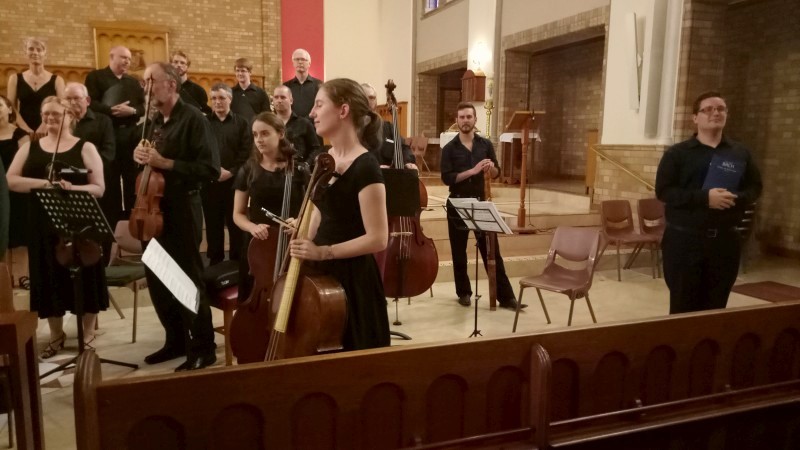
The Canberra Bach Ensemble returned with a program of Nunc dimittis cantatas. I had to read the informative program and a little more to understand the history of all these, of the Canticle of Simeon (Nunc dimittis) and the Feast of the purification of the Blessed Virgin Mary (Candlemass) and Martin Luther's reworking of Nunc dimittis as Mit Fried und Freud ich fahr dahin (in peace and joy I despair). Suffice to say this was nothing like the joyous series of advent cantatas that made up the last CBE concert. All four cantatas were restrained cantatas and one or two seemed to have just one chorus. But this is Bach so there were memorable passages none-the-less. I particularly noticed one with pizz strings in a tenor aria. The program says this "despicts the passage of time like a ticking clock, anticipating the 'allerletzten Glockenschlag' ('very last bell-strike')". Also different is the tuning: CBE had moved from A=440 to 415, standard baroque pitch. Not all instruments were gut, but plenty were, and same with the associated baroque bows. I particularly noticed Dave's huge- but downy-sounding gut-strung bass. A pair of viole da gamba appeared for the first cantata and I was surprised how hushed they were: sounding well under the cellos who were well under the single bass. The first cantata (BWV106) was supposedly written for a funeral; the next two (BWV125&82) were written two years apart for the Purification feast (Did Mary need to be purified? Apparently so.) The final cantata (BWV95) featured those authentic period instruments, cornetto, baroque oboes and the like, and finished with a chorus. Ah, there's a touch of that exhilarating joy that Bach cantatas are known for. The singing was wonderful throughout although I especially noticed the males, not least one duet for bass and tenor. And in some ways, it was a feat of endurance, being a very hot afternoon in Canberra. So a different series of cantatas, a learning experience for those who followed the Nunc dimittis connections, a concert of transition for the CBE and, as ever, a wonderful outing.

Canberra Bach Ensemble performed four Bach cantatas (BWV106,125,82,95) at St Christopher's, Manuka. Andrew Koll (conductor) directed, with Leanne Bear (violin, leader) and singers Keren Dalzell (soprano), Maartje Sevenster (alto), Robert Macfarlane (tenor) and Andrew Fysh (bass).

23 November 2016

The eternal glory of JS


This being the run-up to Christmas, these were for Advent and again we were regaled with a generous program of four Bach cantatas. It was Andrew Koll's return with his rebirthed Canberra Bach Ensemble and it was several hours of great beauty and order and often of spine-chilling thrills. I can only hear the choral segments as a thrill, especially at the end of a cantatas, after the more subdued recitatives and arias. For when the chorus releases, all hell breaks loose. No, that's certainly the wrong metaphor, for Bach composed for the glory of God and these are clearly and transparently glorious, as well as gorgeous. I don't bother to follow the text (sung in German with an English translation). Perhaps I should. Just once I did, when soprano Emma and bass Andrew were singing to each other with quizzical smiles. I discovered he was Jesus and she was the Soul and they were pledging that their love would never part and committing to graze together amongst the roses of Heaven. Apparently, this cantata associates with a Gospel reading (Matthew 25:1-13) of virgins awaiting the arrival of the bridegroom. These are celebrating a central Christian feast, after all, and it is of a different era, even if the music doesn't sound out of place for modern ears. But I just listened. Enjoying the interplay of solo voices, the engulfing chorus parts, the structure and counterpoint of instruments with their ever-forward baroque motion. And it all sat so well. Andrew has drawn together a wonderful cast of performers so there was so little to query. I loved that double act of soprano and bass towards the end of the performance. I admired Leanne's busy violins and Dave's excellent bass part, sometimes doubled by Kristen on bassoon or Anthony on organ or Gillian and Clara on cello. I enjoyed the solo arias but especially the sparse, spacious recitatives, where story is told with minimal orchestration, just one or two instruments, continuo organ with cello or perhaps violin. And the choir of 27, occasionally featuring the tenors alone, or a soloist who walked out front for a role. They performed four cantatas, BWV 61,36,62 and 140. Someone commented that a concert of one composer is to be preferred. I'm not sure (I don't mind Beethoven with Mozart or even Glass). But this was just Bach and it was wonderful. Congrats to Andrew for a successful outing and for the renewed CBE. A great pleasure to be enveloped in several hours of such glory.

Andrew Koll (musical director) conducted the Canberra Bach Ensemble playing four Bach advent cantatas at St Christopher's Cathedral. Leanne Bear (violin) led the orchestra. Vocal soloists were Emma Griffiths, Chloe Lankshear and Keren Dalzell (sopranos), Maartje Seventer (alto), Paul Sutton (tenor) and Andrew Fysh (bass).

19 September 2016

Burning cool


Let's face it. Bach is cool. The audience may not have been big enough and the hair commonly grey, but the four Bach cantatas played by the reformed Canberra Bach Ensemble were a great success and a huge pleasure. The cantatas were BWV119,131,138,34. All religious; I guess all written for Bach's weekly turnaround performances. Huge, complex works; riddled with brilliant counterpoint, often leaving tacets for various players, even violins; joyous and appealing or tragic and saddening; featuring solo voices or magnificent choruses. I wondered a feminist thought that had never entered my head: this is not an era of women's equality, but there are soprano voices and alto voices from women, presumably originally sung by women. Perhaps the orchestra of the time was all male. But the thought passed as the music again spelt its magnificence. Andrew Koll was conducting an SATB choir of 27, including four solo voices, also SATB, and an orchestra of 27. No small feat. The place was St Christopher's Manuka and the sound was heavily reverberating, the seats were wooden pews. I recognised many players and singers so virtually all local, and Andrew commented on the strong local musical scene (despite ANU's wobbles). The sounds were presumably authentic to the era, different from a modern symphony orchestra. This group included recorders and Cor Anglais and organ continuo and massed trumpets and important bassoon bass lines and early walking bass. I loved the solo singing, Emma's soaring soprano through Maartje and Owen down to Andrew's bass: the vocal ornamentation and the earnest religious themes. But the choir is magnificence itself as it raises voice, a towering beauty of harmony from many fine voices. So a smile breaks on your face. It's blissful at these times. Bach is cool; a big Bach ensemble playing capably like this one is a thing of great joy. This was. The event was introduced by the German Ambassador but unusually she returned at the end of the performance, turning to the performers to talk for some time. This is German but now everyone's music and the German Ambassador was thanking Canberrans for playing it. To me, this just confirmed the success. CBE is returning for four Advent Cantatas in mid-November. It's a busy time, but I can only suggest don't miss it.


The Canberra Bach Ensemble was led by Andrew Koll (conductor) and Leanne Bear (orchestra leader) with soloists Emma Griffiths (soprano), Maartje Sevenster (alto), Owen Elsey (tenor) and Andrew Fysh (bass).

29 April 2013

Magnificence


SCUNA presented Bach’s Magnificat and Handel’s Dettingen Te Deum and it got me thinking. The Magnificat is actually the earliest Marian hymn with text from Luke’s Gospel, but in English we can hardly avoid the likeness with the word magnificent which has such common if careless use. So what is magnificent here? I felt the Handel was the “magnificent” one, being outspoken and undiminished and loud and glorious, but really it’s a much simpler work. The Bach is the richer and more complex music and clearly the harder one to perform, with that busily baroque ornamentation and the five soloists. I must listen again but it seemed much more worth the effort. But I loved them both. Megan had a bookgroup mate in the choir and she confirmed the Handel was easier; the Bach was a stretch. But I thought they did worthy justice and the joy of performing such works was clear. The fanfaring trumpets were in the gods, on a balcony above the rest; the soloists to the left came out for their parts; the large choir was arrayed in several rows across the back, behind repetiteur and chamber orchestra and conductor Andrew Koll. The setting was the Anglican church of St Paul’s at Manuka with its impressive organ and large altar area, big enough for all these performers, and bell ringers’ balcony, where the trumpets were located. The annual convention of Australian and New Zealand Association of Bell Ringers, the ANZAB Festival of Bells, had been here for the weekend and I’d heard the eight bells ringing several times but missed the Anzac Day peal. The altar is behind a large arch which I felt may have dulled the sound, but this music is not easily cowered. I particularly enjoyed the elation of timpani and baroque trumpets. A haggard atheist could almost believe God is in this beauty. Certainly Bach and Handel did. I also particularly enjoyed some solo parts: the soprano, of course, because it’s pure and reaches for the Heavens, but also a duo of baritone and alto. At one time, I was stuck by the sinuous melodies outlined by oboe and bassoons. I’d noticed musicians arriving only 10 minutes before the gig, and that looked like cutting it fine. But it all turned out nicely on the night. I felt the orchestra was particularly fine. This is music that oozes joy, and it was just highlighted by hearing SCUNA warm-down by singing their theme in an adjacent room as we departed. A joyous event with music that’s magnificent: Bach’s rich interplay of thoughtful lines and Handel’s sheer forthright declamation and a generous crew to perform it all. Lovely.

The ANU Choral Society (SCUNA) performed JS Bach Magnificat BWV243 and GF Handel Dettingen Te Deum HMV283 at St Paul’s Anglican Church at Manuka with Director Andrew Koll, Keren Dalzell (soprano), Samantha Lestavel (mezzo-soprano), Julia Wee (alto), Norman Meader (tenor), Nicholas Beecher (baritone), Anthony Smith (repetiteur) and Leanne Bear (orchestra leader).