Showing posts with label Christina Wilson. Show all posts

07 April 2024

Darkness and light

It's amusing that this was the second gig with Chris Latham as MD where we sat in darkness.  The darkness was for the projected images of modern art that we were accompanying.  OK as long as your batteries on your music stand lights were fresh!  (They were).  Batteries for tuners, too, because the basses had to tune down E>Eb for the final tune.  Otherwise, this was reverent, as Chris' concert are.  We were located at the Chapel at the ACCC (Australian Centre for Christianity and Culture) near the huge cross on the lake.  The space is cement and thus has its own acoustic.  The music was a string of short pieces, from Bach and Rach through a string of lesser-known Europeans and others, Weinberg, Klein, Weiner and Kattenberg as well Simon, Walton, Koicki and Dreyfus and a segment of lovely FS Kelly songs.  I so love the gentle and touching music of FS Kelly, deceased young in WW1.  Chris had gathered and often arranged the tunes. Our singer was Christina Wilson with her soprano of power and obvious invention that showed when she sang a complex but wordless segment.  Fumiyo Yamamoto also featured on one violin solo.  Let it not be thought that short and predominantly slow means easy.  There's difficulty in delicate bowing and in unexpected counts.  It's nothing like fast incessant Beethoven parts with their own difficulties.  So another successful and purposeful performance with Chris Latham.  Thanks again Chris.

Chris Latham (conductor, musical director, arranger. violin) led Musica da Camera in a string of tunes at the Chapel at ACCC.  Christina Wilson (soprano) sang and Fumiyo Yamamoto (violin) and Margaret Kahn (cello) soloed.

18 April 2016

Knowing the Bible better


I knew of Elijah but not his story. Douglas McNicol was Elijah in the Mendelssohn Oratorio with the Llewellyn Choir and Sinfonia under Rowan Harvey-Martin. The other soloists were Rebecca Collins and Christina Wilson and Michael Martin and Charlie Barnes. So, mainly a local affair with numerous recognised faces, but with import DMcN who went through Elder Con with a friend so I knew of Elijah. I didn't know Elijah's story and didn't know Mendelssohn's setting except a few choral pieces that I've sung: He that shall endure to the end and O come everyone that thirsteth. Both are memorable themes that had me lift my ears. We enjoy much music through recognition. If I didn't know it, certainly DMcN did: he carried music under his arm but I didn't notice him reading it and he was the busiest amongst all the singers. Elijah was baritone, supported by tenor, soprano, mezzo-soprano, and, for just a few lines, boy treble. This was a noble and impressive effort and not one for wusses. The program was three hours including the interval. I pondered the style at one stage. It's obviously not baroque, but the bass style is ordered and scalar like baroque and the singing style also neat and even. The big choral sections were a pleasure as these always are, with ~100 singers giving voice. I enjoyed watching RH-M, too, involved and guiding. A big performance of a Biblical story with much satisfaction that deserved a better-informed listener.

Mendelssohn Elijah was performed by the Llewellyn Choir and Sinfonia under Rowan Harvey-Martin (conductor) with Pip Thompson (concertmaster), Anthony Smith (repetiteur) and soloists Douglas McNicol (baritone), Rebecca Collins (soprano), Christina Wilson (mezzo-soprano), Michael Martin (tenor) and Charlie Barnes (treble).

24 November 2013

Of music & spring & love


It’s always a pleasure when you encounter the sheare ease and comfort of established professional musicians. It’s tto that they don’t have some nerves or take things lightly. They just relate better and perform more easily. Alan Hicks and Christina Wilson are in that category. Relaxed and unstrained even when challenged. Christina joked before the concert that she must get all the notes right because I was recording. I guess she did. I didn’t hear any clangers (alhtough there was one little switch of verses). What I noticed was easy, responsive piano accompaniment and powerful, voluminous mezzo-soprano ornamented with deep vibrato and portrayed with considerable drama. There was presence in the patter, too, as Christina introduced the songs, located composers in time, joked about some of the more silly lyrics. (Like the one where the singer wished to be a jug to carress the lover’s lips), but the topics ranged from spring and warmth and hope and peace to music and love. There were groups of songs by several composers and this was interesting as well as an introduction to some more obscure names. Two songs by Purcell were dedications to music (Santa Ceclia’s feast was the following day) including a strange one of repeating drops: “Till the snakes drop, drop, drop, drop, drop, drop, drop, drop, drop from her head” (Music for a while, from text from Oedipus A Tragedy by John Dryden). Then three songs from Schubert who wrote more that 600 before his early death aged 31. One was the Trout which portrays a cunning fisherman and his dastardly technique and the more tragic song of Gretchen at the spinning wheel to the words of Goethe who recounts Gretchen’s love for Faust “My peace is gone / My heart is heavy / I shall never find peace / never again”. Then a jump to early C20th and songs by Fernanco Obados with touches of flamenco and jazz. Christina introduced one with the outline: “Tiny is the bride, tiny is the groom, tiny is the bedroom. I must buy a tiny bed and a mosquito net”. (Maybe something is lost in translation). Then three songs from Brit Roger Quilter: Fair house of joy, Drink to me only and Lover’s philosophy. You couldn’t not recognise Drink to me only from the words of Ben Johnson, with its A-A-B-A 32-bar structure in 3/4 with turnaround. It makes you realise how common is the infrastructure of Western music, despite the different cultures and repertoires. But how good was this? An excellent end to a lovely little and intimate monthly concert season at St Albans. Christina Wilson (mezzo-soprano) sang with accompaniment from Alan Hicks (piano).

24 June 2013

Triumphs of the blessed


I was going to take this quote from Handel’s Theodora, “Pity suing / Mercy wooing” but Triumphs… seemed to fit. When I checked the libretto I found it’s actually “Triumph o’er her boasted chastity” but I’ll use Triumphs … anyway. I like it.

We saw a performance of Handel’s Theodora by the Canberra Choral Society with various guests and with period instruments. It’s dignified and neat and even touching later in the work, when the Theodora and Didymus, the Christian couple, are sentenced to death by Valens, President of Antioch. Didymus is a Roman soldier who’s fought with friend Septimius, but he’s fallen for the beauty of Theodora and converted for her purity. Valens has declared that all citizens should offer sacrifice to some Roman goddesses to honour Diocletian's birthday. Theodora refuses and is sentenced to a brothel. Didymus goes to Theodora and allows her to escape in his uniform and helmet. Didymus is sentenced to death. Theodora returns, they each offer their own death to save the other and of course they are both sentenced. It’s all strange classical stories which mean so little to us these days and stories of saints and worthy Christians suffering at the hands of heathens and that goes over my head. This performance was a one-off. It felt it started a bit unsteadily, although it was comfortable by the end. The voices were very satisfying, and I could follow most of the story other than Theodora’s words. Soprano training is like that and it’s a weakness when there’s a story like this to follow. I loved the CCS when they sang, all rich and full and smooth, but they were the Christian chorus, after all. Kampactus was the chorus of heathens who chuckled at the promised rape of the pure Theodora and they seemed to have some more intricate lines to sing. I lost a few. I also didn’t particularly notice the period instruments other than the baroque oboe and harpsichord and chamber organ. I assume the strings were gut and perhaps the violins were milder, but I didn’t find it particularly noticeable. I particularly watched cello and bass, partly for the different physical approaches to the instruments: cello is more lightly strung and Anthea attacked it with raised fingers; Helen on double bass was smoother and seemed to be natively conserving her strength given its heftier demands. I admired both their playing. The whole ensemble was warmed up by the end and the end also has some of the best music: the final duo of the lovers and a choral segment that finishes it off. A worthy and satisfying finale.

The musicians did a great job, even if I would have preferred to hear it after half-a-dozen more performances. Oh, and the audience sang. CCS apparently has a habit of introducing singalongs. This time is was three lines of a hymn over four bars that were repeated. The words and music were in the program; the lights came up, we stood and sang, everyone smiled, and we sat down. Nice twist and nice work.

Handel’s Theodora was performed at the Playhouse by Canberra Choral Society with Brett Weymark (conductor), Greta Bradman (Theodora), Tobias Cole (Didymus), Christina Wilson (Irene), Paul McMahon (Septimius), Stephen Barnett (Valens), Kompactus Choir (Heathen chorus), Canberra Choral Society Chorus (Christian chorus) and Evan Kirby (messenger). The ensemble on baroque instruments were Bianca Porcheddu (violin, leader), Lorraine Moxey (violin), Heather Lloyd (viola), Anthea Cottee (continuo cello), Helen Cosgrove (double bass), Kirsten Barry (oboe), Peter Young (chamber organ), James Huntingford (harpsichord).

14 May 2013

Patriots and eggs and the sea

There was a line in The Great South Land saying that Ferdinand de Quiros was the first Australian patriot. It’s about the only thing in the whole work that I didn’t admire and enjoy immensely. We attended the premiere (in this form) of Peter Sculthorpe’s Great South Land, an oratorio celebrating de Quiros, his search for the imagined southern land and his naming of Australia. This is a big, expansive work, lasting just under 100 minutes, in three parts, telling the story of his first and second voyages and attempts to fund a third. This is the late 1500s, at the end of the great period of exploration by the Portuguese. There’s narration by Peter Tregear, voices of Quiros (Andrew Goodwin) and his wife, Dona Ana (Louise Page), and a young soprano, perhaps his daughter, Geronima (Stephanie McLean or Hannah von Thrumm), his commander on the first trip, Medaña (Andrew Goodwin), and his wife, Dona Ysabel (Christina Wilson). The presence of the women was interesting. We think of the adventurers as men, but the women were involved with the lack of husbands for long periods. Like a war, really. And Dona Ysabel seems to have accompanied her husband and called off the first trip to the disappointment of de Quiros.

I loved it from the top, with an imposing entrance, leading to cello harmonics bird calls and swelling strings and brass that spelt rolling seas. I learnt another term this week, eggs, used for whole notes. There are lots of eggs for the strings and often for others. This does not move quickly, It’s like synthesisers with swells and decays. The strings were especially so, while the brass seemed to spell out melodies in short little phrases, although they too were gently formed. The basses (there were 4) were also on the long notes and they stunned me with a huge presence both pizz and bowed. That might be from the room. This is a live room, rectangular, windowed, proscenium arched and stucco-decorated. The percussion also rang out and they are by nature harder, tubular bells or drums. The bells contrasted nicely with the billowing wave-like presence of the rest of the instruments. This was an oratorio. There were several choirs gathered: sometimes singing, early on with back to the audience to give a distance that spoke of the sea, later often speaking lines, sometimes in gathering power with one of the voices. There were five voices for the characters. I enjoyed the varied tones of mezzo and soprano and soprano, the pure girl soprano, the powerful mature soprano reachggn to the heavens, the milder mezzo. I thought Andrew Goodwin’s tenor Quiros was particularly good.

It’s a fascinating story. I would have liked to read the libretto. Perhaps one disspointment was that I missed most of the story. The discoveries, the deaths, the power in the background and the influence of the various women, the dedication to a cause and the failures and bravery of it all. Apparently Peter Sculthorpe has followed the story all his life. He wrote an opera – this oratorio is that opera in new format – and the characters in the history of this work are fascinating: Nugget Coombes, James McAuley, Manning Clarke, Opera House, ABC fiftieth anniversary. Apparently we should add Chris Latham to that, because he had a role in promoting this oratorio version. In the end, this wonderful performance was broadcast live to ABC FM and Chris Latham even brought Sculthorpe into the room by mobile phone to hear the reception of his work. This was truly a memorable night with a winning work of historic interest. But then, it had special relevance to us for two reasons: we live in Quiros Street and we are billetting James Eccles, one of the viola players in the orchestra.

Peter Sculthorpe’s The Great South Land featured Andrew Goodwin (tenor), Alexander Knight (bass), Christina Wilson (mezzo soprano), Louise Page (soprano), Stephanie McLean or Hannah von Thrumm (soprano), ANU School of Music Chamber Choir, Oriana Chorale, Canberra Choral Society with Bengt-Olov Palmqvist (choral director), Canberra Festival Orchestra with the ANU School of Music Faculty and students including DRUMatiX. Roland Peelman conducted.

01 April 2012

Closest to Bach

It felt like the closest that I’ve got to JS Bach when we heard the St Matthew Passion last night. It was performed by the Llewellyn Choir accompanied by the Llewellyn Sinfonia and conducted by Rowan Harvey-Martin at the Canberra Girls’Grammar School hall. Why the closest? I think because it’s storytelling in German. The music remains glorious, but the essence is the story, recited in German by the Evangelist and sung in person by several solo singers and the choir as the People. The words are the essence. It was likely first performed in Thomaskirke, where Bach worked at providing music each week, on Good Friday in 1727. This was work for Bach but it was work of a believer for presentation to other believers. It’s a Passion, a reciting of Christ’s suffering on the cross, the essence of the Christian story. And from my reading of dictionary.com and the Shorter Oxford, this is the origin, from Middle English and mediaeval Latin, of our common word, passion.

It’s a long work, written for soloists, double choir and double orchestra. It was to be performed in two halves, before and after the sermon on Good Friday. The score is further divided into three parts: a narrative using biblical text; various recicatives, arias and choruses; and the chorales. It’s music that is subject to the story and the demands of the people, the claps of thunder, sadness or fear or rejections of the apostles are all expressed clearly. I revelled in the big chorale sections and loved the several returns of the main choral theme, sometimes slower, sometimes livelier, usually with varying words. I enjoyed the dignified Evangelist as he told his story that I wished I could understand without looking at a projected translation, I loved the instrumental accompaniments with the solo singers: violin, cello, organ (I think this is the same chamber organ used by Igitur Nos last week), harpsichord, flutes or oboes. I enjoyed the autal and contrapuntal movements left to right of the choirs and also the orchestras. And it’s an impressive theatre. It looks to be carefully set up for sound, although perhaps for a bigger rather than a precise sound. And it’s pleasantly human in dimensions; it has a massive stage but you still feel close. (Too bad about the noisy aircon). From the orchestra, I particularly noticed the clarity of the two single basses, and that glorious little but persistent organ sound. This music is dignified and ordered, but more than instrumental Bach, it is subordinate to words. A stunning piece of beauty well performed. Congratulations to all involved.

The Llewellyn Choir and Llewellyn Sinfonia performed JS Bach’s St Matthew Passion at the Canberra Girls’Grammar School hall. Key performers were Rowan Harvey-Martin (conductor), Michael Martin (Evangelist, tenor), Stephen Barnett (Jesus, bass), Rebecca Collins (soprano), Christina Wilson (contralto), Rohan Thatcher (bass).

25 April 2011

Not at the Coast, no.2

From wordmadeflesh, from grooves and funk and reggae, to … ABC FM live from the Llewellyn Hall. It’s quite a discombobulating. This was a concert of fairly recent French music by Alan Vivian on clarinet, Alan Hicks on piano and Christina Wilson, mezzo-soprano. I felt most close to home with the final piece, Sonatina for clarinet and piano by Joseph Horowitz. It’s a modern work with major harmonies that are reminiscent of the jazz age and Gershwin. It’s not at all uncomfortable and the jazz-era likeness even fits the clarinet sounds, but it wasn’t my favourite. My favourite was Malcolm Arnold’s Sonatina for clarinet and piano, Op 29, which started the show and was very alive, punctuated with interesting chords and quite wry in its references. There was a very cute piece introduced as by a minor composer and which was quite lovely, Gabriel Pierné’s Canzonetta for clarinet and piano, Op 19. There were several songs by Charles Gounod, including an alternative Claire de Lune, and Claude Debussy’s Première Rhapsodie for clarinet and piano, which was all airy, arpeggiated chords, watery melodies and mystical dreams of nymphs. All very pretty and very identifiably Debussy. This was a civilised way to wile away an hour on a long, holiday weekend, and this one shared with all of Australia.

Alan Hicks (piano) accompanied Alan Vivian (clarinet) and Christina Wilson (mezzo-soprano) at the Llewellyn Hall for a live broadcast to ABCFM. John Crawford was the compere for Sunday Live.

04 July 2010

Drama in the crypt

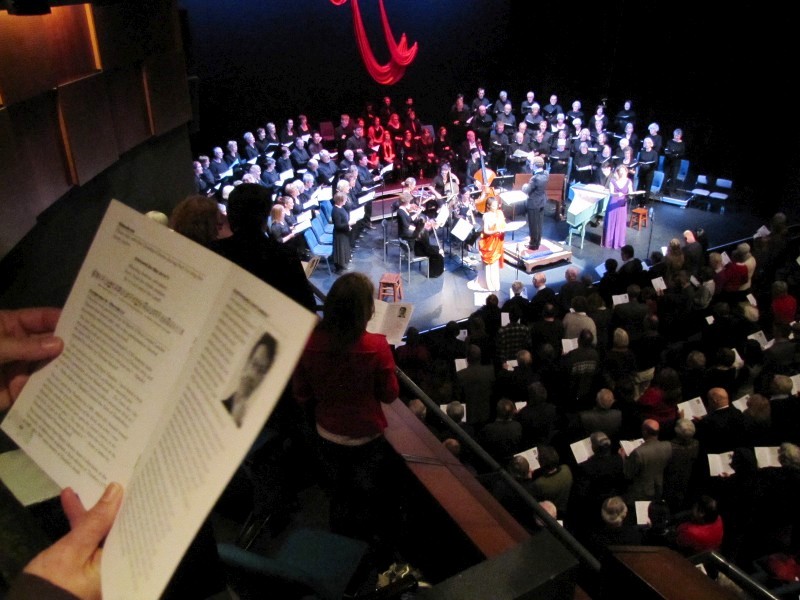
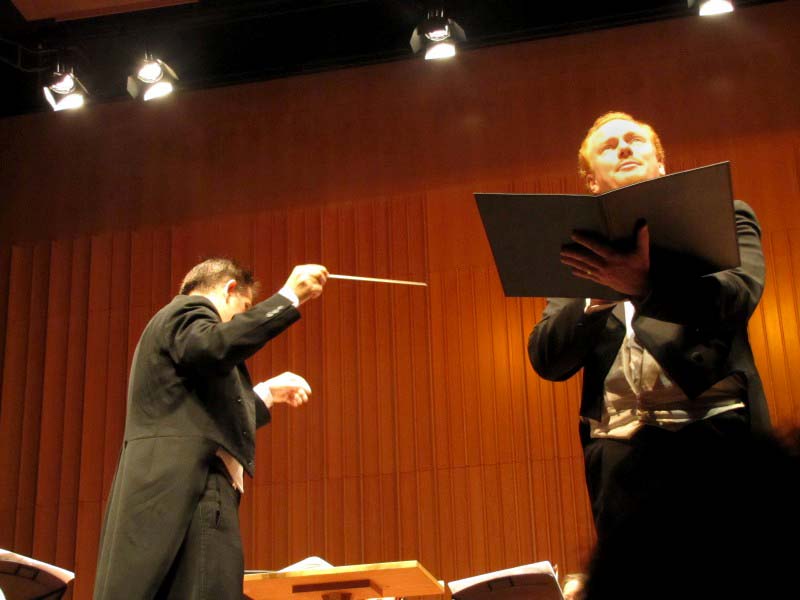
The Catholic mass is theatrical and the Requiem mass is passionate, but Verdi’s Requiem just didn’t click for me in expressing the earthly loss but religious hope of the occasion. I’d heard Mozart’s requiem a few months before, and it was pained and deep. This seemed theatrical: more operatic in its drama and not unexpected given Verdi’s fame as a composer of operas. But the performance by the Canberra Symphony Orchestra and combined choirs was satisfying and capable: well presented, with four decent voices up front and a confident orchestra. We had seats in the second row, so my pics are more individual than inclusive, but it does let you feel a part of the performance. You hear the pages ruffling; the charts cover the singers’ faces and muffle their voices; the instruments come from a generous stereo sound stage; the instruments become almost individual (I thought I could hear Leigh Miller’s individual bass pizzicato tone, and it was wonderful). But I wonder if I missed some of the effect of the choir because of this. They were down the back, behind rows of strings, and they didn’t seem to have a great presence. It could have been the piece: I didn’t notice many big choral segments of richly moving parts. The choir seemed to provide a support role for the more frequent solo voices up front. We were all thrilled by one loud and dramatic theme that recurred several times. Other spots I noticed were two female voices with flutes behind (at least I thought they were flutes, although the program doesn’t list any flute players) and a passage of nice runs of long intervals from the cellos and highlighted trumpets up front for another segment. Suffice to say it was lush and dramatic and emotional if not a deep work. Stereotypically Italian, as is opera itself: the musical equivalent of flailing arms (which I can say as I am one). But why no list of choral singers in the program? Verdi Requiem was presented by the Canberra Symphony Orchestra, with Nicholas Milton conducting. Tobias Cole led a combined choir made up of the Canberra Choral Society, SCUNA, Oriana Chorale and the Llewellyn Choir. The front line singers were Eva Kong (soprano), Christina Wilson (mezzo-soprano), Warren Fisher (tenor) and David Parkin (bass).

20 December 2009

It must be Christmas

Sally observed it wasn’t jazz, but Handel’s Messiah well deserves a post on CJ. The Canberra Choral Society performed it again this year at St Christopher’s Cathedral, the cream brick Catholic cathedral at Manuka. We went to the first of two performances and it was an immensely satisfying experience. The Cathedral is not my favourite building around town, the acoustics were heavy with reverb that made for a loud but somewhat mushy sound and there was frequent traffic noise and Harley splutter outside on Canberra Avenue, but nonetheless this was a treat. It was the long performance with the full 3 Acts, verging on 3 hours with the interval. I thought this was a daring choice and all praise is due. This was my first Messiah (a late starter) but I was glad to hear one where the three parts, dealing with the Birth, Passion and Aftermath, were present, and the familiar arias and the exultant Hallelujah Chorus were in their right places. It was long but the time passed like a breeze. I was impressed by the stamina of both performance and audience. Pews are not the most comfy places to spend three hours, and I noticed the audience stirring but it was uncomplaining and stood for the famed Hallelujah Chorus, as people apparently have since King George 2. I expected that we would be too casual for that these days, but no. It was a pleasant surprise. And the applause was deafening at the end, so the effort was much appreciated.

It was a small orchestra with a light presence that was sometimes overshadowed when the voices took flight. But it had a lovely courtly baroque tone that benefited from the reverb. Clear, fat trumpet ringing through (beautifully resonant and very different from a jazz trumpet tone), bassoon or oboe evident at other times, the strings fairly restrained with 7 violins, 2 violas, 2 cellos and a double bass. Organ and a harpsichord that presumably played the original basso continuo part. The choir was 21 sopranos, 30 altos, 10 tenors, 14 basses and there were arias and recitatives for SATB - Rebecca Collins (soprano), Christina Wilson (mezzosoprano), Christopher Saunders (tenor) and Stephen Barnett (bass) - and the whole was directed and conducted by Peter Pocock.

What glorious, exultant, dignified, elegant, rational music it is! Lines echoed by passing between voices and on to instruments; big and joyous interval jumps, and shapely lines. Apparently Handel is famous for word-painting where the melody mimics the meaning of the lyrics, so lines rise to mountains and fall to valleys, and “crooked” alternates crookedly between B and C#. I heard a unison bass and bassoon line that surprised and amused me. But always the neat cadences to confirm dignity at the end of scenes. I enjoyed it immensely, and the final applause was long and enthusiastic, seemingly beyond the expectations by the performers. In the end, I felt the words were strangely other-worldly (no-one much chats about exalted valleys, easy yokes or feeding flocks these days or even walking in darkness) but the rational baroque music fits well enough with modern rationality in architecture and politics and economics. We left with high spirits and much joy to take on the Christmas season. Truly a fabulous outing, so thanks in spades to my neighbour Trish and the rest of the performers. BTW, ArtSound were recording the Saturday night performance, so keep you ears tuned for the replay.