Showing posts with label Eamon Dilworth. Show all posts

02 June 2019

Now for the dance


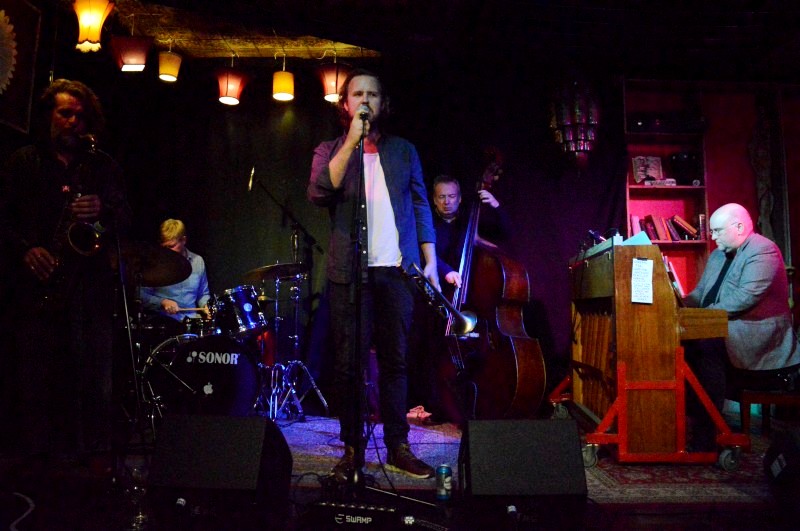
The intellect was satisfied and the feet were to come. Eamon Dilworth was touring Austrlaia and New Zealand playing and singing his much-loved New Orleans joy and calling on his many mates to accompany him. So this was Eamon with some of our locals: John Mackay, Brendan Clarke, Wayne Kelly and visitor already on the stand from the previous band, Ben Vanderwaal. This was joy personified but with that black melancholy that permeates the American South. First up was a joyous second lines blues, as would be played by NOLA marching bands at funerals. Then a string of frolicksome songs, Bye and bye, When I grow too old to drink, His eye on the sparrow, Just squeeze me, and the more sombre St James Infirmary or the country twangs of Jumbalaya or the story-telling original, Livin' the van life, or the upbeat Ilo Iko. All done with joyous trumpet and some capricious responsive virtuosity form John and immense steadiness from Ben and Brendan and Wayne's facetious light-heartedness on the Duke. The name says it all - Crawfish Po' Boy - spelling out huge joy amongst deep emotions, all a great mark of respect to the tradition. Huge pleasure.

Crawfish Po' Boys is led by Eamon Dilworth (trumpet, vocals) with invited guests John Mackey (tenor), Wayne Kelly (piano), Brendan Clarke (bass) and Ben Vanderwaal (drums).

29 July 2018

Milano and more


Eamon Dilworth led his band in the new, larger room at Smiths. It's a good room. The music was good, too. I was thinking of Smalls in NYC and when I visited and when I watch on their video stream. No way this would have been any lesser. The room was great and just in its early days. The compositions, the playing, the authenticity were first class. I could hear that strain of NYC guitar in Carl's driven lines and Hugh was relentless and Mark only met Eamon that day but sat in easily as sideman and Hannah laying solid lines while absorbed with ceiling tiles and Eamon himself having written most of the music, clean and purposeful in composition and performance. He introduced his new album, Viata (=life, Romanian), speaking of purpose in music, relevance not mere cleverness. There's a maturity in his purpose even if joviality in presentation. Nice guy, Eamon, and easy on the mic between tunes. I could hear Miles often enough with his 70s jazz rock grooves, but also odd times and neat melody and written accompaniments, like Hannah's in Milano, a record of his year spent in Italy, or Carl's unisons on melodies. This was seriously satisfying music, wonderfully played, well written, with raison d'etre. I've talked of good music and musicians being everywhere and this night was just confirmation Great gig, intimate and capable and with purpose. A blow out.

And walking out, past PJ O'Reilly's, what did I see? Aron Lyon and mates playing an R+B jam session. It's a different world but it's fun; few chords but deep funky grooves. And Rachael Thoms singing made for a fabulous front line. I've since discoverd the Thurs eve R+B jam sessions as PJ O'Reilly's and some new names to listen to (Allen Stone and, of course, Pino Palladino) and an opportunity for some seriously funky grooves.

Eamon Dilworth (trumpet) led his (Canberra) band comprising Hugh Barrett (piano), Carl Morgan (guitar), Hannah James (bass) and Mark Sutton (drums) at Smiths. He was on tour to launch his new album, Viata.

21 January 2017

Images and formulas


Hannah James's back in town - it's been a while. There was a last minute hitch and a change of band, but nothing lost (the original band, Energetic Zen Quartet, will be at Smiths in Feb). This was still Hannah with Casey Golden, but in a drummerless trio with Eamon Dilworth. They've all played together in various incarnations over the years and here they've coalesced into this unusual format. They are all such impressive players, all competent, all setting and holding rhythms independently, so drums are a luxury but not necessary. The tunes were written by Hannah, with just two from Eamon, and they were substantial pieces: lengthy, intricate with varied parts, telling stories that were sometimes very obviously closely felt and listened. Slip, Number one, Last letter and Portrait; Snowfall, Three different kinds of light. These were all from Hannah, pensive, careful tunes, sometimes obviously deeply felt, observant. Three different kinds described the thoughts of a poet, and clearly spelt out, as music can spell out light. They were all deliciously developed by Eamon on trumpet or flugelhorn or Hannah herself with a few solos or very inventively by Casey on a real upright piano, even if the tuning was problematic. And Eamon's two tunes. Hannah invited Eamon to introduce them and we got a decent intro to Havelock Gardens (modelled after the Fibonacci sequence and music theorist Greg Sheehan who he'd spoken with in Singapore, presumably the location of the gardens). We didn't get an answer on his other tune (what did The hiding signify? Hiding as in hide and seek, or, hiding as in spanking) so Hannah had to play that tune uninformed. These tunes were a little more driven, especially Havelock Gardens with an odd melody, I think spelling 1,1,2,3,5,8. At least the solos were in a more usual time (in 6/8 if I remember correctly). The concert was all open and clear and nicely spelt out with deliciously capable playing. A lesson in jazz richness for some musos arriving for the next set. Wonderful. And we have another opportunity with Hannah and Casey back in late Feb with their Energetic Zen band, this time with drums.

James Golden Dilworth was Hannah James (bass), Casey Golden (piano) and Eamon Dilworth (trumpet, flugelhorn) and they played at Smiths.

06 February 2015

Mark's joys


Mark Ginsburg was back with one of his very sweet and worldly bands. I've heard him a few times at Hippo and the Gods. He always has a wonderful, earthy, human presence and this was no different. This was his South African Project. It's a sextet with Judy Campbell singing variously as another horn and as a ballad diva. She said she enjoyed this, and I'm sure she would have. The horn parts were simple but perfect melodies, danceable and lively and hugely joyous. The ballads were similarly emotional, not so joyous, perhaps talking of lost love or the woes of apartheid or whatever, but always simply honest. This was African music and I guess this is what it's like, but it felt honest and revelling in life. Black music at its source. There's a reason why jazz is rhythmic and Africa is one part of that. Mark spoke openness of South Africa, his current links with the continent and his youth in apartheid SA. It resonated with an audience that hung on every word. Honesty has its own rewards (Abbott and others, think on this!). They played earlier tunes, then some later that related to fusion and contemporary jazz. Abdullah Ibrahim ./ Dollar Brand was unpretentious and perfect. Fikele's delight spoke with the funky fretless bass of Bakithi Kumalo of Paul Simon's Graceland, Chaka Khan, Herbie Hancock and others, but this was the one tune that Brendan Clark (the Junior, without the -e) played on electric. Otherwise he was on double, with a lovely punchy solidity. A few tunes by Bokani Dyer were more of the contemporary style, giving Dave Goodman a lively and driving outing on drums; also a final latin by Chris Skilda (?). But then a few lovely ballads, Malaika (= My love) of lost love, and Little bird, written for Miriam Makeba. The horns out front were Mark on saxes and Eamon Dilworth on trumpet / flugelhorn, both expert in solos and eminently expressive in melody, and Judy sitting in as honorary horn. Ryan Grogan was on piano, a later student at Mark's school in South Africa and a deliciously understated player. What I will take from this is honesty and joy. It's not an image we have of modern-day Africa, mired in Boko Haram and poverty as we are reported, but this was honest and deep and vastly satisfying. Not just immense joy. Lovely gig.

Mark Ginsburg (tenor, soprano saxes) led his South African Project comprising Judy Campbell (vocals), Eamon Dilworth (trumpet, flugelhorn), Ryan Grogan (piano), Brendan Clark (bass) and Dave Goodman (drums).

25 April 2012

Walking bass(less)

There was no bass but I think I heard more walking bass at Eamon Dilworth’s gig at the Loft than I’ve heard in some time. I sometimes think swing is almost becoming a lost art in modern jazz but Eamon and his mates obviously enjoy it and so do I. This was a lovely little concert.

Some hot playing, some organ grooves with those muffled organ bass lines, post-bop trumpet and clear guitar and driving ride defined it for me. That’s not to say this was out of time. Carl’s guitar was crisp and clean in the ’50s style, but his lines were long and tortuous and spanned some impressive ranges. I was wondering how he builds his lines. I thought perhaps on fourths in one tune, but another had clear thirds. Eamon was more scalar in a recognisable post-bop style, so a Kenny Wheeler tune to end the night was not out of place. Steve’s organ was perhaps the defining sound. An organ-based band is unique in presentation and sound: soft and malleable but nevertheless hard swinging. It’s a busy job for the organist, thinking left hand walks and right hand solos or choppy C3 accompaniment. Steve did it with aplomb and also joy, which is fitting, because it is a carefree sound. I heard his solos as more bluesy, against more delightfully contorted yet tonal solos of Carl. And I enjoyed Carl’s comping: modal, busy and wonderfully colourful. And what of drums. James (aka ‘Pug’: I must ask him about that sometime) swung with a very promiment and heavily syncopated kick drum and sharp and precise rolls and rudiments. Nicely fitting for this style, with several generous solos and swapped eights and fours. It’s an old custom but was perfectly apt in this context. This was swinging, lively, joyous music with space for individual solos statements. Old-school but there were also several more worldy tunes. Not so much swing but not out of place. These were originals by Eamon, dedications after a year in Europe and in context of good times and friendships. It’s not surprising that this swinging goodwill continues into his originals. From Bucharest with love switched from a lengthy mutating quarter note arpeggio intro in 4/4 to melody and solos in 5/4 with a funky 3-2 groove then back to the 4/4 as outro. Vienna was a slow, airy jazz tune. Milano was a more modern, funky 8-feel which fits the city of famed and capricious architecture. But you can’t keep a swinger down so one original was a straightahead swing, a university exercise called Starting point. The rest of the repertoire comprised a few less common standards, I love you and East of the sun west of the moon, and an end on post-bop heaven, Kenny Barron’s Voyage. What a lively, joyous and skilled concert. I revelled in it and left with a smile on my face, as you should.

Eamon Dilworth (trumpet) led a quartet with Carl Morgan (guitar), Steve Barry (organ) and James ‘Pug’ Waples (drums) at the Loft.

11 June 2007

To the Harbour, Darling?

So it was, Megan and I set off for a night in Sydney and a few hours at the Darling Harbour Jazz & Blues Festival. It’s now a Jazz & Blues festival, but it was mostly jazz I heard on Sunday. In this current incarnation, it’s a big, commercial event, so there was a good sprinkling of pop, funk and the like for the punters. Not the intensity and mix of a local festival (like Merimbula which was on over the same weekend), but worthy none-the-less. It’s not Canberra jazz, although there was a Canberra contingent present. Here’s a quick summary of what I heard.

The Con (Sydney Conservatorium) Jazz Orchestra was the first event I attended. It was on the Tumbalong Park stage. This was the biggest and most impressive stage – glorious lighting, fabulous line arrays and masses of power for a crystal clear, punchy, full range, processed and polished sound. Sadly, it was a hindrance to other, smaller stages at times due to the sheer power and spread of the sound, but nice while you’re experiencing it.

The Con band was really impressive. A proudly sharp, tight performance on challenging charts. Tunes included A child is born, Nica’s dream and lesser known big band charts. It was hard to determine who was soloing at times, as the players didn’t stand for solos. The solos weren’t all blow-outs, but the ensemble playing was superb: excellent intonation and articulation. Great show. Loved it. Probably my favourite from what I saw.

I just caught a few minutes of Catherine Hunter with the Bobby Gebert Trio. Catherine Hunter (vocals), Bobby Gebert (piano), Brendan Clarke (bass) and James Hauptman (drums). Not enough to really comment, and only a few bars of Catherine, but these are capable players. Of course, these are part of the Sydney ex-Canberra contingent: all but BG studied in Canberra.

I just passed another stage with the Elizabeth Curthew Quartet, but again no comments. She was singing Without love… as I passed by. Gary Holgate was on bass.

I’d seen Eon Beats Project several years before at another DHJF, and was blown out. EBP was then sax, piano, drums, turntable (?), as I remember. No bass. Fabulous, heavy grooves with a distinctive modern sound. This time, they played a set of pretty standard but capable funk/reggae, and with a more common lineup: Rick Robertson (tenor sax), Phil Slater (trumpet), Jonathon Pease (guitar), Gerard Masters (keyboards), Alex Hamilton (electric bass), Ian Mussington (drums) and Evelyn Duprai (vocals). It was a popular set and showed jazz influences from the excellent players. I loved Gerard Masters on piano, organ and clavinet sounds. Phil Slater and Rick Robertson both played great solos, and Alex Hamilton laid down a solid, great sounding and ever-present bass line on a Fender Jazz, with some lovely slight chordal fills. Evelyn Duprai had a great, black, bluesy voice, which suited perfectly and I loved it. The vocals will give you an idea of the style: “You don’t know what you’re gonna do / you don’t know what you gonna say / you’re wondering how you’ll make it through / I’ve got some questions here today“. Hmm … but then jazz isn’t too highly regarded for its poetry, either. Quality funk with some reggae; original tunes; nice playing; eminently sellable.

I caught two tunes by the Bernie McGann Quartet. Bernie McGann (alto sax), Warwick Alder (trumpet), Ben Waples (bass), James Waples (drums). This was typical, quality BM. I heard them play Spirit song and Dexter Gordon’s Fried bananas. Bernie played his typical little impassioned, falling lines. Warwick Alder dissected the tune with post-bop improvisations and some tortured trumpet notes. This is true commitment to the form: tasty, tuneful and without hype.

I heard even less of the Jackie Orszaczky Band with Tina Harrod, and thinking back, I regret it. Again, this is not a jazz band in the standard tradition, but it is informed by the style. It’s more a pop-funk band of considerable style, but also with a unique twist: two basses. JO (bass and leader) sits and plays a front line role, somewhat like a guitar, and actually with a tone also somewhat like a guitar: trebly, crisp, chordal, soloistic and essentially cool and relaxed. In back was Alex Hamilton (bass) who had previously played with Eon Beats Project, doing a similar, fat, funky style. Interesting stuff. The rest of the band was Tina Harrod (vocals) and two other female singers, trombone, tenor sax, keyboards and drums.

I was intrigued by the concept of the next act, so I left JO early. Perhaps I should have stayed. They were Back on the Block, a Quincy Jones tribute. This was a big and superbly professional set of players on the big Tumbalong stage, with sound to match the reputation of Quincy Jones. But it was essentially a superior pop set and I left after a few tunes. Not to put them down – they were very, very good and proved it with an excellent, driven, distorted rock guitar solo as I was leaving – but not what I was there for, so I departed.

I dropped in on the Eamon Dilworth Ensemble. They were bravely playing away, against a massive barrage of sound which was spilling over from the Quincy Jones show. It must have been a challenge, but I guess it was OK when they actually got playing. EDQ was Eamon Dilworth (trumpet, flugelhorn), Jeremy Rose (alto sax), Rob Turner (drums) and Alex Boneham (bass). I particularly liked Jeremy Rose and his calm presence and investigative alto solos.

Next I caught a blast from the past: Crossfire. I remember Crossfire as a very popular touring fusion band in the late-70s. I didn’t remember that they had recorded with Michael Franks, and played with Lee Ritenour and other big names on the Californian scene in their prime. They are now grey haired, with glasses and the like, and have reformed to revisit former glory. And they were still very good. Sharp, interesting playing and original tunes. Worth catching if they visit or when they return to the Basement. The original band members, Jim Kelly (guitar), Tony Buchanan (saxes), Ian Bloxsom (percussion) and Greg Lyon (electric bass), are joined by new members Steve Russell (keyboards) and Scott Hills (drums).

The last gig I caught was the US Navy Seventh Fleet Big Band. I was hanging out to hear a quality American outfit after this Australian music. They were great, as I expected, but nothing to embarrass our locals. Their ensemble playing was sharp and accurate. Some very fast unison sax passages got away from them, but then they were ridiculously difficult, so no shame there, and there were some other unison lines with bass and all the players which came off wonderfully. The solos didn’t particularly knock me out, but they did a great range of styles, with and without singers, and went down really well. There were several modern instrumental big band charts, which were my favourites. But they also did Sinatra with a male singer, Basie/Shuur with a female singer, Glen Miller’s In the mood and the Beatle’s Norwegian Wood, so this was a stylistically diverse set. And they did two songs with the featured jazz singer, Barbara Morrison, who was to feature at the festival later that day: My one and only love, and the blues classic, Everyday I have the blues. BM performed more as a blues than jazz singer for these two tunes: fairly straight with little improvisation, except a nice chromatic line at the end of My one and only love, but she sang with a satisfying, raunchy voice and a great stage presence which was perfectly suitable for this performance.

As for the sound at the event, it was very professional, as you would expect from such a big, commercial gig. On the Tumbalong Stage, the mixing was generally right for the jazz style, although the bass was sometimes unnaturally deep on double bass, rock-loud and overbearing on electric. The horn mix was blissful, with tinkling pianos and guitars and drums coming through fittingly. There was something wrong for the solo horns on the US Navy band – a thin, tin-whistle alto sax tone, and similarly thin tenor – and I heard a buzz in one bass bin on the first day, but otherwise the sound was great. As for the other stages, they were similarly well provided. I was amused by a strong echo on Evelyn Duprai’s mic, but maybe that’s what the band wanted. As mentioned above, there were problems with sound carrying between stages, and John Shand complained about this in his SMH review (“Enough sizzling grooves to warm the brave” / John Shand, in Sydney Morning Herald, 11 June 2007, p. 13). I especially felt sorry for the Eamon Dilworth Ensemble who bravely played on despite a massive background spill from the Quincy Jones tribute band.

But the rain held off while I was there, and I had a good time, and caught up with some bands I’d been wanting to hear for some time. So despite the commercial cum popular bias of the event, it was well worth the trip.
  • More DH Jazz Fest pics from CJ's men in Sydney
  • Darling Harbour Jazz & Blues Festival website
  •