Showing posts with label Ed Rodrigues. Show all posts

21 March 2022

Just one Sunday arvo

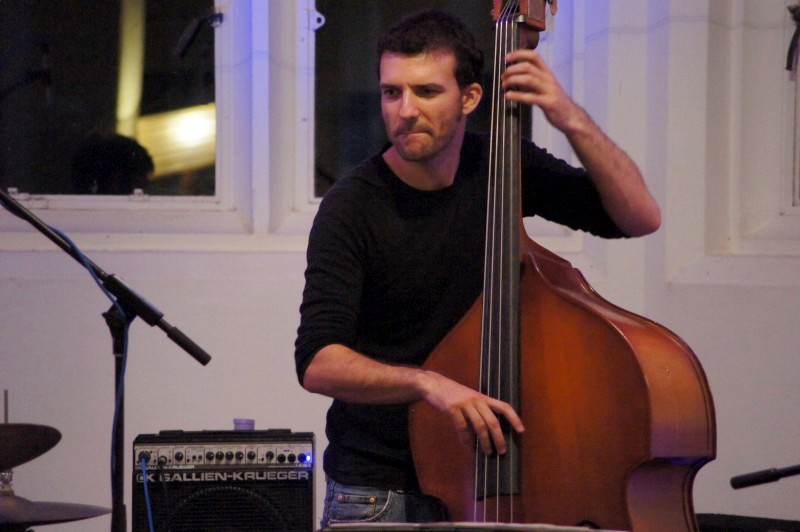
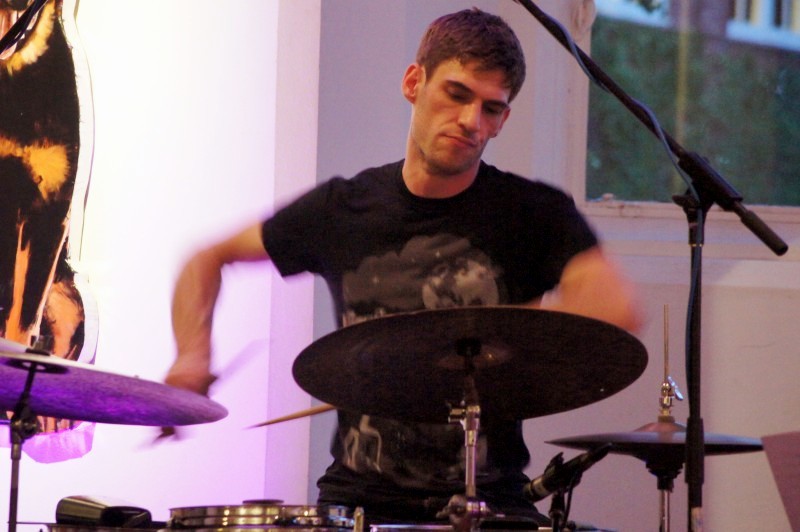
A gig like this just floors me and reminds me of the best of jazz, the chops, the intensity and invention, the commitment, the unpretentiousness of it all.  Some pretention might be deserved, given the quality of playing, but I've seldom seen it in jazz.  Despite the immense harmonic and rhythmic knowledge and huge but ever-developing playing skills.  But jazz musicians are always learning, even the greats, so humility is common.  So it was with Waveteller, despite a breathtaking gig.  This was just a Sunday arvo gig at Smiths, to too few audience, but I for one just chuckled with the devastating playing and interplay and interesting, tangled compositions.  This is music written by bassist Michael, played with Casey and Ed.  They did 11 tunes in two sets, all originals, some from their first CD and others coming out soonish on another.  It had me counting (as in 6-6-6-4 or 6-6-6-6/6-6-6-6-2// or 10/8 as 4-4-1+2).  Then the harmonic movements, some lovely bass solos and devastating, razor-sharp polyrhythmics throughout (ah, that's Ed on drums!) and playful and sustained lines of long and longer intervals on piano.  Not sure what more to say, really.  Checkout Waveteller on Spotify or Bandcamp, but I doubt they will be the same on record.  I find live is just something beyond.  And this was: a devastating furnace that had me chuckling at the audaciousness of it all.  Fabulous.

Waveteller are Michael Mear (bass), Casey Golden (piano) and Ed Rodrigues (drums) and the played one Sunday afternoon at Smiths.

04 May 2016

Quest


Casey, Bill and Ed, and especially Bill and Ed, are old friends of CJ so written up often enough. Even so, this was their first performance in this group at the Gods, although they had all played there in other formations over time. Surprising given they've played together for five years. It's no surprise that I admire them for the Casey's superb phrasing moving cleverly around the chordal structure and Bills superbly accurate playing that can explode but is kept in lyrical control most of the time and Ed's quiet and intense percussive movements that play with colours of instruments and lead a mobile take on the underlying pulse throughout any tune. This is intense and skilled but disciplined. All that we've seen developing over the years but displayed even more strongly after these years together and this post-tertiary training time. They played several originals, I think from Casey's pen, and a few standards and jazz tunes. We know the standards so understand better how they improvise their take on them. I should care is a cyclic standard from the movies and the Great American Songbook so their take on this is demonstrative: inventive, playful, sequenced phrases and mobile time feels and a sweet, driving but relaxed walk. Giant steps was more elusive; Fee fi fo fum evident but divergent. The originals were complex in time and often in changes, again mobile in feel and intensely interacted. All the tunes were that: they play like they've played together for time and they have. Perhaps the showpiece was a 25min number that they'd just recorded for release sometime soonish: long form; 3 parts; a certain chordal regularity. Bill laid down his best solo of the night - awe inspiring - and Ed finished with one; Casey was ongoing with his malleable phrasing. Amusingly Casey himself said later in the night he only wishes to hear so much music like this, intellectual and complex and challenging as it is, but this just tells the value and loftiness of this music. Stunningly rich and intellectually satisfying. The quest continues.

Casey Golden (piano) led a trio with Bill Williams (bass) and Ed Rodrigues (drums) at the Gods.

06 March 2015

Distillations


Casey, Bill and Ed - the Casey Golden trio - are friends of CJ and I've heard them and written of them here several times, but I was still surprised when the music started. This was so quiet. Bill's tone was so close to acoustic. It's what they try to do, but it's uncanny. He had an amp. You almost wouldn't know it but you know he must have one otherwise you wouldn't hear him when he plays quite so gently. Bill can ring a string but often it's just a touch that forms a note, placed just right, sparse, unadorned, nothing excess as this is. Ed is doing something similar, always responding to Casey, always active but it's big tension under tight control. It's accompaniment and colour and interpretation more than obvious beat; the beat is there but implied. I feel Casey is the core, but that's nothing unexpected in a piano trio. He's playing richly embroidered lines or dense, complex harmonies. I follow a melody line and it's long and contorted before it repeats. I listen to the most colourful of harmonies and wish for a piano to do this justice. The tunes were all originals from one or another CD, especially their new one, Outliers, that's had good reviews around the world. And from another, Live at Bennett's Lane, recorded for Mal Stanley and ABC. The covers are all stark in complex black and white drawings; the music is similarly precise and resolute. They played a swinger at Geoff Page's request: Herbie Hancock's Dolphin dance, that wonderfully musical modern theme. I felt it was an entree to their thinking and playing. Again, the precision and listening and gentility; the melody appearing often but not interminably; the swing swung, but interspersed with spaces and implications; still the quiet engagement with each other and the music. It's easy to receive originals in their own context, but to hear a reworking like this on a known piece was a revelation. All strength to Casey, Bill and Ed. Profoundly satisfying stuff played with outstanding skill.

The Casey Golden Trio are Casey Golden (piano), Bill Williams (bass) and Ed Rodrigues (drums). They played at Smiths.

27 June 2014

Casey Bill'Ed


Bill and Ed were so frequently written up here in recent years, while they were top students at the ANU Jazz School, that I wonder what more to write. Casey is not local, but I’ve also heard him several times, mostly with Bill and Ed. Ed is still the immensely committed and responsive drummer with close control and restrained volume. Bill was quiet too (a bit too quiet for my ears) but he stepped up when his frequent solos came around, and spelt out careful melodic snippets leavened with quicker runs, all with firm expression. Casey would frequently enter with solo intros, leading into complex arrangements, odd times, unison taps and the like with his colleagues, purposeful sequences and impressionistic colour. He told Geoff Page and me that he’d studied the grades of classical music and was pleased when Geoff identified the French impressionists as an influence, Debussy and the like. There’s tons of colour here and also spaciousness, and the trio works a treat with a cerebral music that entices with beauty and immense delicacy and close listening. Bill and Ed can stare at each other and at Casey at times and smiles often ensue. Casey often bends over the keyboard, but he’s smiles at the end of a tune too. Here’s a band that plays music of utter seriousness and the achievement shows, proud but never conceited. This is art as it’s made in modern Australia: unpretentious but skilled, informed and deeply serious.

Casey Golden (piano) led his trio with Bill Williams (bass) and Ed Rodrigues (drums) at Smiths

25 February 2013

As the alembic


I was recording, and with the first notes I worried that I’d set the gain control too high. This is a band, after all, with drums. You expect some volume. But the Casey Golden trio was playing at a level that I virtually strained to hear. The drummer was Ed and I know his so-subtle stick play, restrained in volume with an uncommonly intimate contact with the skins. And bassist Bill was there, too, clear but understated, each note precise and with intent and absolutely without superfluity. These days, his playing is sparse, although occasionally visited with little fills of teeming lines or repeated notes or dropping into fast passages and walks when required. And Casey himself, bent over the piano, delicately laying out sequences or melodies or standing as foil to a written bass line of simple clarity. The members moved the focus around the band but virtually without signal, sometimes a short bass solo, or piano featuring but unobtrusively, or a mild ostinato and one of Ed’s blisteringly developed solos. Given the restrained presence, I got to wondering about the PA: one wedge as a monitor for Ed and one feeding the audience and balancing the piano on the left of the stage. Chris Deacon was recording; was it ArtSound’s? It turned out to be Ed’s, with mics for bass and piano, presumably placed to ensure everyone, on and off stage, heard the subtlest details. The result was so slight that you hardly noticed, but it’s an indicator of the detail and distillation of this music. Distilled is the adjective I kept thinking: pure, clean, perfected, tight as, shorn of surplus and the low volume level was indicative. These were highly developed skills, playing detail with precision and control, notes when required and only then, everything considered and limited to the necessary. They played Dolphin Dance and a bop head for an intro, but otherwise this was original music by Casey. The progressions were often quite simple. I’ll enjoy listening back to the recording to better understand the melodies and broader structures, like the unison lines and starts and stops of the arrangements. But the effect was pure: delicately formed and subtle jazz. How good is this? Casey Golden (piano) performed with Bill Williams (bass) and Ed Rodrigues (drums) for too small an audience at Canberra Grammar Gallery.

26 July 2012

The second of two colours

Just a short report on Casey Golden and his trio who I caught for one set just after Amarcord. I reported just a few weeks back on Dave Rodriquez performing with this trio: Casey and Bill Williams and Ed Rodrigues. This night, I heard Bill and Ed as eminently similar in style to when they were performing with Dave: powerful in restraint, emotional, communicative, virtuosic. But to my ears, Casey sounded different here. He performed a few standards – Nardis and Fee Fi Fo Fum and another – and two originals in the set I heard. This was a trio that moved the feel and interpretation constantly, always listening, wick lit but unexploded. Not loud but intense. I heard Casey as more modern here, rather than contemporary and soundscapey as he was with Dave. This was right hand lines and left hand chords, moving dissonances and some sharp, unexpected rhythmic jolts in melody. Bill was all ears, heavily syncopating, openly resting and occasionally swinging. Ed was forever in rhythmic counterpoint with ever changing tones and patterns and snares released and recovered and the thinnest of cymbals and rivets in his bass drum. I’ve watched these guys and they continue to startle. It’s no surprise that they perform at Sydney’s 505. They deserve it. This is wonderfully fluent expression and restlessly motile. Casey Golden (piano) led a trio with Bill Williams (bass) and Ed Rodrigues (drums) at the Loft.

  • Cyberhalides Jazz Photos by Brian Stewart
  • 23 June 2012

    Baghdad, maybe Paris

    I heard Dave Rodriguez’s quartet as American music with an air of desperation: open plains, dry mesas, straight roads. Think of the film Baghdad Café, or perhaps Paris Texas, ie, road movies.The music was open, sparse. I heard drum’n’bass grooves, all sorts of guitars: screaming rock or jazz and reams of effects - echo and synth and loops and swells and wah and more, sampled voices. Someone commented how broad is the jazz palette these days. These are not standards and I’m not sure I heard any swing, but this music is informed by mainstream jazz skills. I remember Bill saying once how great a training ground were the standards, but this was even eights and solid ostinato bass. Ed was replete with his detailed, wonderfully dynamic and bodily-involved drumming, touching with all the grooves and melodies. Both Bill and Ed played some hugely expressive solos, tempered and lyrical but also with releases into furious cadenzas or longer passages. Ed was telling me after of the complexity of the drum rudiments that can be inverted and otherwise contorted to make hundreds of different patterns. You could hear this technical fluency in both these players: there’s intense application here. Casey was not so much right hand solos and left hand chords as rippling harmonies and minimalist change. He played solos that were integral to the music rather than flying over it but they still built energy and excitement. The tunes had titles like Open snow expanse in Middle-Eastern Europe or Sick new one. Fantasdick raised a chuckle when introduced and featured some hip-hop beats which I thought was apt. I saw the charts later, and they were also sparse. Bars of whole and half notes with moving chords and occasional dots, some eighth notes, and one long passage of sixteenth notes played unison. Brian suggested subtlety and finesse as descriptors. Keith mentioned Charlie Haden and the reference seemed right to me with his concern with song and melody and this floating unhurried feel. This was music that moves far from the jazz mainstream and will talk to many audiences. I enjoyed it immensely and I wasn’t alone.

    Dave Rodriguez (guitar) led a quartet with Casey Golden (piano), Bill Williams (bass) and Ed Rodrigues (drums) at the Canberra Grammar School Gallery. I lost my photos so the promotional banner will have to do.

    23 October 2011

    Take them anywhere

    Ed was wearing a t-shirt from Smalls Jazz Club NYC last night when he led his Edband at the Loft. It was a return for some recent masters graduates from the Jazz School, Bill and Ed, with a few mates they are playing with in Sydney, Casey Golden and George Nickolopolous. We got standards and some tunes from some current NYC heavies, but this was not just any standards gig. This was incredibly hot: both difficult and less difficult tunes, played with energy, precision and power and just a bliss to my ears. You could take them anywhere: no way would they be out of place at Smalls.

    Ed was hugely energetic, but he’s also matured since leaving Canberra. He was always precise, always dynamic, always responsive to the guys he’s playing with, but this is taken to another level. This is professional, sharp as, hugely dynamic, precise rolls that end to snaps, whole body and face responding to the music, that frequently twirled stick just evidence. Bill was quieter this day, but always precise: lovely intonation, very quick when he chooses to be although he mostly plays thinkers’ solos. Reliably rhythmic in support and with a wonderful tone from top-end clarity without scratchiness or honk. Casey plays piano and that’s a favourite of mine especially on a decent acoustic grand piano. He played some lovely, clear, fast bebop lines but also atonal patterns, and he played with time, variously with anticipation and delays and a frequent disregard of the barlines. There was a nice sense of variation and development in his solos, building, moving, changing harmonically and melodically inventive. Guitarist George was a different animal. He sat easily, often not playing, behind other solos and played melody with disarming simplicity and restraint, but his solos were urgent, fast from the top, berretta-rapid lines. His earlier solos were of a more obvious harmony, but they developed through sequences that moved high over the tunes’ structure and he surprised me later with some touches that were harmonically and rhythmically free. The sound was fat and deep with electric thud and an edge of echo and the effect was hot and sweaty.

    So I liked the band. And the tunes. Dolphin dance started the night with the most delightful sparseness that was touched with occasional walking swing. It’s you or noone was a hard hitting workout. Isfahan was a ballad with understated guitar melody over colours from piano and brushes. Then My favourite things reminiscing of Coltrane and a pop song, Mad world, which was nice and chordally simple (Bill got a rest). The second set was more adventurous. Chick Corea’s fabulous Matrix was wonderfully tight and alive with its contorted logic. With its urgent and bent head, I‘d forgotten that it’s just a blues. Then two tunes by Ari Hoenig: The Painter and an arrangement in changing times of Coltrane’s Moments notice, mostly in 7/8 but also 5/4. These were difficult tunes, and the playing was hot and so tight. Then Albermarle by NYC saxist Will Vincent. It’s 6/8 with defined rhythmic arpeggiated bass and Bill was reading and obviously concentrating here. Then to finish, what else but All the things you are, but in cycling time signatures: 7/8, 5/4, maybe 4/4, maybe others.

    This was one to lie back and take in as the storm passes over you: energy and precision in equal and generous parts. Bill and Ed blew in from Sydney to play for old mates and it was a blowout. Welcome in the best clubs. Ed Rodrigues (drums) led his quartet, EdBand, with Bill Williams (bass), Casey Golden (piano) and George Nickolopolous (guitar).

    09 May 2010

    Back to the Belgian

    The Belgian Beer Café has been under the hammer recently for restoration. I couldn’t see the difference, but at least now it’s open and Dave, Bill and Ed have returned. This time, with James sitting in for a set. The DBE trio concentrates on playing the standards, and they play them with real love and conviction. The tunes deserve it. They are standards for a reason: because they are great songs. I caught four tunes: Beatrice, Stella, You don’t know what love is and Solar. Solar was sprightly as a modern up-tempo number; You don’t know… was beautifully gentle as a ballad. Beatrice and Stella were played as medium tempo. Easy but demanding solos all round, including by bass and drums. A thoroughly comfortable but imaginative set. The beers are interesting (and appropriately priced) but there’s no cover charge. If you haven’t caught this gig, get down there (Sundays, 3-6pm, Kingston). It's wonderful, committed playing at a high level. Dave Rodriguez (guitar) plays regularly with Bill Williams (bass) and Ed Rodrigues (drums) and James Le Fevre (tenor) sat in for the first set. I was caught without my camera, so my mobile had to do the honours: just to explain the very modest quality.

    18 December 2009

    Ambassadors

    Miroslav Bukovsky and his quartet played the Bruschetta Café on Thursday night. This is a sublime band: the most subtle and virtuosic of the recent students with the mature master and new compositions all round. From the first tune, I thought story-telling. The musical structure was not complex, but the playing was exquisite and pensive. I thought Film Noir with dark alleys and the unkempt, self-damning detective. Think Charlie Haden and Quartet West: purposeful and restrained, precise but with humanity and humility. This was deep, demanding, concert material. The attention level was pretty good in the space, but it was also a restaurant and some people were presumably there for other purposes. Fair enough, and their chatting was mostly curbed by the attention lavished by others in attendance or by one or other of the stunning solos. And the solos were fabulous. Ed positively overwhelmed the space as he developed from the lightest of taps to the most intense of percussive extravagance. Miro dropped eminently tuneful little turns of phrase or descended into long and sharp scalar runs that weaved though dissonances and ended at unexpected places. Luke was muscular in volume for his jaggedy lines, richly extended chords and mobile dissonances. Bill was the great listener, waiting for the muse and then explosive with fast runs, always with honey smooth tonality and long sustain and accurate intonation. No-one standing on anyone’s toes; no interruptions; close listening and huge dynamics. Miro has obvious influences from Miles so no surprise when I heard suggestions of Sketches of Spain in some passages. And I thought later Miles while listening to Luke’s piano a times, but he’s broader in conception than just this one style. To me, this was chamber jazz, meaning intimate and perfect for this audience, but not the French polished form that people often use this term for (here I think MJQ). This had depth of soul and passion, despite the perfection of the presentation and the clarity of intention. This band has recently toured interstate and we may get a CD out of them at some stage. Good, because they are excellent ambassadors. This really is music at the highest level of the local scene, and we are blessed to be able to hear them, and doubly so in such intimate surroundings. Excellent, profound music, and thanks.

    BTW, the Bruschetta Café is a new University of Canberra venue which seems to have good support from the University. It promises to stage some prominent acts in a nice concert environment over the coming year. UCAN does lots of interesting musical things: community choirs and orchestras and the like. And the price, at least for Miro last night and for Eric Ajaye’s Vertical a month or so ago, was unbeatable: free. Well worth your support, and perhaps a pre-concert dinner.

    Miroslav Bukovsky (trumpet) played with Luke Sweeting (piano), Bill Williams (bass) and Ed Rodrigues (drums).

    14 November 2009

    Kind of blue

    Miroslav Bukovsky and mates presented a tribute to Miles a few months ago. I missed because I was overseas, so I was happy to see that it was to be reprised at the Alliance Francaise. The tribute was called Kind of Blue, but it was more a celebration of the late-50s Miles by one of his many admirers, Miro. They played all the tracks from Kind of blue, with occasional transcriptions and the addition of intros as on the album. But they also played three tunes from the Louis Malle film, L’Ascenseur pour l’echafaud, and a tune called MDD (Miles Dewey Davis) that Miro had written on the day Miles died, along with Milestones, that early modal piece from Miles’ hard-bop, pre-cool era. And very satisfying it was, too.

    Most of the tunes from KoB have become jazz standards, and we hear them regularly when jazzers are blowing: So what, Freddie Freeloader and All blues. Blue in green is less common, as is Flamenco sketches. These later are lovely, pensive pieces with Bill Evans harmonies and both were a joy. It was nice to remember that even the common tunes were actually fairly slow and cool in the originals, while they are often now performed up-tempo and with verve. The horns up front were lovely, with those simple, stark but effective melodies to start each of these minimally composed numbers. The soloing was good by all throughout. John’s powerhouse tone and showers of notes and a bible of substitutions. Miro with his Harmon mute for the gentler numbers, or rapidly running the changes with blaring trumpet volume. Sebastian more bluesy then dissolving into dissonant lines and honks and interval studies. Joe Lloyd ever the emotional, passionate downhill run across the whole range of the alto. The rhythm section was another batch of local stars. Luke’s comping was imaginative and responsive and leading but also understated. Ed was the sharp and precise across the dynamic range, constantly changing tones and sounds on his kit with different sticks of mallets or brushes. Hannah was regular and solid throughout long, fast hard-bop walks, up into thumb positions and down to the low E-string. The rhythm section soloed with panache, too. Hannah’s solos were well-formed little gems that were especially memorable on the gentle pieces like Blue in green . Ed’s solos were also short, but strong and clear in intent. Luke’s were rich plays with harmonies as only a pianist can do, right hand working busily up and down the keyboard.

    The three tunes from L’Ascenseur pour l’echafaud were new to me. Miles extended a visit to Paris and recorded the soundtrack for this film for release in 1959. Three tunes: the first was a classic, plaintive Miles melody with Harmon mute. The second was a rolling swing. The third was a fast swing, light and slightly unstable, careening, which appeared in the film behind a car chase. The final tune of the night was an elegy to Miles by Miro. A lovely tune played with feeling and sometimes funereal drums from Ed. So, a satisfying night. A few transcriptions, but mostly original playing influenced by the master from this masterful period of the last 1950s. Much enjoyed.

    Miroslav Bukovsky (trumpet) led a band with Joe Lloyd (alto sax), Sebastian McIntosh (tenor sax), Luke Sweeting (piano), Hannah James (bass) and Ed Rodrigues (drums). John Mackey (tenor sax) appeared as “+1”.

    28 October 2009

    Moruya 2009, farewells

    There’s always a theme that you take from a festival. For me, Moruya 2009 was a farewell for some mates I’ve watched develop over recent years at the jazz school. Now senior and finishing students, they are off to Sydney and will be missed around town. I treat this report with some imprecision, because only some of those below are moving on, but the group plays together and can be discussed together.

    Bill Williams (bass), Ed Rodrigues (drums) and Hannah James (bass) are the three leaving for Sydney. We wish them well, and they certainly deserve it. The three of them all played impressively, even stunningly, over the weekend. Perhaps the best I’ve heard them, certainly amongst the most memorable.

    H.E.L. is an acronym for Hannah, Ed, Lily. Hannah James (bass) with Ed Rodrigues (drums) and Olivia Henderson (piano) played a wonderfully busy and involving set early in the day. There was an original by Olivia, but also jazz standards: Oleo, Invitation, Fee-Fi-Fo-Fum and Horace Silver’s Nica’s dream. Jo Lloyd (alto) also sat in for some screaming, outlandish playing which always thrills. It was a great start for the day, and a challenge to the bands that were to follow (including mine!) I missed Hannah, Ed and Jo reprising some of these in unplanned set later in the day, but it was also well spoken of.

    Luke Sweeting (piano) plays regularly with Bill and Ed, the three being Masters students at the Jazz School this year. Luke’s truly a harmonically rich and intelligent player. A pianist mate was commenting on his voice leading and counterpoint and harmonic alterations. Luke played an unusual duo set with Rachael Thoms (vocals) with a feature tune by Paul Grabowski recorded with Katie Noonan. Contemplatory and sedate, but with vocals flying into the stratosphere and complex interplay between the piano and voice. This tune was especially complex and a challenge but generally so was the rest of the set: unexpected and satisfying.

    But the star event of the day for me must be Edmirobilluke. The name says it all: Ed Rodrigues (drums), Miroslav Bukovsky (trumpet), Bill Williams (bass) and Luke Sweeting (piano). The last set of the night is always the product of a busy day and a good warmup and some tiredness and is awaited with expectation. This was a stunner. The band was all playing at their most exhilarating level. Solos merging through melody, consonance and dissonance and complexity on call. All merged into a set that little distinguished heads or solos or ensemble playing. Original compositions that were heartfelt, unforced: powerful and stylish vehicles for open playing. Superb dynamics that just flowed between and through and amongst instruments so no-one took prominence yet everyone was essential. Gentle, busy, pushing, moving through feels and emotions with ease and inevitability. A stunning and worthy display of original improvised music. My last report on this band at the Gods did not do this gig justice. An excellent performance by Ed, Miro, Bill and Luke.

    To finish off, I have just one little observation of jazz and its adherents. Someone mentioned to me in passing how pleasant are the jazz crew, and it’s true. There’s a confident, snappy air about them. Sometimes there’s a gruff exterior on the guys, but anyone who commits themselves to such a demanding and profound pursuit has to be an admirable type. So I thought as I was looking around the Air Raid on Saturday evening. But jazz isn’t always surrounded by such types and has a colourful history of associations. I’ve experienced several post-gig threats of violence: at Wagga JF, in London, recently in Prague and locally after Hippo. And this time, as I left Moruya, I caught sight of a smashed car windscreen that spoke of small-town anger and frustration. And then another on the drive back, somewhere outside Bungendore. I’ll stick to the jazz, thanks.

    Best of luck to Bill, Ed and Hannah in Sydney.

    07 October 2009

    A return home

    After new places and faces on the jazz scene, I’m welcomed back to Canberra with Miro and mates playing for Geoff Page at the Gods. It’s homely, but I don’t mean that in a demeaning way. These are capable players performing music that’s original and new, although with resonances of Miles around the jazz-rock period.

    I’d heard this band at the National Portrait Gallery some time ago, but it’s developed since then. The compositions are still original, although I think it’s a newer repertoire, with tunes mainly by Luke and Miro, but also with one by Bill. The music is convincingly brooding, intense and atmospheric. The grooves are gentle and sustained. The solos build naturally to high points and with low, slow interludes. They are well-considered solos with dissonance and development and thoughtful search is evident. That’s something I’ve noticed developing in the more mature students. There’s evident knowledge (all the scales and arpeggios, etc) but it’s used for a purpose: solos have speed, but it’s not constant, rather it’s a natural outpouring from a search for a melody, or a way to navigate a tune.

    This band is a combination of the old hand, Miro, lecturer and long-established international composer and performer, with top students at the end of their masters year. The students have been playing together for years, and the interaction shows. I noticed open gazes and with clear, unspoken interactions. I’ve often spoken here of Luke for his chordal and harmonic conceptions, Bill for his speed and clarity, Ed for his intimacy and fluidity, Miro for his maturity and strength and charming but uncomplicated melodies, so I won’t go through it all again. Suffice to say, this was an impressive outing with considerable sensitivity and inventiveness and lots of new and interesting compositions, and I enjoyed it lots. Miroslav Bukovsky (trumpet, flugelhorn) performed at the Gods with Luke Sweeting (piano), Bill Williams (bass) and Ed Rodrigues (drums).