Showing posts with label DW. Show all posts

30 August 2010

So sounds the Harlequin

Text and pics by Daniel Wild

The Harlequin is an appropriately named venue for jazz performance. In eighteenth century Italy, the role of the harlequin was to play the buffoon in an improvised drama. Just as the performers worked from a rough script and pre-set roles, so do the jazz players of today work from sketched chord charts and preconceived notions of what it is to be a lead, bassist or drummer.

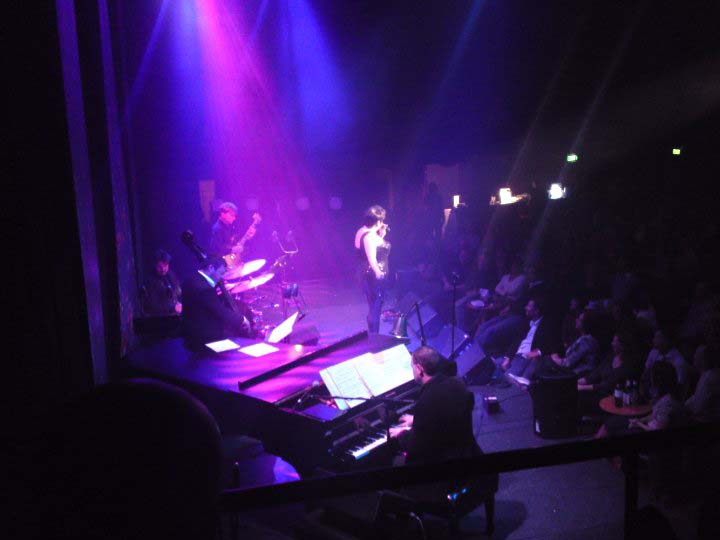
Lindsay Winkler’s quartet provided laid-back and swinging musical soundscapes at the Harlequin in Pyrmont, Sydney. This is a pleasant venue for jazz although the many television screens, multiplied by mirrors, proved distracting for audience and musician alike. The musicians didn’t falter in their improvisation but you could see their eyes wandering towards the screens now and then, and this might have limited the interaction they achieved with the audience and among themselves.

They played “Milestones” at a steady pace, refreshing for a piece that is often played too fast. Granted, the modal structure allows for fast renditions and displays of virtuosity, but note Bill Evans on the Waltz for Debby album, where he showed that the soloist who pays heed to the underlying structure can tease out quartal harmonies. Quotation and exploration of the opening motif are also possible when playing this piece on its merits.

Winkler was a bit rough and squeaky around the edges when quoting the head; once he settled into his solo there were some smooth and vintage alto sax lines. Monique Lysiak’s solo on Milestones was exceptional, indicative of many years experience and a well trained ear. She listens thoughtfully, builds on the main theme and subtly varies it through different tonal centres and pitches. The way she colours her solos by using the whole keyboard is intriguing to the listener. She builds the expectations of the listener. Expectations established, she then made use of what sounded like quartal chromatic ascents that lifted the solo to another level before safely returning to earth in time for Shannon Haritos’ bass solo.

The bass provided solid ground work for the keys and sax and the solos were interesting and executed as if he Haritos was plucking a guitar. She makes the playing seem effortless and has a deft command of the instrument all the way up the fret-board. Her solo on a dreamy rendition of “All the things you are” and on a bluesy piece in F minor were well appreciated by the audience.

“Stella by Starlight” was romantic, dreamy, impressionistic and very satisfying. Winkler seems most at home when playing ballads. He moves the listener with silken tones and thoughtful phrasing that moves like a wave up and over the floating bobber on a fishing line.

Sam Barr’s drumming was solid throughout. Perhaps there was an overuse of the kick drum, but this is purely a subjective assessment. Many like the emphasis that the kick drum can give to a peaking lead phrase (especially in fusion); others feel it has only a minimal place in swinging jazz and should be used gently, if it all. Barr’s solos are always a pleasure to hear. He quotes military themes and is not afraid to overtly experiment around seemingly simple motifs on the snare which are then incorporated into more complex sallies around the whole kit.

The band was tightest when playing medium swing pieces, although there were commendable aspects to every standard they performed. The last piece, BlueTrane, requested by the audience, was one of their best, with deep and harmonies on the keyboard that showcased Lysiak’s touch. At the end of the bass solo, Lysiak made the mistake of telling Haritos what key the piece was in and what note the bass line should centre around. It is best in jazz to leave these things to chance and the musician’s ear. All things considered, there were worse things to be doing on a Sunday evening. This light-hearted jazz, not worn on its sleeve, provided a much needed post-election antidote.

Lindsay Winkler (sax) performed at the Harlequin in Sydney with Monique Lysiak (piano), Shannon Haritos (bass) and Sam Barr (drums).

17 May 2010

Under the House

Text by Daniel Wild; Pic by Sisiely Wong

Nestled in the bowels of the Opera House is The Studio, the perfect venue for variety show Late Night Lounge. Comedy, cabaret, death defying stunts, magic and good wine is the order of the night. Eclectic music accompanies many of the performances – folkish music, tongue in cheek rock and modern lieder with a gothic twist keeps the audience challenged and smiling. Intriguing for music lovers is the House Band – read whoever’s in town. Tonight we were treated to jazz musicians Matt McMahon, Jonathan Zwartz, Carl Dewhurst and drummer Evan Mannell. I wasn’t expecting to see so many top-flight musicians earning their crust in such a variegated fashion. Mannell certainly had the best view for a number of notorious acts – he kept the beat while stockinged buttock cheeks flapped in his peripheral vision during a voluptuous rendition of Turn Back Time. His concentration and courage should not go unrecognised.

The House Band under the direction of McMahon accompanied guitar duo Dog Trumpet – Peter O’Doherty and Reg Mombassa, founding members of Mental as Anything – as they plied their original material from 2007 album anti-social tendencies. Zwartz executed a rollicking bass line while Dewhurst added texture on the third guitar. McMahon has great dynamic sense, knowing when to bring the piano into prominence and when to fade it into that zone where it can just be heard.

In the interval the intimate cabaret action turned jazz club; while patrons procured more champers and beer, the house band played Nostalgia in Times Square. How many people in the audience knew what they were listening to? Such is the nature of jazz that it can add atmosphere, class and communicate directly with people who prick up their ears at such moments. A sharp nine chord can draw the attention of someone waiting at the bar, while a pentatonic run can just as quickly sooth them back into complacency. This laid back style of jazz is perfect for encouraging the audience to mingle, chill and prepare themselves for another descent into heavenly seediness.

If you want to be surprised, shocked and lulled by the beauty of midnight song, get tickets to Late Night Lounge – they sell fast – and be entertained by the sheer (literally) variety of song, dance and provocation that takes place every month under Sydney’s iconic ‘House’. You never know who will turn up, and it’s a good place to see what musicians do best – getting a pile of sheet music and told to play, swing and rock.

14 April 2010

Mainstream jazzativity

By Daniel Wild
Pic borrowed from Experiment Street's FB site, with thanks

Nestled in between Kuletos and the Marlborough Hotel in Newtown is a new type of establishment popping up over Sydney since the relaxing of the licensing laws. The Corridor appears to be a slim terrace turned into several slick and intimate rooms, or rather a series of corridors on different levels, flanked by modern art with pop-culture references. In the top room are some comfy chesterfield chairs and sofas. I commandeered one of these to hear the jazz quartet Experiment Street play for a relaxed group who enjoyed the food (dips, antipasto), wine and chill jazz.

Lindsay Winkler and Mike Walder entered the room on sax and bass to give us extended ruminations on Stella by Starlight, before Roman Pulati on guitar and Steve Lamante on drums casually added the rhythmic texture that brought the piece into full view. Pulati’s punctuated sharp nine chords and parallel work up the fret board provided underpinning and responses to Winkler’s silky sax tone.

Some straight ahead pieces followed, the four/four beat more pronounced, but that didn’t detract from the flow and rhythmic momentum of the group. It is becoming more common for jazz musicians to write straight eight compositions and arrange older standards into the straight eight format. The lack of triplet swing figures was more than made up for by Lamante’s regular tapping on the high-hat, with an offbeat accent every four or so beats to add movement.

Does one need a constant dum-de-dum to be reminded that obviously that jazz is supposedly all about swing? Lamante has a sharp attack and his snare attacks break the air with crisp sharp, yet nuanced thwacks. Even with brushes his dynamic range is large and his tone well defined. He supports the soloist well and knows when to add a couple of well-timed rolls to boost the impact of an evolving solo.

There are more subtle rhythmic shifts alive in jazz today, and the smooth jazz feel is increasingly sought after by audiences who don’t always want to be rocked to the core. Experiment Street choose their numbers wisely and play to the audience. When the pace gets more upbeat, Winkler adjusts his style accordingly. Like Pulati on guitar, he knows how to build a solo.

Winkler is very good at communicating with the rest of the band and it is a delight for the audience to bear witness to the spontaneous creation of confident, heartfelt music, where the musicians are definitely having fun.

Experiment Street finished with “You don’t know what love is”, a moving medium paced ballad that transported the listeners and had one man down on the floor praying for an encore. Experiment Street will regularly be performing at the Corridor so if you’re walking down King Street on a Tuesday night, why not drop in and discover the new faces of Sydney jazz. The Corridor is tapping into the speakeasy market, and Experiment Street knows that audiences are still keen to hear some no-nonsense, expressive main-stream jazzativity.

Experiment Street performed at The Corridor in Newtown, Sydney. ES comprises Lindsay Winkler (sax), Roman Pulati (guitar), Mike Walder (bass) and Steve Lamante (drums).

30 March 2010

Clear(l)y a long way from Kent

By Daniel Wild

The pic is Jon Cleary performing at Treibhaus, Innsbruck, 2008. Thanks to Svíčková for releasing the pic into the public domain at Wikipedia Commons.

Despite the threat of rain – and it being a Monday – the intimate upstairs lounge of the Macquarie Hotel in Sydney was full to capacity for Jon Cleary’s vibrant and smokin’ piano. Touring down under from New Orleans, Cleary clearly knows how to get an audience swinging and foot-tapping. He combines blues and boogie-woogie, with nods back to classical virtuoso technique and forwards to the straight minimalism of pop, all the time retaining the sincerity and spontaneity of rhythm and blues and soul.

Jon Cleary was born in Kent, England but spent 20 years immersed in the life of New Orleans. Outfitted in flat cap, jacket, beige pants and sunnies, Cleary looked like he could play anywhere from a back alley pub or up-market restaurant to a 1930’s bordello. His playing is robust and his lyrics are heartfelt, philosophical and optimistic, touching on love lost and won and the gritty soul in urban life.

This was a solo performance where the performer has to draw all inner reserves of strength and rhythm to keep the collective foot tapping. Cleary had the energy and attitude to make it look all too easy. The rhythmic intensity of his playing and conviction indicates a lifetime of love for the old-school rhythm and blues.

His strong bass lines underpin tinkling blues rolls at the upper end of the keyboard. Often his hands are spaced over a metre apart as he pounds his bass lines with no thought of register, while playing dancing blues riffs with the right hand. The “no fear” approach in the bass brought out the full richness and sonic depth of the baby grand at the Mac and showed that the lower notes of a piano are meant to be played, not just occasionally stroked. He pushed the piano to the limit and it swayed and bobbed he percussively struck swinging blues notes over his solid 1, 3, 5, 7 walking bass line.

Some mid-piece adjustments of tempo were required to keep the feel and pacing steady – and to possibly accommodate the difficulty of some the passages, letting off a bit of the steam. His playing was never needlessly virtuosic. Instead, Cleary uses his instrument to evoke an era when rhythm and swing were more honest and the gap between audience and player was closer.

Cleary had remarkable stamina. He played one set that went for about 1 hour and 20 minutes and then gave an encore, finishing with Blueberry Hill. He must have strong hands to execute the trills and continuous three and four note riffs in the right hand with total fluency. Sometimes the left hand would follow its counterpart up the piano until they were both so high that it sounded like the splash of a thousand raindrops on a crystal pane. Then the two hands soared back down, chasing each other as if possessed by Rachmaninov. The crowd enjoyed these forays into the middle and upper-registers. Cleary’s hair raising chromatic chordal descents were a melange of harmony, and yeh they swung. Every set-play that Cleary executed was greeted by cheers and yehs!

The 80th birthday of Fats Domino was commemorated with a rollicking salon piece. Cleary had actually attended Domino’s party and remarked that he still played as if he was 50 years younger. Special mention was also made of Jelly Roll Morton.

In contrast to his energetic playing style, Cleary’s demeanour is laid-back yet engaging. He sometimes seemed lost in his world, doing his thing, singing his songs; occasionally he would glance at a couple of front-row audience members to ensure they were still having fun or hadn’t nodded off – surely an impossibility with this piano rocking music.

24 February 2009

Five easy Peaces

Text by Daniel Wild

Under the tiled roofs of Sydney’s majestic and architecturally bemusing opera house, two of jazz’s post-bop luminaries showed Australia the treacherous and twisting paths that jazz has taken since Miles Davis liberated the genre in the late sixties. The line-up was second-to-none: a melange of talent par excellence, a conglomeration of super-human skill. Christian McBride was on bass – he’s not bad, ain’t he? And Mr Kenny Garrett on saxophone. Garrett and Corea played with McBride on the bass player’s probing album, Number Two Express. On drums was Brian Blade.

To cut to the chase, to hunt down the hounds, all that needs be said is that McLaughlin was fantastic. Corea did the right thing and allowed him to steal the show. McLaughlin has done a Paganini at some point in his life and had a date with Mephistopheles. If you could compare how many notes McLaughlin can fit into a minute with the RPMs of a Maserati then McLaughlin would exceed the speed limit even on Germany’s autobahns. But unlike a lot of Tal Farlow (and even some Charlie Christian), who has the chops-supreme, McLaughlin also has the scales-supreme, and has access to a store of musical knowledge that Farlow never seemed to tap into. Any one who’s willing to gather an esoteric collection of instruments and then give the so-called assembled band an Indian name – and then create some formidable music – is going to be versatile; able to listen, plan, build tension, make the audience gasp with fear, writhe with enjoyment and applaud with enthusiasm.

But what can one say of Kenny Garrett? He’s obviously spent a lot of time practising in his attic. He began the gig with mild tones, searching for the sounds of his horn as they rebounded willy-nilly around the Opera House Hall with its bamboozling acoustics. By the fourth song Garrett had worked this place out and launched into what would become a Coltrane-esque solo. Who knows how long it went for? The time did not pass and the audience did not budge. Where did the last 20 minutes go? Oh, it’s interval. As we promenaded on the Opera terrace and watched the lights of Sydney’s CBD swirl on the harbour below, we thought of the weird places Garrett had taken us to. The elephants of Africa are in his song; the yowls of mistreated slaves; the liberation of the human spirit. Garrett has a repertoire of feeling and experience to draw on and knows how to wheedle an audience into his confidence.

Blade was a crowd favourite throughout the night. He knows when to embellish the lead player’s riffs and can construct extended meditations and rhythmic confluences in his solos. This also allowed Corea and McLaughlin time to rest and have a bit of a chinwag behind the piano. Christian McBride was a rock. If two formidable weavers of melody are at the fore the bass needs to be steady, ready to buttress the fall of the musician who misplaces a toe on the tightrope. He took a couple of solos, but spent more time ensuring Corea and McLaughlin had enough the space to unfold their matrices of sound.

Nothing more should be said about McLaughlin. He has to be seen or heard. Chick Corea provided searching and thoughtful accompaniments, only occasionally stepping into the limelight to build tension or take a few choruses. His soloing was refined and well-thought. In this quintet he has less scope to go out and can take fewer liberties than he might take in the Akoustic Band. He made a good decision to play the role of purveyor of rhythmic and harmonic nuances and let McLaughlin show the world what the human race is capable of.

This gig was worth a trip to the metropolis. It has been 40 years since Corea and McLaughlin played with Miles on In a Silent Way and this was their encore piece. A standing ovation was assured.

Chick Corea (keyboards) and John McLaughlin (guitar) led the Five Peace Band at Sydney Opera House with Kenny Garrett (sax), Christian McBride (bass) and Brian Blade (drums).

27 November 2008

Worldly Westies

Text by Daniel Wild, pics borrowed from WOW

Ascend the steps to the Hippo Bar and meet Way Out West – an eclectic sextet that’s hard to pigeonhole. The fact that they appeared on Wednesday night at the Hippo indicates they have some relation to jazz, but this is music for music’s sake. Leading the band is Peter Knight on trumpet, who keeps the band in groove with his towering presence, sure-fire gestures and glances that tell the band a modulation is at hand. Playing the saxophones is Adam Simmons – mainly on tenor, but he did pull out some type of soprano sax for some evocative melodic flights. A cursory look at the two horns might suggest this is another Hancock-esque or Art Blakey like jazz combo, designed to get the party moving and present the audience with familiar tunes or catchy riffs done with verve. But, even accounting for the absence of a piano, this is fresh and different.

Way Out West are based in Melbourne’s inner west, although are increasingly spending less time there due to the demands of touring. This is their third time in Canberra. As a Sydneysider I’m not familiar with the cultural melting pot of Melbourne’s inner suburbs, although after hearing this band, I consider myself an aspiring Melburnian and deduce that Melbourne’s inner west must be at least as good as Sydney’s.

Ray Pereira on percussion and Rajiv Jayaweera on drums were the rhythmic heart of this gig. Rajiv has an economical kit – high hat, crash and ride cymbals, snare, bass drum and a cute little “utility drum” just above the snare. There are no toms and his playing is far from cute. While Pereira lays down Afro-cuban rhythms on his congas Jayaweera keeps a steady, supposedly conventional jazz rhythm that lays the temporal groundwork for the music. On closer listening, Jayaweera’s “world” influences – Indian and Latin – are apparent. He will play his kit with hands, set up cross rhythms between the high hat and snare and interject a well timed cymbal crash that splashes like a smooth basketball-sized stone falling into a running stream. Rajiv’s solo in the second set was particular inspiring – the absence of floor toms ruled out the possibility of stomach-rumbling to rolls. Instead, he resourcefully crafted a compelling solo with his snare and cymbals, reminiscent of early Tony Williams. The texture of the solo went from transparent to dense and forceful. All the while Pereira provided him with driving support on the congas.

The rapport between Jayaweera and Pereira is an important feature of the band. Pereira opened the first set with a solo intro on what looked like a small tambourine and sounded like a miniature tabla. Pereira obtained quite a range of sound by applying pressure on the drum skin as he tapped it. By varying the pressure point he could bend the sound by almost a fifth.

Pereira and Dung Nguyen combined at the end of the first set to play one of their own compositions, perhaps written during a jam while the other musicians were taking tea. This type of music is always free, open and unpredictable. Nguyen is perhaps the chief stylist of Way Out West. He plays the guitar and some traditional Vietnamese instruments: the dan bau and dan tranh. His playing allows Way Out West to achieve their distinctive blend of jazz-fusion and world music.

The dan bau appears to be related to the Chinese erhu, but is plucked rather than bowed. A lever operated by Dung’s left hand changes the pitch. He can bend notes to his heart’s content, taking us to the jungle in the night or conjuring the mystery of a western ghost town.

Adam Simmons is particularly idiosyncratic on tenor sax. He lulls you into a false sense of security, beginning his solos with conventional bluesy lines. Then just when you think, cool – this is funky tenor stuff – he launches into bellicose squeals, heartfelt yelps, frogs in your throat growls, offhanded utterances and tones so high up the register only a dog could hear them. Simmons gets a really dirty sound out of his instrument; the type of tone that many believe is the only way a tenor should be played. Rather than the “here I am, let me seduce you with the straight talking sax” approach, Simmons employs the “hey you – you think this rocks? Well what about this eeeeee; or this awwgg; or check this out – yarnk yrank, cahhoooeee grisle grisle.” At other times Simmons backs up Peter Knight’s trumpet musings with underlying “harmonic Persian carpet notes” or lays out and smiles and dances with the upper part of his body.

Although the structure of many of the pieces is modal, Knight’s arranging allows for modulations, time shifts, texture variations and interaction. He has lots of colour to draw upon in this sextet and makes full use of it, turning his combo into a mini-big band.

Don’t let Way Out West surprise you. It’s easy to be lulled by the exotic eastern melodies and coaxed into a false sense of security as if you were a shepherd on the hills of Kashmir with your back turned towards the Himalayas. Then, like a resounding avalanche, Rajiv will smack the snare as loud as possible, your whole frame will shake, and you will awake – excited, curious and apprehensive.

Wednesday’s gig coincided with the launch of their latest album, Old Grooves for New Streets. Way Out West shouldn’t be compared to anyone, but if you like Waiting for Guinness, Monsieur Camembert or Arabesque and are looking for something with a more streetwise, worldly flavour, you’ll do yourself no disservice by buying this album.

Oh, and did I mention the bass player? It seems that by providing the very foundation on which the rest of a band builds lavish musical sallies, by being inconspicuous yet powerful, bass players frequently are taken for granted as just doing their job. If you focus your attention on Howard Cairns’ bass lines you will be amply rewarded. Cairns variation of the bass on beats three and four is particularly notable. Composers, bass players and solo pianists can derive much useful instruction by listening to how Cairns keeps momentum going and maintains interest with his subtle rhythmic and pedal point variations.

Last word has to go to Ray Pereira, who taught the bar how to properly shake a cocktail during a moody piece that climaxed with some almost free and very adventurous jazz. These episodes were always used sparingly and to release and express the growing latent tension. During one of these spells Pereira began furiously shaking what looked like some type of maraca, although it may indeed have been a cocktail shaker filled with cardamon pods.

Way Out West are Peter Knight (trumpet), Adam Simmons (tenor sax), Dung Nguyen (modified electric guitar, dan tranh (Vietnamese zither), dan bau (single string plucked instrument), dan nhi (Vietnamese violin)), Ray Pereira (percussion), Howard Cairns (acoustic bass), Rajiv Jayaweera (drums).

12 July 2008

Bronte gumbo

By Daniel Wild

As soon as the music started, the patrons at the Hippo arrayed their square and circular stools to face the band. The avid listeners remained like this for the night, some nodding their heads, others with head on fist in contemplation. Couples whispered asides about a particular musical moment that had struck a personal chord.

The Miroslav Bukovsky Quintet opened the night with a high energy piece called Shuffle. Like many of the compositions on display tonight, this one opened with guitar, electric bass and drums setting a groove.

In his first solo Bukovsky announced himself like a bugler leading an infantry cohort. He then retreated behind a series of nuanced propositions, like a Greek philosopher enlightening his elect following with some seemingly matter-of-fact thoughts. Then he changed to more regular eight and quarter note lines, before building up the tension by combining regular rhythms with the freedom that had opened his solo. Bukovsky is an adventurous player. He’s not afraid to make occasional adjustments to his tuning valve in order to reach quarter tones and blues notes.

Bukovsky warmed up on his Harmon mute before the first piece began, but hardly used it for the rest of the evening. Not that he needed to. He has a full dynamic range, can play soft, assertive and sharp, wistful or robust. He also spends a lot of time playing the mellower flugelhorn.

Nor does Bukovksy limit himself to his two horns. Spurred on by Evan Dorrian’s gutsy drumming, Bukovsky keeps two percussion instruments on hand. One is a cowbell and the other some type of large maraca covered in beads. If anyone knows their exact names then please post as comments at the end of the article. Bukovsky doesn’t grab these instruments to have a bit of fun between solos – he gives the rhythm section that extra bit more vitality and encourages cross-rhythmic dialogues with Dorrian. With Bukovsky keeping a steady beat, Dorrian has extra space to extrapolate some slightly ‘out’ drum motifs.

The second piece offered a complete contrast to the high octane performance of the first. It was a slow ballad by Greg Stott. Bukovsky said it proves Stott to be a sensitive type. In other pieces Stott certainly shows that he has the chops of Charlie Christian or Tal Farlow, but he is more than just a semi-quaver machine. His produces a large range of tonal effects on his semi-acoustic guitar, along with quartal harmonies and rhythmic devices. This piece demonstrated that he can play ballads and craft convincing compositions.

John Mackey’s solo in the ballad was particularly refined. His use of space and choice of notes ensure his lines are melodic without being sentimental. The sixteenth-notes are not overdone, but rather ripple the waters. Dorrian’s astute interjections on the crash cymbal emphasise and heighten, rather than intrude. His tremolo on the ride at the end of Mackey’s solo signalled the end of a journey and the awakening of new planes of consciousness.

Only when this new level of awareness was reached did Dorrian break out into ecstatic cross-rhythms in a pseudo-drum solo, beneath the reiterated head played by sax and flugelhorn. We were returned to Earth by a ritardando when Dorrian struck the thicker ends of the drum-sticks on the rims of the toms and cymbals.

The ante was upped again with Dorrian opening the next number with African inspired drumming. The guitarists joined him, Jason Varlet on bass creating a steady ostinato which provided the foundation on which the horns built vast edifices. John Mackey’s solo exemplified hard bop tenor playing and really sparked the audience. Fresh from his Coltrane tribute last year, comparing him to the master is stating the obvious. The rich sound he achieves and his ability to conjure rapid runs at will has to be listened to and cannot be described. Sydney saxophonist David Theak has similar versatility. Mackey’s solo was fast and vigorous and went out like a candle burning to the end of its taper.

The settings on Varlet’s guitar and amp were just right – a hard, round lower tone with softness in the upper registers. His ability to sit on a single chord and imbue it with variety, quick passing notes and dramatic modulations inserted at the right moment makes him ideal bass player for hard modal jazz. It was late in the first set when he got his first solo and it had panache. Varlet communicates well with Dorrian and when either of them sense they’ve gone too for out, a nod and a smile reassures.

Greg Stott’s modal sliding doesn’t change the implied chord but alters the colour and can lend different slants and angles to the solo lines. Dorrian always provides a steady beat at the beginning, but as the tune progresses his underlying rhythms almost become compositions themselves. Great use of texture was made in the openings of these songs. The way Bukovsky’s group can enliven a progression based on a single chord or familiar blues progression should give bands an idea of how to compose simply yet effectively.

Although these were original compositions, executed with precision and vibrancy and played effortlessly, this is easier said than done. The second set displayed similar styling to the first, with added intensity. Compositions by Bukovsky, Stott and Mackey included Bronte Café, Maybe Tomorrow and Mambo Gumbo. There were forays into free jazz during the openings of tunes, rhythmic influences from electronic music, guitar comping reminiscent of seventies fusion. Whether Stott is comping or soloing, his playing is harmonically rich and without boundaries.

At one stage it appeared as if John Mackey had had a haircut and grown shorter, but it was Niels Rosendahl stepping in as guest. When Mackey returned from the shadows the tenors navigated a complex head in unison, note for note. Miroslav Bukovsky has assembled a fine entourage. If and when they tour Melbourne, Sydney (or the world) Canberra’s reputation for producing accomplished jazz musicians is in good hands.

05 July 2008

Ugly beauty

By Daniel Wild

An evening with Bernie McGann and his Canberra friends, who are As Famous as the Moon, is to be savoured. This was a collaboration of joviality and affirmation.

McGann was recently inducted into the Graeme Bell Hall of Fame – entirely apt, considering that Bell is considered “the Father of Australian Jazz” and like Bell, McGann has done much to keep quintessential jazz movements like bebop fresh. He has imbued it with vitality and an originality that makes jazz players reassess their approach.

The Hippo Bar can be atmospheric, and with Wednesday’s live jazz, makes for a relaxed midweek outing. McGann, understandably, has mixed feelings playing here. Unless the music is full-blown hard bop or acid jazz, the crowd continually chatters and ironically, it is often those closest to the band who chat the loudest and longest. It’s great they’re having a good time, but if they’re going to indulge in riotous laughter, perhaps they shouldn’t do this under the collective noses of the band.

If you want to see Bernie McGann, sans bavarder, catch him at the ANU as part of the Jazz at the Gods series. Perhaps the cool jazz approach of Bernie and his cohorts lends itself to some idle background chatter, but it’s the chatter that should be in the background, not the music. Those in the know sat on the edge of their stools, musing over McGann’s distinct and personal statements.

As Paul Desmond inherited Charlie Parker’s advances on alto sax, so McGann has expanded Desmond’s. How do you describe McGann’s musical language? There are whimsical outbursts, sharp interjections, rapid machine gun flurries, tender reproaches, resigned expressions of love, primal mumbles, guttural conjectures and jocular yelps. And the music remains hauntingly melodic and human. Bernie establishes an intimate dialogue with the listener that makes the audience seem much smaller. He always keeps his audience in mind. His wealth of experience means he has much to offer his listeners and he can condense many years of life experience in a single solo.

Tonight McGann and jazzmen played three songs per set. Each one lasted about 15 minutes and everyone in the quartet had ample time to build thoughtful, rich and satisfying solos. They all took utterances from each other, built on them and offered contrasting ideas. The interweaving of the textures and their varying density meant the music was always morphing, sometimes abruptly, sometimes seamlessly.

The opening number, Tenor Madness, set the tone for the evening: exploration, dionysian celebration and humanism. Dirk Zeylmans offered interesting scalar passages and the spaces he leaves in between statements gives the listener time to work out where he is in the chorus. His style has connections with both Stan Getz and Warne Marsh. He likes to use the bebop device known as … “the bebop”, where a soloist ends a phrase on an offbeat. It is more common today to end phrases on the beat, but back in the forties and fifties, “the bebop” was all the rage.

Zeylmans shows just how different a tenor is from an alto sax. As well has having different registers, the embouchure required on tenor gives the player opportunities to phrase differently and use sound effects, especially on the lower end of the register, that the alto can’t achieve. Likewise, the alto can emit a range of effects that are less feasible on the tenor, such as greater pitch bend. McGann and Zeylmans amply demonstrated the contrasting possibilities of these instruments.

The second number, Little Suede Shoes, is a composition by Parker in Latin style. It was Parker who first brought Latin stylings to the attention of New York musicians. Getz later extended this project. Both McGann and Zeylmans explored the possibilities the seemingly simple head offered, then launched into more elaborate improvisations that reflected their own idiosyncratic approaches.

Both Chris Thwaite on drums and Lachlan Coventry on bass guitar provided a steady rhythm section when the horns were soloing, then were given ample time and space to build their own worlds when they were free to solo at the back-end of the tune. Thwaite’s solos were always engrossing. He never attempts to dazzle the audience with explosive drum riffs, but builds coherence by developing rhythmical motifs.

Coventry’s bass sounded warm and provided an ideal underpinning for McGann and Zeylmans. When Thwaite was soloing, Coventry’s soft and spacious basso continuos were subtle and intriguing. Like Thwaite, his solos sought to build and develop rhythmic motifs, rather than endlessly running up and down scales.

Other songs played on the night were St Thomas, Softly and other Latin tunes. I left before the third set, when the chatter dies down and the musicians have warmed up. I was told by a reliable source that it only got better, but I’d already left as a satisfied and fulfilled listener.

12 May 2008

Masterly & with integrity

By Daniel Wild

I have had the pleasure of seeing Gerard Masters three times now. A few years ago at the Winebanq in Sydney he accompanied Chico Freeman in what became a coming of age gig, although even then there wasn’t much room for improvement. I also saw him as part of SIMA’s program at the Sound Lounge in the Seymour centre. Inexplicably there were only about ten people present. This certainly affected the intensity of his playing. Masters thrives on intensity, atmosphere and occasion.

The Hippo Bar makes up for the lack of a piano with ambience, closeness and an underground feel (despite it being upstairs). Carl Dewhurst exploited this intimacy by opening with a solo set of experimental and blues guitar. The Hippo is an ideal venue for short solo performances. It is relaxed and allowed Dewhurst to play with the audience dynamic by sometimes musing in the background and then building up his presence with more adventurous guitar riffs.

One piece was decidedly atonal and freeform, making it initially hard listening. But it grew on you and when it finished the listener had begun to adjust to its parameters. Dewhurst made use of an array of pedal effects for this composition. He certainly enjoyed exploring the distorting, bending, shimmering permutations of the strange chords and their relationships. This music is sometimes more safely performed in the privacy of the musician’s home.

Dewhurst finished with a straight ahead blues that became increasingly rhythmically varied and witty. Gerard Masters, who had been watching from various vantage points, appeared after a brief break and began heating things up with Stockton Shuffle. The head has an interesting rhythm and explores minor tonalities before a three beat rhythm asserts itself for Masters’ solo. Evan Manell provides exciting support as Masters builds his ideas patiently, inviting the listener to share in the unfolding harmonic possibilities and melodic fragments that could go down various pathways.

The second piece, Pendulum, borrowed a motif from Chopin’s Nocturne in A flat major. Masters ingeniously incorporates this light, faery motif as a frame around a daring post bop middle section. The original Chopin Nocturne also had an emotionally charged and harmonically challenging B section and Masters expands the romantic depths with some inspiring descents and parallel chromatic chords that define dark and moody tonal centres. Tonality is less important here – it is implied and not stated and engulfed by neighbouring chords which pull and shift the tonality like a gravity-well.

A slower, more relaxed pace, suited for visions looking forward to the horizon and back upon reminiscences, is the setting for Message to My Girl, dedicated to the band’s better halves. The incorporation of classical elements, fourths and rock riffs makes this an accessible trio piece. The Keith Jarrett influence can be seen and again Masters shows admirable patience in building his solo both in volume and intensity. He never overplays and displays his sensitivity and integrity to context. Masters passes the litmus test of the complete pianist by playing thoughtfully and introspectively in this ballad. Many other jazz players who are known for their chops don’t execute as well on ballads.

Cameron Undy’s bass playing is perfect and unobtrusive. The trio complement each other well but both Manell and Undy must be commended for ably supporting Masters’ musical aesthetic. Carl Dewhurst introduced Masters as one of “Australia’s and the world’s best pianists”. I second that. If you are a fringe dweller of jazz, or someone who appreciates classy adventurous playing you have to see a Gerard Masters gig. He is still young and could well be Australia’s answer to Chick Corea, Brad Meldhau and other modern jazz pianists willing to push the envelope and not compromise on musical integrity. Masters’ incorporation of classical riffs, blues, rich harmonies and singing and soaring melodic lines may well convert people indifferent to jazz to this modern and thoughtful music.

Pics coming soon, with any luck

24 April 2008

Gone to ground

By Daniel Wild

With funky underpinnings, hard beats and soulful guitar, led by sax playing that used every register, the Subterraneans offer a fusion of styles that would not be out of place in front of 1500 people at WOMADelaide. Last night they entertained a fragmentary crowd at the Hippo Bar and surely deserved more listeners.

While it is expected that many people don’t arrive until the second set, it was not until the third that some “merry” stragglers boisterously reflected the intensity of the music with some flailing dancing. The second set was the fullest the venue got and no one was ever required to stand. When there’s only standing room jazz at the Hippo is really alive. Maybe everyone wanted to get up early for the Olympic torch relay.

The Subterraneans’ first set was the best as they made sure that first impressions last. James Ryan exchanged some atonal musings in rhythmic free form with Steve Hunter on bass by way of intro before the band launched into the full-blooded first tune, Portobello Blues.

Hunter puts his whole body into his playing: wrapped in a scarf to shield him from the onset of the Canberra winter, his dark and imposing electric bass swung with the momentum of his solid and inventive lines. He uses the full range and his solos sound like another seamless section of the music, rather than just a solo over accompaniment. Ryan and Flower added to this seamlessness by executing vamps that bolstered Hunter’s virtuosic playing.

There were elements of ska in this first piece, with chordal accompaniments solidly on the offbeat. Although one chord would be used for extended periods, the inventiveness of the soloing developed the thematic material of the head and intro. Both Ryan and Hunter showed their ability to play fast sixteenth note runs over quarter beats that were about 140bpm.

The second song continued the intense driving playing, with James Hauptmann on drums providing energetic straight-eights with furious hits on the snare that caused audience members to involuntarily blink. Along with his brother and sister, James studied at the Canberra Jazz School. He gets different sounds out of the steel rims of the drums by hitting them further up or down on the stick. The rims aren’t used solely for embellishment: at times they provide the actual beat. The force of his playing caused his bass drum to imperceptibly inch away due to the knocks it was taking, requiring Hauptmann to dexterously pull it back in between beats.

Apparently Aaron Flower prepared the second number over only two rehearsals. This should come as no surprise given his technical ability. He won the National Jazz Award for guitar at the Wangaratta Jazz Festival last year. He was also practising in between sets. His authoritative soloing interwove bluesy and chromatic jazz lines with punctuated power chords. Most noticeable is his ability to build a solo, starting with a few low key intervals expanded out to wavy melodic eighth notes. If he peaks early he pulls back and starts building again, unlike other players who just keep going or go off the boil. This gives his music greater narrative depth, meaning and refinement.

James Hauptmann did well to keep his rhythm during a 7/4 piece in the first set. I had several discussions as to the time-signature of this piece. CJ’s editor suggested it was 15/4 (8/4+7/4) against the head and 8x7/4+1x4/4 against the solos, but wasn’t too sure. The chord progression was built on minor third chords a minor third apart, giving a semblance of subterranean conspiracy.

The second set continued the frenetic pace of the first. First up was a piece called Rush. When one listener yelled out “Roxanne” (or perhaps “Roxette”: either way the chord and rhythmic progression was decidedly rock), James Ryan facetiously replied that that was for the third set. The pace slowed with the introspective Borders of Thought and the third set was decidedly more laid back. Perhaps fatigue, physical and mental, had taken its toll on the band. The sheer intensity was certainly demanding on the audience.

The best piece of the second set, and the climax of the gig, was a composition called Habitat. Drawing on a jungle setting, there were all the growls, cahoos and calls reminiscent of Dizzy Gillespie who made a Night in Tunisia the birth of modernism, only superseded by some efforts of Mingus’ big band. Hauptmann was in his element here with exuberant African patterns. Ryan imitated birds, elephants and other mysterious unidentified wildlife that conjured up the elusive closeness of being in the middle of a lively animal commune.

The final set settled into Weather Report beats and straighter playing. A sixteen bar blues with country/rock feel gave The Subterraneans a more straightforward template. Hauptmann’s drumming was still assertive and bold, while Hunter embellished his forthright bass with well-timed chords in the middle of the fret board.

This is the type of gig you tell your friends about (where were they?). It reaches the primal impulses inside (and out, if you’re inclined to tap your feet or nod your head, or can’t help yourself and have to get up and dance). If you’re a musician, you’ll be asking yourself why you can’t play like this and you’ll go home and practise. If you’re not a musician, you’ll be back for more, eager to contribute your “yeahs!” and “that’s great boys!” in between solos.

The Subterraneans were James Ryan (tenor sax), Aaron Flower (guitar), Steve Hunter (electric bass) and James Hauptmann (drums).

26 February 2008

Ornette

By Daniel Wild

It’s not every Sunday evening two massive cruise-ships, or floating hotels, embark and dock at Circular Quay. Nor is it every Sunday that Ornette Coleman plays at the Opera House. As the ship spotters moved about the harbour foreshore, enjoying the sun, bands and … big ships … a segment of the crowd made its way to the Concert Hall to hear one of the remaining legends of jazz. Among the expectant concert-goers were drummer John Pochee, “Freebopper” Mark Simmons, saxophonist Matt Ottignon and pianist Alister Spence.

As an appetiser we were treated to the music of Mark Atkins. As Coleman has played with the Joujouka musicians of Africa and expressed an interest in touring the Northern Territory it was a pity Atkins and Coleman didn’t play together. Not a show-off by any means, Atkins’ didgeridoo playing was evocative and summoned the spirit of the outback. One piece told of a showdown between emu and dog. There was the dog’s bark as it hunted the emu and the emu’s laughter as it outwitted the dog. These sound effects were superimposed on long undulating drones. Atkins also demonstrated that he can play a major third – a technical feat that Coltrane could do on his tenor sax. Atkins also called upon his days as a rhythm guitarist while accompanying himself on didj – a feat that must require a great deal of dexterity and concentration.

After a brief interval the doyen of progressive improvisation appeared. Ornette Coleman shuffled slowly on stage in a dapper blue suit, without his trademark hat, and spoke softly into the microphone. Any hints of feebleness were swiftly dashed as his band, which included two electric basses and one acoustic bass, with son Denardo on drums, launched into a typical Coleman tune – flighty, ethereal, at times lyrical then percussive – which seemed to be over soon after it started. Whether his compositions are short and packed with meaning, or whether I was simply lifted by the waves of sound and fell into a trance I cannot say. Coleman knows how to end a tune – the abrupt, but very tight finishes were always unexpected, whimsical, statement making, and entirely appropriate for jazz. Not like Coltrane’s habit of winding up and down modes when the piece is ending. Coleman’s abrupt endings signify the duality between the musical world of ideas and the blanket of silence that envelopes and jerks the listener back to reality.

Coleman’s melodic lines often floated around the perfect fifth and minor third, with suggestions of a pull back to a tonic. His inflections over the perfect fifth were lyrical and tapped raw emotion. The basses never sounded extraneous or busy. The acoustic bass was often bowed, while one electric bass played fast walking bass lines and the other was played almost like a guitar, achieving a soft, rounded and subtle sound. The counterpoint of three basses was exciting and a full of momentum. While Denardo’s drumming was fast it wasn’t frenetic, and left plenty of room for statements from Coleman and the bass players.

Conventional jazz idioms, such as walking bass and swing were not overused. Denardo often played straight 8s on the ride cymbal and against this regular pattern would emerge Ornette’s solos – within the frame, but not confined to the beat. It is hard to put your finger on his sense of swing. When he plays fast runs the beat is certain. When he is lilting around a note he has fixated on or puncturing notes in the air the swing is less certain. At times the music swung hard and would have suited the intimacy of a jazz club, but Coleman can not be pigeonholed easily. Some compositions, usually the slower ones, were right at home in the concert hall, as if the quintet had transformed into a chamber group. Classical themes explored included Stravinsky’s Rite of Spring, Bach’s Cello Suit and Amazing Grace.

Ornette Coleman briefly played the violin in one of his pieces, getting a shimmering sound from rapid tremolo. His trumpet work was very interesting. It seemed as if one instrument melded into another – the transitions between the two instruments were not blatantly noticeable, but rather changed the atmosphere. Several times he elicited chuckles from the audience as he put his saxophone down and emitted some sharp animalistic sounds on the trumpet. This was a very refreshing concert. He duly gave the audience their wanted encore, finishing with Lonely Woman.

11 October 2007

Monk to funk

Text & pics by Daniel Wild. Alister Spence Trio at the Jazz School: Alister Spence (piano), Lloyd Swanton (bass), Toby Hall (drums). Miroslav Bukovsky (trumpet) and John Mackey (tenor sax) sitting in.

In the rarefied confines of the Canberra Jazz School a select audience lounged on chairs, elbows resting thoughtfully on tables, heads contentedly on chests. They were select because they were students or teachers fortunate enough to be aware that Alister Spence and his trio performed on Tuesday night. Those who turned up were treated to wistful melody and impressionistic harmony coasting on the waves of an ambient muse. But that wasn't all.

After lulling the audience into sense of dreamland security, the Alister Spence Trio let fly with spin-offs of Monk, atonal conflagrations and funky grooves provided courtesy of the ever imaginative Lloyd Swanton on bass and the versatile Toby Hall on drums. Hall doesn’t treat the drum-kit as a kit – it is a set of percussive instruments placed strategically to allow maximum use of all percussive effects. His intense playing can be studied by drummers and instrumentalists of all persuasions looking to enhance their repertoire of sound and syncopation.

The reference to Monk was an inverted interpretation of In Walked Bud, ingeniously layered and stretched to have the listener wondering “where have I heard that before?” Spence’s influences are classical as well as jazz. He commenced formal jazz training aged 30, and as a late developer, confirms Bill Evans’ assertion that those who mature later have more profound things to say.

Spence has mastered the genre of the barcarolle, the image of the eternal traveller celebrated by Mendelssohn, Chopin and the poet Coleridge, further developed by Debussy and reaching its apotheosis in Herbie Hancock’s Maiden Voyage. That’s not to say Spence has nothing new to add to this sublime tradition. Knowledge of his predecessors gives him a platform to enlarge the harmonic vocabulary. Only by acknowledging debts owed to the past can one bring an individual contribution to the prow.

Australia is lucky to have Alister Spence continue this visionary journey inspired by the sea. His suspensions flow and build upon each other, he reaches down into the muddy registers of the piano then unfolds a gnarly motif in the middle range, followed by upper crystalline structures. All this while building suspense with careful attention to dynamics.

Spence enhanced the tone pallet by using samples to commence some of the numbers. He also explored prepared piano techniques where the harp inside the piano is plucked or the strings scraped with fingernails. These methods were not overused, but demonstrated the versatility and origins of the piano and the possible directions of modern sound.

It is almost unnecessary for this band to employ singular techniques: they need only rely on their ability and musical knowledge to call forth a torrent of free jazz (which remains accessible and exciting) or meditative lapses into subconscious realms. Hall sometimes uses the sides of his sticks for a more plaintive sound on the edge of the drum, or shorter decay on the cymbals. He even conjured the will o’ the wisp with brushes on a glockenspiel.

Does anything need be said about Swanton’s bass? Comparisons with Paul Chambers, Eddie Gomez or Christian McBride only work insofar as Swanton is an individualist. He can make his instrument sound like a human voice or he can play it like a guitar. As the foundation of trio music the bass must remain solid yet driving: in the frame, but adventurous in order to inspire flights of fancy from the other musicians. Whoever Swanton plays with, he lifts the standard of performance.

Miroslav Bukovsky and John Mackey joined the trio for the second set. Both were a little tentative at the beginning, but got into stride after the first few notes of their solos. Mackey impressed with some firm and energetic playing and also showed he has command of the mellower sound available to tenors. Bukovsky responded well to Spence’s playing, citing some Hubbard-like drills and punctuations and soaring cadences.

The musicians deserved a larger audience but didn’t seem to mind. However, the Australian public are doing themselves a disservice by not turning up to such good gigs. Perhaps late-notice prevented suitable promotion of this concert. Maybe lack of university resources means there are not enough funds to put into advertising. It’s fine to say that Europe, Canada and the US have an illustrious heritage of artists who inspire the promotion of fine music, but Australian artists will never attain the respect they deserve, nor have more peers to measure themselves against unless governments get off their veritable backsides and do something about it.

That said, this was a most enjoyable evening. The half-empty hall was soon forgotten, subsumed under an ocean of great music making.

29 September 2007

Gypsy soul, after Paganini

By Daniel Wild

Rob Shannon, musical director and guitarist of Arabesk, has a diverse musical background. He began on drums and journeyed to India to study Hindustani percussion and on his return to Australia he found it more professionally worthwhile to also play guitar. He is the rock of this band, his knowledge of styles fusing a bunch of idiosyncratic musicians.

After violinist Veren Grigorov emerged from the audience and joined the other band members they never looked back. Their music had punch, drama and not a bit of craziness. There were some atmospheric numbers reminiscent of shifting Arabian sands, but on the whole this was the music of the bazaar.

The band's most obvious progenitors are the Reinhardt-Grappelli duo with the violionist taking the lead. But it's no long-shot to compare Grigorov's virtuosity with the daredevil antics of Paganini two centuries ago, although Paganini was also a competent guitarist. That's the only way one can knock Grigorov off his pedestal – to compare him to past masters.

What more can one say about the violinist? Can he be imprisoned in words? On stage he cannot contain himself and is a live wire on the verge of literally electrifying the audience. If he existed in Elizabethan times he would make fine jouster. He handles his bow with dexterity and precision. He only dropped it once to prove he was human. How many bows did he have? Only two were seen at any one time, but out the back there was a whole horse ready to provide hair. And we haven't even discussed his playing yet. Perhaps it is easier to reference his playing by describing the accompanying body language. He must walk around the backyard and house attached to his violin for it seems they are one. He has combined the career of modern dance with captivating and frenetic violin playing. While he runs through gypsy modes his knees twitter.

When he hits a revelatory chord he springs in the air. Grigorov can imitate, bird, dolphin, wolf-whistle, the “neeh-nih-neeh-nih-neeh-nih” of the playground and a host of other unidentifiable sounds.

At one point it seemed the drummer and violinist indulged in a tiff which Shannon distracted the audience from by relating anecdotes. Welch refused to make eye contact with Grigorov for the rest of the set. During the interval they made their peace, although Welch refused to catch any more of Grigorov's leaps on the cymbal. Along with Shannon, their new bass player provides a solid and feisty underpinning. His expression showed his commitment and despite being distracted by the flailing provocative gestures of Grigorov, he never lost his cool.

For a fitting finale to the final piece (not including the encore) Welch launched into a 12 minute drum solo. At times it was tribal, martial, tense, risky, self-assured and virtuosic. One word could describe it: exhilarating. When questioned after the performance about the length of the solo, he replied, “I thought everyone was getting bored.”

The majority of staff at the Southern Cross are attentive and kind. There is a minority, however, who should improve their etiquette. When one asks for directions, one points relative to the customer's left or right. When asking for directions to the nearest smoker's niche we found ourselves in the denizens of club operations because the attendant was referring to his left and we, self-centred bunch us fellows are, assumed he was referring to our left. Also, when I reentered the main entrance after a breath of fresh air, one attendant, escorted by two burly security guards, proceeded to say, in no uncertain terms, “You just came in here! Where are you going?” etc etc, to which I replied, “I'm with the band Arabesk” and all was settled. Not to take the glamour off a superb outing. I would repeat the experience many a time, and urge all lovers of music and showmanship to do the same.
  • Arabesk on MySpace
  • 20 September 2007

    Under Black Mtn, the Gods (JG1)

    Text by Daniel Wild, pics by Eric

    Under Black Mountain lie 'The Gods' of ANU – a small cafe where poets, painters and musicians meet to listen, discourse and splash paint. Well, maybe they don't splash paint but the place is like a mini-gallery where artists can display their conceptual work.

    The Gods is appropriately opposite the Careers Centre and next to STA Travel. Artists looking for work need go no further than five steps across the lane, apply for a job, then head back in for a coffee. Musicians with the money to travel can check out the latest airfares to New York and Paris, spiritual homes of jazz. But Canberra does well to protect its talent from the big smoke of Sydney or the sophisticates of Melbourne (tongue firmly in cheek – ed.)

    Tuesday evening saw the continuation of a series of jazz performances organised by Geoff Page. This gig combined the best from Sydney and Canberra under the banner of the James Greening Quartet.

    On drums, the effervescent Colin Hoorweg set lively and syncopated beats. He is particularly impressive on the latin numbers where he freely makes use of the tom-tom Max Roach style. His brush work on the cool numbers was refined and allowed the music to breath. He never misses an offbeat on the high-hat. Miroslav Bukovsky's trumpet playing is second to none in Canberra and needs no summarising. Whether playing acid jazz, swing, cool or bop, his playing reflects the nuances of the band around him and lifts all performances to a higher level.

    Eric Ajaye is Canberra's best kept secret. An accomplished bass player across all genres, Eric's latin grooves are reminiscent of the bass player on Freddie Hubbard's ground breaking composition, 'Little Sunflower'. Speaking of trumpeters, James Greening pulled out the pocket trumpet for a few numbers, delighting and surprising the audience with his fluid lines and mellow tone. But the trombone is his signature instrument and he plays it as it should be played. He doesn't try and imitate the sax or trumpet with too many notes – instead he makes use of the trombone's slide and produces wistful blue notes and weaves hypnotic narratives.

    The band enjoyed themselves and after settling down, indulged in some witty repartee amongst themselves and between themselves and the audience, who were relaxed and cheerful. And so another evening at the gods was wiled away. Along with the Hippo Bar, this is Canberra's most intimate venue for jazz.

    02 September 2007

    Camembert flowing freely

    By Daniel Wild

    From Puccini to Rheinhardt, Italy to New Orleans, Monsieur Camembert's arrangements are free flowing and how the leader keeps it all in check is anyone's guess. Each song forms a narrative but leaves space for improvisation, allowing each voice to speak.

    Pic borrowed from the band's webpage

    The audience was unusually quiet during the first set. At first the band seemed to wonder why they weren't responding or dancing, for this music infuses the body and gives elan to the soul, causing it to dance in the eternal embrace of the bacchanal.

    Only after the second set, when bellydancers Gypsy Noir and the Canberra Dance School whirled like dervishes by the stage did the ambience heat up. Rita Markwell, Min Mae and Fiona MacPherson impressed the some band members sufficiently to perhaps hint at future events in a similar burlesque vein.

    The group's tone palette varies. Silveresque piano runs converse with eastern European guitar lines. Mark Harris steals the show with his brilliant parodying in tenor. Matt Ottingnon on sax puntuated the air, and swapped to flautish whispers and musings on the clarinet. He is proficient on an array of wind instruments, and was surrounded onstage like a footsoldier with advanced weaponry.

    The blend of culture in Monsieur Camembert bestows on this music a refreshing vitality and universal appeal. My only groan is with the Southern Cross Club's reticent attitude to standing capacity. But ultimately the club is to be commended for sourcing fine gigs. Mike Nock was a similar success for them. The venue's acoustics are excellent and the lighting and stage setup is fine. I look forward to more great performances here.
  • M. Camembert's homepage
  • M.C. on MySpace (listen)
  •