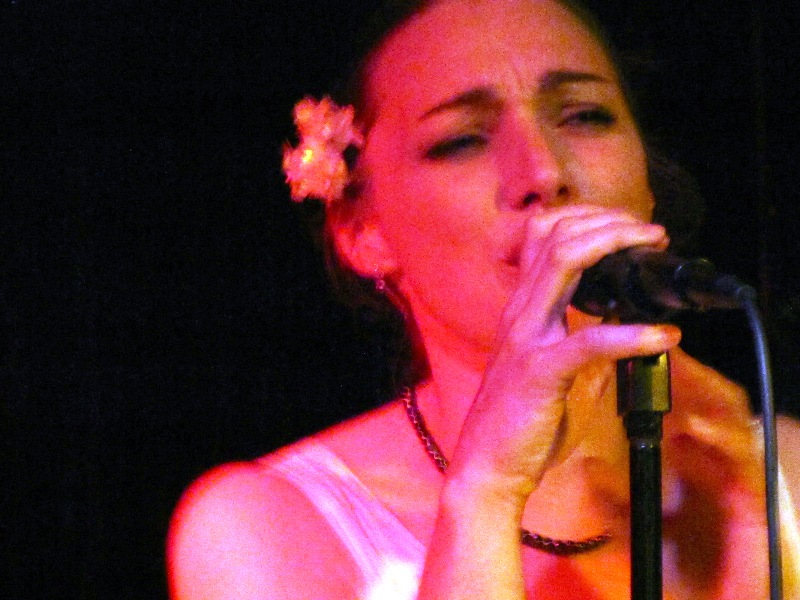
Showing posts with label Eamon McNelis. Show all posts

09 November 2025

Gai Paris

C'est vrai!  Paris is strong on jazz and, as I understand, also on earlier jazz styles and we have our own authentic Canberra-cum-Australia reps in the midst of that scene.  This weekend they were home to visit family and we caught them at Smiths, upstairs, in McGregor Hall.  Leigh Barker is the leader and also the Canberra person but now in Paris with Heather; otherwise Melbourne, the Coast, another Canberran and Latvia.  Latvia?  Well pianist Max Teakle was genuine Latvian on tour and he recognised local sit-in Valdis Thomann for his Latvian roots.  Paris can also be quite mixed and bohemian.  Whatever, this was hugely fun, inviting, joyous music.  Leigh leading with his gut strung bass; Heather with the most apt voice for this style and a good bit of playful pleasure and, to boot, violin.  Eamon just the part with an Elvis lick and overall presence and wonderful trumpet and Valdis hugely impressive as the trom offsider so comfy he seemingly had had a life lived in this very band.  And not least, Mark down the back setting and syncopating the tempo.  Just lovely.  Often slow, always rock solid steady, sometimes toungue-in-cheek implications, through a string of standards of Ellington and Frankie Valli and Billie Holliday and June Carter Cash and plenty of originals from Leigh and perhaps others.  All from their album that Leigh was indulgently spruiking on the night, Cross Street, in all formats (although only 7 vinyls available on the night).  Just great fun and great entertainment from a very professional outfit playing the era.

Leigh Barker (bass) led his band with Heather Stewart (vocals, violin), Eamon McNelis (trumpet), Valdis Thomann (trombone), Max Teakle (piano) and Mark Sutton (drums) at McGregor Hall, upstairs at Smiths Alternative.

05 November 2011

Big Bluesy Band

The chalk and cheese saga continued when I attended the Loft for the full New Sheik experience. Leigh Barker’s full band was there for a night of swinging, down-home dirty bluesy, hollerin’ jazz and it was great. This is a very good band playing music of an era that is is variously touching and refreshing and enlivening to visit. This is Billie Holiday passion, Ellingtonian intellect, Fats Waller bounce, blues growl and corn field holler. Great fun, touching or entertaining lyrics, and the biggest audience I’ve seen at the Loft. It’s an era that entertains and has a following, and this band does the job of promotion and can tickle an audience so deserve the following.

Leigh Barker is the new sheik himself, leading the band from his surprisingly loud unamplified bass (I’m pretty sure even this gig was not amplified). Quipping with the audience and choosing tunes at whim for the gig and the recording that was in train. Heather Stewart is the vocalist up front who also doubles on classically-trained, but down-home violin-cum-fiddle. She’s wonderfully touching when singing Billie Holliday and nicely growling on the blues. Both the horns, Eamon McNellis and Don Stewart were blow-outs. They both display a love of the older styles of jazz, so their solos are delicious and lively diatonic explorations of the chord structure, their playing includes the growls and glissandoes and tonguing that shout New Orleans, their harmonised backing licks are neat and clean and their collective improvisation was intelligent and together. And it wasn’t just old style: I noticed Eamon breaking from sweet diatonics into dissonance several times, but he’d equally sit easily on the most minimal of melodies and drain it for its beauty. And what lovely brassy tones they each had: clean, rounded, nicely articulated. Matt Boden led a few tunes in trio or smaller formats. I loved his simple statements and correct, clear interpretations of the underlying harmonies. And Al McGrath-Kerr was introduced as the band member with the longest name (the band was described as the “least single band I’ve even been in … in case anyone’s getting any ideas”). Al was open and quite minimal, dropping into loping marches or playing with rudiments and rolls.

I love Ellington’s Come Sunday, so that was a delight when they played it as a violin-led quartet. Billie Holliday featured in I must have that man and again in Moonlight and you and you could do nothing but empathise with the desperation. There weer joysome blues, often with the guys in the band hollerin’ responses to Heather’s calls. They played a Tom Vincent original, Big Creek wedding, with a cyclic, songbook structure. Nice to see our players playing tunes by their mates: we don’t just have to play the Real Book. There was an Appalachian fiddle tune that they jazzed up into swinging solos, and a blues tune that the audience voted for, Driving Ducks Blues. And the wit of Fats Waller’s Write myself a letter.

So, a busy night at the Loft, lots of fun, lots of good playing, lots of history and wit and a touch of nostalgia. And the night was recorded in the current full-bore, multitrack recording series that ArtSound is involved in, so we might hear it someday as a CD. I for one loved it. The New Sheiks are Leigh Barker (bass), Eamon McNelis (trumpet), Don Stewart (trombone), Matt Boden (piano), Al McGrath-Kerr (drums) with Heather Stewart (vocals, violin).

10 January 2011

Wayback machine

Leigh Barker led the band in a few instrumentals before Heather Stewart came on stage, and I was thinking this is so far back … way back. This was a Billie Holliday tribute, so I knew it would be early in jazz history, but I was not quite prepared for the trad playing: two-feels and clarinet and strictly arpeggiated trumpet and four-on-the-floor guitar chords on What is this thing called love. The following tune was Old fashioned which was just confirmation. Then Heather came to the stage with Moonglow. A beautiful tune, of course, but continuing the era. All very much pre-bop. But these guys performed with panache, good humour and wonderful musicianship, so even this beatnick was taken by the end.

The songs were obvious and many have been done to death, but they swung and they had inherent humour which was just enhanced by Heather’s ever-joyous presence and occasional improvisation on the lyrics. How can you not like an era that produces lines like this: “Get your fingers off it / ‘n’ don’t you touch it / you know it don’t belong to you”. Nothing too opaque about that, although nothing openly stated either. And delicious numbers like After you’ve gone, or intense blues like Low down blues, or innocently optimistic larks like When you’re smiling, or nautically romantic songs like Sailboat in the moonlight or Slow boat to China. This was a great era for songwriting, despite some I still can’t take to, like All of me or Sweet Sue. I still have to learn to appreciate such informed silliness. Heather helped with her engaging humour but also with a sense of phrasing and variability of lyrics that spoke of the great singers. And she most easily led this band, although in a democratic way. It wasn’t rehearsed, she was open about that, but it melded, despite the negotiations on keys before a song, and the relaxed approach to the set list. But then these guys were good. The horns were great. I’d heard Eamon McNellis before and was not at all surprised. He’s got easy facility to play the changes with great clarity and with controlled tone (and thankfully, volume) but he could also let go, and with ample confidence. A long articulated pedalled note that led to flourishes, and later his ease with playing sustained eighth note lines, doubling to sustained 16th notes, then further doubling to sustained 32nd notes was seriously impressive playing, even at a relaxed tempo. Jason Downes completed the horns, mostly on clarinet but also on alto. I don’t often hear clarinet, so it imparts that old-time feel, with octaves and glissandi, lithe, snakey, bent thing that it is. But it sat nicely with trumpet for collective improvs, or improvising against a trumpet melody or less frequently playing melody with trumpet improv backing. Jason took a similar role with the alto, but I certainly found his alto solos more understandable for my ears. Collective improvisation is something modern players are toying with, and there’s lots to learn from this era. Otherwise, I just lapped up the lovely harmonies of a decent horn section, even only in two. That was so nice.

The rhythm section took me back further, though. Lynn Wallis was seriously into two-feels on drums. It’s true to the trad sound and Lynn played them perfectly well, but those trad fills and the grooves just don’t swing that much to my ears. Similarly John Scurry on guitar with banjo-like four-on-the-floor guitar comping and a very soft, unsustained, woody guitar tone. I enjoyed this well enough and particularly enjoyed the tone which I expect is of the era with no amplification, but it dated the music for me. Similarly the chordal solos with those fast strums and chord slides. All perfectly good playing from Lynn and John, but old-fashioned to my ears. (Thinking back, it’s strange how the timing for the overt parts, vocals and melody, was so malleable, while the underlying beat was so squared, but I guess this is trad and bop was to change that). Leigh was his capable and fully-toned best. Ably and clearly stating chords and not missing any passing changes. I was surprised not to hear slapping, but maybe it’s out of place in this context. His solos were always relaxed and lyrical, and I was impressed when he was toying with the melody of All of me in a different key and Heather called a bass solo and he could easily continue the melody with variations. It was only All of me and only G but that’s musical competence.

So in summary, I really liked this time travel by the end. The malleable timing, the good natured vibes, the relaxed tempos, the harmonies and collective improvisation and some very, very good playing went down a treat, even if the cut time feels and clarinet slides are still borderline for my ears. Moulding the fig is a work in progress for me, but with musicians like this, I’ll enjoy the apprenticeship.

Heather Stewart (vocals, violin) led a band with Eamon McNelis (trumpet), Jason Downes (clarinet, alto sax), John Scurry (guitar), Leigh Barker (bass) and Lynn Wallis (drums).

05 November 2010

Restoring our history

Modern life is very much lived in the fast, unrelenting present: we forget our history, which also means that we forget our dues to the past. I don’t come at the argument that jazz ended in the ‘60s but I value history. Leigh Barker’s Quartet obviously do too, and I found their recent gig at the Gods was refreshing and different because of it.

Leigh with his acoustic bass (truly acoustic: miked, no pickup) and slapping technique and gut sound led the outing, but Mark fitted admirably with older-style grooves (sometimes strange and clumsy to my modern-influenced ears but which just fitted) and always sharp rolls and accents and rimshots and hihat sizzles and the solos from Sarah and Eamon were talking with a blues accent. One mate spoke of the piano solos as “gritty”: a nice metaphor and it fitted often enough. I was initially hearing hard bop: strong tonal lines and solid swings with that blues background. But as the night wore on, I started hearing more styles, more influences. Piano and trumpet both broke from consonance for lines that spoke clearly with dissonance and substitutions, and even touches on modal styles and more linear improvisations, rather than locking to the chord changes. But then, back to the past, with lovely gentle swings and vocals from Sarah on an old song, Please be kind, as played by Sinatra/Basie, that reminded me of the current wave of female jazz singers. And a historically apt interpretation of What is this thing called love, sung by Eamon and finishing the night with a touchingly distant and devastating interpretation. Just last weekend, Eamon won the Wangaratta National Jazz Award, this year for brass, so I wasn’t surprised by his fluency and command. His was a masterful performance: a forceful tone, clearly enunciated; melodic, structured, fast solos with growls and bends and releases; wonderfully present and in command. These were not long solos but they spoke clearly and authoritatively.

I think it was the phrasing and rhythms that determined the band as located so much in history, despite the dissonance and modal freedoms that appeared throughout the night. This was harking back to pre-bop, but influenced by many generations after. Or was it the other thing I noticed, that the lines were just right: apparently simple because they were so unjarring. I noticed that first with Sarah’s solos: apparently simple, mostly arpeggiated, and so right. Musicians know this is no easy achievement. It takes work to play simply and inevitably: it’s not something you can fake. James LeFevre was there, and in true jazz bar style, he sat in for the last tune. James played very well, but differently: a longer solo, more modern-challenge, more ecstatic, less classical. It was an interesting juxtaposition and so appropriate for a band that exuded jazz history in bars and bordellos to invite in the local.

I very much enjoyed and was refreshed by Leigh Barker (bass) with Eamon McNelis (trumpet), Sarah McKenzie (piano) and Mark Sutton (drums), and James LeFevre (tenor) sitting in for the last tune.

22 October 2009

Presence of the past

Tom Vincent played the Band Room last night, the night following Sean Wayland. Within minutes of the Tom’s start, I realised how much I’d enjoyed them both, but also how the gigs were hugely different. It was a fascinating juxtaposition. To me, Tom speaks from the history of jazz. One of my mates heard the 1950s, and there were clear references to the era before cool, with a sensibility that said bop but a control and earthiness that was post-bop, but there was also solid and comfy swinging bass and a drum style that spoke of an earlier era still. Jazz history is rich and full, but the modern world can have a short memory. I remember being struck by the strength of this past when I heard Michael McQuaid’s Red Hot Rhythm Makers playing 1920s dance hall music at the Wagga festival a few years back. I still don’t go out of my way for early jazz, but I can enjoy it when it’s well played and it’s not just nostalgia. Tom’s band plays history with an awareness of modernity, thus doing our history justice.

Tom leads the band with considerable fluidity. Last time I heard him, he played unending improvised medleys that challenged his offsiders to stay with him. This time he played a repertoire. But he moved rhythms and tempos radically at times, taking the band in sometimes unexpected directions. And he led with calls or imploring gazes or solo piano introductions to set the scene. His playing can be whimsical and obtuse and there’s plenty of dissonance, and these are modern sensibilities. So although it speaks to the past, this music is not a museum piece; rather, it touches an earlier era with respect and intelligence and a modern consciousness. Eamon McNelis on trumpet was a wonderful foil to Tom’s piano and I enjoyed his playing immensely. He was formal, with nary a note or arpeggio or scale out of place, for harmony or pitch or tone. I expected he was classically trained, but he corrected me. He’d had 2 years of classical training, but it was other influences that formed him: he mentioned Eugene Ball and Wynton Marsalis. His tone was pure and classical: accurately formed and pitched and bell-like in texture. Here was the calm and measured formality to respond to Tom’s elusive and elastic lines. Ex-Canberran Leigh Barker provided the bass line, and it was fully acoustic, meaning unamplified. Tom noted this, and said it changes the presence of the whole band. Certainly playing double bass without amplification is rare. It must limit the volume of the band, although I didn’t notice it was particularly quiet. Leigh gets impressive volume, perfectly adequate to match drums and trumpet and the Yamaha grand. And it was a rounded, soft bass that lent support with well chosen lines. Hugh Harvey on drums was the stylist that most said pre-bop to me, with soft kicks highlighting infrequent accents, and shuffles and brushes and steady snares. It fitted nicely and avoided prominence.

I think they played a few originals: some unexpectedly short, just a melody and that’s it. But mostly it was the standards repertoire: Willow weep, Cottontail, Cherokee, Straight no chaser, Foggy day, Ellington, Monk and the like. They played Coltrane’s Resolution in an interpretation which was challenging by being out of era. But I felt their strength was these earlier materials that they played with an understanding and vitality and approachability that brought them to life and was free of nostalgia. It was an uncommon pleasure. Tom Vincent (piano) led a quartet with Eamon McNelis (trumpet), Leigh Barker (acoustic bass) and Hugh Harvey (drums).

PS, After writing this, I listened to Tom Vincent’s Blood red CD, and I find it’s different again from this performance. It’s a trio set recorded live for the ABC, with mostly short, original tunes, and a very modern piano trio sound. From the first tune with the fourths of McCoy Tyner, it was unexpected. Tom is certainly an interesting and varied player.

16 June 2007

LBQ@WE

The Leigh Barker Quintet is still in town. They performed last night at the White Eagle. Other commitments meant I missed most of it, including the trio outfit Leigh runs called “The Shieks”. But the last set I heard was impressive, and the performance I’ve most enjoyed from them. It could be the venue, but I think it’s the White Eagle audience. Here musos are performing for their peers, so they are on their mettle, and able to be, and perhaps called to be, more daring or creative or challenging. There’s an atmosphere of goodwill and there’s no hype, but there’s some residual competitiveness, too.

The core intent of the band was unchanged: a melange of modern improvisation and more traditional underpinnings, presented through mostly original compositions (Leigh prefers to just call it improvised music). But whatever the labels, this seemed a more authentic and lively performance then the others I’ve heard. They played a beautiful, as yet untitled ballad with reference to Charlie Haden. It featured some tasty and convincing soloing from piano, sax and trumpet. There was also a hard-bop original called Guts of steel by Al Mcgrath-Kerr with hints of McCoy Tyer in some passages in fourths by the piano. So, a broader range of materials from an increasingly interesting band.

06 June 2007

First of the Gods

Leigh Barker’s Quintet were the first performers in this year’s Jazz Series at the Gods. Leigh and his mates provide a real Canberra ambience at their local gigs. Leigh, the leader and bassist, is a local, as is John Felstead on saxes. But it’s not just the fact of their background, but also the presence of friends and family at his concerts, and the references to the local area, that only a Canberran would understand. Their first CD is called “Off to Moruya”. It’s obviously a reference to the Moruya Jazz Festival, where they regularly play. Apparently, the cover designer was a Melbourne bloke who was intrigued by a grotesqueness in the name, Moruya, so it stuck for the album. Then, there’s the hot swing original tune called Merimbula, another obvious reference to a town and a local jazz festival. But the band is now resident in Melbourne, and apparently is very busy with work there. So in truth this is another homecoming from more successful ex-patriates.

I like this band’s complexity of conception. It’s a real mix. You may hear pre-bop in the rhythm section, cut time on drums, perhaps a gentle swing on bass, along with the sound of French boulevards on the piano accordian, and a bit of modern dissonance on the sax and trumpet. So it’s an intriguing and, to me, unique blend of trad, mainstream and modern styles. And their presentation fits to boot: brown suits, with jackets removed after a few tunes, and rolled up sleeves for the busy end of the night. Leigh even wore braces. Perfect. This is intelligent entertainment. No wonder they have plenty of work.

The night started with Ellington’s The Mooch. (I’m sure they started with this at Hippo’s when I saw them, but it’s a perfect, sleezy tune to set the ambience). There was a tune by Heather Stewart of Melbourne, called Music Room, which featured a cut-time reminscent of European films – cute, humourous and deceptively light music. There were several originals by the band, recalling Moruya and Merimbula, If I had a brain from the Wizard of Oz, and a Nat King Cole favourite called Ruby and the Pearl. They raised a chuckle with a tune called “What this thing called, love?”, and ended with a dedication to Bill Frisell (I think I got this right), which surprised me given the style, called In the country with Bill.

From my modern jazz, soloistic, individualistic point of view, I most liked the solos of the two horns. Eamon played some very satisfying fast lines, and often broke out into dissonance with repeated patterns at chromatic and other intervals. John also frequently dipped into the distorted pool of dissonance, and I liked that. When I previously heard Matt at Hippo’s he played both accordion and piano, and I thought there was more inventiveness on the piano. This time he only played accordion, and the style was not so much jazzy as euro-folk and ambient. I liked this, and it certainly highlighted the uniqueness of the band. Leigh and Al both set capable rhthyms, and did a few nice solos, too.

The Leigh Barker Quintet are Leigh Barker (bass), Al Mcgrath-Kerr (drums), John Felstead (saxes), Eamon McNelis (trumpet), and Matt Boden (piano, accordian)

Leigh’s band plays again at White Eagle on Thurs 14 June, for those who missed this show. ArtSound recorded the concert, so you can also expect to hear the band on radio over coming months. Thanks to Geoff Page for organising the series. The next Gods to visit the Café are Sandy Evans, Toby Hall and Brett Hirst, on 3 July. These are authentic Australian jazz gods, so get there if you can.

23 February 2007

In from Melbourne, off to Moruya

Leigh Barker and his quintet played at Hippos last Wednesday to launch their CD. It was a strongly local affair. The band is from Melbourne, but 3 of 5 are from Canberra and studied music here. Even the title of the CD was a giveaway: “Off to Moruya” was an obvious reference to our local and intimate jazz festival down the coast. The band is John Felstead (soprano, alto sax), Eamon McNelis (trumpet), Al McGrath (drums), Matt Boden (piano, accordion) and Leigh Barker (bass). FYI, the locals are John, Al and Leigh.

It was an interesting set. I was initially taken aback with a pretty old-style sounding jazz tune to start the night, Ellington’s "The mooch", and I wondered if this was to be outside my normal (modern) expectations. But any competent and serious artform knows and respects its history, and this was evident as I listened some more. This was a modern interpretation. It displayed considerable fidelity to the original, but the solos were often in a more modern vein, with dissonances not necessarily heard in the original versions. So, to me it was interesting and an eye-opener to other approaches to jazz.

This was music with a laid-back nature, thoughtful and considered. It was frequently composed and complex, but then opening to more individualist solo passages. I noticed a distinct change in the band’s sound when Matt moved between accordion and piano. The piano segments were richer with more complex harmonies and more modern solos. The accordion offered a more folky accompaniment, and while soloing was harmonically simpler and more dense with chords rather than single note runs. To me, John played the most harmonically challenging solos on the night (which saxes are apt to do anyway). I enjoyed following one particularly clear-cut solo which moved through scalar lines, diminished arpeggios, patterns, some nice licks, 4ths and the like: neat and cleanly structured. Al played some really impressive, clear, fast, diatonic bop-style solos, but also went out often enough. Leigh and Al supported with a rhythmic underlay which harked back to pre-modern styles, often playing a cut-time beat (2 beats to a 4/4 bar) on drums, and a matching two-feel bass line within a 4-to-the-bar walk. Occasional concurrent solos by the horn front line just confirmed the underlying pre-modern style of much of the music.

I enjoyed the Ellington starter and it seemed very appropriate, but otherwise the music was original. There was a suite written for the Merimbula Jazz Festival in two parts with a lovely discordant melody by multiple instruments to start the second part. There were ballads and funny titles. We were advised that “Attie’s exit” related to “Ray’s dilemma”, but we are none the wiser than that.

Nice stuff all around. So it seems Canberra is providing players of note for both the Melbourne and Sydney jazz scenes.

  •