Showing posts with label Rhys Butler. Show all posts

04 February 2025

SoundOut 2025-3


Then the internationals again, this time for a sax quartet of Richard, Bertrand, Rhys and Jean-Luc playing steady, slowly shifting tones with perhaps some circular breathing in the mix.  All this to visual projected accompaniment from Nicci Hayes who had appeared in the previous year.   And to finish off, some younger local performers, Alex, Gabriella, Jamie and Stuart, as a new generation, from Canberra and Sydney, comprising drums, tenor sax, guitar and invented instruments.

The saxophone quartet comprised Jean-Luc Guionnet (alto, France), Richard Johnson (tenor), Bertrand Denzier (tenor, France) and Rhys Butler (alto) with Nicci Hayes (visual projections).  The final session was performed by Alex Tucker (drums), Gabriella Hill (tenor), Jamie Lambert (guitar) and Stuart Orchard (guitar, invented instruments).
03 February 2024

SoundOut 2024 / 1

Richard Johnson's SoundOut festival is back for its 15th incarnation.  It's presumably well known in these pages as an experimental and free jazz festival featuring Canberrans, Australians and a spattering of internationals.  And for that matter, sadly, just a spattering of audience.  This is not the most popular musical style: eclectic and authentic, yes, but popularity limited.  I won't get too all, but I do expect to get to one workshop and two or three concert sessions.  First up was Session 1 Friday evening.  I came in as Biomorph were performing.  This is the veritable core group of Richard Johnson and Rhys Butler playing tenor and alto saxes.  I heard flickering, moody, floating, whale calls, tonguing and horn staccatos and a closeness that comes with time playing together.  Then French internationals Animal Duo comprising Diemo Schwartz (electronics) and Guylaine Cosseron (vocals).  Sounds of cymbals, explosives, unexpected dynamics and more from synth and vocals that sounded of wind, grunts, animal noises and gutted with taped vocal chords.  Variously swelling, settling, floating, menacing.  Third up was a favourite for me, especially given I play bass.  Panghalina comprises an odd combination of bass plus two drummers, each playing another instrument, vocals or synth.   It comprised Helen Svoboda (bass, vocals), Bonnie Stewart (drums, vocals) and Maria Moles (drums, synth).  This sounded more ordered to my ears, but still mightily improvised.  They told me later of SoundOut being an opportunity return to improv roots given they are otherwise touring an album and playing those tunes which were originally productions of improv and remain improvisatory but with some structure.  I noted how "this has structure, thus some expectations amongst improv with huge intensity and high wordless vocals".  They later talked of parameters, being standard modes of expression (short note, long notes, staccato, etc) also a pictorial sense, as in long notes as landscape and short notes for Jackson Pollock.  Tech also took a role: Maria's synth but also TC Helicon over Helen's voice and a Boss RC505II to sample and loop Bonnie's voice, but more importantly, their voices found natural, improvised notes and merged through gentleness and harmonies.  Some structure over improv: how I like it.

Biomorph comprised Richard Johnson (tenor) and Rhys Butler (alto).  Animal Duo comprised Diemo Schwartz (electronics) and Guylaine Cosseron (vocals).  Panghalina comprised Helen Svoboda (bass, vocals), Bonnie Stewart (drums, vocals) and Maria Moles (drums, synth).

17 October 2022

Sound and light out

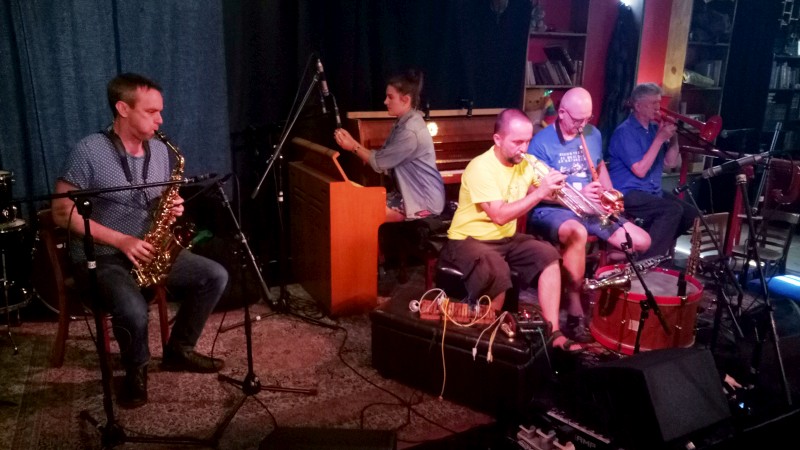
I just caught a snippet of the long set, but it was intriguing.  This was a SoundOut gig located in the middle of Civic in an ex-hair salon (sounds the part!).  Bright lights and colour outside through the glass; colour projections inside from a series of film projectors of 8mm variety.  Authentic analogue, Interestingly complete with authentic analogue film loops.  Two projectors mostly, sometimes superimposed, otherwise side-by-side.  Seven musicians responding to this, in lines seated at the opposite walls.  The whole was noise, repetition, squeaks and sparks, drone noises and the like.  Two guitarists, trumpet, three winds of various persuasions.  There was an intriguing home-built synth, too, with pitch and modulations controlled by hand movements and a chip to respond to it all; small and mounted on a rough timber stand.  Unique.  This is the nature of SoundOut, that experimentation and noise that makes music with closed eyes for inquisitive audiences.  Sadly, not too many of them.

SoundOut presented Louise Canham (experimental film projection) with the Noise Floor Ensemble comprising George Kay, Jamie Lambert (guitars), Rhys Butler (alto), Richard Johnson (wind instruments), Rory Villegas (trumpet), Tom Fell (saxes) and Brian McNamara (invented electronic instruments) at Antics Hair in Civic.

02 February 2020

SOSat arvo 1-1


This was SoundOut 2020, Saturday afternoon session. As always, there was a mix of performers local and Australian an foreign. We all expect the ringins from OS to be the exciting ones, and they often are, of course, being the stars invited and presumably supported by their embassies. I was particuarly looking forward to Achim, Frank and Wilbert who had massively impressed me with a short informal perfomance in the workshop, but that was for the evening. I arrived to hear a trio of sax, sax and vocals/electornics from Rhys, Richard and Tony Osborne. Nice, flowing, nuanced with tones and noises. Then Peter Hollo, cellist with electronics. I checked out his web page: he records postfolkrocktronica as Raven, has played classical with AYO and more and pop with Deborah Conway, the Whitlams and more, os he has chops. It showed in his playing with an awareness of melody and traditional techniques, nicely embellished with electronics and loops and the like. I heard yearning, distance, lovely acoustic cello tone, and later some tongue taps and what seemed quite like a constructed compostion. Nice. Then on to a feature trio, Dylan Van der Schyff, Elisabeth Harnick and our own local, Jess Green. A power trio: high energy from the opening; exciting and varied; quick insectoid flourishes form Jess; all manner of tones from dismantled kit and standard techniques from Dylan; scrapes and noises from within the piano into effusive keyboard with indeterminate harmony from Elisabeth. A huge pleasure.

Rhys Butler (alto), Richard Johnson (soprano) and Tony Osborne (vocals, electronics) played first. Peter Hollo (cello, electronics) played second. Dylan Van der Schyff (drums), Elisabeth Harnick (piano) and Jess Green (guitar) played third. SoundOut 2020 Saturday afternoon at the Drill Hall Gallery.

21 January 2019

Inside Smiths and our heads


It was hot outside, or at least the Smiths Sunday arvo jam session was on. Anthony was playing a solo right up the neck. I was impressed. But I was there for something far more esoteric: Petr Vrba, Czech trumpeter over for SoundOut. So expect much less rhythm and groove and harmony and melody, perhaps some melody and long notes and squeaks and squeals and, in his case, electronics and ring modulation. Nothing prepared other than a head and ears. This is performance from sheer awareness and some technical preparation although not necessarily of the traditional sort. Petr played a first set and it was loud enough that it was above the level of Anthony and co outside. Then our locals, EMSC Trio, comprising Richard, Millie and Rhys. Then a combination with Petr and EMSC and Miro, our local friend but also a Czech trumpeter. He picked up a nifty, red and black, plastic trombone from the wall at Smiths and took part in the last number. At various times, the jazz was intrusive, but often it was lost in louder sound. I liked the more forceful, louder take by EMSC which seemed to grow the energy. They played well. Petr was outstanding alone and strong with the others. Miro was relatively quiet, but that set also worked. I closed my eyes a few times and was taken by sounds and noises. There's an honesty here and although it's just a matter of listening, it's also a matter of discarding. I tried a jam at SoundOut once and I couldn't break my habits. Whatever, this was one of the most accessible of these experimental and free concerts and I enjoyed it. Too bad I missed the jam though.

Petr Vrba (trumpet, electronics) performed solo then later with EMSC Trio, comprising Richard Johnson (soprano sax), Millie Watson (pedal organ) and Rhys Butler (alto sax), and Miroslav Bukovsky (trombone).

  • SoundOut Festival 2019
  • 10 February 2018

    Degrees of freedom

    It's all free improvisation at SoundOut, but there are degrees of freedom. It's usually played on musical instruments, sounding as expected (and intended?) or not. Sometimes it's played on anything, with mics and various noise sources. Or the instruments are prepared with cloths or bells or clips or other so the strings or bells or tubes don't sound as normal. The sticks on strings and between strings and the clothes line clips and perhaps blutack as classics. Then the range goes through to instruments played as instruments, with various atonalities and implied all. Here I can see the references, the skills and the rest that I admire. Or I think I can. I remember asking a pianist whose playing I'd admired about keys and such technical matters. Nope, nothing. I'd been fooled. Or maybe they just don't talk of that. The workshop talked of all manner of things, but assumed players "know their instruments": a big ask but not the matter of concern. There were several groups who played with noise, with non-instruments or newly electronics.

    First up Alexandra Spence, Bonnie Lander and Goh Lee Kwang. Close listening to match voice, (for a little time) drone clarinet, electronics and papers and a mobile phone ap (presumably a sequencer of some type) triggering tones to an old radio as amp. Odd but small, quiet and an easy lug. Then a quartet of Ben Drury, Casey Moir, Julia Reidy and Millie Watson. I was blown out by atonal piano laying by Millie (and singing by Jennifer Nell who sat next to me for this set) at the SoundOut workshop but none of that here. This was plucks and sweeps on piano strings with lightly suggested rhythm from 12-string guitar and double bass noise and restrained but very inventive effected vocals from Casey. Again, fairly quiet but listening. Psithurism Trio are Rhys Butler, John Porter and Richard Johnson and are locals. They played a set with Alexandra Spence, this time on clarinet, and altoist Georg Weissel. A free, open, listening thing with plenty of noises, removed mouthpieces, clacks and drones and taps: noise informed by real instruments. These were the obscure, open, relatively quiet improvs of the Sunday afternoon at SoundOut 2018.

    Alexandra Spence (clarinet, electronica), Bonnie Lander (vocals) and Goh Lee Kwang (electronics) performed at SoundOut 2018. Ben Drury (bass), Casey Moir (vocals), Julia Reidy (guitar) and Millie Watson (piano) also performed. Psithurism Trio played with Alexandra Spence (clarinet) and Georg Weissel (alto) at SoundOut 2018. Psithurism Trio are Rhys Butler, John Porter and Richard Johnson.

    14 March 2017

    Open


    It was an afternoon of two concerts and how different can two concerts be? First up was free improv at the suitably live Drill Hall Gallery with Richard Johnson and Miroslav Bukovsky with Rhys Butler sitting in for the shorter second set. It's an interesting combination. Miro as the more melodic player led Richard to play melody as I've never noticed from Richard before; later Richard led Miro to play clicks and pops as he will on these occasions. I hadn't noticed Richard playing a flute body with sax mouthpiece before, but it worked a treat, sharp with tack-like valves and effective tonality. Miro moved through trumpet and flugelhorn and percussion; Richard also played sax, often into a drum skin, with and without mouthpiece. I found this a particularly successful outing in the open, free, unplanned style. The second set was shorter, with Rhys on alto mostly playing various noises, long notes, clicks and the like. The aircon was a problem with perceptible background hiss against the quieter parts: apparently it can't be turned off. But a very successful outing for an appreciative audience.

    Richard Johnson (soprano, flute) played free improv with Miroslav Bukovsky (trumpet, flugelhorn, percussion) at the Drill Hall Gallery. Rhys Butler (alto) sat in for the second set. The concert was in the context of an exhibition by Elisabeth Cummings.

    02 February 2015

    Texture

    SoundOut is our annual local opportunity to be immersed in experimental music and here is SO2015 and some regulars and a string of new faces.

    I managed two sessions this year and they divided neatly into two styles. The first was Saturday afternoon. The program featured several trios and one solo performer. There was a similarity in search for texture and tone. There was none of the standard melody, harmony or rhythm to speak of, at least not as envisaged by theory of Western music, although I did feel some sense of harmony in pairings of tones at various times, perhaps two saxes or accordion and sax or laptop and sax or even output from a single laptop. Or a single voice, when throat singing. But this search from tonal and ranges of sound from instruments was central, as was the texture of interacting instruments in a space. These sets were almost consistently meditative, slow, often quiet or with long, long crescendos and diminuendos. Nothing was quick here. All was space and listening and tonality. Psithurism was the first trio. Richard, Rhys and John are locals, mostly playing alto, tenor and soprano saxes, airing and spacious, speaks and squalls and reverse attacks and tonguing and rippling notes and burbling and tones like controlled feedback. Then Jason Kahn sang solo. This was firmer, long phrases from well-used lungs, exploring vocal tones and vowels, vibratos and slow pitch changes, worldly tones of North American natives and throat singing with polyphony. I wondered at the effect on his vocal chords, at times. I smiled to think how easy it was to travel with this instrument. I wondered if some of the sounds were so personal they should only be heard by a partner. But I josh. Then another trio, piano sax and guitar. Meredith playing virtually always under the lid, strumming or thumping strings, perhaps with a right hand on the keyboard holding notes or damping, and again a search for texture from Christian's sax and guitar, with Sam's guitar just once edging to break out into more standard soloing. Then a final duo, of Klaus and Paul on two laptops with Monica on piano accordion. Again, this was a set of texture. Monica playing long, steady chords or notes that would grow and withdraw with the bellows and the electronics finding and moving pure tones. All very meditative, slow, searching, trancelike, perhaps slumberous.

    SoundOut is a challenging listen and increasingly that's something we need, in Canberra and in Australia, as little thinking shrinks our broad and educated minds. For without those broad and educated minds, Canberra is little more than the country town that many (mistakenly) claim it to be. While music suffers in Canberra, SoundOut remains vibrant. It's an international community that's daring and welcoming to its visitors and this can only broaden the life of our city and enhance our international integration. And, if we must talk dirty, even enhance our music tourism and international recognition.

    Psithurism comprised Richard Johnson (soprano sax, drum skin, cornetto), Rhys Butler (alto sax)and John Porter (tenor sax). Jason Khan (vocals) sang solo. Meredith Maloney (piano), Christian Kobi (tenor sax) and Sam McAuliffe (guitar) played a trio. Monica Brooks (piano accordion) performed with Klaus Kilip (electronics) and Paul Heslin (electronics). SoundOut 2015 was held at the Drill Hall Gallery.

    27 January 2014

    SoundOut2014/1 (Friday night) continues...

    Continues ...

    I was particularly interested in the paired bassists, especially given one was playing my bass. Slawek and Clayton, both bass, with Cor piano and Sean drums. This was a more conventional format, and the masculine side of the night. Strong from the start, then into tortured, pressured, intense, manic playing. Piano was punctuated and with some harmony; the basses were bowed, pizzed, explored, tapped, loud and intense; the drums were sometimes rabid, never steady, all fills and explosions and space and just some quieter passages. I was interested in the tones and the aggression of it all while somewhat fretfull for what the instruments were enduring, respectful for the search for newness, aware of the excessiveness and volume of it all, dismissive of some of the techniques. (This was an early and wrong impression. I was pleasantly surprised by the bass chops I heard next day from both bassists. But as I've found before, manic intensity at this level drives out the staid traditions and correct techniques of many arts; often, but not always, with justification). If these guys were playing their own basses, I may have relaxed and warmed to it, but as it was, I didn't relax enough to enjoy in this performance. (BTW, the bass was perfectly OK, as promised).

    It still perplexes me that new music is so often played on old instruments. Given the traditional instrumentation, I warm to a musician who displays impressive traditional technique or knowledge. I noticed this with bassist Clayton when he was warming up for the end-of-session jam with a very steady and nicely developed bass groove, and also with his traditionally-styled pizz and ostinatoes during that jam. The harmonies and feels may have been new, but the techniques and groove were of long established. The group development was more unitonal and textured and atmospheric, but here was a family or historical connection with other music. So too, Richard's baritone sax in this set, that picked up on the groove and permuted it. The first set had Richard on soprano sax and drum playing with clarinet, two altos and one tenor sax. The whole merged in my ears into a melange of tonguings and tones and drones, but in openings I could pick out some wonderful ostinato lines from Richard, fast, clear, nicely structured around a quick passage and a long note, with slow minimalist change. This was impressive chops and lovely, understated accompaniment. It was not always obvious and sometimes hidden in the mix, but impressive when it appears. So too, with bass clarinetist Krista in this session. She had classical tone, toyed with varying lengthy intervals that sat so intriguingly and gloriously, even contrapuntally, in this busy mix. The distinct tone helps. In another set, Kim's guitar was somewhat a crossover in technical matters. I felt it held its session together with sweet fingerpicking and regular strumming, although only sometimes of chords; othertimes it was open strings or harmonics, so undefined harmonies. But this worked, especially interspersed with a similar-sounding zither-like instrument. It worked also due to clarity of the instrumental mix. Richard on gourdaphone and Reuben on trumpet and these are distinct sounds. This is also where I appreciated the skilled techniques in much new music. I know Reuben as both a bopper and a more experimental musician. Here it was all breath and tongue and unformed notes and mutes. It's a technique requiring competence and training, although not traditional. Not surprisingly, it can take knowledge of the instrument and the form to understand its complexities. Knowing a crossover artist can help.

    SoundOut is our local incarnation of this worldwide branch of new music. Not easy, always a test to these ears, but a worthy wakeup call to your own conservative tendencies. Looking forward to another session. ABC FM were recording, Julian Day was MC-ing. You can hear SO performances over coming weeks on Julian's New Music Up Late.

    Psithurism Trio + played the first set, Richard Johnson (soprano sax), Rhys Butler (alto sax), John Porter (tenor sax), Krista Martynes (bass clarinet) and Rosalind Hall (alto sax). Second set was Slawek Janicki (double bass), Sean Baxter (drums), Cor Fuhler (piano) and Clayton Thomas (double bass). Last set was Kim Myhr (guitar), Reuben Lewis (trumpet) and Richard Johnson (gourdophone, drum, soprano sax). The end-of-night collective improvisation comprised Richard Johnson (baritone sax), Rhys Butler (alto sax), John Porter (tenor sax), Clayton Thomas (double bass), Cor Fuhler (guitar) and Reuben Lewis (trumpet).