
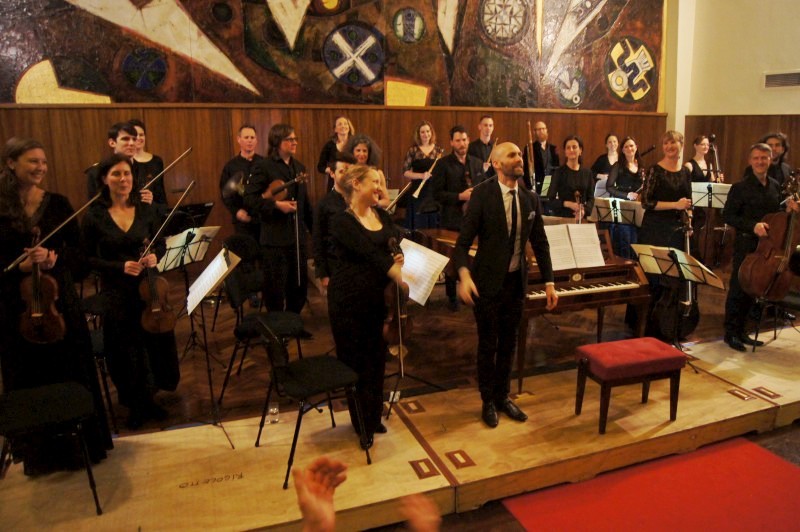
David Greco (baritone) led the Australian Haydn Ensemble in string quartet formation with Skye Macintosh and Matthew Greco (violins), Karina Schmitz (viola) and Daniel Yeadon (cello) at the Albert Hall.
David Greco (baritone) led the Australian Haydn Ensemble in string quartet formation with Skye Macintosh and Matthew Greco (violins), Karina Schmitz (viola) and Daniel Yeadon (cello) at the Albert Hall.

Australian Haydn Ensemble called the concert Heavenly Sopranos and sure enough most of the program featured a soprano and mezzo pairing. AHE doesn't often perform with singers (3/28 posts on CJ). This program featured several works by Johann Adolf Hasse, a renowned opera composer in his time,, Francesco Durante, a teacher of Pergolesi, and the feature, Stabat Mater by Pergolesi, who, interestingly, died young aged 28. Stabat Mater has been around this Easter. There were two other performances before this one. I missed both but it was a topic of discussion. Easter usually has a few double-ups, as there are recent historical double ups from Beethoven. The playing was superb, as expected. The styles of this era aren't too challenging, but I still was breathtaken by the unity of many lines, especially where all strings double timed with unison fills or where the violins expressed together or partly with viola. There was a theorbo, too, quiet but often identifiable as a guitar plucked tone, and this bassist was hugely admiring of Pippa's obvious international experience and delicate skills. I liked the first half but was somewhat perplexed by Stabat Mater. Yeah, her son was going to save the world but he's still dying on the cross in front of her, so why is the music quite so light? There are touches of tragedy but not much. But the crux of it is the baroque and church thinking of the period, I guess. Nonetheless, a stunning bit of performance. Loved it.
Singers Celeste Lazarenko (soprano) and Helen Sherman (mezzo soprano) were accompanied by the Australian Haydn Ensemble at Wesley. On the night, the AHE were Skye McIntosh (director, violin), Matthew Greco (violin), Karina Schmitz (viola), Anton Baba (cello), Pippa Macmillan (bass), Simon Martyn-Ellis (theorbo) and Joanna Butler (chamber organ).

We'd heard our mates, the Australia Haydn Ensemble, play a Beethoven Symphony no.6 at Wesley two years ago. Last night they returned with another, B7. Now this is a renowned work (the odd numbered symphonies are, but B6 is OK too) and I was looking forward to the listen, but what really hit me in the end was the effect of this concise version of a well known work. They played it with one flute, two each of violins and violas, one each of cello and double bass so it had nothing of the huge impact of an orchestra but it had clarity and concision and I heard different things. Well, maybe I responded to different lines that were more obvious, clear and precise even if less powerful. Not better or worse but very different and thus informative and expressive. And quite memorable. Of course I listened to Jacqueline on bass, and thought of when I played this work and whether my bowing could have been quite so effective (of course not!). The bass end was all clarity and dynamics, but then this was common throughout the players. I remember sudden dynamic changes by all that stunned. Maybe it's easier with fewer players to define those dynamics. And I felt I understood the structure and changes better; they were more evident. So this was different and hugely enjoyed. It left me with a huge smile on my face. But that was the second half. The first half was another Beethoven, his Egmont Overture, similarly concise and clear. The middle work was Boccherini String Quintet Cmin. It was written for such an ensemble and the music was truly lovely, but nowhere near the complexity and avid life of the Beethoven, so it was lovely and the presentation was not unexpected. It was what it was and it was lovely just for that. So, I left with another dose of Beethoven awe and a huge smile. BTW, they played well, too, and sounded a dream.
Australian Haydn Ensemble performed Boccherini, Beethoven Egmont and Beethoven 7 at Wesley. AHE were Skye McIntosh and Matthew Greco (violins), Karina Schmitz and James Eccles (violas), Daniel Yeadon (cello), Jacqueline Dossor (double bass), Melissa Farrow (flute).

There were seven days of Creation and they were covered within parts 1 and 2 of Haydn's Creation at the Canberra International Music Festival, if I got the lyrics right. So what of part 3, after the interval? It may have been Adam and Eve enjoying each other, for there were some lyrics thus suggesting. But then I didn't get all the lyrics. I was entranced by the truly excellent bass playing of Kirsty McCahon sitting tall and up front and I didn't catch much of the rest. Even the whales that James mentioned at interval. Well, maybe they were a big bass part (?) but I was just watching the bowing and hearing the incredible projection of one baroque, presumably gut, bass amongst such a large ensemble and the way she seemed to almost ignore the music and look around constantly. I downloaded the music this morning and it's not so difficult to read, being baroque, but still, I was in awe. But otherwise, the individual singers were very good to great, the chorus was impeccable, the orchestra based on the Australian Haydn Ensemble was tight and expressive and Chad, who I drove the other day, the keyboardist, was Euro-confident and again someone who knows when to raise his head from the music, the baroque horns just sounded great and Roland was his hyper-energetic self as conductor and driver of it all. I was in awe from the first few minutes from the tightness and clarity and precision and overwhelming baroque beauty, and it just continued for the two-or-so hours of the performance, but then, for the sake of the occasion and the musical beauty, I was prepared to ignore some distinctly dated, particularly non-feminist awareness. Did I say I enjoyed it? Yeah, and the bassist was good too.
Haydn Creation (Die Schöpfung) was performed at the Canberra International Music Festival by Roland Peelman (conductor), Skye McIntosh (concert master and leader of the...) Australian Haydn Ensemble, Chad Kelly (keyboard), Alexandra Oomens (soprano), Andrew Goodman (tenor), James Ioelu (bass), Sydney Chamber Choir (vocals) with Kirsty McCahon (double bass).

The Australian Haydn Ensemble played Boccherini, Mozart and Beethoven 6 at Wesley. AHE comprised Skye McIntosh (violin, Musical director), Matthew Greco (violin), Melissa Farrow (flute), Karina Schmitz and James Eccles (viola), Daniel Yeadon (cello), Bonita Williams (bass).


 Despite their reputation, I hadn't warmed to Schubert's songs before but this was different. Australian Haydn Ensemble came to town with guest singer David Greco. The ensemble was restructured at the short notice after a death in the family meant leader and first violinist Skye couldn't make it. Simone moved from second to first violin and Rafael sat in on second. Otherwise the team was James and James and Jacqueline. The program also changed with mostly alternating Schubert songs and miniature string quartets from The Four Seasons by Felicien David. FD was also new to me but generally much more light and joyous than the Schubert. The whole was presented as a single set with no interval and with discussions and translations of Schubert's songs ad backgrounds by David. Delightfully and unexpectedly, the concert went off with no applause until the end. This was a pleasure. I've come to dislike clapping for jazz solos and the response here was blissfully uninterrupted. It may leave the performers a little lost between tunes but it carries the flow of music purposefully. The playing was neat and involved as always. Jacqueline was solidly tested in a later song, the famed Der Erlkonig, but her presence was rich and full throughout. So were the others. I wondered about balance at one time as passages passed between strings, but it's relatively trivial, and the commitment, especially from Simone, was captivating. David's interpretations were stunners, with big, rich voice, clear enunciation (although given that it's German, I didn't catch much anyway) and emotive, even dramatic, presentation. His tonal formation was to die for. My choir does nothing of the sort: I'd love to hear the choirs he's appointed to, given this sample (Westminster Abbey and Sistine Chapel, no less!). It was a short program given the last-minute changes but deeply satisfying so the repertoire change was no disappointment and it taught me the impressiveness of this Schubert song repertoire. So, it went well. Our condolences to Skye.


 Simone shows it openly, with frequent smiles and grins. The others smile and glace less obviously or frequently but they are all eyes and ears, too. You see it as they come to a pause, or the end of a phrase, how they look up to Skye or each other. Then the exact attack, the shared fortes or denouements, at the most detailed level, within and between phrases. This is close playing and it's a key to chamber music with its intimate scale and unprotected exposure. They just did it so well and so comfortably. Jacqueline was unavailable so this was played without bass, interestingly, as much of this early classical music was written. The program was all Haydn: London Trio (flute, violin and cello), a string quartet and the Symphony no.104 London. The trio was written for home playing. I could only sit aghast thinking of the demands placed on home musos. But there was no TV in those days, so plenty of time for practice for the comfortable classes. Some lines just flawed me: from Anton's cello, or Skye's lead or Simone's responses or just how the whole group stopped then seemed to float for a lengthy pause, twice, I think, in the final movement of the symphony. I've said much of this group as they are friends and I've seen them numerous times, but I am never unsurprised. Truly lovely stuff.


 It was repeated neatly for one passage, then played without dynamics for another. It's just detail, but it's this detail played through a group that makes for the lush convergence of it all. This understanding is usually shared in rehearsal, when a leader details how to play whatever passage, the band busily annotating and coming to a common understanding. Of course you need the chops and communication and the rest on stage, too. AHE does it was panache, smiles passed around amidst the serious music making. I'd commented on the smiles but also the overt face of one player and AHE stalwart Simone agreed and commented that you have to get on well and AHE does. It's obvious. Skye led the strings, but mostly Erin conducted from the harpsichord, standing for the symphonic works but seated for the keyboard concerto. They played Mozart (symphony no.29 Amaj), two CPE Bach (Keyboard concerto Cmaj and Sinfonia Ebmaj) and Haydn (Symphony no.52 Cmin). All were lovely, but I took a particular pleasure in the two CPE Bachs, being courtly but lively and inventive. The Haydn was an early Sturm und Drang work so an attempt to perceive human experience in its variety, or rather its impassioned agitation. It's virtuosic and pre-romantic but seems untimely to my contemporary ears. The Mozart was just plain sweet all round. Just another highly capable and investigative concert from AHE, this time in bigger orchestral format in Albert Hall, rectangular, timbered and high ceilinged, a space that authentically matches the style. Loved it.


 The arrangement has parts taken by different instruments, and apparently this is annotated, so a viola line maybe be identified as from oboe or clarinet or whatever. Cimador's forces were two violins, two violas, cello, bass, flute and keyboard. The cello and bass seemed to just take the known lines, presumably also the two violins for the two violin sections, and, I thought, the piano, but the two violas and flute presumably took on any number of lines from woodwinds or brass or whatever. So it was a fascinatingly different but similar piece. So what else did I note? The whole was sweeter and more open than an orchestra. AHE do great dynamics, but still gut and pianoforte doesn't manage the extremes of modern instruments. The tonal colours of lines changed with the different instruments playing them. The violins and flute were a bit quiet, but maybe that's from where I was sitting. There were also odd tones from odd combinations, eg, flute and cello. These are great musicians and I enjoyed the playing immensely. The bass and cello are a firm and committed block and often prominent - Jacqueline's pizz was particularly effusive - and their application was a pleasure. This group always enjoys itself with smiles all round, but I've noted that before. Some interpretation was unexpected, like the slow take on the early part of the third movement. That surprised me but it was effective. And those lithe runs from the strings and complex plays between hands by the piano. All a huge pleasure and intriguing. Otherwise, they played Mozart Symph no39 Prague and Overture to Magic Flute. More staid than the challenging Beethoven but with their own challenges, not least with some devastating lines. So a great pleasure for my return.


 in conformity, yet not lifelessly cloned; how individual instruments would spell out their parts (Anthony's cello was impeccable) so even a note had form and life, or would bounce with staccato; how the whole was dynamic and expressive and how a few passing glances would hold this all together. The tunes of this are often not so very difficult to read or to play, mostly with harmonies and melodies that fit scalar or arpeggiated patterns except for the occasional oddball phrasing that may trips you up or some cadenza that flies with semiquavers. This is not music of dissonances or odd times but of order and dignity and some humour, except maybe for the slow middle movements that can be things of exquisite beauty. There were the tuning interludes, which are so much a part of this period music, but the rounded tone is the end result and so lovely. And these are friends: those glances were often little smiles and the guys joshed at the end and they all glowed with pleasure. The theme was the baroque oboe and a few quartets named "the Hunt". The format was quartet for all, string quartets or three strings with oboe. The music was Haydn String Quartet ‘The Hunt’ Op.1 No.1 Bbmaj, Mozart Oboe Quartet K.370 Fmaj, Janitsch Oboe Quartet Gmin and Mozart String Quartet ‘The Hunt’ K.458 Bbmaj. This was a small incarnation of the AHE, a core with oboe, but they are always intellectually thoughtful and musically wonderfully satisfying. That delicacy and unity that a string quartet can portray, this time with music and instruments located somewhere in the early classical period. Just a joy as always and an education in just performance.


 I loved the music, of course, Chevalier de St-George, Mozart and Haydn, from that early classical era, and I especially loved how they played it (that explains their smiles and mine). The dynamics were so detailed and shared, with swells and dims and cres turning on a note and phrases that were spelt out in notes and dynamics that moved together. So well done; so strong and together. This is what matters, the shared expression in and around the melody and the driving consistency of the rhythms, and this had all these. Melvyn Tan just played one piece, the Mozart Concerto for keyboard no.18 K456, leading from the chair with music oddly on a stand to his left. He played fortepiano, so softer and less sustained than a modern piano. We were sitting right in front and even for us it could hide behind a decent forte from the orchestra. Melvyn, too, was all smiles, obviously a generous and welcoming guest, bent over the keyboard for his solos or twisted to the orchestra and waving in leadership. The other pieces were Chevalier's symph op.11 no.2 Dmaj and Haydn Symph no.85 Bbmaj 'La Reine', dedicated to Marie Antoinette. Of these, the Haydn was the more demanding with some tortuous lines in a few places. But mostly I notice the easy speed. This music is pretty regular and reasonably easy to read and play, but to spell the phrasing and to easily hold the swift lines demanded of all the instruments (bass gets its share) and to do it all with lightness and vivacity is the challenge. AHE does it with ease and aplomb and much good humour. So, congrats to Skye and her group for the development so far, and it'll be interesting to watch just how far this can go. Just a wonderful, joyous concert with considerable historical authority.

 The Mozart was Fantasy in F minor, K.504 rearranged for "mechanical organ" and it was a strange thing that held little similarity to the ordered, often light, sometimes humourous music of Mozart. The first Boccherini, String quintet op.25 no.6 Amin, was Spanish-influenced and understandable enough in the baroque context but his op.30 "Night music of the streets of Madrid" was anything but. It was written by Boccherini to be performed only in Spain (the Italians are a proud people!) and not to be published outside. But it was, so we have it. It's a programmatic work, with parts named Ave Maria Bell or Soldier's drum or Minuet of blind beggars or Retreat. It tells a story. It also plays the part. First up, a strong rhythmic passage on one note from first violin; a little later, strummed chords on cellos held on laps like guitars (apparently required by the score); still later, a mad viola bowing on one note representing drums and a very challenging bowing over all four strings on violin 2, repeated a few bars later (I was amused to see Caroline's relief after carrying off each of these!). All strange, not particularly contrapuntal or otherwise baroque-like and very resonant of Spain and Flamenco. Thus oddity of this concert. Another, perhaps, was Cambini, a lesser-known baroque composer with a satisfying but fairly uneventful piece. Good to hear music like this occasionally, rather than just the masters: it gives perspective. So, an divergent but satisfying concert, for the notable playing, the humour and interesting journey, but especially for the strange but informative program.


CanberraJazz.net's reports & pics
CJ: Promoting modern jazz in Canberra, Australia.
CJ is brought to you by Eric Pozza, long time jazz lover, bassist, and CJ's author, editor, photographer, webmaster, owner and general dogs body.
> Click on pics to view larger images
v See Labels/Names index below
Initials in the Labels/Names index below are for contributors other than Eric
Subscribe


