The big news of the day was the demise of Pavarotti, and of course we heard Nessun Dorma (or at least its spine-tingling chorus) several times on the radio.
Sadly, our local experiment in student jazz promotion also passed away on the same day. The Jazz Sessions as the White Eagle ended last Thursday night. It’s been a great series, even though the venue never seemed optimal. I liked the authentic Polish food and beer and there was plenty of space, but the stage and proscenium arch were dividers between band and audience, the room could be chilly in winter, and there was a lot of electrical noise to fight with in the audio department.
But the music was excellent. The early sessions were pretty informal, usually with a local band and a subsequent jam. But over time, they became virtual concert performances. But they were always in a jazz style, so there was ample time between sets to mingle and compare brands of beer, but there was also quiet and rapt attention while the music was playing. And the music was always challenging, interesting, diverse. Perhaps the presentations were too generous. I’ve heard up to 12 performers on a night, including imports, and it’s a lot of people to pay. In a business sense, this may be a failing: the two-band format was always costly. But in an artistic sense, it was an element of WE’s success. There were lots of local players who wanted to air their exploratory musings, and equally there were imports who sought a venue offering an informed and welcoming audience for original music and more esoteric jazz styles. In balance, the business side probably doomed WE, but the artistic side created its legacy.
So perhaps we should cheer the series which was the White Eagle, and hope that a new venue, and perhaps a new round of organisers, rises to take its place. It’s been a great series of nights. Many thanks to Phill, Hannah and Ed for their work over the last 18 months or so. Thanks to ArtSound for recordings and PAs. Thanks to various students who performed or helped out with setting up and taking down after each event. Have a well earned rest, and let’s hope for a new incarnation of the passion which was White Eagle.
BTW, I think all the White Eagle sessions have been written up on CJ. Just click on the “White Eagle” label below this post, or in the right hand column of this page, to view all.
Showing posts with label White Eagle. Show all posts
Showing posts with label White Eagle. Show all posts
08 September 2007


Symphonic to harmolodic
The last White Eagle offered another night of fabulous, but fascinatingly different performers. It’s almost de rigeur that the two sets are markedly different, and this night was perhaps the most extreme in this respect. The first set was the harmolodic.

 Legedis Benz’s set featured a triptych of Ornette Coleman tunes (Peace warriors, WRN and a very stylised blues, Feet music), a Roscoe Mitchell number (Noonah), Zappa quotes and originals by all members. Needless to say, this was the challenging end of the spectrum. There were fast and furious unison lines throughout, and harmolodic invention abounding. Harmolodics? It’s the concept that underscores Ornette Coleman’s music. It’s somewhere east of free. We had a chat about it after the gig. Apparently it’s none too clear with anyone, but it seems to demand all players to perform as improvisers and to clear themselves from support roles, and for their melodic inventions to be free of limits of conventional harmony, melody and rhythm. Suffice to say, after furious intro melodies with rapidly changing keys and pretty indistinct tonal centres, the players perform free with no underlying key or even tonal centre. Challenging all round, but hugely satisfying (if done well).
 LB comprises Jarrah Jones (guitar), Sam Young (drums) and Simon Milman (bass). Jarrah played like I’ve never seen him before: dischordant chords, sharp phrases, sustained atonal lines, bent notes and vibratoed chords, odd intervals, scraping strings. All short, sharp sounds. Oddly, I caught a snatch of the guitar tone from the Coupling theme at one stage. Sam was tight and played with a drum tone to die for. Perversely, he could be stunningly simple and clearly expressed, with solos that often dropped back to straight, sustained grooves, like an eye in the storm. Simon was unorthodox even in his choice of instrument: an amplified acoustic bass guitar. It imparted such a different tone, and surprisingly apt for this outing: acoustic, not rich, deep and woody like a double bass, but fatter, more middly, but still clearly acoustic. Interesting. Playing wise, Simon ran with the others, harmonically adventurous, freely moving over the fingerboard, sometimes playing with thumb and fingers in a softer slap style, but otherwise fingerstyle. Simon also introduced the music. There was a constant theme of nicer or nastier (which was even carried on in references later by Matt Baker later in the night). You couldn’t say any was “nice” in the sense of a beautiful ballad, but this was not the intention. This was extreme sport for musos and they carried if off fabulously. But I’m wondering where we’re likely to hear them again, given the demise of WE. Perhaps Moruya?

 The Matt Baker Trio was literally the symphonic end of the night. The trio was Matt Baker (piano), Karl Dunnicliff (bass) and Dave Goodman (drums). Matt’s recently returned from Europe and his comments and compositions harked back to Switzerland. His latest album, “From an afternoon in the mountains”, has tunes like Les Dentes du Midi and Le Tour d’Epee as dedications to towns and mountains in this picture-card-perfect country. As for symphonic, there was talk of recording with a chamber orchestra, and a surprisingly successful performance of the main theme from the first movement of Rachmaninov’s second piano concerto. Matt talked of trying to record jazz in a classical style, but then performed classics in a jazz style. I was intrigued by the similarity of these harmonic movements to those of jazz. (Perhaps this was just his interpretation). There were some classical piano playing that jarred with my jazz sensibilities, but I found the piece surprisingly satisfying. This was a crossover that worked. Continuing the lyrical side of the night, there was even a beautiful composed piece with no improvisation. Otherwise, this was very competent, mainstream-modern jazz with hints Bill Evans and the like. Syncopations, close interactions, convincing rhythms and rolling solos. Matt played lots big sounds. I noticed plenty of block chords and patterned solos. Karl played great bass accompaniment; always rhythmically strong with a rich and clear tone. I particularly loved Dave’s drums on this outing. It was standard mainstream style-wise, but it displayed perfectly timed triplet feels, beautiful rimshot work, and more, and was generally a pure and accurate performance in the style. As an aside, Dave was telling me he’s studying for a PhD in jazz. Dr Goodman … very cool. A jazz PhD … would this be a first in Australia? I wondered if you could achieve a PhD in performance. His is not performance, but deals with changes in drum styles over the modern jazz era. So the night finished was a very satisfying but very different performance.
 Deborah and Ian Pavletich, local musicians and studio owners.
Thanks to both the excellent bands for this last evening at the White Eagle. Vale! White Eagle.

 Legedis Benz’s set featured a triptych of Ornette Coleman tunes (Peace warriors, WRN and a very stylised blues, Feet music), a Roscoe Mitchell number (Noonah), Zappa quotes and originals by all members. Needless to say, this was the challenging end of the spectrum. There were fast and furious unison lines throughout, and harmolodic invention abounding. Harmolodics? It’s the concept that underscores Ornette Coleman’s music. It’s somewhere east of free. We had a chat about it after the gig. Apparently it’s none too clear with anyone, but it seems to demand all players to perform as improvisers and to clear themselves from support roles, and for their melodic inventions to be free of limits of conventional harmony, melody and rhythm. Suffice to say, after furious intro melodies with rapidly changing keys and pretty indistinct tonal centres, the players perform free with no underlying key or even tonal centre. Challenging all round, but hugely satisfying (if done well).
 LB comprises Jarrah Jones (guitar), Sam Young (drums) and Simon Milman (bass). Jarrah played like I’ve never seen him before: dischordant chords, sharp phrases, sustained atonal lines, bent notes and vibratoed chords, odd intervals, scraping strings. All short, sharp sounds. Oddly, I caught a snatch of the guitar tone from the Coupling theme at one stage. Sam was tight and played with a drum tone to die for. Perversely, he could be stunningly simple and clearly expressed, with solos that often dropped back to straight, sustained grooves, like an eye in the storm. Simon was unorthodox even in his choice of instrument: an amplified acoustic bass guitar. It imparted such a different tone, and surprisingly apt for this outing: acoustic, not rich, deep and woody like a double bass, but fatter, more middly, but still clearly acoustic. Interesting. Playing wise, Simon ran with the others, harmonically adventurous, freely moving over the fingerboard, sometimes playing with thumb and fingers in a softer slap style, but otherwise fingerstyle. Simon also introduced the music. There was a constant theme of nicer or nastier (which was even carried on in references later by Matt Baker later in the night). You couldn’t say any was “nice” in the sense of a beautiful ballad, but this was not the intention. This was extreme sport for musos and they carried if off fabulously. But I’m wondering where we’re likely to hear them again, given the demise of WE. Perhaps Moruya?
 The Matt Baker Trio was literally the symphonic end of the night. The trio was Matt Baker (piano), Karl Dunnicliff (bass) and Dave Goodman (drums). Matt’s recently returned from Europe and his comments and compositions harked back to Switzerland. His latest album, “From an afternoon in the mountains”, has tunes like Les Dentes du Midi and Le Tour d’Epee as dedications to towns and mountains in this picture-card-perfect country. As for symphonic, there was talk of recording with a chamber orchestra, and a surprisingly successful performance of the main theme from the first movement of Rachmaninov’s second piano concerto. Matt talked of trying to record jazz in a classical style, but then performed classics in a jazz style. I was intrigued by the similarity of these harmonic movements to those of jazz. (Perhaps this was just his interpretation). There were some classical piano playing that jarred with my jazz sensibilities, but I found the piece surprisingly satisfying. This was a crossover that worked. Continuing the lyrical side of the night, there was even a beautiful composed piece with no improvisation. Otherwise, this was very competent, mainstream-modern jazz with hints Bill Evans and the like. Syncopations, close interactions, convincing rhythms and rolling solos. Matt played lots big sounds. I noticed plenty of block chords and patterned solos. Karl played great bass accompaniment; always rhythmically strong with a rich and clear tone. I particularly loved Dave’s drums on this outing. It was standard mainstream style-wise, but it displayed perfectly timed triplet feels, beautiful rimshot work, and more, and was generally a pure and accurate performance in the style. As an aside, Dave was telling me he’s studying for a PhD in jazz. Dr Goodman … very cool. A jazz PhD … would this be a first in Australia? I wondered if you could achieve a PhD in performance. His is not performance, but deals with changes in drum styles over the modern jazz era. So the night finished was a very satisfying but very different performance.
 Deborah and Ian Pavletich, local musicians and studio owners.
Thanks to both the excellent bands for this last evening at the White Eagle. Vale! White Eagle.
21 July 2007
Bloody cold night, hot jazz
Carl Morgan and Marc Hannaford each led trios for the latest White Eagle session. They shared a bassist and a jazz school. But otherwise these were very different outfits. Carl’s trio presented standard tunes with go-ahead bop playing. Marc was more the modern, compositional, creative end of jazz. But both gave us highly competent and interesting presentations.
 Carl’s trio was Carl Morgan (guitar), Mark Sutton (drums) and Mike Majkowski (bass). This was a straight-ahead jazz outfit. There was at least one original by Carl, but otherwise the set was made up of renowned standards including Recordame, Coltrane’s Lazybird and Wayne Shorter’s Black Nile. Carl is well regarded at the jazz school and is developing into a masterful player. He uses a crisp, clear tone, perhaps with a little reverb, but otherwise uneffected. It allows lots of easily-understood scalar and arpeggiated runs and sometimes abstruse chordal backing (hints of Scofield, of course). And he also shows a more lyrical side at times. Mike capably held clear harmonic structures in walks and syncopated backings, and played several rhythmically strong solos. I particularly liked the fast and highly rhythmic solo passage to start Black Nile. Mark provided strong support or drums and some clearly stated solos. He was the oldest and presumably most experienced of this trio, and I feel it showed. The young guns like their fingers on the trigger; the wisdom of age is somewhat more restrained. Same as it ever was. And it’s great to see the tension. So, Carl’s trio gave us a very interesting, capable, straight-ahead performance.
Marc Hannaford’s was a very different trio. Partly because it was four piece for some time, when Miro joined in. But mostly because the music was so different. The band was Marc Hannaford (piano), Mike Majkowski (bass), Alex Masso (drums), sometimes with Miroslav Bukovsky (trumpet).
 This was more modern, compositional, exploratory. I think the pieces were all compositions by Marc himself. I saw some charts, and they were pretty sparse, but they had underlying complex concepts, harmonies, ideas that were informing them. Apparently two tunes were based on rhythm changes, but throughout the night, I only heard one limited passage of perhaps 16 bars that was obviously these changes. And apparently Giant steps was hidden in there somewhere, but I never picked it up. (I wasn’t the only one to miss it). What I did hear was some interesting melodies with sometimes odd or broken times, obtuse bass lines, open and punctuated drums, ongoing fluidity and interactive changes of style including occasional free playing and some fabulous piano and trumpet soloing.
 Marc introduced the tunes with titles like Beaver in the hallway (this was one where the title actually seemed to match the tune), Mustard cucumber (Mike’s favourite sandwich; sounds good; must try it), Dark pants, Fortunate incompetence, Cubist no. 7 (hidden rhythm changes; in retrospect, the cubist reference is apt). I loved listening to Marc’s piano solos. Fast, fluent passages broken in little snippets of a bar or two, or occasionally longer lines. Sometimes I heard modern classical; perhaps he has some classical training. Miro joined for several tunes. His playing was quite different, more bop-influenced. Again, great playing, and this despite being new to the charts. Both Mike and Alex formed a superbly effective component of all this. Alex was closely following the others’ playing. It was fairly soft volume- and touch-wise, but mobile. Mike changed style throughout, but his walks most interested me. His note choices capably obscured the underlying chords, to give that seemingly undefined tonal centre that makes for modern jazz.
Sadly, too few people attended. They missed some great performances. Also, the piano needs some work, or at least a tune. It was a pretty honky-tonk version of Marc Hannaford that we heard. But despite this, it was another great night at White Eagle.
Marc Hannaford's MySpace site
 Carl’s trio was Carl Morgan (guitar), Mark Sutton (drums) and Mike Majkowski (bass). This was a straight-ahead jazz outfit. There was at least one original by Carl, but otherwise the set was made up of renowned standards including Recordame, Coltrane’s Lazybird and Wayne Shorter’s Black Nile. Carl is well regarded at the jazz school and is developing into a masterful player. He uses a crisp, clear tone, perhaps with a little reverb, but otherwise uneffected. It allows lots of easily-understood scalar and arpeggiated runs and sometimes abstruse chordal backing (hints of Scofield, of course). And he also shows a more lyrical side at times. Mike capably held clear harmonic structures in walks and syncopated backings, and played several rhythmically strong solos. I particularly liked the fast and highly rhythmic solo passage to start Black Nile. Mark provided strong support or drums and some clearly stated solos. He was the oldest and presumably most experienced of this trio, and I feel it showed. The young guns like their fingers on the trigger; the wisdom of age is somewhat more restrained. Same as it ever was. And it’s great to see the tension. So, Carl’s trio gave us a very interesting, capable, straight-ahead performance.
Marc Hannaford’s was a very different trio. Partly because it was four piece for some time, when Miro joined in. But mostly because the music was so different. The band was Marc Hannaford (piano), Mike Majkowski (bass), Alex Masso (drums), sometimes with Miroslav Bukovsky (trumpet).
 This was more modern, compositional, exploratory. I think the pieces were all compositions by Marc himself. I saw some charts, and they were pretty sparse, but they had underlying complex concepts, harmonies, ideas that were informing them. Apparently two tunes were based on rhythm changes, but throughout the night, I only heard one limited passage of perhaps 16 bars that was obviously these changes. And apparently Giant steps was hidden in there somewhere, but I never picked it up. (I wasn’t the only one to miss it). What I did hear was some interesting melodies with sometimes odd or broken times, obtuse bass lines, open and punctuated drums, ongoing fluidity and interactive changes of style including occasional free playing and some fabulous piano and trumpet soloing.
 Marc introduced the tunes with titles like Beaver in the hallway (this was one where the title actually seemed to match the tune), Mustard cucumber (Mike’s favourite sandwich; sounds good; must try it), Dark pants, Fortunate incompetence, Cubist no. 7 (hidden rhythm changes; in retrospect, the cubist reference is apt). I loved listening to Marc’s piano solos. Fast, fluent passages broken in little snippets of a bar or two, or occasionally longer lines. Sometimes I heard modern classical; perhaps he has some classical training. Miro joined for several tunes. His playing was quite different, more bop-influenced. Again, great playing, and this despite being new to the charts. Both Mike and Alex formed a superbly effective component of all this. Alex was closely following the others’ playing. It was fairly soft volume- and touch-wise, but mobile. Mike changed style throughout, but his walks most interested me. His note choices capably obscured the underlying chords, to give that seemingly undefined tonal centre that makes for modern jazz.
Sadly, too few people attended. They missed some great performances. Also, the piano needs some work, or at least a tune. It was a pretty honky-tonk version of Marc Hannaford that we heard. But despite this, it was another great night at White Eagle.
16 June 2007
LBQ@WE
 The Leigh Barker Quintet is still in town. They performed last night at the White Eagle. Other commitments meant I missed most of it, including the trio outfit Leigh runs called “The Shieks”. But the last set I heard was impressive, and the performance I’ve most enjoyed from them. It could be the venue, but I think it’s the White Eagle audience. Here musos are performing for their peers, so they are on their mettle, and able to be, and perhaps called to be, more daring or creative or challenging. There’s an atmosphere of goodwill and there’s no hype, but there’s some residual competitiveness, too.
The core intent of the band was unchanged: a melange of modern improvisation and more traditional underpinnings, presented through mostly original compositions (Leigh prefers to just call it improvised music). But whatever the labels, this seemed a more authentic and lively performance then the others I’ve heard. They played a beautiful, as yet untitled ballad with reference to Charlie Haden. It featured some tasty and convincing soloing from piano, sax and trumpet. There was also a hard-bop original called Guts of steel by Al Mcgrath-Kerr with hints of McCoy Tyer in some passages in fourths by the piano. So, a broader range of materials from an increasingly interesting band.
19 May 2007
Effects, anyone?
Last night’s White Eagle seemed a detour into the 21st Century and jazz as it is now: a melange of styles and sounds, with clear references back to jazz history, but with newer tonalities and technologies. I’ve asked on CJ poll whether there’s jazz after Bitches Brew. I was not surprised that everyone who answered, answered “Yes”. But I was surprised that so few people answered. The question was a bit of a joke for me, and presumably for those who didn’t bother to answer, but it’s still argued in conservative jazz circles. Jazz suffers from such internecine dischords. The trad/modern standoff still appears occasionally and the argument over electronic instruments is ongoing. But I’ll choose to sit this one out. I’ll just return to my M-Base Collective and Branford Marsalis and amuse myself thinking about how this White Eagle would have upset the conservatives.
 Trident+1 started the night. Trident are a trio comprising Chris Thwaite (drums), James Luke (bass) and Lachlan Coventry (guitar). The +1 is Ben Marston (trumpet, flugelhorn). James described the style as “made up on the spot, with some jazz standards to meet up … sometimes”. This is definitely the approach. It’s loose and improvised, but they have achieved this open and responsive relationship through playing together for considerable time. The experience shows. The set comprised 3 extended improvisations. There were soundscapes and funk and reggae and one hard swing. There were processed sounds galore. I guessed octavers, autowahs or synths, choruses, reverbs and echoes on trumpet, bass and guitar, and there may have been others. There were mesmeric repetitive rhythm passages, mostly set by guitar or bass. There were loads of solos from all instruments, variously standard jazz styles or more impressionistic. There were squeels of whales from flugelhorn, and didjeridoos emanating from bass. And there were lovely calls back to the jazz and even pop forms with melodies that rose from the highly processed, rhythmic substructure: Alone together followed by Nica’s dream over reggae; Madonna’s Material girl with a coda of Weather Report’s Birdland; Mingus’ Nostalgia in Times Square. The floor was littered with effects. There were two PAs on stage for the instruments alone, as well as the obligatory stage PA. It all sounded highly processed, compressed, full and fat, like recorded music rather than simple, acoustic jazz.
 Chris played fabulously in this format: richly changing rhythms; great counterpoint to more or less regular grooves of the other players; some excellent, accurate, clearly intentioned solos. James played a fretless 5-string Jazz bass, through masses of effects and into a PA for clear, sharp, full-range sounds. He played confidently, mimicked Zawinul-synths and didjerdoos and more, and played some lovely solos along with chords and harmonics at various other times. Lachlan was relatively traditional in this context: attractive and not overwhelming effects, and some crisp, clear jazz soloing. Ben set the scene with known melodies played with simplicity and conviction, but also dropped into impressionistic sounds and effected solos, and the first time I’ve heard octavered flugel. Great, confident and convincing playing all around.
Trident+1 are a fabulously involving and developed outfit playing the highest level of groove-infected, culturally-inclusive music with a jazz sensibility. Trident play every Tuesday night at Trinity Bar in Dickson. Catch them!
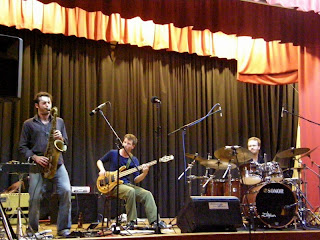 The second band was a less processed and took a more standard modern jazz approach, but still displayed frequent effects on sax and bass. And it also featured electric bass (another one to upset the conservatives). The band was the Matt Keegan Trio out of Sydney’s JazzGroove stable: Matt Keegan (tenor sax), Cameron Undy (electric bass) and Dave Goodman (drums). The trio played original music in the modern jazz idiom, with frequent blues or funk feels, and some monster unison lines.
 Matt mostly plays a considered, calm and melodic style with clear intentions and a considerable exploration of dissonance. On the other hand, he loosened up and played excitedly on the later tunes on the night, and also played with a range of effects on various tunes throughout the night. Cameron is a frequent visitor to Canberra, being a product of the town and the Jazz school. He plays with a strangely wooden tone on a 5-string electric bass: more woody than crystal clear; very satisfying on fast funky patterns and occasional blistering solos. I found it interesting to hear the way Cameron dug into the strings with strong double bass-strengthened fingers. It made for a very different and more traditional sound than James’ in Trident (although James also plays double bass). I was also interested to notice how much a statement of the underlying rhythm was Cameron’s soloistic style. It’s not unusual in bassists; I noticed a similar approach by Zoe Hauptman. Dave played a strong, steady and definitive role in this band along with a busy, satisfying solo later in the night. The band lifted for the last few tunes, when Cameron rose from his seat, and the energy level was turned up a notch. So, a strong and competent modern jazz outfit.
Matt Keegan's website
 Trident+1 started the night. Trident are a trio comprising Chris Thwaite (drums), James Luke (bass) and Lachlan Coventry (guitar). The +1 is Ben Marston (trumpet, flugelhorn). James described the style as “made up on the spot, with some jazz standards to meet up … sometimes”. This is definitely the approach. It’s loose and improvised, but they have achieved this open and responsive relationship through playing together for considerable time. The experience shows. The set comprised 3 extended improvisations. There were soundscapes and funk and reggae and one hard swing. There were processed sounds galore. I guessed octavers, autowahs or synths, choruses, reverbs and echoes on trumpet, bass and guitar, and there may have been others. There were mesmeric repetitive rhythm passages, mostly set by guitar or bass. There were loads of solos from all instruments, variously standard jazz styles or more impressionistic. There were squeels of whales from flugelhorn, and didjeridoos emanating from bass. And there were lovely calls back to the jazz and even pop forms with melodies that rose from the highly processed, rhythmic substructure: Alone together followed by Nica’s dream over reggae; Madonna’s Material girl with a coda of Weather Report’s Birdland; Mingus’ Nostalgia in Times Square. The floor was littered with effects. There were two PAs on stage for the instruments alone, as well as the obligatory stage PA. It all sounded highly processed, compressed, full and fat, like recorded music rather than simple, acoustic jazz.
 Chris played fabulously in this format: richly changing rhythms; great counterpoint to more or less regular grooves of the other players; some excellent, accurate, clearly intentioned solos. James played a fretless 5-string Jazz bass, through masses of effects and into a PA for clear, sharp, full-range sounds. He played confidently, mimicked Zawinul-synths and didjerdoos and more, and played some lovely solos along with chords and harmonics at various other times. Lachlan was relatively traditional in this context: attractive and not overwhelming effects, and some crisp, clear jazz soloing. Ben set the scene with known melodies played with simplicity and conviction, but also dropped into impressionistic sounds and effected solos, and the first time I’ve heard octavered flugel. Great, confident and convincing playing all around.
Trident+1 are a fabulously involving and developed outfit playing the highest level of groove-infected, culturally-inclusive music with a jazz sensibility. Trident play every Tuesday night at Trinity Bar in Dickson. Catch them!
 The second band was a less processed and took a more standard modern jazz approach, but still displayed frequent effects on sax and bass. And it also featured electric bass (another one to upset the conservatives). The band was the Matt Keegan Trio out of Sydney’s JazzGroove stable: Matt Keegan (tenor sax), Cameron Undy (electric bass) and Dave Goodman (drums). The trio played original music in the modern jazz idiom, with frequent blues or funk feels, and some monster unison lines.
 Matt mostly plays a considered, calm and melodic style with clear intentions and a considerable exploration of dissonance. On the other hand, he loosened up and played excitedly on the later tunes on the night, and also played with a range of effects on various tunes throughout the night. Cameron is a frequent visitor to Canberra, being a product of the town and the Jazz school. He plays with a strangely wooden tone on a 5-string electric bass: more woody than crystal clear; very satisfying on fast funky patterns and occasional blistering solos. I found it interesting to hear the way Cameron dug into the strings with strong double bass-strengthened fingers. It made for a very different and more traditional sound than James’ in Trident (although James also plays double bass). I was also interested to notice how much a statement of the underlying rhythm was Cameron’s soloistic style. It’s not unusual in bassists; I noticed a similar approach by Zoe Hauptman. Dave played a strong, steady and definitive role in this band along with a busy, satisfying solo later in the night. The band lifted for the last few tunes, when Cameron rose from his seat, and the energy level was turned up a notch. So, a strong and competent modern jazz outfit.
13 April 2007
Eugene Wright - add your comments below


 "Senator" Eugene Wright was Brubeck's bassist on the Take 5 sessions and a stalwart of the LA jazz scene who played with many other influential jazzers. He's just played at White Eagle with Anita Thomas (reeds), Mike Price (guitar) and Mark Sutton (drums). I couldn't make the gig, so I invite your input. Add your comments below. Over to you. If you have pics, send to me for later publication.
Thanks to those who left comments. More welcome. Looks like I missed a great show. Thanks esp to Luba Thompson for the great review and these pics.
Ivory and apoplexy
White Eagle offered another double bill last night. This is obviously developing as the nature of the event, with audio provided and recorded by ArtSound, and a local band and a local or visiting band as a main act. Tonight’s show featured Ivory Hunter, Daniel Hunter’s band, and the return of Sydney’s Trio Apoplectic.
 Ivory Hunter is led by Dan Hunter (guitar), with Yen Nguyen (drums), Gareth Hill (bass) and Munro Melano (keyboards). I hadn’t heard of Ivory Hunter before but I assume the musos have been playing together for years at the Jazz School. I’ve reported on these players several times on CJ, but mostly they were playing the standards repertoire (very capably). However, Ivory Hunter is a platform for originals. The tunes were penned by various band members and covered a range of approaches. There was one bordering on hardbop, but mostly they were more melodic and tuneful. I particularly liked a couple of tunes from Gareth, a ballad and another tune with a very convulsive melody leading into a hard swing. Daniel’s Act of will was an interesting piece with a sustained quarter-note melody that had my mind drifting. And I have to mention Dan’s Scofeel. It’s an obvious take on Scofield, with indefinite timing, sleezy down-South solos, bluesy organ in the background, and Chambers-style drum patterns crossing the bar lines. So there was quite a range of styles here: floating and relaxed, bluesy, out. I had the feeling these guys were beyond simple exuberance, and were seeking more musical statements.
Daniel always plays in a restrained and careful way, and he did so this night. He plays occasional flourishes but lots of well-considered melodic lines. Gareth also led as melodist on several tunes and played some excellent solos. He’s a strong player, and his tone is also strong: good muscular fingers dragging the strings for a clear, woody tone. Munro played synths at times, along with piano and organ sounds. I particularly liked his comping, especially following his responses to Dan when he played outside. Yen held it all together and played several expressive solos, not least on his own compositions.
As for the band name, Hunter is an obvious reference, but is there some other message? Perhaps. The smooth surface and alabaster colouring of ivory seems to fit the music.
 Trio Apoplectic were quite a change after the more relaxed Ivory. Right from the top, they played with intensity, energy and intelligent interaction. I’ve written about TA before; they played at the first White Eagle session. Their return was quite triumphant. This was modern jazz of a high order. Intellectual, emotionally demanding and satisfying, great playing with great, clear sounds, exploratory. I love this style and I was trying to place it. Perhaps Joe Henderson? I asked them about their influences. Interestingly, they offered Bernie (McGann) and when I further inquired, they suggested other players around Sydney.
TA are Dave Jackson (alto sax), Abel Cross (bass) and Alex Masso (drums). They play a mix of standards and originals. Originals come from the pens of Alex and Abel, especially Abel. They played Monk’s Boo Boo’s birthday. Originals included the oddly named Details of how to get apoplectic on your licence plate (apparently a renowned title at Sydney’s Birdland records). There were soundscapes and free styles, hard swing and balladic styles, bowed bass reminiscent of didjeridoo and sax harmonics. Several of these tunes are on the CD, and were played at TA’s last White Eagle concert. I feel they’ve explored the music much further, and this was the source of such a satisfying performance.
 They all played with intense energy and commitment throughout the show. Noone played too obviously, or displayed the chords too evidently. The harmonies and counterpoint were fascinating. They were also all very balanced, each player providing an essential ingredient and contributing equally to the complexity and richness. This is just highlighted by the open sound a chordless trio. Dave plays alto, and it fit so well: smooth and sinuous, but also intriguing and exploratory. Abel played hot from the top, and played some excellent solos. The underlying chords were interpreted so subtly I wondered if the tunes were modal. A lovely modern style. Alex was mobile and varied on drums: brushes or sticks, cymbals or drums, sparse or dense.
Another great night at White Eagle, in expectation of White Eagle’s debut as an international venue next week, with the bassist Senator Eugene Wright.
 Ivory Hunter is led by Dan Hunter (guitar), with Yen Nguyen (drums), Gareth Hill (bass) and Munro Melano (keyboards). I hadn’t heard of Ivory Hunter before but I assume the musos have been playing together for years at the Jazz School. I’ve reported on these players several times on CJ, but mostly they were playing the standards repertoire (very capably). However, Ivory Hunter is a platform for originals. The tunes were penned by various band members and covered a range of approaches. There was one bordering on hardbop, but mostly they were more melodic and tuneful. I particularly liked a couple of tunes from Gareth, a ballad and another tune with a very convulsive melody leading into a hard swing. Daniel’s Act of will was an interesting piece with a sustained quarter-note melody that had my mind drifting. And I have to mention Dan’s Scofeel. It’s an obvious take on Scofield, with indefinite timing, sleezy down-South solos, bluesy organ in the background, and Chambers-style drum patterns crossing the bar lines. So there was quite a range of styles here: floating and relaxed, bluesy, out. I had the feeling these guys were beyond simple exuberance, and were seeking more musical statements.
Daniel always plays in a restrained and careful way, and he did so this night. He plays occasional flourishes but lots of well-considered melodic lines. Gareth also led as melodist on several tunes and played some excellent solos. He’s a strong player, and his tone is also strong: good muscular fingers dragging the strings for a clear, woody tone. Munro played synths at times, along with piano and organ sounds. I particularly liked his comping, especially following his responses to Dan when he played outside. Yen held it all together and played several expressive solos, not least on his own compositions.
As for the band name, Hunter is an obvious reference, but is there some other message? Perhaps. The smooth surface and alabaster colouring of ivory seems to fit the music.
 Trio Apoplectic were quite a change after the more relaxed Ivory. Right from the top, they played with intensity, energy and intelligent interaction. I’ve written about TA before; they played at the first White Eagle session. Their return was quite triumphant. This was modern jazz of a high order. Intellectual, emotionally demanding and satisfying, great playing with great, clear sounds, exploratory. I love this style and I was trying to place it. Perhaps Joe Henderson? I asked them about their influences. Interestingly, they offered Bernie (McGann) and when I further inquired, they suggested other players around Sydney.
TA are Dave Jackson (alto sax), Abel Cross (bass) and Alex Masso (drums). They play a mix of standards and originals. Originals come from the pens of Alex and Abel, especially Abel. They played Monk’s Boo Boo’s birthday. Originals included the oddly named Details of how to get apoplectic on your licence plate (apparently a renowned title at Sydney’s Birdland records). There were soundscapes and free styles, hard swing and balladic styles, bowed bass reminiscent of didjeridoo and sax harmonics. Several of these tunes are on the CD, and were played at TA’s last White Eagle concert. I feel they’ve explored the music much further, and this was the source of such a satisfying performance.
 They all played with intense energy and commitment throughout the show. Noone played too obviously, or displayed the chords too evidently. The harmonies and counterpoint were fascinating. They were also all very balanced, each player providing an essential ingredient and contributing equally to the complexity and richness. This is just highlighted by the open sound a chordless trio. Dave plays alto, and it fit so well: smooth and sinuous, but also intriguing and exploratory. Abel played hot from the top, and played some excellent solos. The underlying chords were interpreted so subtly I wondered if the tunes were modal. A lovely modern style. Alex was mobile and varied on drums: brushes or sticks, cymbals or drums, sparse or dense.
Another great night at White Eagle, in expectation of White Eagle’s debut as an international venue next week, with the bassist Senator Eugene Wright.
16 March 2007
Niels & Greg
It was another excellent night at White Eagle. It’s really turning into a great performance outlet for intriguing, challenging modern jazz forms. This night had two parts. First was the launch of a CD by Niels Rosendahl, one of our most capable recent students and now an international export. And a very different performance in a groove-based, fusion style by Greg Stott’s band.
 Niels Rosendahl presented the CD launch. The band was virtually the same as that which appears on the CD: Niels Rosendahl (tenor sax), Michael Azzopardi (piano), Eric Ajaye (bass) and Chris Thwaite (drums), joined on odd tunes by Anna Thompson (violin) and Jono Apps (trumpet). The CD adds Jonno’s brother, Luke Apps (trumpet) on one track. Niels played six tracks from the CD. They were all quality compositions, in a variety of modern acoustic jazz forms, ballad, latin, straightahead post-bop and the like.
Niels’ soloing displays a mature melodic intent these days. Solos seem to grow naturally from the underlying tune, rather than being forced over the top of a chord progression. It’s not surprising that his writing is also strong: melodic, unforced, satisfying. So his playing shows beautiful and fitting melodies with lovely use of intervals; flourishes and fast passages which are not infrequent but never forced; full use of the range and tonality of the instrument. In summary, it was a polished performance with considerable musical depth.
Michael played piano, rather than keyboard, in this context. It was rich and varied and inventive, as we always expect of him. Michael is always harmonically mobile, and his backing harmonies enrich the music no end. Eric is a master, defining and playing with grooves or laying down a fast, rock-solid walk, or soloing with real intimacy and relevance. Chris listens intently and interacts richly with the other players. He seems to set up a rhythmic and percussive sound scape in support of the others, but also solos freely on his own behalf. Anna joined in on two tunes, one where she plays response to Niels’ call. Violin is not a common jazz instrument, but she plays with a jazz sensibility, and it’s hard to avoid reminiscences of Jean-Luc Ponty, especially given her effected tone. Jono joined for a good, solid latin tune, where one or more trumpets was a necessity. It fitted fabulously, created an infectiously danceable salsa beat, and played a good solo to boot.
 I bought the CD. First impressions are very positive. I’ve been immediately impressed by the maturity of both the composition and performance, the good sound, and the general competence all round. Apparently, copies will be available from Abels, or you can contact Niels through his MySpace site. BTW, Niels is returns to London in a few days.
The second set of the night was very different. Greg Stott is a jazz graduate, and is involved in the music training at the Jazz School and TAFE. He’s impressed me immensely in the past, so I was looking forward to this show with anticipation.
 Greg Stott (guitar) led a band comprising John Mackey (tenor sax), Wayne Kelly (keyboards), Jason Varlet (bass) and Mark Sutton (drums). From the start it was full on, fast, capable and fun. The tunes were challenging. The blowing passages and the underlying rhythms were repetitive, but I find that’s the nature of this style. But the playing was supremely competent and the tunes themselves had interesting and well-played heads. This was a first gig of this combination with this music, so the sharp performance was doubly impressive. The tunes were all originals by Greg, including one very altered version of Ellington’s Caravan which still displayed some well-hidden evidence of its ancestry. I loved the title: Campervan. There was one tune that sounded to me like nothing less than a country-blues waltz (although a very sophisticated version). I heard Metheny melodies and West-Coast sounds in there, too.
The musicianship was of the highest order. Greg plays fast lines which generally seemed diatonic, but with variation and interest, and a sweet, pure Strat sound. John played his normal style of intensive solo, although I thought it was a bit less discordant than usual. Interestingly, when I started hearing some more discordant sounds, it seemed to me the band lifted and interacted more. Jason played fast, solidly and proudly on bass, using the whole panoply of modern electric bass styles (slaps, fingerwork, chords). His sound was great, too. His Warwick bass growled with a fat, middly sound and a clear top end twang. I could understand why Jack Bruce played the Cream comeback with a custom Warwick: it’s very much a modern version of the Gibson e-bass sounds of the sixties. Wayne soloed and backed with his normal panache and ease in groove styles. Mark played his role well, as he always does, although his parts were pretty simple and repetitive, but that's what this music calls for.
So there was great playing all around and it was obvious that it was well received by lots of musos and others on the night. They clearly are wonderfully competent players, do fusion fabulously well and play solid original tunes. Fusion's not my cup of tea but this is well done, so don’t miss an opportunity to hear them.
Niels Rosendahl on MySpace
Greg Stott on MySpace
 Niels Rosendahl presented the CD launch. The band was virtually the same as that which appears on the CD: Niels Rosendahl (tenor sax), Michael Azzopardi (piano), Eric Ajaye (bass) and Chris Thwaite (drums), joined on odd tunes by Anna Thompson (violin) and Jono Apps (trumpet). The CD adds Jonno’s brother, Luke Apps (trumpet) on one track. Niels played six tracks from the CD. They were all quality compositions, in a variety of modern acoustic jazz forms, ballad, latin, straightahead post-bop and the like.
Niels’ soloing displays a mature melodic intent these days. Solos seem to grow naturally from the underlying tune, rather than being forced over the top of a chord progression. It’s not surprising that his writing is also strong: melodic, unforced, satisfying. So his playing shows beautiful and fitting melodies with lovely use of intervals; flourishes and fast passages which are not infrequent but never forced; full use of the range and tonality of the instrument. In summary, it was a polished performance with considerable musical depth.
Michael played piano, rather than keyboard, in this context. It was rich and varied and inventive, as we always expect of him. Michael is always harmonically mobile, and his backing harmonies enrich the music no end. Eric is a master, defining and playing with grooves or laying down a fast, rock-solid walk, or soloing with real intimacy and relevance. Chris listens intently and interacts richly with the other players. He seems to set up a rhythmic and percussive sound scape in support of the others, but also solos freely on his own behalf. Anna joined in on two tunes, one where she plays response to Niels’ call. Violin is not a common jazz instrument, but she plays with a jazz sensibility, and it’s hard to avoid reminiscences of Jean-Luc Ponty, especially given her effected tone. Jono joined for a good, solid latin tune, where one or more trumpets was a necessity. It fitted fabulously, created an infectiously danceable salsa beat, and played a good solo to boot.
 I bought the CD. First impressions are very positive. I’ve been immediately impressed by the maturity of both the composition and performance, the good sound, and the general competence all round. Apparently, copies will be available from Abels, or you can contact Niels through his MySpace site. BTW, Niels is returns to London in a few days.
The second set of the night was very different. Greg Stott is a jazz graduate, and is involved in the music training at the Jazz School and TAFE. He’s impressed me immensely in the past, so I was looking forward to this show with anticipation.
 Greg Stott (guitar) led a band comprising John Mackey (tenor sax), Wayne Kelly (keyboards), Jason Varlet (bass) and Mark Sutton (drums). From the start it was full on, fast, capable and fun. The tunes were challenging. The blowing passages and the underlying rhythms were repetitive, but I find that’s the nature of this style. But the playing was supremely competent and the tunes themselves had interesting and well-played heads. This was a first gig of this combination with this music, so the sharp performance was doubly impressive. The tunes were all originals by Greg, including one very altered version of Ellington’s Caravan which still displayed some well-hidden evidence of its ancestry. I loved the title: Campervan. There was one tune that sounded to me like nothing less than a country-blues waltz (although a very sophisticated version). I heard Metheny melodies and West-Coast sounds in there, too.
The musicianship was of the highest order. Greg plays fast lines which generally seemed diatonic, but with variation and interest, and a sweet, pure Strat sound. John played his normal style of intensive solo, although I thought it was a bit less discordant than usual. Interestingly, when I started hearing some more discordant sounds, it seemed to me the band lifted and interacted more. Jason played fast, solidly and proudly on bass, using the whole panoply of modern electric bass styles (slaps, fingerwork, chords). His sound was great, too. His Warwick bass growled with a fat, middly sound and a clear top end twang. I could understand why Jack Bruce played the Cream comeback with a custom Warwick: it’s very much a modern version of the Gibson e-bass sounds of the sixties. Wayne soloed and backed with his normal panache and ease in groove styles. Mark played his role well, as he always does, although his parts were pretty simple and repetitive, but that's what this music calls for.
So there was great playing all around and it was obvious that it was well received by lots of musos and others on the night. They clearly are wonderfully competent players, do fusion fabulously well and play solid original tunes. Fusion's not my cup of tea but this is well done, so don’t miss an opportunity to hear them.
10 February 2007
The team that brings you White Eagle
Jazz at the White Eagle is turning into a major event. For those who don’t know, it’s a monthly performance and jam session run by several students from the ANU Jazz School. The driving forces are Ed Rodrigues, Hannah James and Phill Jenkins. Respectively, they play drums, bass and bass, so just goes to prove that the rhythm section is the driving force in jazz.
 From left, Ed, Hannah and Phill
This is not music for the faint-hearted, but if you like to hear what musos choose to play for themselves or for other musos, this is it. The performance side regularly features musicians out of Sydney or Melbourne or top local bands, sometimes with staff from the Jazz School. The Sydney contingent is frequently out of the Jazzgroove cooperative. Many of the players from out-of-town have Canberra connections, being originally from Canberra and/or having studied at the local Jazz School. Following the featured bands, there’s usually a jam session with local students or graduates.
The event is held at the White Eagle (Polish) Club opposite the O’Connor shops (otherwise the venue for the long-running folk equivalent, Merry Muse). It’s a comfortable venue, with cheap grog and Polish beers available, and uncommon but authentic Polish food. There’s plenty of time between bands for a chat, plenty of seating and Euro-café-style tables and easy parking, so it’s a comfortable and easy-going event.
 In addition, most of the sessions are recorded by Chris Deacon with the help of Neal Gowen, both from our local ArtSound FM 92.7, so you’re likely to hear snippets on radio after the event.
Thanks to Ed, Hannah and Phill for their great work.
Just $12 for a great night with drinks at club prices. BTW, there’s a link to White Eagle’s MySpace site at the top right hand of the CJ Home page for future reference.
White eagle's MySpace site
 From left, Ed, Hannah and Phill
This is not music for the faint-hearted, but if you like to hear what musos choose to play for themselves or for other musos, this is it. The performance side regularly features musicians out of Sydney or Melbourne or top local bands, sometimes with staff from the Jazz School. The Sydney contingent is frequently out of the Jazzgroove cooperative. Many of the players from out-of-town have Canberra connections, being originally from Canberra and/or having studied at the local Jazz School. Following the featured bands, there’s usually a jam session with local students or graduates.
The event is held at the White Eagle (Polish) Club opposite the O’Connor shops (otherwise the venue for the long-running folk equivalent, Merry Muse). It’s a comfortable venue, with cheap grog and Polish beers available, and uncommon but authentic Polish food. There’s plenty of time between bands for a chat, plenty of seating and Euro-café-style tables and easy parking, so it’s a comfortable and easy-going event.
 In addition, most of the sessions are recorded by Chris Deacon with the help of Neal Gowen, both from our local ArtSound FM 92.7, so you’re likely to hear snippets on radio after the event.
Thanks to Ed, Hannah and Phill for their great work.
Just $12 for a great night with drinks at club prices. BTW, there’s a link to White Eagle’s MySpace site at the top right hand of the CJ Home page for future reference.
Carl D & Aunty Richard visit
There was a wonderful twin performance (do musos call this a twin-set?) Thursday night to open the White Eagle series for 2007. Aunty Richard and Carl Dewhurst visited from Sydney. As you’d expect from the genealogical naming, these are family: three out of the six players were from Canberra and studied at the local Jazz School.
 Aunty Richard started with a highly syncopated groove set. AR is Joel Woolf (tenor sax), Ben Rogers (electric bass) and Tim Firth (drums). It was a great, open sound, especially as a sax trio without a chordal instrument, although Ben played so many chords and harmonics on a beautifully crisp, clear sounding Musicman 5-string bass that perhaps I shouldn’t say this. There were plenty of solos and a really effective interaction between players. Some tunes, if not all, were originals. Sometimes they were fairly simple grooves enhanced with immense dynamics and rich playing, but there were lots of complex time signatures, and changing times in different sections of the pieces. My reading of one (Temptations?) was that it comprised a ballad-like melody moving to an 8/8 passage, then to rock beats, and returning to the slow passage, with a drum solo in 10/8. But there was considerable variation. One tune started with a post bop intro, then into a meditative section, then a hard swing tenor solo with syncopated bass and drums. The set ended with Leaf blower. It was a Joel original. He described it as an outcry of anger and resentment over issues like David Hicks, Iraq War and the like, but brought to a head by a neighbour’s leaf blower one Sunday morning (many of us will both understand and concur). It comprised a heavy, angry rock rhythm surrounding passages which were both brooding and threatening. Nice one. I think this one is one their MySpace site.
 A great, inventive, modern start to the night, and a performance in one of the most interesting branches of today’s jazz. BTW, Ben is the Canberra connection, studying at the local jazz school to 2005.
Carl Dewhurst’s Trio was obviously from another side of the family, because it was massively different in sound and conception, although it too was fabulously well played. Where Aunty Richard reminded me of M-Base and Buckshot LeFonque, CDT reminded me mostly of Cream, although in a jazz vein. It was intense, beefy, muscular, loaded with bell-like guitar solos, very responsive drumming, and a fat, woody, busy bass line.
 CDT comprises Carl Dewhurst (guitar), Cameron Undy (bass) and Evan Mannell (drums). In this context, Carl played fast and out. To me, it was a Mahavishnu-like sound and approach. Mostly the tunes were in this style, too: fluid, fast, intense, insistent, earthy, dynamic but not dramatically so. Again, these were largely originals, and with plenty of odd twists. Stutter shuffle was an obvious shuffle beat, but with very unobvious rests inserted as well as a few bars of simple swing. I tried to count the time signature. It was something around 13/8, but it wasn’t that. And on top of that, they managed a fabulous hard swing. Quirky and a huge challenge. Similarly with Pepe le Pieu, which was an equally quirky blues number. And (London) Geezer, dedicated to Cockney culture, which was a rock tune, with endlessly rising chords and a plucked rhythm pattern on the guitar. But just to confirm they do quirky, Carl brought out a Beatle-esque piece called Granite, which really did sound like it could have been from of the White Album era, and followed a little later with a version of Georgia. These two tunes displayed wonderfully controlled melodies along with rich chordal and octave soloing in Georgia.
These are masters at work, and we caught them on their days off from the grind of commercial music making.
So, after Carl and Aunty’s visit, what is there to say other than “Haven’t we got a talented family?”
Aunty Richard's MySpace site
Carl Dewhurst's website
 Aunty Richard started with a highly syncopated groove set. AR is Joel Woolf (tenor sax), Ben Rogers (electric bass) and Tim Firth (drums). It was a great, open sound, especially as a sax trio without a chordal instrument, although Ben played so many chords and harmonics on a beautifully crisp, clear sounding Musicman 5-string bass that perhaps I shouldn’t say this. There were plenty of solos and a really effective interaction between players. Some tunes, if not all, were originals. Sometimes they were fairly simple grooves enhanced with immense dynamics and rich playing, but there were lots of complex time signatures, and changing times in different sections of the pieces. My reading of one (Temptations?) was that it comprised a ballad-like melody moving to an 8/8 passage, then to rock beats, and returning to the slow passage, with a drum solo in 10/8. But there was considerable variation. One tune started with a post bop intro, then into a meditative section, then a hard swing tenor solo with syncopated bass and drums. The set ended with Leaf blower. It was a Joel original. He described it as an outcry of anger and resentment over issues like David Hicks, Iraq War and the like, but brought to a head by a neighbour’s leaf blower one Sunday morning (many of us will both understand and concur). It comprised a heavy, angry rock rhythm surrounding passages which were both brooding and threatening. Nice one. I think this one is one their MySpace site.
 A great, inventive, modern start to the night, and a performance in one of the most interesting branches of today’s jazz. BTW, Ben is the Canberra connection, studying at the local jazz school to 2005.
Carl Dewhurst’s Trio was obviously from another side of the family, because it was massively different in sound and conception, although it too was fabulously well played. Where Aunty Richard reminded me of M-Base and Buckshot LeFonque, CDT reminded me mostly of Cream, although in a jazz vein. It was intense, beefy, muscular, loaded with bell-like guitar solos, very responsive drumming, and a fat, woody, busy bass line.
 CDT comprises Carl Dewhurst (guitar), Cameron Undy (bass) and Evan Mannell (drums). In this context, Carl played fast and out. To me, it was a Mahavishnu-like sound and approach. Mostly the tunes were in this style, too: fluid, fast, intense, insistent, earthy, dynamic but not dramatically so. Again, these were largely originals, and with plenty of odd twists. Stutter shuffle was an obvious shuffle beat, but with very unobvious rests inserted as well as a few bars of simple swing. I tried to count the time signature. It was something around 13/8, but it wasn’t that. And on top of that, they managed a fabulous hard swing. Quirky and a huge challenge. Similarly with Pepe le Pieu, which was an equally quirky blues number. And (London) Geezer, dedicated to Cockney culture, which was a rock tune, with endlessly rising chords and a plucked rhythm pattern on the guitar. But just to confirm they do quirky, Carl brought out a Beatle-esque piece called Granite, which really did sound like it could have been from of the White Album era, and followed a little later with a version of Georgia. These two tunes displayed wonderfully controlled melodies along with rich chordal and octave soloing in Georgia.
These are masters at work, and we caught them on their days off from the grind of commercial music making.
So, after Carl and Aunty’s visit, what is there to say other than “Haven’t we got a talented family?”
08 December 2006
Jess & Niels
Last night’s White Eagle was a night of maturity in several ways. In the musical sense, it was a homecoming for two wayfarers and ex-Jazz School students, and both presented mature, developed music. In the performance sense, it was a big night at the White Eagle, with perhaps 150 people in attendance at the last show of 2006.
The crowd celebrated the end of a great first year for the White Eagle sessions. Earlier this year, several jazz students took on the task of presenting themselves and developing their own venue. Like Jazzgroove in Sydney, they’ve taken control of their own art through a cooperative venture. It gives Canberra a venue for performances by its own peripatetic offspring jazzers, and gives the current crew of developing musos a venue to perform, meet and jam. And the big turnout included the families of some of the visiting players as well as lovers of the art. So congrats to Ed, Phill and Hannah for the White Eagle success.
 The first players of the night were the Niels Rosendahl Quartet. Niels has just arrived back after a year travelling in Europe and SE Asia, and further studying his tenor sax. He instantly impressed me with a new calmness and sureness in his presence; with clear and purposeful improvisations; with understated but nonetheless fast and complex lines; with clear and impassioned articulation. What he played was necessary, not just impressive. Niels had recommended a book to me the previous night, “Zen guitar”, as a good read, so it was no surprise that exuded a zen-like bearing on the night. He’s obviously developed immensely after time in SE Asia and Europe, mostly in Edinburgh. From the rubato start of “God bless ye merry gentlemen”, to another rubato section on the final tune, “Silent night”, the selections were apt and the performance was convincing. Otherwise the band played various original tunes by Neils and Michael A.
 From left, Niels, Michael, Ed and Bill
The band was an impressive unit: Michael Azzopardi (piano), Ed Rodrigues (drums) and Bill Williams (bass) accompanied Niels Rosendahl (tenor sax). Michael played with incredible energy and commitment as always; Ed was connected and interpretive; Bill was a rock with strong walks, and intriguing solos with a hard, clear tone. Ed told me afterwards that he felt all was inevitable and correct while playing with Neils. It showed. Niels finished the night by inviting John Mackey up for a minor blues, so it all ended with the local tenor masters at play. Niels continues to improve and impress; watch him.
 The Jess Green Septet was totally another proposition. Jess composes and leads a band with a broad, inclusive, world style. There were infectious rhythms borrowed from all over the place (rockabilly, blues, garage bands and reggae were in there, and she has a connection with, and influence from, Ghana). There were varied time signatures (7/4, 5/4, lots of triple times, 3/4 or 6/4, as well as the old standard, 4/4). There were varied harmonies and counterpoint in the 4-part horn section. So this was orchestrated music, of a modern, global style, with jazz leanings, and plenty of improvisation. What got me about the improvisations was the appropriateness of the solos to the musical context. As well as actively leading the band, Jess plays guitar. She did several wonderful, understated solos with soft picking and a bell-like tone on her Telecaster Thinline (the semi-acoustic model with humbucker pickups), as well as holding lots of rhythms with riffs or even simple chordal work. All the horns played solos, as did drums and bass. In one spot, there was an unusual combination of trumpet soloing against drums, then becoming more standard as the bass joined the action. Zoe Hauptmann is a great bassist, and I loved her immensely fitting solos on two tunes. Her match with the rhythm and groove and horn-based harmonies, and the spaces she left for the horn parts, were immaculate. I was taken by her great, solid tone, too. She works the strings hard, and the resulting sound is solid and dirty and endlessly reliable. I also particularly liked the varied harmonies from the horn section. The writing was good, and the players combined beautifully. And Chris T, sitting in for the night of drums, did a great job. So this was another mature offering; this time of original, contemporary, world-style music.
 Jess Green with her Dad and brother
The Jess Green Septet were: Jess Green (guitar, composer, leader), Matt Keegan (tenor sax), Dan Junor (alto sax), John Hibbard (trombone), Simon Ferenci (trumpet), Zoe Hauptmann (bass), Chris Thwaite (drums, replacing Evan Mannell).
It looks like there’s no White Eagle session in January, but expect a return in February.
Jess Green's new CD, "Singing fish"
Niels Rosendahl's MySpace site
The crowd celebrated the end of a great first year for the White Eagle sessions. Earlier this year, several jazz students took on the task of presenting themselves and developing their own venue. Like Jazzgroove in Sydney, they’ve taken control of their own art through a cooperative venture. It gives Canberra a venue for performances by its own peripatetic offspring jazzers, and gives the current crew of developing musos a venue to perform, meet and jam. And the big turnout included the families of some of the visiting players as well as lovers of the art. So congrats to Ed, Phill and Hannah for the White Eagle success.
 The first players of the night were the Niels Rosendahl Quartet. Niels has just arrived back after a year travelling in Europe and SE Asia, and further studying his tenor sax. He instantly impressed me with a new calmness and sureness in his presence; with clear and purposeful improvisations; with understated but nonetheless fast and complex lines; with clear and impassioned articulation. What he played was necessary, not just impressive. Niels had recommended a book to me the previous night, “Zen guitar”, as a good read, so it was no surprise that exuded a zen-like bearing on the night. He’s obviously developed immensely after time in SE Asia and Europe, mostly in Edinburgh. From the rubato start of “God bless ye merry gentlemen”, to another rubato section on the final tune, “Silent night”, the selections were apt and the performance was convincing. Otherwise the band played various original tunes by Neils and Michael A.
 From left, Niels, Michael, Ed and Bill
The band was an impressive unit: Michael Azzopardi (piano), Ed Rodrigues (drums) and Bill Williams (bass) accompanied Niels Rosendahl (tenor sax). Michael played with incredible energy and commitment as always; Ed was connected and interpretive; Bill was a rock with strong walks, and intriguing solos with a hard, clear tone. Ed told me afterwards that he felt all was inevitable and correct while playing with Neils. It showed. Niels finished the night by inviting John Mackey up for a minor blues, so it all ended with the local tenor masters at play. Niels continues to improve and impress; watch him.
 The Jess Green Septet was totally another proposition. Jess composes and leads a band with a broad, inclusive, world style. There were infectious rhythms borrowed from all over the place (rockabilly, blues, garage bands and reggae were in there, and she has a connection with, and influence from, Ghana). There were varied time signatures (7/4, 5/4, lots of triple times, 3/4 or 6/4, as well as the old standard, 4/4). There were varied harmonies and counterpoint in the 4-part horn section. So this was orchestrated music, of a modern, global style, with jazz leanings, and plenty of improvisation. What got me about the improvisations was the appropriateness of the solos to the musical context. As well as actively leading the band, Jess plays guitar. She did several wonderful, understated solos with soft picking and a bell-like tone on her Telecaster Thinline (the semi-acoustic model with humbucker pickups), as well as holding lots of rhythms with riffs or even simple chordal work. All the horns played solos, as did drums and bass. In one spot, there was an unusual combination of trumpet soloing against drums, then becoming more standard as the bass joined the action. Zoe Hauptmann is a great bassist, and I loved her immensely fitting solos on two tunes. Her match with the rhythm and groove and horn-based harmonies, and the spaces she left for the horn parts, were immaculate. I was taken by her great, solid tone, too. She works the strings hard, and the resulting sound is solid and dirty and endlessly reliable. I also particularly liked the varied harmonies from the horn section. The writing was good, and the players combined beautifully. And Chris T, sitting in for the night of drums, did a great job. So this was another mature offering; this time of original, contemporary, world-style music.
 Jess Green with her Dad and brother
The Jess Green Septet were: Jess Green (guitar, composer, leader), Matt Keegan (tenor sax), Dan Junor (alto sax), John Hibbard (trombone), Simon Ferenci (trumpet), Zoe Hauptmann (bass), Chris Thwaite (drums, replacing Evan Mannell).
It looks like there’s no White Eagle session in January, but expect a return in February.
28 October 2006
Sam Young, Wayne Kelly, White Eagle
It was another successful outing at the White Eagle last night: two bands, several jams and another ArtSound recording.
 The Sam Young Quartet opened the night with a guitar-based sound that you seldom hear in the jazz scene. That’s a shame, because this was an interesting and involving set, reminiscent to me of the 60s/70s electronic jazz of Miles (the era of Bitches Brew and Jack Johnson). SYQ comprised Sam Young (drums), Jarrah Jones (guitar), Aron Lyon (guitar) and Gareth Hill (bass). They played originals, variously by Gareth, Sam and Aron, as well as Wayne Shorter’s “Mascalero”. The music was mostly intense and pensive, but there were occasional dramatic flourishes (for example, Sam’s opening for his original, “The breaks”) and the final tune by Aron was more upbeat. Most guitar solos and melodies were played by Aron, accompanied by Jarrah’s chordal work. I’ve been impressed by Jarrah’s chordal work in several performances. His interesting voicings and free movement over rhythmic structures generally loosen up a band. They particularly suited this era. Aron was playing with rich effects and the combination with Jarrah made for a modern sound with complex heads and solos. Sam and Gareth are both highly capable players in their own rights, both as accompanists and as soloists, so the performance was a joy (if you can say “joyful” for this style of music). The sound was a little muddy at times, and there were some problems with hum, but otherwise much enjoyed.

 The Wayne Kelly Quartet followed with a very different style of music. This was more straight-ahead rhythmically, harmonically more defined, instrumentally less effected and with more clear distinction of solos. So, it seemed more structured or patterned than the fluid style that SYQ played (although really it wasn’t). But these guys were so professional. They played tight, over complex tunes, and passed great solos around. The music was original – plenty of tunes from Wayne’s recent CD, and a few by Mike. WKQ were Wayne Kelly (piano), Brendan Clarke (bass), Mike Price (guitar) and Mark Sutton (drums). There were tons of high points to note. Amongst others, I remember: excellent accompaniment by Brendan (he’s a great bassist, with an unusual sweet and rounded tone); an excellent solo at the end from Mark; a very appropriate tune by Mike called “Young guns” (he’d see lots as the head of the Jazz School) with a very appropriate solo (including sweeps, patterns and sidestepping, which are outside Mike’s normal style); Brendan’s charts falling from his new music stand and him organising them with his feet while playing (funnier than most jokes you commonly hear on stage); Wayne’s great tunes from his recent CD. Wayne gave away some of his influences in the names of a few tunes: “Mr Hank Mobley” and “Dr Kirkland Blues”. Overall, highly professional and highly swinging.
The night finished with a few student jams. The next White Eagle session features the Jess Green Sextet with Neils Rosendahl on 7 Dec.
http://myspace.com/jazzatthewhiteeagle
 The Sam Young Quartet opened the night with a guitar-based sound that you seldom hear in the jazz scene. That’s a shame, because this was an interesting and involving set, reminiscent to me of the 60s/70s electronic jazz of Miles (the era of Bitches Brew and Jack Johnson). SYQ comprised Sam Young (drums), Jarrah Jones (guitar), Aron Lyon (guitar) and Gareth Hill (bass). They played originals, variously by Gareth, Sam and Aron, as well as Wayne Shorter’s “Mascalero”. The music was mostly intense and pensive, but there were occasional dramatic flourishes (for example, Sam’s opening for his original, “The breaks”) and the final tune by Aron was more upbeat. Most guitar solos and melodies were played by Aron, accompanied by Jarrah’s chordal work. I’ve been impressed by Jarrah’s chordal work in several performances. His interesting voicings and free movement over rhythmic structures generally loosen up a band. They particularly suited this era. Aron was playing with rich effects and the combination with Jarrah made for a modern sound with complex heads and solos. Sam and Gareth are both highly capable players in their own rights, both as accompanists and as soloists, so the performance was a joy (if you can say “joyful” for this style of music). The sound was a little muddy at times, and there were some problems with hum, but otherwise much enjoyed.
 The Wayne Kelly Quartet followed with a very different style of music. This was more straight-ahead rhythmically, harmonically more defined, instrumentally less effected and with more clear distinction of solos. So, it seemed more structured or patterned than the fluid style that SYQ played (although really it wasn’t). But these guys were so professional. They played tight, over complex tunes, and passed great solos around. The music was original – plenty of tunes from Wayne’s recent CD, and a few by Mike. WKQ were Wayne Kelly (piano), Brendan Clarke (bass), Mike Price (guitar) and Mark Sutton (drums). There were tons of high points to note. Amongst others, I remember: excellent accompaniment by Brendan (he’s a great bassist, with an unusual sweet and rounded tone); an excellent solo at the end from Mark; a very appropriate tune by Mike called “Young guns” (he’d see lots as the head of the Jazz School) with a very appropriate solo (including sweeps, patterns and sidestepping, which are outside Mike’s normal style); Brendan’s charts falling from his new music stand and him organising them with his feet while playing (funnier than most jokes you commonly hear on stage); Wayne’s great tunes from his recent CD. Wayne gave away some of his influences in the names of a few tunes: “Mr Hank Mobley” and “Dr Kirkland Blues”. Overall, highly professional and highly swinging.
The night finished with a few student jams. The next White Eagle session features the Jess Green Sextet with Neils Rosendahl on 7 Dec.
07 October 2006
White Eagle double barrel
Another great night was had at the White Eagle last night. This is only the third night, but these sessions are developing well, and promise to create quite a stir over time. Last night it was a double bill with the Gerard Masters Trio (Sydney) and the John Mackey Quartet, followed, of course, by the jazz jam session.
 First on was John Mackey (tenor) with Miroslav Bukovsky (trumpet), Bill Williams (bass) and Ed Rodrigues (drums). John and Miro are teachers at the CSM, so considerable talents with lengthy histories. The tunes were originals, I think mostly from John’s portfolio but including some from Miro. The style is probably best described as hard bop, in the idiom of Art Blakey: solid rhythms, fast walks, sharp unison heads, long structured solos and dynamics rising and falling with the solo changes. John plays challenging solos in the style of Coltrane. Good, authentic, inventive stuff; in and out of the harmonies, all over the beat, and lots of impassioned sounds. Miro was a bit of a surprise to me. I usually picture his playing in the context of Wunderlust rather than in a bop-style, but he did this admirably well. Sharp playing, fast runs, clean playing. Bill and Ed are students (only 2nd year, I think, but it doesn’t show). Ed’s playing with great confidence these days – he was lively and busy and relevant both this night and the night before with the large ensembles. Bill has a great reputation. Just the other day, someone was praising his 300bpm walks at a recent concert practice. He put down a solid and reliable undercurrent, and played interesting solos, and fitted comfortably with Ed. This was a nice band, presumably put together for the night but very capable.
The Sydney import in the second set was obviously awaited with anticipation by the CSM students. They have been saying for some time (in awe, it seemed to me) that Gerard Masters was coming for the next White Eagle session. This was no let down. It was a sublime performance by a piano master with an elite pair of offsiders. Gerard Masters has been selected to contest the Piano prize at this year’s Wangaratta Festival, and we could see why.

 The trio was Gerard Masters (piano), Cameron Undy (bass) and Dave Goodman (drums). Again, the music was mostly band originals by Gerard, but included one from Cameron’s sister, Fiona, and another by Sean Wayland. This was subtle and complex music. There was a good deal of swing at times, but it also had Euro elements; no II-Vs here. Gerard plays incredibly mobile interpretations of the harmonic structure. His substitute chordal work is constant, ongoing and convincing; sometimes hard-on soloing, other times gentle and intuitive. Cameron is also a master in this style. He could freely move over the fingerboard, but he’d play simply, then intersperce with incredibly fast and complex little runs. He’s a master of that fingerboard: fast and comfortable and always appropriate. And Dave was there with a big grin, and similarly relevant playing. Dave’s grin was a bit of a symbol for the band – they communicated well, enjoyed each others’ playing, and it showed. But to me, the defining issue was how they could portray the essence of a tune. They were not just running chords, but voicing the very character and meaning of the pieces they were playing. They are trained - that’s clear - but I was surprised by their young age and real musical maturity. These are guys to watch. Too bad about the poorly-tuned piano, but nothing in life is perfect.
Both these concerts were recorded by Chris Deacon of ArtSound, so they should appear on radio in coming weeks.
 First on was John Mackey (tenor) with Miroslav Bukovsky (trumpet), Bill Williams (bass) and Ed Rodrigues (drums). John and Miro are teachers at the CSM, so considerable talents with lengthy histories. The tunes were originals, I think mostly from John’s portfolio but including some from Miro. The style is probably best described as hard bop, in the idiom of Art Blakey: solid rhythms, fast walks, sharp unison heads, long structured solos and dynamics rising and falling with the solo changes. John plays challenging solos in the style of Coltrane. Good, authentic, inventive stuff; in and out of the harmonies, all over the beat, and lots of impassioned sounds. Miro was a bit of a surprise to me. I usually picture his playing in the context of Wunderlust rather than in a bop-style, but he did this admirably well. Sharp playing, fast runs, clean playing. Bill and Ed are students (only 2nd year, I think, but it doesn’t show). Ed’s playing with great confidence these days – he was lively and busy and relevant both this night and the night before with the large ensembles. Bill has a great reputation. Just the other day, someone was praising his 300bpm walks at a recent concert practice. He put down a solid and reliable undercurrent, and played interesting solos, and fitted comfortably with Ed. This was a nice band, presumably put together for the night but very capable.
The Sydney import in the second set was obviously awaited with anticipation by the CSM students. They have been saying for some time (in awe, it seemed to me) that Gerard Masters was coming for the next White Eagle session. This was no let down. It was a sublime performance by a piano master with an elite pair of offsiders. Gerard Masters has been selected to contest the Piano prize at this year’s Wangaratta Festival, and we could see why.

 The trio was Gerard Masters (piano), Cameron Undy (bass) and Dave Goodman (drums). Again, the music was mostly band originals by Gerard, but included one from Cameron’s sister, Fiona, and another by Sean Wayland. This was subtle and complex music. There was a good deal of swing at times, but it also had Euro elements; no II-Vs here. Gerard plays incredibly mobile interpretations of the harmonic structure. His substitute chordal work is constant, ongoing and convincing; sometimes hard-on soloing, other times gentle and intuitive. Cameron is also a master in this style. He could freely move over the fingerboard, but he’d play simply, then intersperce with incredibly fast and complex little runs. He’s a master of that fingerboard: fast and comfortable and always appropriate. And Dave was there with a big grin, and similarly relevant playing. Dave’s grin was a bit of a symbol for the band – they communicated well, enjoyed each others’ playing, and it showed. But to me, the defining issue was how they could portray the essence of a tune. They were not just running chords, but voicing the very character and meaning of the pieces they were playing. They are trained - that’s clear - but I was surprised by their young age and real musical maturity. These are guys to watch. Too bad about the poorly-tuned piano, but nothing in life is perfect.
Both these concerts were recorded by Chris Deacon of ArtSound, so they should appear on radio in coming weeks.
25 August 2006
White Eagle jammers
Here are the four jamming groups for the last White Eagle Jazz session. Don’t miss the next session. These sessions are off to a great start. There were about 30 people at the first event, and about 120 at the second. Some work’s required on the PA, but it’s a great night and interesting food and drink on tap. It opens at 7.30 and starts promptly at 8pm, so get there early for the full show.
 Afro Blue. Played by Mike Azzopardi (piano), Carl Morgan (guitar), James Luke (bass), Andrew Swift (drums), Sebastian McIntosh (tenor sax)
 Nostalgia in Times Square, Oleo. Played by Julian Banks (tenor sax), Daniel Hunter (guitar), Wayne Kelly (piano), Andrew Swift (drums), Brendan Clarke (bass)
 Things ain’t what they used to be. Played by Hannah James (bass), Jono Apps (trumpet), Al Clarke (trombone), James LeFevre (tenor sax), Ben Foster (piano), Dave Rodriguez (guitar), Sam Young (drums)
 My romance. Played by Hugh Deacon (drums), Madeleine Hawke (vocals), Stu McKnown (bass), Sebastian McIntosh (tenor sax), Andy Campbell (guitar)
 Afro Blue. Played by Mike Azzopardi (piano), Carl Morgan (guitar), James Luke (bass), Andrew Swift (drums), Sebastian McIntosh (tenor sax)
 Nostalgia in Times Square, Oleo. Played by Julian Banks (tenor sax), Daniel Hunter (guitar), Wayne Kelly (piano), Andrew Swift (drums), Brendan Clarke (bass)
 Things ain’t what they used to be. Played by Hannah James (bass), Jono Apps (trumpet), Al Clarke (trombone), James LeFevre (tenor sax), Ben Foster (piano), Dave Rodriguez (guitar), Sam Young (drums)
 My romance. Played by Hugh Deacon (drums), Madeleine Hawke (vocals), Stu McKnown (bass), Sebastian McIntosh (tenor sax), Andy Campbell (guitar)
14 July 2006
First White Eagle jazz session
Congratulations to the students at the CSM Jazz School who have started this new monthly session. It’s held at the Polish White Eagle Club opposite the O’Connor shops (given the sign on the wall, I infer it’s also the location of the longstanding Canberra folk club, the Merry Muse). Thanks to Ed and Phil who I think organised it; well done.
The night starts at 8pm, and last night it ran to midnight. The format is a visiting band for two sets, then a jam, mainly featuring students from the jazz school. The band for the inaugural session was Trio Apoplectic (see my other review). Authentic Polish food (interesting and very different) is available earlier in the night. The bar stays open late and beers are cheap. Numbers last night were not too large (there’s plenty of room for more), and it’s pleasing to see they weren’t all just Jazz School students who are naturally in the information loop.
The jams last night featured 4 groups of players, generally playing 2 tunes each, although the later ones got just one tune as it was approaching closing time. The tunes played were well known standards. If you’re interested in playing, practice tunes like Have you met Miss Jones, Stella by starlight, Nostalgia in Times Square, Straight no chaser – they were all played last night.
Keep an eye on canberrajazz.net for announcements of future sessions.
Fist visit includes membership to the Polish Club. $13/$10
The night starts at 8pm, and last night it ran to midnight. The format is a visiting band for two sets, then a jam, mainly featuring students from the jazz school. The band for the inaugural session was Trio Apoplectic (see my other review). Authentic Polish food (interesting and very different) is available earlier in the night. The bar stays open late and beers are cheap. Numbers last night were not too large (there’s plenty of room for more), and it’s pleasing to see they weren’t all just Jazz School students who are naturally in the information loop.
The jams last night featured 4 groups of players, generally playing 2 tunes each, although the later ones got just one tune as it was approaching closing time. The tunes played were well known standards. If you’re interested in playing, practice tunes like Have you met Miss Jones, Stella by starlight, Nostalgia in Times Square, Straight no chaser – they were all played last night.
Keep an eye on canberrajazz.net for announcements of future sessions.
Fist visit includes membership to the Polish Club. $13/$10
Three apoplectic jazzers
 Trio Apoplectic played last night for the inaugural monthly concert and jam organised by Jazz School students at the Polish White Eagle Club. TA are a young Sydney band, comprising Dave Jackson (alto sax), Abel Cross (acoustic bass) and Alex Masso (drums).
They played two sets of modern acoustic jazz comprising 50/50 interesting standards and originals. I heard it as post-bop, but perhaps other descriptions are apt. Non-originals included tunes by Mal Waldron, Tony Gorman, Thelonius Monk (BooBoo’s birthday), Ellington (Sonnet for Sister Kate/Coco) and the standard The Blue Room (Rogers & Hart?). The originals included “Details of how to get Apoplectic on your licence plate” (no other band is likely to use that title!) and the hard bop tune Dynamite which finished the night on a high.
 This is a chordless trio, so there’s a open sound, which lets you hear each instrument clearly. It also demands that the harmonies are well defined by the bass and sax, and they were. I love this format, especially because I can so easily make out the bass lines which can be lost in more full orchestrations. I loved Abel’s excellent, lively and communicative bass playing. He was very comfortable when walking and in freer support roles, and he played great solos. He also had a satisfying woody sound, and a beautiful looking bass of a rich mahogany-coloured timber with strong grain patterns; lovely. Dave played thoughtful solos, with lots of clear and well-maintained pattern work and nice structure. He seemed deeply involved when he was playing, and showed a real relationship to the tune at hand. Alex supported, with close interaction with Abel, and increasingly frequent solos (mainly trading 8s, but one or two full solos later in the night).
I thoroughly enjoyed the playing, and the small crowd obviously did too. It’s great to see more Sydney players coming down, and the opportunity for Canberrans to get to know the products of the venerable jazz course at the Sydney Conservatorium.
Thanks to TA's press release for the mono pic above.
Subscribe to:
Posts (Atom)


