Showing posts with label Stephen Magnusson. Show all posts

05 October 2014

Getting real


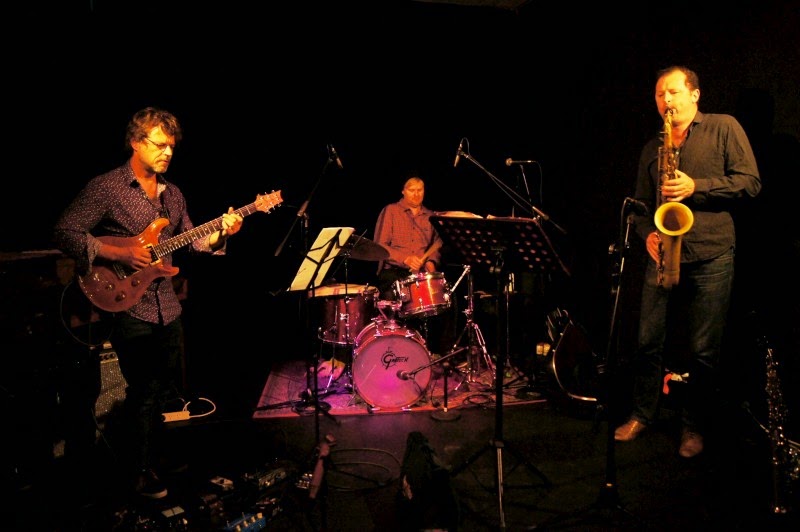
A friend posted to Facebook "Shit just got real" during this gig. She was right. This was the concert of Jamie Oehlers, Steve Magnusson and Ben Vanderwal. These are peak players in the Australian jazz scene. They were visiting Canberra to launch a new CD, Paper Tiger. There was no bassist (Bassless allegations was mentioned as a possible band name, probably in jest), but anomalous lineups are common these days. Steve played some bass lines or fingerpicked and the low notes did the job. Jamie also took an accompaniment role, behind Steve's guitar solos, and this is unusual but given his skills, wonderfully effective. This was choppy music. There was just one swing, as I remember, and one ballad. This was solid even-eights drumming that had me wondering what passers-by would be discovering. Few rock drummers will play with Ben's sharpness and invention. Jamie's solo lines were ever varied. These players were all this way: profoundly knowledgeable of options and thus fresh in their choices. Steve's technique, too, was choppy. Not smooth and distorted and searing but crisp, twangy, staccato and rabidly fast and endlessly varied. I guess these guys, too, have their habits and licks, but nothing seemed too obvious. Their new CD is 15 short tunes and this performance was pretty much that. The shortest was around 90 seconds and they obviously surprised themselves when it suddenly ended. Even the longest was perhaps 7 or 8 minutes. Jamie's known to play extended solos but this was a different experience. There were originals from all members and wit around the stories to introduce them. The music may be deadly serious, but this band's got the banter. Ben ran a commentary on left communitarianism ("We're all in this together") while denying any interest in politics. Was this banter for the Canberra visit? Ben wrote A song to parallel park to and he claimed to dislike it from the start, only to let it loose on his mates. A rocking chair on a carousel (on a cruise ship in choppy seas) was a song title and a story in itself. Then there were covers: Backhand by Keith Jarrett, Word from Bird by Ornette Coleman, Slow boat to China, Hard times come again no more. This was a challenging mix of contorted or pretty melodies that are developed with immense complexity. Jamie's Lament was a lovely ballad although never too obvious. Paper tiger was rubato, experimental with loops. Slow boat is a lovely old tune but was busily embellished. Hard times was in three and played with relative simplicity. This is a peak experience for jazz in Australia, three of the most capable and inventive players together and on record. It certainly got real; the final slice of the sandwich.

Jamie Oehlers (tenor, soprano saxes), Steve Magnusson (guitar) and Ben Vanderwal (drums) launched their new CD, Paper tiger, with a gig at Smiths.

18 September 2011

Katie Noonan does string theory

Text by Brenton Holmes

Only Katie Noonan could deliver as first course to her full-house audience an earnest young string quartet playing edgy modern art music. But it worked beautifully. The Sydney Symphony Fellowship Quartet (Freya Franzen and Monique Irik –violins; Tara Houghton –viola; Adam Szabo-cello) set the space vibrating with two of the Three Idylls (1906) by Frank Bridge before launching into String Quartet No.4 (2003) by the Latvian composer and eco-warrior Peteris Vasks. Written for the famed Kronos Quartet, the SSFSQ delivered a similar punch in a work that blended Stravinsky’s rhythmic grunt with the ferocious tonalities of Shostakovich’s late quartets.

One minor gripe. The individual instruments were fitted with the wonderful DPA clip-on condenser mics, but with the volume pumped up each instrument seemed hyper-exposed, and we lost the more blended quality that gives a string quartet its trademark unified voice.

The main event showcased Elixir’s new album First Seed Ripening, most of which comprises settings of poems by the Australian poet Tom Shapcott. The songs had been conjured into existence in the unhurried atmosphere of Arthur Boyd’s artists’ retreat Bundanon. The album uses strings to fine effect. The lyricism of Magnusson’s guitar and Hurren’s sax is the sweet, warm solder that fuses the elements together.

Katie opened the Canberra concert with the title track First Seed Ripening. Guitar and voice strolled in, Hurren prodded gently and the quartet glowed behind them. Noonan fluttered and glided around Magnusson’s simply plucked lines. Hurren slipped in a mellow solo before Magnusson joined him in what was reminiscent of a Golla and Burrows outing. The aperitif went down well.

My Skin is a Glove came next, with arranger Steve Newcombe giving the cello a hauntingly beautiful opening, the full quartet nestling in behind a tender-voiced Noonan, with a nicely understated guitar from Magnusson. The end hovered. The audience paused, rapt.

Katie then invited us to imagine tropical semi-nudity and other delights as she introduced another Tom Shapcott work, Stuff of Myths Magnusson had fun with his digitally-enhanced guitar intro before settling into a jaunty Airto Moreira feel. Noonan splashed happily in the shallows. Husband Zac’s sax joined her for some playful parallel precision work and we all came away suitably tanned.

Next came Pierrot, a Melbourne-tinged tribute to the sad clown, with an especially fine interplay between all the instruments, Magnusson’s plucking hinting at Ry Cooder. Noonan’s remarkable vocal abilities serve her well on songs like this. It is an instrument over which she exercises exquisitely subtle control.

Sleep Soundly, Peacefully was the song Katie and Zac wrote together as they anticipated parenthood for the first time. Magnusson’s intro drew the song perfectly into its lullaby mode. The room became a poetry reading. Katie Noonan can pluck a high note from anywhere and let it hang, only to lay it down gently as she would her baby’s head.

Time to switch to Radiohead In Limbo, and Elixir gave it a suitably FX treatment, looping Katie’s voice and Steve’s guitar. There was a touch of coloratura in the Noonan stratosphere, the crowd whooped its pleasure, and a clapping patron with glowing forearms caught some onstage attention.

Shapcott again manifested slightly tropical in Elixir’s efforts with Last Night’s Comfort. The jaunty Caribbean feel returned. Katie and Steve delivered some delicious duets.

Next came Tip of Memory from Elixir’s self-titled 2003 album. Essentially a waltz, and here in an arrangement by Paul Grabowsky, it was one of the evening’s highlights. Think of George Martin’s effort on Eleanor Rigby and you’ll catch the quality of Grabowsky’s work. The cello lines gave Adam Szabo a chance to shine.

Noonan made Joni Mitchell’s My Old Man her very own. Saying cheekily that she “doesn’t do covers … I prefer to think of them as tributes”, Katie delivered a tribute that Joni would have been proud of.

Three fine songs rounded out the concert. Hemispheres had the string quartet open à la Appalachian Spring, slipping neatly into Magnusson’s guitar; Nocturne satisfied in every respect; and Snapshot gave Katie Noonan the chance to remind us of just how remarkable the voice is that a jammed-packed audience had flocked to hear at the Street Theatre.

The blessing that is Elixir will be visited upon audiences around the country through September and October: Melbourne 17 September; Mullumbimby 23 September; Adelaide 7 October; Perth 8&9 October; Hobart 13 October; Launceston 14 October.

17 June 2011

Masters, young and old (DHJF-2)

It was Ron Carter who brought me to Sydney for the Darling Harbour Jazz Festival this year, but I’m a bass player and I know that plenty of guitarists came for Kurt Rosenwinkel. These are very big names and they were accompanied by other big names. Quite spectacular.

Firstly, Ron Carter. I was lucky enough to catch him twice: in the rain at DHJF and at the Basement the following night. He’s an absolute legend, of course, and I was not surprised or disappointed by his identifiable playing. Large hands, very lank and bony, and a sound that’s so hard it’s like concrete. This was stunning and unique. He’s not young and everyone was suffering from the cold, so the Basement show was the more comfortable, but both shows were impressive. This was sweet, correct, solid mainstream playing. I felt he struggled with a few things he attempted, from age or the cold, but I’d still dream of playing just a part of it with his authority and deceptive simplicity. Fabulous and so easily swinging with the most clear of bass lines that always served the tune as master. I was not the only one to notice how solid was the groove despite the lack of a drummer. This man is a rhythm unit in one performer and beautifully undemonstrative at that: deceptively simple and easily embellished. His offsiders were no slouches, of course. Mulgrew Miller was a delight with easily lyrical and occasionally dissonant statements that were so sweet and unforced, sliding off the fingers with no strain of performance or thought. This was the key: easy, comfortable improv and melody with the most perfect of swings. Guitarist Russell Malone was the youngster with an evident respect for his elders, but he was no underling. Always a ready smile and with eyes that caught every nuance, sharp and choppy backing and bluesy solos that again were deceptive in their intuitiveness. Wonderful, sharp and satisfying playing from the seniors of our art. The Ron Carter Trio are RC (bass), Mulgrew Miller (piano) and Russell Malone (guitar).

Secondly, Kurt Rosenwinkel. I’ve noticed how my guitarist mates speak in awe when KR’s name is mentioned, and I met a female bassist who’d flown from New Zealand to hear him, so KR is seriously admired. I’d heard him at Wang but in unfortunate acoustics. This time, I heard clearly and understood some of the excitement. This was Kurt’s Standards Trio with Eric Revis and Justin Falkiner. A formidable group. I noticed KR’s easy fluency and knowledge of the fingerboard, but that’s to be expected, but I also noticed a chordal approach that blended chords and melody or solos easily. His sound had some obvious gentle echo or reverb and occasional mild distortion, but essentially this was clearly spoken fluency, not effects. And the fluency was devastating at times. Solo lines covering three or more octaves seemed to drop with ease, and those fingers shaped into delightful chords and resolved into single note work. An object lesson in technique and a delight with clear sound. Both his associates took significant roles, especially drums, but I did feel that the guitar was clear leader. Eric Revis had a surprisingly soft tone, but maybe highlighted after hearing Ron Carter’s solidity. I’d been thinking of the training of some of the US drummers I’ve heard recently, especially given their concentration on snare and rudiments, but Justin was more tom-centred and thus softly sounding. Again, drums were easily concordant with the others, but this is perhaps the essence of a standards trio. The standards were Monk’s Reflections, Invitation, Goodbye pork pie hat, Bud Powell’s Blue pearl and Wayne Shorter’s Fall. A lesson in technique and gentle interaction. The Kurt Rosenwinkel Standards Trio are KR (guitar), Eric Revis (bass) and Justin Faulkner (drums).

Lastly, a mention of some big local names. Katie Noonan’s Elixir was supporting Ron Carter on his Australian tour and appeared early in the long night at the Basement. To me, Elixir continue the song tradition that predates jazz. Not surprising, given that Katie has classical training. This is a beautiful, mobile, soprano voice and wonderfully expressive of very thoughtful and considered words. There were some original compositions, but also several songs with words from poet Thomas Shapcott. The lyrics were superb, earthy, purposefully repeated, of love and life (to a woman pregnant; of love remembered semi-naked on a beach) with well-timed rough-hewn sensuality. Steve Magnusson’s accompanying guitar was precise with a sense of independent time that was formidable. Zac Hurren’s soprano sax was admirably restrained (I’ve seen him in full flight, and he can be a challenge) with lyrical lines and up-turned endings, but he did inject just a touch of dissonance towards the end. To my ear, this was sublime song in the long song tradition with just a touch of jazz influence. Elixir are Katie Noonan (vocals), Zac Hurren (soprano sax) and Steve Magnusson (guitar).

21 May 2011

Oh my gawd

There were a lot of those “oh my gawd” moments when I caught Oehlers/Mackey/Magnusson/Zwartz at the Loft. It was a party for the local jazz community and everyone was there; standing room only in our oddly located and intimate venue. These are some of the cream of the Australian jazz dairy, and friends to boot. This was to be standards: easy and relaxed but also serious and with energy and life to spare. This is the instrumentalists’ life, ears and heart and exertion. It was interesting to see two top tenorists together; interesting to have heard two top Australian guitarists and two vastly different approaches to jazz on two consecutive nights. Wonderful.

The band was Jamie Oehlers (tenor) and John Mackey (tenor), Steve Magnusson (guitar), Jonathan Zwartz (bass), Mark Sutton (drums) and Andy Butler (piano). There were two sets, just seven tunes, all standards, perhaps two hours of playing: All the things you are, My one and only love, Body & soul, Footprints, and a few others I recognised but couldn’t name. There were rabid, extended solos and taut accompaniment. There were contrasts in style and friendly challenges. These guys are playing for friends, but there’s a friendly rivalry like a footy team together in the muck. Suffice to say there were many Oh my gawd moments, and the response is little other than a chuckle at the seemingly impossible playing. Fabulously involved scalar movements and patterns from Jamie; blistering lines of quizzical uncertain pitch from Steve; outrageously dirty blues with atonal flourishes from John; firm tone, perfected intonation, melodic fluency, easily extended range and a unique line in single fingered scales from Jonathon; great energy, punchy kick and blushing cymbals from Mark; almost classical, overlapping scalar lines from Andy.

It was just a blow but it was a window on the highest skills around. What a way to party.

  • Cyberhalides pics
  • 22 September 2010

    Visiting Roper Bar

    It was quite minimal, quite droney, quite miasmic, quite intuitive and internal. Crossing Roper Bar was a combination of Paul Grabowski’s Australian Art Orchestra and four aboriginal performers, the Young Wagilak Group. The work was Crossing Roper Bar. It was sponsored by the HC Coombs Creative Arts Fellowship. It lasted 40-minutes and comprised a series tunes/grooves, largely without a break. I earlier noticed strains that I recognised (was it Hancock or jazz-rock Miles?), then there were clear grooves that were predetermined, and signals leading change, as well as constant taps of clapsticks in various simple, cutting rhythms, and less common didjeridu accompaniment. The rhythms were king, so bass and drums were key. These were Philip Rex and Nico Schauble, so very capably presented. There were colours and textures and occasional solos from reeds and trombone and violin, tinkling piano and keyboards making appearances but not prominent, and guitar also tinkling or texturing. Then the front line. This was obviously very different: those incessant claps, droning vocals that touched on Western scales but moved and bent into a very different sense of tonality, sometimes vocals in some sort of harmony that sounded satisfying but not understood by my ears, the didj, of course, but also that sharp, animal- or bird-dancing, the heels and toes that rock and tap and slap so precisely, the body and arms that snap from position to precise, repeated position. It’s something white Australians know of and even feel to some degree, but not something we make. The joyous but incongruous juxtaposition of bodies and cultures at the curtain call made this painfully obvious. But the good will was also obvious and welcomed. This is a cross cultural event, even if it’s a product of one country. We need it, although I for one don’t particularly understand it.

    Australian Art Orchestra performed with the Young Wagilak Group from Ngukurr, Arnhem Land. The AAO performers were Paul Grabowsky (piano, keyboards), Tony Hicks (saxes, flute), Niko Schauble (drums), Philip Rex (bass), Steve Magnussen (guitar), Errki Veltheim (violin), James Greening (trombone, pocket trumpet). The Young Wagilak Group were Benjamin Wilfred (yidaki [didjeridu], bilma [clapsticks], vocals), Roy Wilfred (bilma, vocals), David Wilfred (yidaki), Wesley Wilfred (dance, vocals).

    04 April 2008

    Splendid six stringer

    Every now and then you attend a concert that gives you real pleasure, leaves you wishing for more. Stephen Magnusson at the Jazz School Band Room last night was one of those. A good concert requires great competency, of course, but that’s not enough. It may be a mixture of many things: the environment, the audience, a compelling repertoire, the band clicking, the mood you’re in. I’d only seen Steve at Wangaratta for a short time in the local Cathedral. I could hear the capability of the performance, but the pews and paraphernalia didn’t appeal, and I only caught a few minutes anyway. But the Band Room is more purposeful and the performers are closer and more intimate. The result was a stunner.

    Stephen had come up from Melbourne for an afternoon workshop and this performance. He played with a select group of students from the Jazz School on tunes they had presumably first heard on the day, on a borrowed guitar, and with John Mackey and Miroslav Bukovsky sitting in for a few tunes.

    Stephen played with a light, airy, open approach. His fingerwork and resultant tonality was mostly clipped, so each note was individually articulated. It’s not an uncommon style, although totally another thing from the smooth, furbished styles of many guitarists. I hear a similar approach in some masters who seem to have tired of sleek and smooth, and seek expression and substance. He ranged widely and freely over the fingerboard, as you’d expect: up and down and across. The lines were lovely: wide and narrow intervals; flowing and long and strong; diatonic, but occasionally and strongly dissonant. He switched neck positions freely and formed fingers constantly around the shapes of arpeggios and chords. Solos often sounded of ragged valve distortion, perhaps from his Fender amp, but he also played with a (volume?) pedal for smoothed attacks, and for one tune used a pedal called a Memory Man for what seemed like looped but reversed backing. When comping, he was variously chordal or contrapuntal or soloistic, but always busy and responsive. His chords featured many richly coloured extensions. His solos retained interest and variation for multiple repeats of choruses. They were fast but not usually blistering, although there were some lines that left the room holding its breath. And always clear and melodic in intention.

    Obviously, I was transfixed by Stephen’s playing, but I did catch some of his band. Bill continues to play wonderfully; a few very apt solos, and solid, interesting backing. I enjoyed his take on Rhythm changes, where he played obvious notes, but with lots of unexpected gaps, making for a modern and interesting sound while still clearly defining the rapid but prosaic changes. Austin made me take note with some stunning lines dropped in neatly through the night. He concentrated strongly, often enough dropped out to leave space for others to comp, returned with strong chordal work; very nice playing. Evan can look a little ungraceful, but close your eyes and you’ll hear he’s actually responsive and intense and smooth where it matters, in his playing. James played some very satisfying solos in his bluesy style, with occasional screams and stutters. Matt Lustri was restrained on the night but supported capably. The band members came and went for different tunes, with only Steve resident through the night. The end of each set featured a blow with John Mackey and Miroslav Bukovsky, both local staff and respected senior players. This brought different styles and sounds: lively and exciting approaches to standard tunes on the blues and rhythm changes.

    There were some interesting tunes. The first was light and airy, mostly with a simple descending 4 chord, 4 bar structure. There was a hick, hillbilly tune that would have been crass if not so well performed. Stephen composed this to express the initial boredom and slow awakening to the beauty (and creepiness) of the outback during a 10hr drive. The looped guitar mentioned above was accompanied with brushes, and was based on Peter Gabriel’s Don’t give it up. There was a version of Somewhere over the rainbow by Steve and Miro. Stephen introduced it as “a bit daggy” but it was performed in a captivating modern style with the melody well hidden and only appearing well into the performance. There was a tune dedicated to Gary Costello, that I felt I‘d heard somewhere before. Gary was obviously a much respected bassist in the Melbourne scene.

    It was all over too soon, as is common with these gigs at the Band Room. The early start and finish times makes them very comfortable mid-week outings. We all departed for an early night after a wonderfully satisfying few sets of jazz from someone who’s clearly an Australian master.

    Stephen Magnusson (guitar) played with Evan Dorrian (drums), Matt Lustri (guitar), James LeFevre (tenor sax), Bill Williams (bass), Austin Benjamin (piano), John Mackey (tenor sax), Miroslav Bukovsky (trumpet).

    06 November 2007

    The guitars have it (Wang 2)

  • Wang 1

  • Guitars were a big theme at this year’s Wangaratta Jazz Festival. Firstly, and most obviously, because it was this year’s instrument for the National Jazz Awards. Secondly, because of the visit of the renowned New York guitarist, Kurt Rosenwinkel. Thirdly, due to the presence of those Australian masters of the instrument, James Muller and Stephen Magnusson.

    The Awards were a fascinatingly attractive thing for me. I attended late on the first day of the semi-finals to hear the two Canberra entries: Ben Hauptman and Carl Morgan. But the sessions were strangely addictive, so I was back next morning to catch the five remaining players. The ten semi-finalists were chosen blind from CDs sent by applicants, so these were all worthy entrants. Each player performs three tunes (a blues, a ballad, a composition by Bird or Scofield) with common accompaniment. Three entrants are chosen to perform on Sunday for the final. Strangely, the finalists performed the same three tunes for both performances. Not strangely, given it was the final, in the main hall, and going live to ABC Radio, they each looked pretty nervous, and clearly all made some minor fluffs. But it was capable playing all round and a fascinating few days.

    What got me most was the diversity of the entrants. There was straight-ahead jazz, fast and slow, post-modern, blues and rock influences, clean and effected. It was all there. I didn’t envy the judges, although the criteria would have helped markedly. I didn’t always share the decisions of the judges, but that’s part of the game, and a common topic for conversation on the streets.

    The winner was Aaron Flower who performed two simple, blues/rockabilly tunes with notable accuracy and a superbly lyrical version of the lovely ballad, You don’t know what love is. My guess is the ballad won it for him: it was truly sumptuous. Second place went to Ben Hauptman. Ben’s Canberra born and bred and a product of the jazz school and now resident in Sydney, along with his talented siblings, Zoe (bass) and James (drums). He played a more rock-influenced set. I loved his starter on Ellington’s Caravan. Then an original ballad in a trad vein, Unity Hall, and a highly effected Billie’s Bounce. I had missed Hugh Stuckey of Adelaide at the semis, but he was the talk of the streets before the final. He played a straight-ahead clean jazz style with panache, so he was also a good chance.

    I also heard several other semi-finalists of note. Carl Morgan is our local flash at the jazz school (viz, his nickname is Nuke as in nuclear bomb). Carl played a Scofield tune, It is written, along with My foolish heart and an original blues tune in the fast, flashy style that we know him for. Carl was the youngest of the semi-finalists (only 19 and only in his second year of tertiary jazz studies). The relative lack of experience showed, but he’s likely to be around for the next guitar awards and should be a force to be reckoned with. I also enjoyed Nashua Lee’s highly effected and blues-rock influenced set, Matt Smith’s sweet and stylish modern jazz playing and his choice of tunes (including a lovely Charlie Haden ballad, Spanish love song), and the confident, otherworldly sound and approach of the Japanese born, Brisbane-based Yusuke Akai. I didn’t hear all performers, but I sympathise with the judges.

    For me, perhaps the stars of the whole show were the rhythm section accompanists: Sam Anning (bass) and Ben Vanderwal (drums). I’ve written of each of them several times on CJ, and they are both excellent. Here, they accompanied in numerous, radically different styles both appropriately and supportively and soloed freely and on command. Admittedly they had the advantage of being continually warmed up, and not having the spotlight on them, but nonetheless they were superb. Theirs were stunning performances in their own rights.

    The panel comprised the venerable Mike Nock and the two guitarists who shared the Award in 2000: James Muller and Stephen Magnusson. These are a very different pair. I have heard James numerous times, and several times at this festival. He’s cool, sharp, professional and controlled in his playing, but his lines are fast and clear and rise with massive passion and often huge denouement. James may be a local, but he’s clearly a world-class exponent of the instrument. I’ve only heard Stephen at this festival, and don’t really know him, but what I heard seemed more fluid, soft and sweet. Definitely his presence is very different. Usually we think of Sydney as brash and Melbourne as cultured. This pair presents a challenge to those stereotypes.

    The other guitar highlight was the highly regarded New York exponent of the axe, Kurt Rosenwinkel. He’s renowned as perhaps one of the greats of the present time. My guitarist friends seem lost in description and comparison, so he’s got a unique approach. I didn’t attend his solo concert, which got some very positive comments, but I heard him in two performances with Barney McAll’s band. The PA sound was abysmal for the first and only reasonable for the second, although I felt his first performance was the more interesting. It was obviously competent, interesting and sometimes searing, but I need more time and better sound to form my personal opinion (with a world great, my expectations are more demanding). But it seems I missed something, given this reference from Scofield: “one of the finest and most creative jazz guitarists playing today”. I’ll just blame the lousy PA mix!

  • Wang 3
  •