Showing posts with label Rebecca Collins. Show all posts

17 December 2017

Mary and more


We caught L'Enfance du Christ at Wesley, performed by the Llewellyn Choir. It's one of Megan's favourites, although she knows it in the original French. This was in English. I could understand some more, of course, but it's never easy to catch lyrics. Reading some, I'm not sure it mattered. What I read was a strangely domestic thing, just a passage of St Matthew's gospel, in Berlioz's own words, in three parts, telling of Herod's and his massacre of the innocents and the flight into Egypt by Mary and Joseph with the baby Jesus and the arrival at Sais. It lasted a little over 90 minutes, with a shorter middle section, apparently written first and expanded for the final work, comprising the most famous tune, the Shepherd's farewell. In addition to the large choir of 80 SATB singers, conductor Rowan Harvey-Martin led five singers (one woman as Mary and four men) and the Llewellyn Sinfonia of 19, mostly made up of CSO players. The work was very attractive and admirably performed so the time went easily and we were treated to three final carols for Christmas, including Silent night where our sing-along was invited. So, a lovely work that I'm very glad I caught, well presented in an intimate venue. Even from the back, we could see enough to be involved even if the choir was offside in the stalls for some of the time. Wonderful.

The Llewellyn Choir and Sinfonia performed L'Enfance du Christ at Welsey under Rowan Harvey-Martin (conductor) with soloists Rebecca Collins, Rohan Thatcher, Andrew Fysh, Michael Wilson and Michael Martin (vocals).

18 April 2016

Knowing the Bible better


I knew of Elijah but not his story. Douglas McNicol was Elijah in the Mendelssohn Oratorio with the Llewellyn Choir and Sinfonia under Rowan Harvey-Martin. The other soloists were Rebecca Collins and Christina Wilson and Michael Martin and Charlie Barnes. So, mainly a local affair with numerous recognised faces, but with import DMcN who went through Elder Con with a friend so I knew of Elijah. I didn't know Elijah's story and didn't know Mendelssohn's setting except a few choral pieces that I've sung: He that shall endure to the end and O come everyone that thirsteth. Both are memorable themes that had me lift my ears. We enjoy much music through recognition. If I didn't know it, certainly DMcN did: he carried music under his arm but I didn't notice him reading it and he was the busiest amongst all the singers. Elijah was baritone, supported by tenor, soprano, mezzo-soprano, and, for just a few lines, boy treble. This was a noble and impressive effort and not one for wusses. The program was three hours including the interval. I pondered the style at one stage. It's obviously not baroque, but the bass style is ordered and scalar like baroque and the singing style also neat and even. The big choral sections were a pleasure as these always are, with ~100 singers giving voice. I enjoyed watching RH-M, too, involved and guiding. A big performance of a Biblical story with much satisfaction that deserved a better-informed listener.

Mendelssohn Elijah was performed by the Llewellyn Choir and Sinfonia under Rowan Harvey-Martin (conductor) with Pip Thompson (concertmaster), Anthony Smith (repetiteur) and soloists Douglas McNicol (baritone), Rebecca Collins (soprano), Christina Wilson (mezzo-soprano), Michael Martin (tenor) and Charlie Barnes (treble).

01 April 2012

Closest to Bach

It felt like the closest that I’ve got to JS Bach when we heard the St Matthew Passion last night. It was performed by the Llewellyn Choir accompanied by the Llewellyn Sinfonia and conducted by Rowan Harvey-Martin at the Canberra Girls’Grammar School hall. Why the closest? I think because it’s storytelling in German. The music remains glorious, but the essence is the story, recited in German by the Evangelist and sung in person by several solo singers and the choir as the People. The words are the essence. It was likely first performed in Thomaskirke, where Bach worked at providing music each week, on Good Friday in 1727. This was work for Bach but it was work of a believer for presentation to other believers. It’s a Passion, a reciting of Christ’s suffering on the cross, the essence of the Christian story. And from my reading of dictionary.com and the Shorter Oxford, this is the origin, from Middle English and mediaeval Latin, of our common word, passion.

It’s a long work, written for soloists, double choir and double orchestra. It was to be performed in two halves, before and after the sermon on Good Friday. The score is further divided into three parts: a narrative using biblical text; various recicatives, arias and choruses; and the chorales. It’s music that is subject to the story and the demands of the people, the claps of thunder, sadness or fear or rejections of the apostles are all expressed clearly. I revelled in the big chorale sections and loved the several returns of the main choral theme, sometimes slower, sometimes livelier, usually with varying words. I enjoyed the dignified Evangelist as he told his story that I wished I could understand without looking at a projected translation, I loved the instrumental accompaniments with the solo singers: violin, cello, organ (I think this is the same chamber organ used by Igitur Nos last week), harpsichord, flutes or oboes. I enjoyed the autal and contrapuntal movements left to right of the choirs and also the orchestras. And it’s an impressive theatre. It looks to be carefully set up for sound, although perhaps for a bigger rather than a precise sound. And it’s pleasantly human in dimensions; it has a massive stage but you still feel close. (Too bad about the noisy aircon). From the orchestra, I particularly noticed the clarity of the two single basses, and that glorious little but persistent organ sound. This music is dignified and ordered, but more than instrumental Bach, it is subordinate to words. A stunning piece of beauty well performed. Congratulations to all involved.

The Llewellyn Choir and Llewellyn Sinfonia performed JS Bach’s St Matthew Passion at the Canberra Girls’Grammar School hall. Key performers were Rowan Harvey-Martin (conductor), Michael Martin (Evangelist, tenor), Stephen Barnett (Jesus, bass), Rebecca Collins (soprano), Christina Wilson (contralto), Rohan Thatcher (bass).

20 December 2009

It must be Christmas

Sally observed it wasn’t jazz, but Handel’s Messiah well deserves a post on CJ. The Canberra Choral Society performed it again this year at St Christopher’s Cathedral, the cream brick Catholic cathedral at Manuka. We went to the first of two performances and it was an immensely satisfying experience. The Cathedral is not my favourite building around town, the acoustics were heavy with reverb that made for a loud but somewhat mushy sound and there was frequent traffic noise and Harley splutter outside on Canberra Avenue, but nonetheless this was a treat. It was the long performance with the full 3 Acts, verging on 3 hours with the interval. I thought this was a daring choice and all praise is due. This was my first Messiah (a late starter) but I was glad to hear one where the three parts, dealing with the Birth, Passion and Aftermath, were present, and the familiar arias and the exultant Hallelujah Chorus were in their right places. It was long but the time passed like a breeze. I was impressed by the stamina of both performance and audience. Pews are not the most comfy places to spend three hours, and I noticed the audience stirring but it was uncomplaining and stood for the famed Hallelujah Chorus, as people apparently have since King George 2. I expected that we would be too casual for that these days, but no. It was a pleasant surprise. And the applause was deafening at the end, so the effort was much appreciated.
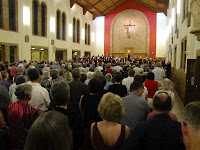
It was a small orchestra with a light presence that was sometimes overshadowed when the voices took flight. But it had a lovely courtly baroque tone that benefited from the reverb. Clear, fat trumpet ringing through (beautifully resonant and very different from a jazz trumpet tone), bassoon or oboe evident at other times, the strings fairly restrained with 7 violins, 2 violas, 2 cellos and a double bass. Organ and a harpsichord that presumably played the original basso continuo part. The choir was 21 sopranos, 30 altos, 10 tenors, 14 basses and there were arias and recitatives for SATB - Rebecca Collins (soprano), Christina Wilson (mezzosoprano), Christopher Saunders (tenor) and Stephen Barnett (bass) - and the whole was directed and conducted by Peter Pocock.

What glorious, exultant, dignified, elegant, rational music it is! Lines echoed by passing between voices and on to instruments; big and joyous interval jumps, and shapely lines. Apparently Handel is famous for word-painting where the melody mimics the meaning of the lyrics, so lines rise to mountains and fall to valleys, and “crooked” alternates crookedly between B and C#. I heard a unison bass and bassoon line that surprised and amused me. But always the neat cadences to confirm dignity at the end of scenes. I enjoyed it immensely, and the final applause was long and enthusiastic, seemingly beyond the expectations by the performers. In the end, I felt the words were strangely other-worldly (no-one much chats about exalted valleys, easy yokes or feeding flocks these days or even walking in darkness) but the rational baroque music fits well enough with modern rationality in architecture and politics and economics. We left with high spirits and much joy to take on the Christmas season. Truly a fabulous outing, so thanks in spades to my neighbour Trish and the rest of the performers. BTW, ArtSound were recording the Saturday night performance, so keep you ears tuned for the replay.