Showing posts with label James Greening. Show all posts

16 June 2026

Never wearied

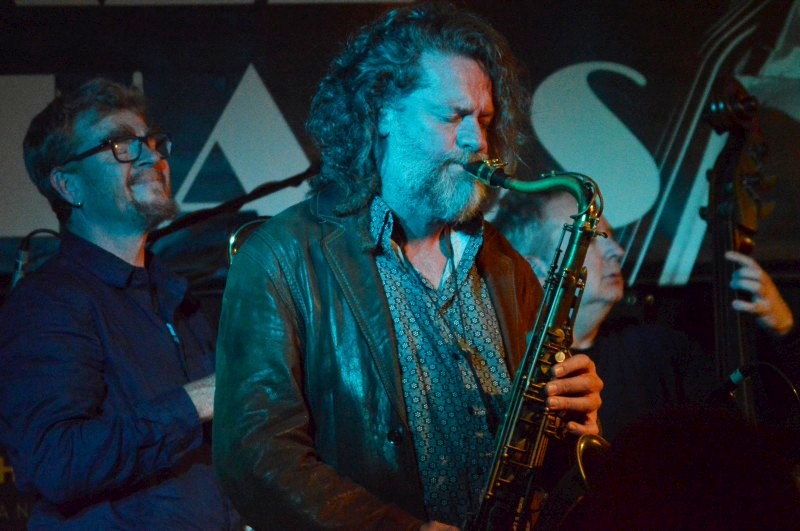
It's their 45th anniversary concert tour and CD and these are masters and seasoned of our jazz craft so it's so surprise that this was such a deeply satisfying gig to attend.  Sure, we see them in smaller groups but to hear the compositions, the solos, the personalities, the arrangements of little big band colours is a special thing.  I'm still thrilling at the precision of those colours; of the contemporary classical crossover of Kevin Hunt's piano outings; of the touching depth of Sandy's introduction to the gig and Miro's Ornette-infused Nostalgia (isn't what it used to be) to end it all, of Steve Elphick's understated but ever correct Hadenesque presence.  And they fit a space like this, theatrical, spacious, respectful, nicely amplified.  It was casual, too, compered by Sandy and a space and casualness that we could see, experience the personality, musical and other, of each of these players.  I was amused by the cool pleasure of Warwick Alder and his chat with Miro; ever gregarious and friendly James Greening and his quips and then floored by his trombone responses to a Sandy solo; the as-one pairing of Sandy and Andrew and offsider Paul; Matt filling in for John Mackey, blowing in this own style and verve.  Rease Cameron was new to me, but nicely effective.  Just 10 tunes over 2 hours and two sets.  A hugely mature set of musos and musical and compositional grouping ends in a fabulous and deeply satisfying night of music.

Ten Part Invention performed at The Street Theatre.  10PI comprised Miroslav Bukovsky (co-musical director, trumpet, flugelhorn), Sandy Evans (co-musical director, tenor, soprano saxes), Paul Cutlan (tenor, baritone saxes, clarinet), Andrew Robson (alto), Matt Ottignon (tenor, flute), Warwick Alder (trumpet), James Greening (trombone),  Kevin Hunt (piano), Steve Elphick (bass) and Rease Cameron (drums).

19 April 2026

Canb Jazz Fest 1

Thanks to Nigel and Beth and Bevan for the latest take on a Canberra Jazz festival.  They have the venue, a main stage and several smaller spaces, so this is very likely to be workable and the return next year had already been announced.  Great!  And Day 1 was a friendly, often inspiring outing.  First up was Tom Fell and his quartet which I raved about when I saw them recently.  Tom with Damian Slingsby, Nick McBride and James Luke on bass this time, so a classy and capable outfit playing music from Tom's new CD and at least one standard, Isfahan, with a plea for peace in our times.  Not the only performance that had such a theme appear.  I wrote sweet, correct, understated, adult, but there were some spots where it let go too.  Tom's soprano sax is his expansive, dirty, dissonant instrument: his tenor seems to pop up for more balladic numbers.  Then upstairs for Mic Knight trio, a reformation with offsiders who have now left Canberra for Melbourne given the ructions at ANUSOM, Evan Teece and Oliver Stott.  These were more let-go, unrelenting takes on standards, Almost like being in love, Green Dolphin St, Stella.  I like the unrelenting outlandish playing and but personally melted over James Luke's certainty and clarity with Tom.  Brett Hirst was to offer that later, too.  Then Wanderlust, Miro's fabulous, band of stars with the most delicious originals melodies out, not least Bronte Cafe, once regular star on ABCRN.  I had to leave towards the end.  I managed ~35mins and they had only finished their second tune.  This was Miro with James Greening, John Mackey, Alister Spence, Fabian Hevia and Lachlan Coventry.  Miro said they hadn't played together for 18montsh but you wouldn't know it.  Smooth, inventive, glorious harmonies on delightful melodies, almost casual passing of solos, with Miro looking around in admiration and joy.  It all started with a considerably free piano solo, then into the bass groove and head.  Solos from front line, Miro essential, James playful, John nicely developed but ultimately explosive.  Perhaps piano and maybe bass and drums, then to the head.  Then a joyous chatter and into Bronte Cafe.  It's a wonderfully joyous tune, again Miro and explosive John, but amusingly then James bringing it down with his communicative leading solo.  That really was a wonder, and perhaps then Fabian's solo.  Not sure.  But suffice to say I dreaded that I had to go, but some duties called.  

Tom Fell (soprano, tenor) performed with Damian Slingsby (piano), James Luke (bass) and Nick McBride (drums).  Mic Knight  performed with Evan Teece (bass) and Oliver Stott (drums).  Wanderlust comprised Miro Bukovsky (trumpet, flugelhorn) with James Greening (trombone), John Mackey (tenor), Alister Spence (piano), Lachlan Coventry (bass) and Fabian Hevia (drums).  They performed at the inaugural Canberra Jazz Festival at Smiths. 

13 March 2024

A funky Heaven

If you keep your eyes peeled and know the scene you can happen on a great event, a visit or gathering, variously social and musical, that's a memory maker.  Peter O'Mara at Smiths was one of those.  It was a small audience and a decent sized band (6).  There were old mates and influences and shared histories and now mature skills and notable occupations.  James Greening was there as his vibrant, jovial and immensely capable self, as coordinator and interface but also so-inviting trombonist.  Of course, so was Peter O'Mara, very early influenced by Miro (in the '70s?) and warmly recognising it, now Professor at a Hochschule for music in Munich, in a building once the office of Hitler, no less, blaring away with dirty distorted lines or clear chordal parts.  Peter's return visit was the excuse for this gig.  And John was there, blistering on tenor but also very simple and bluesy on another tune if always with the quick and twisting phrase immediately available but never abused.  And Hamish, solid and understated and always, always, correct and apt.  They were playing a tribute to Jacky Ozsasky, famed and loved for his funky bands and arrangements.  Perhaps they had all played with him at various times.  They played a few of his arrangements this night amongst some PO'M originals and arrangements, including of Miro's passionately beautiful Peace please.  Lachlan was a picking force on his Fender 6 bass and was probably the only one not to have played with JO (Lachlan?).  Then to top it off, Dale Barlow, another of this family, arrived with flute to play the second set.  He'd been expected to play the previous Sunday at but couldn't in the end, so this was the opportunity to catch him.  A mate described him as veritable Australian jazz royalty, apparently the only Aussie to have played with the famed Jazz Messengers.  Then we learn from stage chatter that Dale played his first recording on Peter's first album.  The family history continues.  So what of the music?  Apart from the basics of the chops and the huge inventiveness of these top flight players, it was spectacular and alive and joyous and infectious.  As were the tunes.  Miro's Peace please is emotionally entrancing but there was also James Brown funk and Amin grooves and classic Freddie Hubbard '70s funk (Red clay) and Peter original fusion.  I was in Heaven but I was not alone.

Peter O'Mara (guitar) visited Smiths to play with a band of old mates comprising Miroslav Bukovsky (trumpet, flugelhorn), James Greening (trombone), John Mackey (tenor), Lachlan Coventry (bass) and Hamish Stewart (drums) and Dale Barlow (flute) sat in for the second set.

20 June 2022

OWJF2022-9

Then old friends Wanderlust.  Now this was amusing as well as inviting and attractive.  Firstly, the tunes are to die for.  We hear a small number mostly at every Wanderlust concert, but I never tire of the colourful melodies and  insistent, somewhat international grooves and the three part front line and the solos.   They are in their 30th year but not playing too much, given Covid.  I imagined them flying by the seat of their pants but this is jazz.  Miro organising, passing or calling for solos, those unique feels, the amusements of James and all, really.  When do you see the saxist putting down his glasses on the stand, the trumpeter picking them up, the trombonist checking them out too, all while a delirious solo is taking place, with all in place for John when he's finished, you can only smile in collusion.  Then glorious startups from Fabian, all percussive rather than drum-styled, an unexpected solo started from Brendan when the audience didn't seem to want an end to the concert, and those delightful and expansive solos and fills from Alister.  Mightily musical but so much more; an intensely joyous event but also just lovely, inviting tunes.  How can you not love this outfit?

 And now for something completely different: The Morrisons.  This was classy country/roots/whatever.  Nice harmonies, up feels, fiddle and a string of stringed instruments, banjo, two guitars, a mandolin or similar and bass with slap-style playing. Someone mentioned Australian bluegrass and confirmed the lyrics and stories and compositions were local.  That's good.  I liked this outfit, capable and lively and happy.  Also nice was the location in the Lord Anson pub, so a chance to eat and have a beer.  A very different experience to the church-cum-concert hall events and a chance to chat with neighbours.

 Wanderlust and The Morrisons played at the inaugural Orange Winter Jazz Festival. Wanderlust comprised Miroslav Bukovsky (trumpet, flugelhorn), James Greening (trombone), John Mackey (tenor), Jeremy Sawkins (guitar), Alister Spence (piano), Brendan Clarke (bass) and Fabian Hevia (drums, percussion).  No names given in the program for The Morrisons.

16 June 2022

OWJF2022-5

And then to finish day 1 I attended two concerts and stayed throughout.  First up was The Vampires.  They are favourites from some time back and no less today even if they started a little wary on the day.  They've changed and interestingly, as drummer and sole original member on the night, Alex, said, there are many Vampires out there.  This time three of four were unavailable, two overseas and one with Covid.  Noel was new to me on bass but apparently he'd filled this role often enough and looked comfortable.  Tom had some warning of his call so seemed pretty prepared.  Tessie had very little, being a last minute Covid cover.  So it was a tentative start but by the end they were blowing with relative comfort and great joy.  The Vampires are like that.  The grooves are steady and lively and even mesmerising and the heads are genuinely attractive melodies with playful twists.  Tom played with effects which gave a studio feel.  I much enjoyed the interplay of Tom and Tessie and their capable listening on collective improvs.  Collective improvs are not too common, being  trad-styled, but I like the sense of danger and throwing caution to the wind and the challenge to players.  I also enjoyed how Noel approached his solos, not so much creating melody or counterpoint, but exploring and emboldening the rhythm.  Nice playing, increasingly settled and that sense of playfulness that I enjoy from The Vampires.

And finally, The catholics.  Note the spelling, of course.   Here's another band that's been around for yonks.  And another band that entertains, playing attractive tunes with virtuosity but keeping the pleasure in the listening.  But I was somewhat surprised by a meditative, pensive band this night, less excitable than I remember.  Just gloriously soft and pensive to start, although they wound up to Wes Montgomery later.  Hilary Geddes was sitting in and her inventiveness and versatility were self-evident.  Sandy was her eternal joyous and virtuosic self as is ever our venerable James on trom.   Fabian and Hamish lay a more rich rhythmic underlay given drums and percussion and it's always pleasant and strange that more don't take this path.  I guess there's more to pay, though.  Gary mostly played accordion but took to the grand piano beside him occasionally.  Lloyd oversaw the group as host and bassist.  There is always joy in a catholics concert and this also had a pensive side.  Lovely.

The Vampires and The catholics played at the inaugural Orange Winter Jazz Festival.  The Vampires comprised Alex Masso (drums), Noel Mason (bass), Tom Avgelikos (trumpet) and Tessie Overmeyer (alto).  The catholics comprised Lloyd Swanton (bass), Sandy Evans (tenor, soprano sax), James Greening (trombone), Gary Daley (piano, accordion),  Hilary Geddes (guitar), Fabian Hevia (percussion) and Hamish Stuart (drums).

15 February 2022

Venerable at 30

Wanderlust is 30yo.  That's quite an achievement for a band.  Miro's group that has changed a little but not tons over the years.  Still that delightful sweetness, that glorious sense of melody, that easy virtuosity with no pretense or hubris.  This is music to delight in.  They played their 30th anniversary show at Street Theatre 1.  The sound was a delight: I noticed when I tried to track each instrument, guitar, bass, drums, piano, perhaps sax soloing, and they were all there, clear and ringing, but nothing in the way.  Then the playing.  Of course, Brendan was a blast, but from a bassist that is without saying.  And his offsider, Fabian on drums, also a blast and an intriguing opening to the music of South America.  I hadn't realised he'd escaped Pinochet; I knew of Miro's escape from Russian tanks entering Prague.  It was a different Australia then.  Then Alister blew me out with the most alacritous jazz lines but also roguishly-perpetuated dissonance.  That is serious harmonic chops.  And working across the front line, John has those harmonic chops too, that we know, but my bliss was hearing his solo on Wanderlust, a tune by Duke Ellington.  I knew the tune, of course, but not the title.  John played the most unexpected and melodically glorious solo, so much in the tradition of the originators.  Bliss.  He told me later he'd been thinking who he would emulate and reeled off a string of Ellington's performers, what, Johnny Hodges, Harry Carney, Ben Webster?  That's listening.  Then Miro, of course, gloriously melodic on flugelhorm, more stretching on trumpet.  I was noticing the sound helped me experience these guys more than I remember.  James is always a blast and an amusing stage presence, and his playing this night was overwhelming at times, deliciously tonal but also playfully quick and lithe playing to the trombone's strengths.  And finally Jeremy, always certain and clear and crisp, not so fast as certain and tuneful.  Fabulous band.  They played only 7 tunes in their 90 minute allowance, so plenty of solos shared around.  The audience delighted in it all.  They were mostly compositions by Miro.  Miro's melodies are delicious and this band plays the heads with authority, sweetly tuned but also expressive.  Bronte Cafe, Delicatessence, Mumbo Gumbo,  Pressure makes diamonds.  Mumbo Gumbo felt like a 12-bar at first, but I ended up counting 16+1.  An interesting structure.  Fabulous tunes that even found an outlet on radio as program themes (Bronte Cafe on ABCRN).  And that Ellington tune, Wanderlust, and one each from Alister and Fabian.  Then an end.  But an invitation for drinks to celebrate.  Great night of music and even a beer to finish off.  Other than the difficulty getting a pic (yeah, I know, it shows above!), all was well with the world.

Wandlerlust played their 30th anniversary concert at the Street Theatre.  Wanderlust were Miroslav Bukovsky (trumpet, flugelhorn), James Greening (trombone), John Mackey (tenor), Jeremy Sawkins (guitar), Alister Spence (piano), Brendan Clarke (bass) and Fabian Hevia (drums).

21 July 2019

Wander at will


I did just see them passing by - I have a few times - but I was blown out as always. Miro got Wandlerlust together for a gig at the Jazz Haus and it was a stunner. From the first bars of a lengthy, adventurous piano solo from Alister to open up, through the renowned Wanderlust songbook and a few newbies and a delightful standard by Duke Ellington called Wanderlust, no doubt, this was a thing of wonder. Bronte Cafe is famed not just for the band but for its incarnation as a theme on ABCRN a few years back. Dakkar just sits luxuriantly. There a good bit of Africa here, with one from Jeremy (missed the title) and Miro's Pressure makes diamonds (a fabulous title dedicated to Nelson Mandela). And deep grooves with Delicatessence and the latin/New Orleans Mumbo Jumbo. And that deliciously beautiful tune, again by Miro, Peace please, which they played as an encore and profound ending. This was Wanderlust as lustful as I've ever seen them. Gloriously tight and intoned heads that sit over infectious rhythms; James with his ever-gleeful presence and deeply satisfying solos; John and Brendan as the local visitors and insanely effective; Alister as deeply, harmonically investigative, Fabian all infectious latin, Jeremy often unobtrusive then guitar clean and melodic. Megan asked about some of the background, where these overly capable musicians on riffs spelling complex African grooves. Backing solos or backing out completely for solo bass or drums or guitar to play genuinely alone. Just so good. Great players know when to talk and when to sit. And again, those perfect heads. Someone mentioned there's not much ensemble playing. No, not written. These are mostly infectious grooves with gloriously melodic heads and space for improv that they leave to these great players. Did I say I enjoyed it? Hugely enjoyable tunes from the best of players. What's not to like?

Wanderlust appeared at the Jazz Haus. Wanderlust were Miroslav Bukovsky (trumpet, flueglhorn), John Mackey (tenor), James Greening (trombone), Alister Spence (piano), Jeremy Sawkins (guitar), Brendan Clarke (bass) and Fabian Hevia (drums).

15 June 2016

Another day, another suite


And here I am thinking jazz suites are rare. This was Lloyd Swanton's composition, mostly music, but with accompanying and explanative spoken word and projected photographs. Again, with a collection of some of Australia's best jazz-oriented musicians and even a classical mate of mine, James Eccles, of the Australian Haydn Ensemble and Noise and more. The Ambon suite told the story of Lloyd's uncle, Stuart, who was sent with Gull Force to Ambon Island in WW2 to protect against Japanese invasion. It was a woefully inadequate response, a doomed action, and Stewart and Gull Force ended as prisoners of the Japanese, enduring harsh treatment for several years, Stuart dying of beri-beri just the day before the end of the Pacific war. Tragic and sad for family. Interestingly, while researching, Lloyd found webs of connections, not least that the father of legendary Melbourne jazz drummer, Brian Brown, had also been prisoner and died on Ambon. It's a small jazz world. We have heard much of military matters recently as the Abbott Government lavished on the centenary of WWI, and I just hope this worthy project got some of that funding.

So what of the performance, of itself and inevitably with some comparison to yesterday's jazz suite by Stu Hunter? There were spoken words but not singing; music that was both more traditional (mirroring the music of the time) but also noise, of dismantled wind instruments and tapping various other instruments and bass with rattling metal attachments; the playing on all was impeccable; I drooled over the silver sheen of Michel Rose's pedal steel guitar (more complex than I'd imagined: 20 strings, 9 pedals, 8 knee levers? I have loved this instrument since hearing MR with the catholics - he told me that was early '90s; he'd left to play with Lee Kernaghan); I enjoyed the classical and authentic touch with James E playing uncle Stuart's actual viola; I was entranced by yet another solo by James G played with his uncommon abandon; I enjoyed some heavy beats in the second half, although these were not common, and some exquisite four part wind passages, and otherwise some delicate percussion; a passage of tunes by the strings was lyrical, just bass, viola, pedal steel, ukelele and guitar; I was intrigued by the uncannilly authentic sounds of tropical birds and forest in one passage; I was blackly amused by some stories, like the unknown brother flying low over Ambon Harbour for sheer bravado and surviving Japanese ack-ack, or of the meat-case bass. This was aural colour and historical song, religious faith and humour in adversity all in a true family story. There were even pics of Stuart's gravestone, now updated with military honour, and of his diary now resident at the War Memorial. This was touching, educative and musically satsifying, so a great success all round from a wonderful set of mature, communicative musicians and a emotionally touched composer. A second wonderful jazz suite.

Lloyd Swanton (bass, composer) led the band in the Ambon Suite at the Street Theatre. The band was Lloyd (bass), Paul Cutlan (saxes, clarinets, recorder), Sandy Evans (saxes), Alex Silver (trombone), James Greening (trombone, cornet, tuba, baritone horn), Fabian Hevia (percussion), Ron Reeves (kendang, percussion), Hamish Stuart (drums), James Eccles (viola), Michel Rose (pedal steel guitar), Jon Pease (guitar), Sam Lemann (ukelele).

13 June 2016

Suite life


A suite is a big view and not very common in jazz, but Stu Hunter does them. The migration is the third that he's composed and recorded and the first that I've heard on tour. We were lucky enough to catch the final night here in Canberra, after performances as far afield as Perth and as illustrious as the MIJF. The final night mostly has the best awareness of the music and the most delirious pleasure in playing and that's what it seemed to me this night. Not least aided by the Canberra connections, through frequent gigs or teaching or studying at our School of Music in its illustrious past. I assume there's also family here for some of them. I could only admire and wallow in the deep, often minimalist grooves, the sometimes raucous horn parts, the heavy rhythms or detailed drums or essential, busy, feathery e-bass, or Stu's directorial piano segments or Tina's blues-infested voice that stepped through lyrics in three component songs of nine tune/movements. I couldn't catch all the words and these would be essential for the theme; reading them after from the CD cover I'm still not hugely more confident in my interpretation. The migration seems a broad story of life, a "celebration, conversation, a comment and a wish ... my own life process put to music ... questions instead of answers ... movement of ideas and beliefs ... and growth and sharing of culture and ideas". That's a broad palette for the theme. The music was broad too, as well as virtuosic (although no surprise on the virtuosity given the lineup). Bass was core to the work. It started with a wah bass solo then a driving dirty bass with overlying yearning horn themes. Then a heavy groove with Afrobeat horns; a short pensive section; the theme laid out with voice on Twelve stages of freedom. Requiem for belief was a written four part horn tune (including tuba) with drums accompaniment (think Nino Rota). There was a piece outlining flowing water then a piano-heavy ballad speaking of love; an ecstatic blues/funk song with words of moonshine but themed of the joys of life lived. Finally a klezmer-like ending called Land of Gypsies, instrumental and outgoing and open to the world. Nice to see the migration was ultimately well-received by the composer. It was certainly well-received by the audience. I hugely enjoyed the grooves, head-nodding for long passages (there's a lot of music here to dance to), the horns were great, the rhythm section was wondrous, especially Cameron Undy (local origin, now Sydney), very busy on a uniquely lithe bass (short scale Fender Musicmaster with split pickup?), and Simon's insistent drumming, Tina's voice was intimately bluesy and powerful with heavy vibrato. And Julien's bass clarinet, amusingly sometimes sounding of didj, Matt's much restrained solo lines breaking into flurries, James' playful virtuosity on tuba and everything else he touches, Phil's calmly explosive precision, Carl's occasional guitar (I remember just one larger solo this night, mostly lost in the mix to my ears) that can plumb real musical depths, Declan's insistent rhythms that established more than one tune, and Stu's guidance and oversight from the piano stool and sharp solos and penetrating comping. 80 minutes that entranced and involved and passed with ease. In the wake of the like of Mingus and Carla Bley, Stu Hanter has produced his third large format compostion and it was a wonderful, engaging success.

Stu Hunter (piano, composer) led the band in performing his suite, The migration, at the Street Theatre. The band was Stu with Phil Slater (trumpet), Matt Keegan (saxes, clarinet), Julien Wilson (saxes, clarinet), James Greening (trombone, pocket trumpet, tuba), Carl Dewhurst (guitar), Cameron Undy (bass), Simon Barker (drums, percussion), Declan Kelly (percussion, drums), Tina Harrod (vocals).

04 December 2014

Real adults


James Greening and mates came to Canberra and it was obvious the adults were in charge for the night, at least at the Gods. This was Greening from Ear to Ear. All light and jovial but supremely skilled and in command and well prepared. I wrote notes: respectful of tradition, deeply skilled, open, unpretentious, respectful, communicative (everything other Canberra- visiting adult-pretenders are not). But back to the music. The Gods is undergoing renovation, so we were in the Arts Centre foyer. More square, damply reverberant but nicely fat sounding with the audience. The band was close in one corner. This was a 7-piece band with three horns in front and the writing showed, as did the excellent musicianship. These guys are top of their trade and the harmonies were blissful and the grooves sat with precision, unstressed, seemingly so easy, but that's the skill showing. Playing music as it should be played is deceptively easy, but it takes years to master. These guys had it. These are Sydney masters and I was entranced. The first set was James' Tam O'Shanter Tales suite. He wrote the suite while in Tasmania and it's dedicated to the musical influences in his life: his family, Monk, his wife, Jackie Orszaski, with some less obvious insertions, like Parallel lines (a fabulous little big band chart) and Hazara (of more political relevance). I was stunned by the ease of interaction and perfection of the harmonised sound. These were not easy charts, but always played with easily but sweetly. Then the solos. I loved the Hammond tone from Gary and the fabulously twisting percussion from Fabian. James' solos were perfectly formed and Andrew's were a lesson in melodic statement, embellishment and development. I have admired his sax playing for years and I learnt something here on the night. Paul was more abstruse, less a matter of formal development than an emotional journey. Steve Elphick was sitting in for Brett Hirst and set some firm grooves and was nicely considered in his solo. I don't remember Hamish taking a solo, but every bar was rich with variation and connection. Another lesson. The second set was a few tunes from band members. Fabian played guitar on Domingo, simple descending chord changes over a medium tempo 4 with an Euro street vibe imparted by lovely accordion from Gary. Andrew's 22 degree halo featured Fabian's percussion solo that floored me with its delayed beats and falling rhythmic complexity (Latin training required). Then another then Lowdown, again from Andrew, funky with an odd count. There were changes of instruments: Rhodes - Hammond - accordion, or bass clarinet - tenor, or alto - baritone, or trombone - sousaphone - pocket trumpet (that's an odd combination and quite a challenge of sizes) or double - electric bass. All fabulously played, tight as, perfectly harmonised and blended. This was fabulous and about as good as it gets.

Greening from Ear to Ear played at the Gods. GfE2E are James Greening (trombone, sousaphone, pocket trumpet), Andrew Robson (alto, baritone sax), Paul Cutlan (tenor sax, bass clarinet), Gary Daley (accordion, organ, piano), Steve Elphick (bass), Fabian Hevia (percussion, guitar) and Hamish Stuart (drums).

04 June 2014

Luke's back


Luke visits often. It's wonderful that he does. He's a wonderful product of this town, and he's now ensconced in the Sydney scene, so we get a touch of that whenever he's in town. He's prolific, too. He's involved in a range of projects playing a range of compositions. He writes lots. The tunes seem diverse in the different bands. This was his sextet. The last incarnation of his sextet perhaps 2 common tunes, so he writes. As proof, he played one that was just finished on the day, so unnamed. The sextet comprises three horns - tenor, trumpet, trombone - up front and there's some satisfying writing for the three, but there's time, too, for open band improv, or for features for each instrument, including the rhythm section. So space for the individual, but also for the combined force of a capable band. I particularly loved the pairing of the two brass, trumpet and trombone, Ken Allars and James Greening, but that's an easy enough attraction. They are wonderful players and sensitive and responsive to others. Mat Keegan was on tenor for this gig. He's a different kettle of fish: wildly understated with just the occasional flourish. James H-D stunned me volume from his little GK and then entranced me with woody tone to die for while he was playing solo. Finn was strong, impulsive, driving, never at rest. Lovely playing and apt for this diverse but loud and powerful music. Luke was the perfect leader, always invited and supportive and guiding from the piano stool. Plenty of solos, there, too. I usually hear him on Rhodes when playing electric. It a real and non-digital tone and solos nicely, and comps with a generous rotundity behind a full ensemble. For something different, Geoff Page sat in for a reading of his Elegy [to jazz trumpeters] against a cool blues with angular head to start the second set. Well informed and a treat for jazz historians. I was interested that all the tunes had a reference: Little whippers to kids playing; Really on time to drummer Namchoon Kim; Dashing horse; Introvert. There are stories here, although stories are never too obvious in music. Tit bits that started as march and morphed to reggae. This was a compositional success and an individual romp for the players. Great stuff.

Luke Sweeting (piano) led his sextet comprising Ken Allars (trumpet), Matt Keegan (tenor), James Greening (trombone), James Heazlewood-Dale (double bass) and Finn Ryan (drums) at the Gods. Geoff Page (poems) recited for one tune.

02 April 2014

Glee


There was much glee around James Greening (there usually is). This time it was about his frequent gigs here recently in Canberra. It's too bad that Andrew Robson and the rest of the band haven't been here so often of late. This was an eclectic outing, intelligent and varied and unexpected. Several times Andrew's baritone sax gave a funky Mingus or New Orleans groove when he took that up. But then another time he played a trio with bari, bass and drums and this was smooth, sleek, melodious. He liked to vary the instrumentation, too. It wasn't at all surprising that the front liners played bari/alto, tenor/soprano and trom/pocket trumpet. But it was surprising that James or Sandy left the stage for various tunes, and even more surprising when bassist Steve left. That was on Flex, a Jackie Orszaczky funky-blues dedication, where the bari took the bassist's role. There were some other dedications, too, to musicians Andrew has played with. Two watch Bob was a dedication to fellow 10 Part Inventionist Bob Bertles from a quip by Miro Bukovsky. This was a slow, lumbering groove with a jauntily lyrical melody (played without Sandy). A march, Sound the trumpet ring the bells, was also introduced with a story of Jackie Orszaczky. I heard Jackie O too infrequently, but he's one of those musicians with immense admiration amongst his peers. John Pochée was recognised with the opening tune called The Alchemist. This one featured two solos, alto then tenor. Against the alto solo, the band dropped out to leave just drums in support before returning; against the tenor solo, the remaining support was bass. Andrew wrote something similar in the piece I found most impressive for the night, Texas Ranger, which was bluesy with some fast bop, and twisted and playful like Ornette. What little I've written has been most successful when I used an idea, even an arbitrary idea, as a formulation, so his palindrome doesn't surprise me. It's called Glenelg and it's a musical palindrome (spelt the same forward and backward). It's a busy 8-to-the-bar on bass with a slow melody over and solos that decay to free then to recover the melody with drums taps on 3,4. BTW, we learnt that Steve is a cryptic crossword filler and he'd recognised the palindrome immediately. Combover was a light take on early jazz with frequent changes. These tunes were from a new CD that this quintet has just released. Unlike his previous albums, this was unthemed; Andrew just wanted to record a group of favourite tunes, so the varied nature is no surprise. I reckon I'd heard a few before. It was a joyful band, too, led by Andrew's smiles and James humour and Sandy's good will. James has been a total pleasure to hear so often of late: wonderfully lyrical while playful and wearing dissonance so lightly. I enjoyed Steve's understated firm and restrained bass playing and Hamish's presence and sympathetic playing. Andrew's presence is light and friendly, but his playing is intelligent, as is Sandy's expressive sax; I especially enjoyed the soprano this evening. Andrew is a Cnaberra boy and we need to see more of him. This was a great outing with a varied repertoire of pleasurable performance and underlying intelligence.

Andrew Robson (alto, baritone) led a quintet with Sandy Evans (tenor, soprano), James Greening (trombone, pocket trumpet), Steve Elphick (bass) and Hamish Stuart (drums).

17 March 2014

When Simon met wonder


I'm listening to Reina De La Pileta a as I write this. It's the album launched the other night at the Street Theatre by Simon Milman with Wanderlust. Simon composed the music. it's strongly influenced by his latin background and interests, and it's very good. I've admired Simon's compositions and performances for some time. Whether Ornette-influenced or Latin or whatever, his work has purpose. The launch was in the Street Theatre 2, an intimate performance space, with a few wide rows of seating and a good PA and an upright piano. Fabian was unavoidably absent and ably replaced by Steve Marin. Otherwise, this was the Wanderlust we know and love. James and Miro up front, forming perfect harmonies and Miro in some of the best form I've heard with clarity and perfectly formed notes and inevitably correct phrasing and sweeping scalar responses. James seems to be playing more trumpet these days, so he was on trumpet, pocket trumpet and trom and a few beats on cajon. Again, always impeccably phrased and intoned lines. Alister withheld his playing with some immensely simple but well placed small chords that fit latin and one reggae feel, but then laid out some solos that floored me and that we mates talked about after the performance, delving into syncopations and sequences and then into a delicious free jazz of colour and magnificent in conception and performance. This was not a gig of solos, although everyone had at least one - the horns had plenty - but from the relaxed grooves, these solos just emerged with intent and energy and they all were lessons in melody and structure. Then Jeremy, who mostly played supportive parts and also laid out at times, but took a few driven Scofield monster-solos and I think one on nylon strung acoustic, but his playing that floored me was some richly dissonant chording in one of the tunes that said Bitches Brew to my ears. Very prominent and just fabulous. Simon, too, was mostly supportive (he could have been louder in the mix) rather than flashy, but his solo was a lovely melodic statement with real connection and no phony flash or flourish, more than just a bop overlay over the changes. Drummer Steve was sitting in, apparently at short notice, and he did the job admirably, laying rhythms and nicely snapping the snare, and his solo was a cracker that not just Miro and ever-supportive James were admiring. Wanderlust is a band of long standing with mature musicians and an engaging repertoire. Simon's compositions did them justice and vice-versa. The first set comprised tracks from the album and the second had more album tunes and some Wanderlust classics and Simon's take on Cold Chisel's Khe Sahn. After the intro, I guessed this would be Khe Sahn (I knew Simon had arranged this tune) but even then I only caught one phrase in a 10-minute rendition. James' comment at the end was "Where did that come from?" It wasn't at all obvious, but it was another goody. Congrats to both Simon and Wanderlust for an enticing evening of exceptional playing. Truly impressive.

Simon Milman (compositions) launched the album Reina De La Pileta / Wanderlust meets Simon Milman. The performers were Miroslav Bukovsky (trumpet, flugelhorn), James Greening (trumpet, pocket trumpet, trombone), Jeremy Sawkins (guitar), Alister Spence (piano), Simon Milman (bass) and Steve Marin (drums).