Showing posts with label Andrew Leigh. Show all posts

04 March 2026

John and Maruki

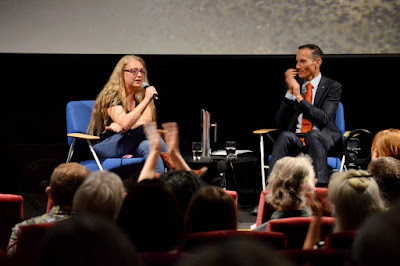
It's somewhat strange but lovely that a principal from the LSO and violist from a significant string quartet formed the Maruki Community Orchestra with its invitation to all to take play, regardless of expertise, and to take on major works.  But that was John Gould.  My first Maruki concert was my second orchestral concert and it featured Beethoven Symphony no.5.  I will always remember how John would recount stories of famed conductors and performers through practice.  But John died sometime back and now we record his loss with a musical biography from PC (Paul) Hubbard, now conductor.  The book was launched over the weekend with a film, String Quartet, about his Carl Pini String Quartet, a discussion with author Paul led by Andrew Leigh, and a short violin play by Winsa Daniswara on  John's old violin, now Paul's.  I have yet to read the book and I look forward to it but the discussion already was informative.  Interestingly, Paul used AI in writing the work, so that too will be intriguing.  A mark of respect for John.

John Gould and the Maruki Community Orchestra was written by PC (Paul) Hubbard and launched with a film, discussion and short violin recital at Lyneham High School Performing Arts Centre.

01 March 2022

No basement at Pizzagate

I'd seen Van Badham on a Webinar but still I went to her Meet the Author session at ANU and I'm glad I did.  At one stage she mentioned watching flat faces over Zoom.  I know what that's like.  It's more intense and immediate being there.  You can't break it up to get a coffee so the listening is different.  Colin Steele introduced the session and thanked the ANU Security Team who were in attendance.  Security team?  As we heard more, we understood that VB is targeted and threatened for her stance.  She was speaking to her new book, QAnon and On: a short and shocking history of Internet conspiracy cults.  So we heard of the appeal of conspiracies after distress and of the ego boost of secret knowledge.  Of pathways (including divorce) and especially health movements, yoga teachers and the like, apparently big in Australia.  Of "fusion paranoia" where upset people unite through common causes.  Of rabbit holes and algorithms.  We learnt that the Pizzagate pizzeria didn't even have a basement!  And of Van's relationships to Bonobos.  And of robot dogs used by the AFP and streaker from the Deep State at our recent Canberra demos.  That was new: I'd only heard of the sound cannon.  Of group delusion creating orthodoxy and then loyalties.  Van suggested that we'd been lucky in Canberra, not least through sophisticated policing.  All new and interesting.  She spoke of a long commitment to fighting fascism; of being called a "communist dyke Jew whore" (quite common observations in some circles...).  Of her respect and commitment to democracy; of her family's Union background; of participation and support for democracy being a sacred duty (not a theme I'd expected, actually).  There were stories: Sean Hannity calling Trump a "Blue collar billionaire";  private planes being flown to the 6 Jan attack at the US Capitol.  She spoke of Trump supporters as "overwhelmingly middle class", small business and the like, whose position was threatened, rather than the downtrodden poor as envisaged by the Left.  There was humour but seriousness in her (borrowed) description: "lumpen bourgeoisie".  I liked her preparedness to question both sides.  Then onto her pessimism about US politics, how there was "total capture of the Republicans in the US" by populism, but how some neo-Conservatives of the Reagan era were anti-Trumpists.  There were questions on FB, language and trigger words, the role of feminism in this context, conspiracy thinking in the Canberra protests and its role in the coming Federal election.  She expanded on how techniques in political misinformation are common around the world, with even some statistics shared between US and Australia in one campaign.  I know of much of this: I read about it often enough.  Our exceptional rate of vaccinations suggest that mostly Australians are somewhat immune but she remains deeply worried and so do I.

Van Badham (author) was speaking in relation to her new book, QAnon and On: a short and shocking history of Internet conspiracy cults, at ANU.  She was interviewed by Andrew Leigh (Academic, ALP MHR).

05 October 2013

Land of the Fair Go


Andrew Leigh made good on his promise at a previous Politics in the Pub to return when he published his next book. The book is Battlers and billionaires : the story of inequality in Australia. Andrew is a Labor MP so is probably a bit freer now after Abbott’s success at the recent Federal election. He’s also been a Professor of Economics at ANU so I value his informed insights. He displays an obvious evidence-based approach and an awareness of where evidence ends and opinion starts and this appeals to me. It takes honesty to offer that your side of politics may find an issue difficult. He did that when talking of evidence around education, families and successful children (the success of stable families with “concerted cultivation”). Otherwise, his evidence was well supportive of his centre-left position. He described the level of inequality with a ladder metaphor that had Gina Rinehardt 10km up, above very many rungs. He provided a potted history of inequality in Australia. At first we were egalitarian when all had little, but then land grants and presumably other factors led to a high level of inequality by the 1820s/30s (think Dickens). The 1890s depression through to WW1 was another peak with mass unemployment and wages, but not prices, capped. Then the 1930s/40s saw increased egalitarianism with the growth of manufacturing and capping of both wages and prices leading to an increase in home and car ownership. It’s indicative rather than proof, but the pay of BHP’s CEO is an interesting measure of inequality. In WW1, an average worker required 50 years of income to match the CEO’s annual income; in the late 1940s, 15 years; now it’s 2 lifetimes! Inequality is even stretching within the BRW Rich list: the distribution of wealth is becoming more uneven even there. All this matters for various reasons: because we feel inequality matters; because Australia has an ethic of a Fair go; because inequality has impacts on health, social mobility and a the responsiveness and ability of society to change. He noted Australia’s spirit of egalitarianism in history and sport, but he also questioned whether the ethos is at risk. There were questions. He mentioned Daniel Moynihan on black society in America and Susan Mayer’s What money can’t buy. He mentioned the Henry review and dismissed an inheritance tax as a political impossibility in Australia and mentioned a progressive expenditure tax (I’d never hear of this one) which economists like but recognise it’s virtually impossible to implement. He observed that globalisation and technology combine to create superstars and concentration of wealth, but that they are unassailable; other policy responses are needed to deal with the outcomes here. He noted Keating’s comments on the ‘50s/’60s as “Australia’s salad days”, good days for social connectedness and egalitarianism. He responded to a question about charity beginning at home with a comment about few surveys being available: three cheers for the evidence-based commentator. He admitted some weakness by Labor on some issues (single parents, newstart), but highlighted other successes and pilloried some approaches expected from Abbott’s government. I was particularly taken by his description of Abbott’s Maternity Leave scheme as using transfers to benefit the wealthy. Tax reductions have served this way in the past, but not tax transfers. He worried about the influence of small parties and the Palmer party in the Senate, the loss of the mining tax and the regressive changes to tax and superannuation. He noted that governments can take the right or wrong direction, and commented that this was “strikingly inegalitarian”. He suggested that “inequality is a partisan notion” and that arguments from social mobility may more successfully convince voters. Again he was refreshing in questioning people in progressive politics, saying they are interested in (good) expenditure but less interested in finding the cash to cover it. He noted that median household expenditure is now ~$80K and that those above this level are richer than half of Australians. I’m pleased to hear this because I share Andrew’s political position, but also because it’s refreshing to hear someone who’s both informed and honest in arguing his position. We’d benefit from a lot more like Andrew Leigh.

Andrew Leigh spoke at the Australia Institute’s Politics in the Pub.

30 March 2013

What’s good and bad for us


I’d expected to receive an email saying Andrew Leigh’s presentation at Politics in the Pub had been cancelled. After all, he’s just been promoted to the Ministry, as Parliamentary Secretary assisting the PM, just a few days before in the debacle which was the most recent Labor leadership spill. But I received no email and the event was on and he turned up. I bought a beer and perused the crowd. I like Politics in the Pub. It was busy. There was lots of humour and good will. I wondered if this is a respite from the chill winds outside for the centre-left. I got talking to a guy next to me who turned out to be a Christian Brother. Lucky I did, because this was one recommendation later by Andrew Leigh. He was talking of his new book, Disconnected, which investigates social capital and engagement in the community in Australia. It’s familiar territory. I thought of Robert Putnam and it turns out that Andrew had worked with Putnam for some time. Andrew’s a local Federal MP and was an economist at ANU, so this is localised for Australia and with an awareness of Canberra and it showed.

Andrew started by noting that social capital is a relatively new concept for economics. He described it by providing various measures and then surveyed the decreases in these measures in Australia over the period from a peak around 1960. Nothing surprised me much: membership of associations, car use, involvement in politics, valid voting, church attendance. Here I was interested that he said even atheists should care about dropping church attendance, because “church goers are nicer” (quoted from Putnam). I guess this crosses the Pacific, although we have very different experiences of religion. Then workplace social capital, union membership, knowledge of neighbours, rise in living alone, involvement in sport. He did observe that suicide and murder have dropped and that people still watch sport although they don’t participate (I thought of the commercialisation of sport). But Andrew is not a luddite. He recognises the value of our ICT, cars, TVs, ATMs, etc. The issue is how to manage them for our benefit. He also noted a few social changes that have reduced community. Women are overrepresented in social capital, but they have now gone out to work so have less time for community building. He ran a mile from suggesting we return to the past but noted the cost of everyone busily being involved in paid work. He also noted that ethnic diversity, at least initially, lowers trust (but then recovers). Think Catholic/Protestant in Australia’s past. Putnam’s answer is that we “hunker down”, go private. We are working longer hours and this is often welcomed by the worker. (I found this an interesting claim: that not all longer work hours are at the instigation of the employer).

Then he got to Canberra, noting that it’s consistently highest in Australian measures of social capital: organised sport, share of volunteers, donations, lower litter in Clean Up Australia surveys. He noted we are marginally more educated, wealthier, better planned but also that we spend less time in the car than people in other cities (8 days pa vs Sydney 13 days pa vs Australian average 11 days pa these are days as 24 hours!). Also, that despite Sydneysiders’ pride in the Opera House, Canberrans are more likely to have gone to the theatre or opera in the past year. He noted psychological studies of email and that Silicon Valley companies now limit email to certain times per day. Also that studies of kids now show virtually all time out of school, eating and sleeping is spent in front of a screen. The answers? Not too much offered. Try new things, eg, say hello to someone or listen to a new radio station. Recognise the value of donating money. Government can’t do it for us. Renewed social capital requires a “cultural renaissance” and it starts with you and me. Well, I’ve discovered buses and I talked to the bloke next to me and we have street parties, so I’m on the way.

There were questions and comments and some jokes. Donate to the Australia Institute – it’s as good as sex. Someone noted that cultural institutions are growing, viz, in Tassie. A few people were optimistic that social entrepreneurs and “glamourteers” (volunteers in cultural institutions) are taking a new, more individualistic path. This sounds like a ‘60s “the personal is political” message which has some truth in it, but can be naïve in practice. Someone asked why we need social capital and someone else about relationships to neo-liberalism. In each Andrew revealed his economics orientation (fair enough), noting that markets work better with trust (I thought: what about corporate oligopolies) and justifying actions by personal benefits (know your neighbours so they will ring the cops when someone’s taking your TV; friends bring you soup when you’re sick) and identifying Adam Smith as in Theory of moral sentiments as his favourite economist.

I felt it worthy and his heart was in the right place, although I found nothing particularly new. In fact, it was a few questioners that had me pondering more, especially the optimistic few. I side with the “we’ll all be doomed” set while preferring with community over individualism and valuing the very tools (dare I say “progress”) that causes us many of these problems. Maybe it’s needed so we can work together to fix the bigger problems, but I still feel uncomfortable discussing community while the climate changes. Is this Rome burning?

BTW, Andrew’s next book is due out mid-year and it’s on Inequality, which he noted has taken risen since the 1960s, mirroring social capital’s fall. Now that’s a revealing pair! He’ll be back at Politics in the Pub to present that one, too.