Showing posts with label SCUNA. Show all posts

21 May 2022

Melting moments

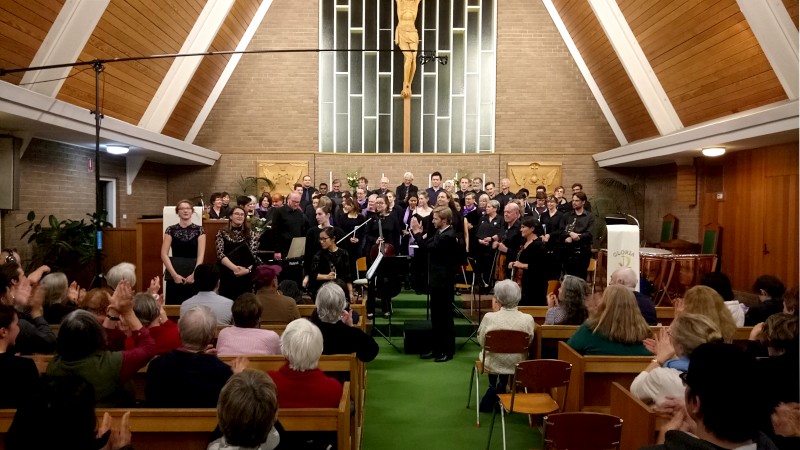
I'm now listening to Emma Kirkby and Christopher Hogwood and the Academy of Ancient Music playing Mozart Requiem and they are better than SCUNA was last night.  But that's saying nothing.  I still melted in the ensemble passages, the power and commitment were there with nice intonation and some standout voices peaking through.  They were missing one bass soloist (the other covered) and others from Covid or whatever, but they were still eminently satisfying.  And the soloists had nice voices and worthy intonation, if a little more projection might have helped.  But they didn't have the support of a period orchestra, just a pipe organ, but again, well played by one of our local stars, Anthony Smith, under the baton of another, Matthew Stuckings.  This is music to draw tears and I did feel the pull at times from power and pensiveness and serious intent.  It's from another era of course, but eternal in a cultural way even for those less religious.  An alternative to social media?  Yeah.  Be drenched in a major choral work and rediscover your soul, eternal or otherwise.  So not Emma Kirby and AAM?  No, but SCUNA have history and commitment and, even as a non-auditioned choir, that intent and capability and intelligence that is endemic in Canberra and is why I love this town.  And I've hardly even mentioned that Mozart is a god and these works are to die for.  I melted over this.  Great work!

The ANU Choral Society (SCUNA) performed Mozart Coronaton Mass and Requiem at Wesley under Matthew Stuckings (director) and with repetiteur Anthony Smith (pipe organ).

20 May 2019

Gloria!


We were celebrating the day after the election ... at least the death of Queen Mary but also her birthday and, I guess, Jesus. This was SCUNA, the amusingly named choral society hinting at inebriation, and they had their orchestra (virtually all players from NCO) and two solo singers, soprano Veronica and mezzo AJ under Lennie. The tympanis were out for the renowned and hugely memorable funeral march. I'm told the tymps were added later and this arrangement was used in the renowned '70s film, Clockwork Orange. "He cometh up and is cut down like a flower" / "of whom may we seek for succour" / "who for our sins art justly displeased" / "deliver us not into the bitter pains". It's a heavy feeling. This was perhaps the most intense and stunning work but not the Gloria of the program. That was Vivaldi's. First half Purcell with the Queen's funeral march and Come ye sons of art, written for a birthday of Queen Anne (royalty was presumably good for commissions; these days I guess it's the mining industry) then Vivaldi Gloria in D major after interval. So a generous program to raise the spirits or, with QM, to delve into depths. Glorious music throughout. The two soloist vocalists were great and fitted neatly together in duet passages. I especially enjoyed AJ's solos. The choral singing was generous and the musical passages nicely presented. Evelyn on cello was busy and did a particularly satisfying job. Lenny led it all and even doubled on trumpet at one time. I know of harp and carillon and he was toying with a violin in the break. What else does he play? So, a great comedown from election weekend. Who needed it?

SCUNA (ANU Choral Society) presented Purcell and Vivaldi at St Peter's Lutheran Church. Leonard Weiss (conductor) directed with soloists Veronica Milroy (soprano) and AJ America (mezzo soprano) and accompaniment by Anthony Smith (keys, organ) and the SCUNA orchestra with bass provided by Evelyn Andrew (cello).

08 November 2016

Uplifting and downcasting


It was a small space for a decent audience and even a smaller one for SCUNA and orchestra and soloists to perform three majestic Handel Coronation anthems and Mozart Requiem. It all deserved more. The Handel is irredeemably satisfying and grand and uplifting. The Requiem is hugely intriguing as well as touching and a little confusing. The confusion is around how much is original Mozart and I've been amused to find out how many people have tried to remedy this. The original completion was by Mozart's young student Sussmeyer and that's the one we generally hear; this completion was by extant US musicologist Richard Maunder; Wikipedia lists 13 others. Maunder removes a few Sussmeyer parts and adds a rediscovered Amen fugue and makes some other changes. The added fugue was obvious enough, but the removed sections weren't. There were also changes to Lacrymosa which were obvious enough. But the overall work was similar and the early movements appeared unchanged (including to the note level for the bass line that I mostly know). So, interesting and occasionally surprising but essentially familiar. This is a big program and choir, orchestra and soloists did a good job on it if there were some little discomforts. Sometimes, this was interpretation, like when I felt the pace was a bit slow, a function of the audience's recall of a piece. There were some glorious passages in the Mozart. I especially enjoyed the two soloist extremities - soprano and bass - on this outing, and the very neat and capable bottom end of the orchestra - cellos and basses. Again, my attention coming to bear. I also particularly enjoyed the brass, which had such a role in this outing, and the timpani which seemed particularly effective and prominent in this small space. But what a great night of truly great music with the intellectual rigour that Lenny brings to his craft. Wonderful outing.

The ANU Choral Society (SCUNA) with orchestra and soloists performed Handel and Mozart at Wesley Church under Leonard Weiss (conductor). Anthony Smith (organ) accompanied and soloists were Rachael Duncan (soprano), Janene Broere (alto), Charles Hudson (tenor) and Andrew Fysh (bass).

27 May 2014

Jubilate SCUNA


This was one big gig and the best that I've heard from SCUNA. A big choir; lots of music; a fascinating series of takes on common themes. We heard two versions of Psalm 100, Jauchzet dem Herrn by Schütz and Jubilate Deo by Gabrieli. We heard a pair of Magnificats from Anerio and Anon and four Cantate Dominos from Monteverdi, Pitoni, Croce and Hassler. Two masses, Symphoniae Sacrae a 12 and Missa Brevis in F, both by Gabrieli and a Renaissance bracket with four songs of des Pres, Arcadelt, di Lasso and Parsons. To top it off, we heard an original piece by a member of the choir, in the style of all this, Domine, quid est homo? by Mark Chapman. I was speaking to a few of the choir before the performance and they were insistent on this. So they should be. What a link of past to present, that we have early music written today at ANU.

This was the best I've seen SCUNA, the most confident and the most hard working. The space was big and wet and the sound was full and rounded with voices merged to one. Just as the choristers like it (although too wet for many other styles). I thought I could identify the difference of Italian and northern - the Italian as more exultant and gregarious and the German as less ornate, more respectful, but I didn't convince myself from this collection, mainly because he balance was too Italian so statistically unreliable. Also one piece (the Cantate Domino of Giovanni Croce?) seemed to change in national character, firstly slow and devout, then more independent and outgoing, so what value that judgement? A Monteverdi Cantate Domino had me thinking of pop embellishments and how nothing is new. I enjoyed following a few sounds. The Allen organ was dramatic when it let go those low notes, deep and space filling and persistent, and it was ever present, more so than a little baroque pipe organ. The voice of Paul Eldon, visiting tenor, stood out a mile. The majesty of the baroque trumpets that sounded for several tunes. There was variation, too. Full choir or small choir, or full choir with semi-chorus, two small orchestras and that organ. St Christopher's doesn't have the presence of a mediaeval stone buttressed cathedral, but it's an apt place for all this religious joy and exultation. So this was a wonderful concert, much enjoyed and very extensive and intellectually challenging with its revisitations of common works.

The ANU Choral Society (SCUNA) was conducted by Andrew Koll (musical director) with cantor Paul Eldon (tenor), Anthony Smith (organ) and Charis Messalina (concert director, soprano). Too many others to mention, but suffice to say about 70 singers in two choirs and 17 instrumentalists in two orchestras.

29 April 2013

Magnificence


SCUNA presented Bach’s Magnificat and Handel’s Dettingen Te Deum and it got me thinking. The Magnificat is actually the earliest Marian hymn with text from Luke’s Gospel, but in English we can hardly avoid the likeness with the word magnificent which has such common if careless use. So what is magnificent here? I felt the Handel was the “magnificent” one, being outspoken and undiminished and loud and glorious, but really it’s a much simpler work. The Bach is the richer and more complex music and clearly the harder one to perform, with that busily baroque ornamentation and the five soloists. I must listen again but it seemed much more worth the effort. But I loved them both. Megan had a bookgroup mate in the choir and she confirmed the Handel was easier; the Bach was a stretch. But I thought they did worthy justice and the joy of performing such works was clear. The fanfaring trumpets were in the gods, on a balcony above the rest; the soloists to the left came out for their parts; the large choir was arrayed in several rows across the back, behind repetiteur and chamber orchestra and conductor Andrew Koll. The setting was the Anglican church of St Paul’s at Manuka with its impressive organ and large altar area, big enough for all these performers, and bell ringers’ balcony, where the trumpets were located. The annual convention of Australian and New Zealand Association of Bell Ringers, the ANZAB Festival of Bells, had been here for the weekend and I’d heard the eight bells ringing several times but missed the Anzac Day peal. The altar is behind a large arch which I felt may have dulled the sound, but this music is not easily cowered. I particularly enjoyed the elation of timpani and baroque trumpets. A haggard atheist could almost believe God is in this beauty. Certainly Bach and Handel did. I also particularly enjoyed some solo parts: the soprano, of course, because it’s pure and reaches for the Heavens, but also a duo of baritone and alto. At one time, I was stuck by the sinuous melodies outlined by oboe and bassoons. I’d noticed musicians arriving only 10 minutes before the gig, and that looked like cutting it fine. But it all turned out nicely on the night. I felt the orchestra was particularly fine. This is music that oozes joy, and it was just highlighted by hearing SCUNA warm-down by singing their theme in an adjacent room as we departed. A joyous event with music that’s magnificent: Bach’s rich interplay of thoughtful lines and Handel’s sheer forthright declamation and a generous crew to perform it all. Lovely.

The ANU Choral Society (SCUNA) performed JS Bach Magnificat BWV243 and GF Handel Dettingen Te Deum HMV283 at St Paul’s Anglican Church at Manuka with Director Andrew Koll, Keren Dalzell (soprano), Samantha Lestavel (mezzo-soprano), Julia Wee (alto), Norman Meader (tenor), Nicholas Beecher (baritone), Anthony Smith (repetiteur) and Leanne Bear (orchestra leader).

28 January 2013

Here and there

SCUNA called this concert Here, there and back again. Although I had forgotten the name at the time of the concert, I felt this movement. Firstly, the music was mediaeval accompanied by lute and harmonium and recorders. This speaks to me of belief and piety and great cathedrals but add percussion and classic 1 2+ or 1 2+3 rhythms and it’s more bawdy dens and rollicking wenches. Then I noticed a drone and more recent harmony (an understandable challenge to the choir) and touches of English that I recognised, speaking of sleep and love. This was obviously modern but still had resonances of deep choral history. The two feel returned with a dancable gait. Then more from the past and a return to the present singing “break my heart again … trying to pretend” and an end with gospel and blues: Swing low sweet chariot with a classic black male call, a blues lament and an odd but amusing disjunct of barbershop. It was a short concert or twleve short pieces and with no chatter with the audience. I would have liked to hear just what it was we were listening to. It’s common for choirs to have a historical bent, and SCUNA certainly displayed one here. Even the modern tunes had a relationship to the past despite more modern harmonies or lyrics. But it’s obvious the group enjoys its outings, and they are a decent choir singing a range of musics. I particularly enjoyed renewing a love of male voices when one tune featured a passage reminding me of chant. I enjoyed the solo voices and the gospel calls and the mediaeval sound of recorders and drums. I could imagine boisterous swilling and dancing as in one or another Breughel. But barbershop is where it ended, and that’s much more of the present. So, this was a lovely Sunday interlude that happened to celebrate the weekend of Australia day. As I left I thought of identity, a recurring theme on this weekend. Give us something to identify ourselves in the sweep of history, as this concert did. Better a greater understanding, than some nationalist symbol of us and them. SCUNA performed at the High Court for the Musical Offerings series, with Andrew Koll (conductor), Anthony Smith (repetiteur, keyboard) and Steven Weller (percussion).

10 December 2012

Christmas as in schooner

Christmas is a time for choral concerts (any other time, too). This year’s was SCUNA with a program called Celestial harmonies : music for contemplation and celebration.

There were some strange but intriguing associations in this concert. Three versions of O magnum Mysterium, from de Victoria (~1600), de Cristo (~1600) and Lauriden (1974). There were several Schubert songs, one by a small sub-choir of women (SSAA), another by soprano accompanied by clarinet and piano. Then Rachmaninoff. The Vespers (or better, All night vigil Op.39, no.1-7) was performed by the full choir with organ and soprano voice. The Vespers were choral and predictable, but the two piano pieces, splitting each set into two parts, was an unexpected bit of programming. They were Prelude in D flat major and Etude-Tableau in C minor. Just the thing to challenge the jaded Christmas carol ear: not particularly celestial but riveting and an awakener. Then a few final tunes to end a generous concert, an encore and a rendition of Laudate nomen Domini (Christopher Tye, ~1550), apparently the theme song of SCUNA. I found the choir gelled better with some simpler harmonies. These were relatively complex charts: not just SATB, but SSAATTBBP, where my P is Basso Profundo (apparently down to D). I fancied the extremes of sopranos and basso profundo when they clearly rang out. I enjoyed the interplay of voices passing through harmonies. I really enjoyed the firm, confident solo soprano of Sarahlouise Owens in combination with choir for the Vespers and clarinet and piano for a Schubert. Despite its odd presence and slightly wonky upright, I relished Anthony Smith playing Rachmaninoff. This was a turn-of-the-century Russian romantic blast of huge handfulls of notes. It’s a surprise to see Anthony outside his continuo, subsidiary role for a change. The whole was led by Andrew Kroll with casual seriousness.

Finally, I enjoyed visiting St Andrew’s, which I pass by regularly. I expect this is our grandest church, even in its unfinished state. Canberra has a batch of post-religious brick constructions that lack the solemnity and magnificence that’s due to churches. This one is still awaiting its dome, but it’s sandstone in a stubby Greek cross design, high and spacious, nicely detailed with quotations inscribed in Art Deco script and furnishings with swirly gothic decoration, and with a heaven-seeking tower and gargoyles. Too bad about the British desire to hang flags in churches (I only noticed one), but for 99-year old Canberra, this is magnificence. And as for that name: SCUNA as in schooner; a perfectly lame university pun. Ya gotta love it. SCUNA (ANU Choral Society) was conducted by Andrew Kroll in large mixed and small female formations, accompanied by Anthony Smith (continuo, piano) and featured Sarahlouise Owens (soprano) and Hannah Freedman-Smith (clarinet) at the Church of St Andrew, Forrest.

27 November 2011

Two takes on Christmas

I’ve missed too much recently with gigs and work and family, but I managed to emerge with an odd but satisfying combination of choral works for Christmas by SCUNA, the ANU Choral Society. The concert was for Christmas and there were two works, but of quite a stunning diversity.

Firstly, a modern (1943) piece by Britten to the quirky words of Christopher Smart written about 150 eyars earlier while he was in an asylum. You don’t catch the words while sung, but this was praise of God by all things created. Wikipedia describes it as “idiosynctratic and ecstatic”, and that easily fits, given lines like “For I will consider my Cat Jeoffrey, ... a cat, surpassing in beauty, from whom I take occasion to bless Almighty God” and subsequent praise for the valourous mouse. This was a work of organ, choir and SATB soloists, in eight sections lasting 17 minutes. I felt most comfortable with the big choral segments with supporting organ. This is clearly not an easy work and the performance was pleasing.

The second work was far easier to digest. Marc-Antoine Charpentier’s Messe de Minuit is a midnight mass written for the Jesuit Church of St Louis in Paris. It was written in the popular song style of the time for a small orchestra and choir. This was sweet, lively dance-like baroque music featuring the simple tones of recorders with organ and strings. Lots of sturdy crotchets and bouncing dotted crotchets from the orchestra and diatonic calls and responses from the choir. Nowhere near the challenge for the ear or the intellect that the Britten presented, but perhaps more comely for the Christmas season. I liked this one very much, especially with its smooth sounding strings and the directness of the recorders.

This was also my first visit to All Saints Anglican Church in Ainslie. It’s an interesting building with an interesting history. It originally served as a railway station for funeral trains at Sydney’s Rookwood Cemetery. Funeral trains ended in the 1920s and the roof was finally taken by bushfire in the 1950s. Stan Taunton and son, Canberra builders, transferred the stones to Canberra, rebuilt the roof and it was dedicated in 1959. It’s a lovely sandstone building featuring hewn sculpture, and it has a strange form to allow trains to enter at one end. So it’s slightly odd in design and purpose and location, but humbly reminiscent of European mediaeval churches.

SCUNA performed Benjamin Britten’s Rejoice in the Lamb and Marc-Antoine Charpentier’s Messe de Minuit at the All Saints Anglican Church in Ainslie with conductor Matthew Stuckings and accompaniest Anthony Smith.

10 April 2011

Ave Maria

Ave Maria is close enough. At least the first half was dedicated to Pope John Paul II’s particular devotion: Mary, mother of Jesus. And we were in the large reverberant space that is St Christopher’s (Catholic) Cathedral in Manuka to hear SCUNA’s concert for the run up to Easter. It was a wonderful presentation of some very beautiful sacred music.

We are a diverse and secular culture now (although our newer religions are often more strident in response) so it’s no surprise that most of the program was from a much earlier time. Pergolesi’s Stabat Mater was composed in 1736 to the words of a 13th Century Franciscan, Jacopone da Todi. Vivaldi’s Gloria (the well known one, RV 589) is from 1715. But there was one modern work: Górecki’s Totus Tuus. Polish Catholic Górecki wrote this for a visit of the Polish Pope, JPII, to his homeland in 1987. It’s an a capella work and was performed with the choir starting at the back of the cathedral and walking forward slowly to finish at the altar. It’s a simple work, simple lines moving together and with much repetition, but quite stunning in its holy minimalism. It was also interesting to hear the individual voices as they passed along the aisle: some strong, some less so. But in toto, a stunning work that was particularly popular on the night.

Pergolesi’s Stabat Mater followed. I know this from a Hyperion recording we have at home, sung by two voices, soprano and countertenor, and with 7 musicians (strings and continuo). The original was written for male soprano (not many of them these days) and male alto. I was wondering how SCUNA would perform it. This version was orchestrated for SATB choir with perhaps half of the 12 numbers sung by an individual voice or two voices in harmony. I missed the constant harmonies of the solo voices on the recorded version, but a choir has its own beauty and power. This was a large choir and easily filled the space although I’m not sure I caught all the harmonies, perhaps due to rich reverb. But the reverb particularly suited the solo voices. Tobias Cole was incredibly forceful and well controlled and he was theatrical as he has been every time I’ve seen him. Louse Page’s is not a voice to crack crystal. I hear her as more rich and dark which is probably more true to the original intent. I also noticed the very capable continuo that seemed to hold the musicians together. This was a beautiful and touching performance of delicate and somewhat courtly music with a dolorous theme. Lovely.

Last was Vivaldi’s Gloria. This is well known although not by me but I recognised a few passages. I heard this as more majestic and joyous than the dolorous Stabat Mater, although there are numbers here that also speak to the crucifixion. The instruments were expanded with trumpet and oboe for the satisfyingly baroque sound that I expected of Vivaldi. It amuses me how few words are in these pieces, but they are so beautifully arranged (and in obscure latin) that we hardly notice. What huge joy is in Gloria in Excelsis Deo and what deep historical resonance is in “You who takes aware the sins of the world, have mercy on us”. This is Christian liturgy at its most powerful and, faithful or not, you have to have a heart of stone not to be affected by the glory and power and history of it all.

Which reminds me of a visit to the Vatican museums. It’s a wonder how powerful and honest is the religious art of Catholic mediaeval Europe, but visit the Vatican’s museum of modern art and it’s weak and affected and strained. So it was with unexpected that I so enjoyed the Totus Tuus. A modern religious work that works. Surprising and satisfying. This was a wonderful concert in the lead up to Easter, whatever your beliefs or non-beliefs.

SCUNA (ANU Choral Society) presented Pergolesi’s Stabat Mater, Górecki’s Totus Tuus and Vivaldi’s Gloria at St Christopher’s Cathedral with Jonathon Powles (conductor), Anthony Smith (continuo), Louise Page (soprano) and Tobias Cole (countertenor).