Showing posts with label Shoeb Ahmad. Show all posts

05 February 2020

SOSat eve 1-2


Two more acts finished up my Saturday evening session at SoundOut. First up was an Australian trio with father and daughter Alister and Alexandra Spence performing with Canberra local Shoeb Ahmad. Great to hear them all again. This was mainly noise/electronics/drones with some piano noises from under the lid from Alister, but later joined by some piano notes, mostly prepared, so flowing and steady, and some delicious waterfalls of notes. Then another international outfit, this time Commonwealth (apparently taking on renewed interest following Brexit from just the day before). Arthur Bull (Nova Scotia) and Scott Thompson (Quebec) joined Roger Turner (UK) for a busy, sometimes chaotic, musical exploration. Roger is all over his drums with all manner of standard and non-standard techniques and no limit. I was particularly amused by masses of sticks, although that may have been next day. Suffice to say he's busy and extremely varied in performance. Arthur got a lovely sharp picked tone from his amplified acoustic guitar and also explored techniques, not least pie tray and ebow (not the only use this weekend). I particularly enjoyed Scott with his obvious training, perhaps classical, perhaps jazz, with lovely tones and effectively speaking mute. Again, committed and energetic and forceful: a take-no-prisoners set.

Alister Spence (piano), Alexandra Spence (electronics) and Shoeb Ahmad (electronics) performed as a trio. The Moniker Trio followed. It comprised Arthur Bull (guitar, Nova Scotia) and Scott Thompson (trombone, Quebec) joined Roger Turner (drums, UK). SoundOut 2020 Saturday evening at the Drill Hall Gallery.

12 November 2013

Pre-Popp

It was a big evening of electronica-cum-experimental. Marcus Popp was being welcomed by two acts: Canberrans Spartak and Sydney resident Hinterlandt.

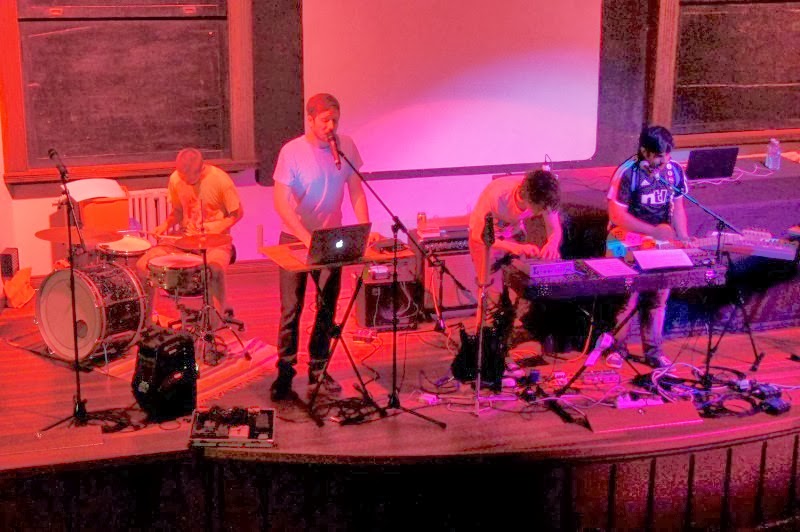
I’d seen Spartak several times. They are well known to CJ and they’ve taken on various combinations over time. They now appear as a quartet, but more surprisingly, with vocals. Evan sang, and so did Shoeb for a few tunes. I liked this. It seemed to give the music a place and purpose. They sang of “the Thrivers” and the like, so there’s a message, too. The lyrics are sung with the oddest of melodies comprising unexpected intervals moving all over the place, and the harmony matches that. You can hardly speak of scales here, and although you could interpret as harmony, I doubt it’s written that way. The rhythm takes the standard 4 bars of 4/4 with the chunky, truncated grooves of this style. It all works. I like this pop-like take. The guitars and bass, when they are played, tend to the down-beat-on-crotchet-on-one-note/chord style, so that’s no challenge, but they got in some delightful solos, Evan a fabulous one on acoustic drums and another shorter, but nervous and tonally varied one on drum machine, and I admired Matt’s rabidly syncopated bass-machine line on an early tune. I was interested and impressed but also well entertained. Very well done. Spartak were Shoeb Ahmad (guitar, electronics), Evan Dorrian (drums, electronics), Matt Lustri (guitar, bass, electronics) and Rory Stenning (electronics, drums).

Then Hinterlandt, the one-man band project of Sydney - based Jochen Gutsch. I don’t say one-man band lightly here. Jochen played one long tune. He introduced it with trumpet, adding effects and processing, rambling through glockenspiel and guitar and finally back to trumpet to end. There was considerable preparation here: this was clearly not all improvised. The instruments matched against supporting samples and loops at various times. I was impressed by just how much work must have gone into this. The musicianship was nothing virtuosic (not that that’s not an issue here) but the introductory jazz melody on trumpet was quite fascinating and restless with some missing beats and slipping melody. The styles touched on contemporary jazz, rock, metal. The metal was heavy with body-shuddering sub-bass and one hand guitar strums. Then a return to trumpet and an unexpected end. This was interesting and obviously subject to considerable work of composition. I had a few concerns. I did find the sub-bass was oppressive, but sub-bass is common in this music, and I felt the composition was too all-encompassing and thus somewhat unfocussed. Like a pizza with the lot. But what do I know of these styles? Hinterlandt is Jochen Gutsch (trumpet, guitar, glockenspiel, percussion, effects, processing).

18 January 2013

Not really jazz, but a tightrope

The locals do experimental, too. I’ve come to experimental music and free jazz through Richard and Shoeb and SoundOut and Smiths Bookshop and a few more connections. It’s not a popular form. It’s not even something I warmed to at first. I guess it’s got rules. It looks like it can be faked but the cognoscenti see through it. Skills make the difference and you can sometimes judge them. Some skills are just too far out of the mainstream for common recognition, like separated sax mouthpieces or playing underwater and the like. I can recognise bass technique, even if it’s unconventional, and also standard instruments played with trained technique. Similarly, I can recognise musical sensibility in the use of echo and processing and loops and electronica. It’s otherworldly but still human. And often, even without conscious recognition, but closing your eyes you can tell that something has structure or flow or harmony or tonality. This music is largely post-tonal so needs to be judged in its own context. So as I newcomer, I like to hear different approaches, different people, different skills and conceptualisations; to cover the waterfront. This night, at Smiths, before Philipe Petit, I heard three short sets and three groups: interesting and educational.

First up was Luke Pendeaux and Danny Wild. As I understand, Luke played sampler and sequencer (Roland SP404 and MC303) with Danny on laptop sequencer (Ableton live). This was rhythmic music an underlay of drone, heavy in repetition and minimal in change. Various samples were dredged up, edited and discombobulated, mixed with occasional voice that was similarly processed, the whole changing gently over time, with occasional squeals and whale calls and space ship launches and detunes and slow downs. I liked the slightly latin starting groove but wondered how we got to a shuffle swing at the end. I initially felt a sonata-like form in three parts - exposition, recapitulation - but then it seemed to continue to further parts. One thing that’s quite unique about this music is how it’s busily automated so leaving time for swig of a beer between thoughts. That’s civilised. When I go for a beer on stage, it’s usually an unholy intrusion.

Second was Shoeb Ahmad. He would have played duo with Philipe Petit but equipment availability intervened. His key instrument is the guitar, a telecaster with single pole twang, slow arpeggios, sustained chords. This is not a music of guitar virtuosity but of watery change. He uses a string of effects and a sampler. The twang undergoes watery change. But it overlays an unrelenting noise of notes without end. It’s overwhelming, threatening, other than human, throbbing. We felt lost, threatened, rolled by a tsunami of sound. Just breathing, throbbing with heartbeat regularity. But then human sounds like clap slicks, primitive, cicada sounds, and a final crescendo of sampler then strummed chords and silence. Unsettling music, dark despite the country twang.

Third was a trio of Andrew Fedorovich, Reuben Ingall and John Wilton. Their presentation was earthy, animal. These were calls in the wild from sax mouthpiece. Rugged slaps and windblown shudders, echoing and grooving like ants and bats in the night. Then decay, an electronic drop in pitch, like a plane falling or a perhaps a crow circling, aware, calm, observant. Then night nocturnal creatures, mystery and unknowingness, Sustained twisted, bent animal tone from sax and splashed of malletted cymbals to replace the regularity of mallets on skin. Then suddenly violence leading to slow decay and some relief. Here again I noticed the automation, laptop wielding Reuben able to take a swig while sax and drums were immediate, in the moment, living as in humanity.

How else to describe this music? I close my eyes and more than other musics, its soundscape expands and its logic appears. Its direct and unconventional and even uncivilised, and that can be good in art. Whatever, I’ll be hearing more, especially with the fourth SoundOut Festival of this music coming up in just a few weeks’ time. The performers were was Luke Pendeaux (sequencer, sampler) and Danny Wild (sequencer); Shoeb Ahmad (guitar, effects, sampler); Andrew Fedorovich (alto sax), Reuben Ingall (laptop) and John Wilton (drums). The location was Smith’s Alternative Bookstore.

13 May 2012

The outreaches of downtown Manuka

Spartak is currently in season at the Canberra Contemporary Arts Space at Manuka and I got to last night’s gig. They are playing with a series of visitors. Last night’s was Londoner, Ollie Bown of Icarus, who is now resident in Melbourne.

For me, Spartak is always the outreaches of my sonic experience: minimalist digitally-effected guitar drones from Shoeb with percussive expression layered over the top from Evan. I joke with Megan about it (she prefers Beethoven) but I like it, even if my understanding is short. But then understanding it probably not what’s required with this music. Ollie added laptop convolutions of the live stage sounds that droned or pulsed or mutated to our ears. It was loud or delicate or percussive and always meditative. I heard authentic BBC Radiophonic Workshop (think Dr Who) at one stage and I also felt dense, deep power when I sat near a bass trap corner. I heard Evan’s richly interpretative drummer that just says training and craft to my ears. I heard Shoeb’s electronics and minimal, recurring, slightly mutating guitar chords, although Shoeb's and Ollie's drones often merged to my ears. I even heard some thinly present voice from Shoeb at one stage, although I may have missed it if I wasn’t looking. Experimental and free music of this style is always a walk on the wildside, but I’m refreshed by it and taught again to listen meditatively.

Even Manuka has its outreaches. The minimalism continued in the visual arts on display and the space. The art was mostly tiny and dwarfed, even in this small room; seating was minimal (actually, none) but I felt that suited the music; most sadly, the walls are bare and refective and so the sound was mushy and the drums sounded distant with reverb. All part of the challenge that is a walk in the wilds of Manuka.

Spartak performed one night of its Cue Funktion residency with Ollie Bown (laptop) of Icarus. Spartak are Shoed Ahmad (guitar, electronics) and Evan Dorrian (drums).

29 February 2012

An Ark in a storm

The Loft is now underway for the year and I caught the Silver Spine Arkestra last night. It’s an obvious reference and tribute to Sun Ra and I locked in the date when I saw it. I found the electronica and experimentalism of the band was a reminder of Sun Ra, but his embedding in the greater jazz tradition and swing and Ellington in particular was not on show to my ears. I trust the cult-like personal demands of the original were also missing: Sun Ra was inventive but he was also a demanding and idiosyncratic leader. I’ll put it down to his background on Saturn. The SSA played two sets, each comprising a single improvisation. The first was more rhythmically and harmonically obvious. Shoeb played bass guitar here on steady quarter or eighth notes that outlined a two chord pattern. I particularly enjoyed a 2 chord bass loop that was nicely tentative and meditative and seemed to merge the bass into the group improv rather than feature it as a definer of the groove. The second was more airy, as Shoeb toyed with mixer and electronics. For me, the defining point of contact for both improvisations was Evan’s drums with his unconventional rhythmic patterns that defined feels and moved to create structure and improvisational spaces. These spaces were effectively filled by laptop-generated drones and digitally effected, refracted and refactored tones from Reuben, and long, slow contrapuntal notes or bowed sax bits from Andrew on alto. Miro provided the melody, close harmony and percussion that added detail to the whole. I heard a similarity to modal Miles of the fusion period and Miro also mentioned that. I delighted in one precisely placed trumpet harmony with Andrew’s alto that was indelibly pure. And Miro’s trumpet reappeared in processed form from Reuben’s laptop at times. He also played some fascinating African percussion instruments and whirling drones. The second improvisation featured visitor Andy on piano. This was minimalist, meditative, modulating piano taking both gentle bass and alternative rhythmical roles and using closely spaced chords with slight alterations of one note or unassertive arpeggios. Like SSA’s namesake, this is challenging and unconventional music; music for closed eyes and not for visible pleasure; music as sound that crosses into free improvisation. Nice one.

The Silver Spine Arkestra comprised Miroslav Bukovsky (trumpet, percussion), Andrew Fedorovich (alto sax), Reuben Ingall (laptop electronics), Shoeb Ahmad (bass guitar, synth) and Evan Dorrian (drums). Andy Butler (piano) sat in for the second set.

20 March 2011

Kaoss?

Shoeb Ahmad and his digital processing was the common feature at a challenging concert I attended yesterday. Spartak played the first set with two numbers. Austin Buckett presented a work originally written for a string quartet as the second.

This was a larger, 5-piece Spartak. I’ve written here of Spartak as a duo. The essence of drums/percussion and processed instrumental sounds was still there, but this was bigger and more exploratory. The first tune was indicative of the approach and structure. Evan started by setting percussion rhythms. Tim introduced a simple melodic line on trumpet, repeating with some small variations. Andrew played mostly harmony notes. He once inserted a snippet of modern jazz (lovely) but returned to simpler harmony notes, which are a better base for Schoeb’s digital manipulations. These digital sounds formed an intense and all-encompassing background for snippets of notes and varied percussion until Tim restated his simple melody and the tune ended. Guitarist Morgan was also there with few notes but extended effects. I couldn’t identify his part, although Shoeb was obviously clear on his space. It’s music that has its own logic and art and it demands intense contemplation. I find it rewarding although the passers-by at the Street seemed a bit non-plussed. I found the clarity and strength of the trumpet was perfect to cut through the environmental noiseworks and also as a base for these manipulations. I also noticed the tunes grew and fell away (obvious enough) and interestingly it was the human sounds that made growth and the digital sounds that accompanied the decay. Not sure I can read any more into this than that the digital followed the instruments, but maybe it’s a comment on our human progress? Growth as a search for harmony, tonality, melody, structure; digital as mechanical, intervened, under human control but not human. The second piece first had me amused with shades of scifi: R2D2 and, more profoundly, Forbidden Planet. Again, the trumpet set intervals and the alto found harmonies, and the electronics bent and repeated these sounds and fed them back amongst a clatter of rhythm. These are not easy sounds, but they are satisfying.

The second set was Austin Buckett leading a performance of his piece, Stuttershine. It was originally written for a string quartet but performed here by piano, cello, viola and violin with digital manipulations. It started sparse, with rubato notes passed between piano and strings and built to end with a constant arpeggio-like single-note passage on piano that seemed to restate the sparse melodic movements of the first part. Over this was again the digital processing of strings by Shoeb. I really enjoyed the un-manufactured sounds of acoustic stringed instruments as well as the ringing acoustic piano tones. The digital reformulations seemed a bit intrusive to me although the concept of a reworked environment was good. Perhaps this was just a little too loud or edgy for the gentle stings. I found it satisfying work of composition and of performance, somewhat related to Spartak, perhaps as the distant more-upright cousin?

How great is it that we have such music here? Congratulations and thanks from CJ. BTW, my title, Kaoss, makes reference Shoeb’s principal interface for these digital manipulations, Korg’s Kaoss Pad dynamic effect processor. Shoeb was using the mini-KP with laptop and numerous other digital dongles. Spartak was Evan Dorrian (drums), Shoeb Ahmad (digital manipulations), Tim Bowyer (trumpet), Andrew Fedorovich (alto sax), Morgan McKellar (guitar, delay). Austin Buckett (piano, composer) led a quintet comprising James Larsen (cello), Xina Hawkins (viola), Elyane de Fontenay (violin) and Shoeb Ahmad (digital manipulations) playing his piece, Stuttershine.

13 February 2011

Big improv

It’s not a thing of melody or even harmony, although there’s some minimal harmony there, and although there are times of immense rhythmic energy, there are others where rhythm is in repose. I don’t find Spartak and their like an intellectual music, more a music that guts the senses and pummels the emotions: intensely present and demanding of a response. Spartak’s gig yesterday at the Phoenix was wonderfully satisfying. I think it’s mood that this music emanates, with segments that are dreamy and others explosive.

Evan was in fabulous form. The drums were loud and heavy and big sounding in rock style rather than submissive swing and he was writhing in his seat as he threw forth the most truncated syncopations, hugely varied in rhythm and tone and, well, creative. I was aghast with these drums. Powered, precise, full and rounded and profusely varied. Taking the more cerebral drones from Shoeb’s processed guitar or voice or clarinet and exploding rhythmic possibilities. This was loud and it fitted, although it would have benefited from a clearer PA to serve the sound. I lost the detail of Shoeb’s lava-like structures as they flowed glutinously through the soundscapes. I noticed some simple repeated minor thirds, but the PA didn’t do justice to the detail, and the essence of this is the detail. The duo played a single set of 30 minutes, moving in and out through themes like Peon the week before. This was one set of Travis Heinrich’s mini festival, “Hey Dad, can you pick me up from Josh’s, otherwise it’s like two buses”. Being a parent to this university-aged group I see it from the other side, but the odd title rings true just the same. Nice to visit the Phoenix, too. It’s delightfully bohemian-bedraggled with a pleasant and intelligent clientelle. The festival was mostly indie, JJJ-style but the audience recognised and responded to this free, improvised music. So both audience and band impressed. Short but sweet all round.

Spartak are Shoeb Ahmad (guitar, voice, clarinet, laptop and processing) and Evan Dorrian (drums, percussion, some processing) and they played at the Phoenix Pub.

PS. Thanks to Shoeb for this explanatory info below. BTW, Spartak are soon heading off to play concerts in Kuala Lumpur, Singapore and Japan. Best of luck from CJ. In the meantime, you can hear them on 17 March at Urbancity, a mixed arts festival around Canberra over several days in March.

"I like what you wrote about our music being just really an intellectual music but something more visceral and physical - that's how we approach the improvisations we do and I think it helps making it a bit more 'accessible' though of course, I think the music itself has to mean something to the listener to really understand it, as with most free improvised music.

"Also, it's good that you noted that a lot of the sonic detail wasn't clear through the PA. Evan and I feel that we play louder and 'heavier' in those situations, even if it's still very washed out. I assume it adds to the physical nature of the sound but when we perform in, say, a gallery space, the music becomes a little bit more clear and spacious, maybe more delicate too.

"Re my sounds, I am essentially running my electric guitar through various effects pedals with distortions and looping functions directly into the laptop where I also have some processing tools and can set up loops, mainly as layers. Melodically, I was building up layers of guitar notes and chords, both clean plucked and without the string attack so I had a base before I started playing any sort of clear chord progression. During the middle section, I used the guitar as a soundboard by using the pickups to amplify the dictaphone with a field recording of trains I took in Bangladesh and also amplified the music box to have a melodic point of difference.

"The harmonica mic I had was also going into the laptop, so I could do some real-time processing with either the vocal or the clarinet so it has a more texturally quality.

"Evan was running loops and sounds of his laptop at various points during the performance though he also does some live processing with a microphone on the drum kit which adds a nice texture to the wall of sound."

Lightly edited email from Shoeb Ahmad