Showing posts with label Evan Mannell. Show all posts

09 May 2012

Prog folk folk 2

Still at FrogFest, and I was to see Ben Hauptmann’s band, BOB, and Mr Fibby.

BOB was a totally different experience. Highly trained playing that was tight, richly improvised and ornamented and arresting in concept and in performance. It started with a subtle but mobile solo on keys from Damien, precise and understated, then into melodies that spoke of folk song and solos with long crescendos that built steadily and unerringly. Ben’s guitar is always honest and impressive, sharply toned and with a touch of banjo or country-hick influence. Julian entered on tenor for several melodies but I was surprised his solos seemed so few in number. Damien reappeared for solos, but I particularly liked his presence as organ bass and piano/organ accompaniment. I was particularly following Evan. I seldom have much to say about drummers, but I was dazzled by this display: rock solid and stable beats, singular grooves of deadened snare and toms or smashing cymbals. All the time with precision and delicacy and refreshing, committed fills. I heard this as a master class in rock drumming. BOB features Ben Hauptmann (guitar) with Julian Banks (tenor), Damien Slingsby (keys) and Evan Mannell (drums).

Last was Mr Fibby. I’d heard tell of the band, so I was interested to have a listen. How clever was this, and how different? Classically-trained instrumentals accompanying zany story telling with an Eastern European accent. I’m sure I caught some Bach amongst the Gypsy instrumentals. I certainly enjoyed the story-book references to ANU V-C Ian Young for his current threat to the School of Music. (He was not a welcome man at this event!) These were contorted and somewhat improvised stories with dreamy logic and fairy tale characters. And tones of violin, cello and acoustic guitar that were played with real skills and panache, despite the none-too-classically-perfect environment. This was serious theatrical fun with great wit and serious fine-music skills. Highly recommended. Mr Fibby are Zavi (aka Sam King, guitar), Rusalka Seraphina (aka Emma Jasmine Kelly, violin), Borracio (aka Spike Thompson, cello) and No Important (aka Adam Hadley, story teller).

07 March 2012

Boutique rock & everyman beer

It’s not just in the name that we hear hints of misspent youth, but the Alcohotlicks are mature and respectful of their past and the music is invigourating even if you don’t share the era. My era is earlier and most of the audience’s era was later, but we could all feel the raunchy grooves and the beer-spilled bars that speak from this music. One tune was a dedication to Sonic Youth; I heard intimations of Metallica in another; Evan volunteered influences from Dirty Projectors. One tune even sounded more country-ish, perhaps Doobie, to my ears and it was a thing of prickly beauty which was somewhat surprising amongst this fare which was guitar music but of a richly altered form. The guitars were often effected: mostly just sustained and overdriven but there were organ tones there too. The two guitars were interesting both individually and as a pair and that’s not surprising given their 1st and 2nd prizes for guitar at Wangaratta a few years ago.

But they are quite different in style. To my ears, Aaron is more overt, steady and clear with lines that talk in open sentences. Ben is more effected and expansive, not shredding but with a similar voluminous extravagance. But these were their solos, and that was only part of their roles. There was no bass, so they took rhythm duties, too, which were mostly chordal, often steady four-to-the-floor, or pretending at a bass line. To my bassist ears, guitars are always pitched too high for this, but I noticed some intriguing atonal lines from Ben in one tune. I didn’t notice the lack of the bass, and neither did another bassist mate who I talked to, but it changed the aural effect: to middy and chordal and leaving wide open space for the drums. The bass drum thudded away and even led several of the tunes with emotional crescendoes of increasing frequencies of kick. And I noticed the rest of the kit as thuddy and deep, as Evan toyed with standard rock fours and syncopated to fives or whatever. Several tunes were all incessant, woody drums and only sparse cymbals for highlights. This was not a night for the ride: it was more hi-hat or shats (as introduced by Evan) or metal snaps. It was intelligent drumming: quirky riffs that were unfussily sustained. Despite the chords and lines of the duo guitars, it was the drums that defined it for me, with Evan’s wonderfully essential and sometimes dishevelled jazz-chop takes on rock drumming. But this just extended to the band that was so well sorted and settled and agreed, despite some devilishly unexpected repetitions and syncopations. Suffice to say I enjoyed the night!

The Alcohotlicks are Ben Hauptmann (guitar), Aaron Flower (guitar) and Evan Mannell (drums).

17 May 2010

Under the House

Text by Daniel Wild; Pic by Sisiely Wong

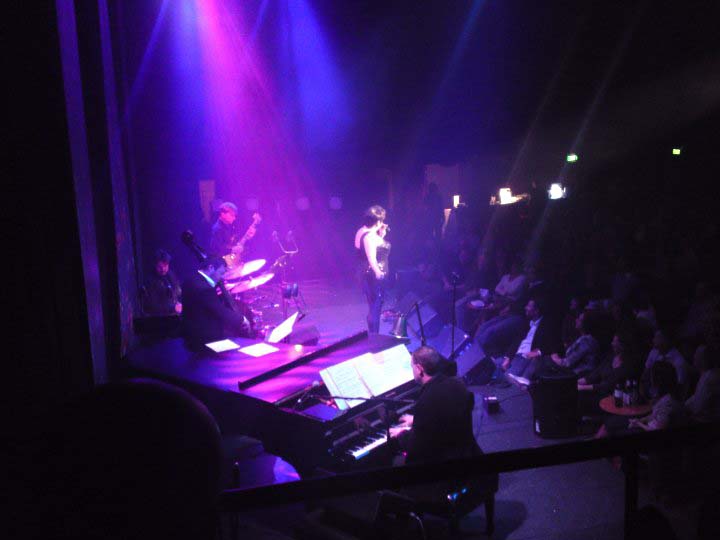
Nestled in the bowels of the Opera House is The Studio, the perfect venue for variety show Late Night Lounge. Comedy, cabaret, death defying stunts, magic and good wine is the order of the night. Eclectic music accompanies many of the performances – folkish music, tongue in cheek rock and modern lieder with a gothic twist keeps the audience challenged and smiling. Intriguing for music lovers is the House Band – read whoever’s in town. Tonight we were treated to jazz musicians Matt McMahon, Jonathan Zwartz, Carl Dewhurst and drummer Evan Mannell. I wasn’t expecting to see so many top-flight musicians earning their crust in such a variegated fashion. Mannell certainly had the best view for a number of notorious acts – he kept the beat while stockinged buttock cheeks flapped in his peripheral vision during a voluptuous rendition of Turn Back Time. His concentration and courage should not go unrecognised.

The House Band under the direction of McMahon accompanied guitar duo Dog Trumpet – Peter O’Doherty and Reg Mombassa, founding members of Mental as Anything – as they plied their original material from 2007 album anti-social tendencies. Zwartz executed a rollicking bass line while Dewhurst added texture on the third guitar. McMahon has great dynamic sense, knowing when to bring the piano into prominence and when to fade it into that zone where it can just be heard.

In the interval the intimate cabaret action turned jazz club; while patrons procured more champers and beer, the house band played Nostalgia in Times Square. How many people in the audience knew what they were listening to? Such is the nature of jazz that it can add atmosphere, class and communicate directly with people who prick up their ears at such moments. A sharp nine chord can draw the attention of someone waiting at the bar, while a pentatonic run can just as quickly sooth them back into complacency. This laid back style of jazz is perfect for encouraging the audience to mingle, chill and prepare themselves for another descent into heavenly seediness.

If you want to be surprised, shocked and lulled by the beauty of midnight song, get tickets to Late Night Lounge – they sell fast – and be entertained by the sheer (literally) variety of song, dance and provocation that takes place every month under Sydney’s iconic ‘House’. You never know who will turn up, and it’s a good place to see what musicians do best – getting a pile of sheet music and told to play, swing and rock.

05 May 2010

Very alternatively playful

The Drips were the backing band for Ahmad Jamal. Drips? I’d noticed the name in emails or on Facebook recently, and immediately recognised Carl Dewhurst, Cameron Undy and Evan Mannell when they stepped on stage.

It was a strange concert, in line with the band’s self-demeaning name, and no doubt a challenge to all, even if it was strangely apt for the AJ support. Apt because they were taking AJ’s rhythmic contortions to logical and extreme conclusions. There was groove here, but the band was expertly avoiding the beats to create the strangest of twisted, contorted patterns. Not easy, perhaps not even pleasant, but fascinating and very difficult ot perform. There were occasional chromatics and harmonic contortions, too, but I felt the key was the rhythmic perversity. What else? A parallel self-demeaning (although confident) introduction about this being their biggest gig (for The Drips, perhaps, but these are capable and busy players otherwise); some very capable guitar solos, although again twisted; bass pleading and leading and sometimes bleeding, with massive distortion and richly effected tones and odd chords and even thumb positions (on e-bass?); perverse and delayed rhythms, which provided an essential drumming context. Suffice to say, all very strange and perverse, but also fitting and expertly done. Feel up to it? Check out what the Canberra contingent (Cameron and Carl are local Canberra products) is doing these days on the edge in Sydney.

The Drips are Carl Dewhurst (guitar), Cameron Undy (electric bass) and Evan Mannell (drums).

25 July 2008

Not for the fainthearted

Zac Hurren’s Trio arrived at Hippo last night with some fierce playing all round. I wrote of MFO recently as blissful. Blissful is not the word for this, but emotionally charged it was. Descriptions like hard, demanding, unflinching, challenging are more apt for this art.

The trio is chordless, comprising sax, bass and drums. This clears the air and leaves space for individual expression and equal roles for all players. It’s a demanding task master for all performers and audience, but exhilarating with the intensity and free flowing nature of the sounds that emanate. I’ve heard various sax trios and they all have this air to some degree, but Zac’s compositions, influences from free jazz and few standards, just highlighted the intensity. This is take no prisoners; commitment to the fore. Not the cultured, self-controlled, witty, civilised world of the American popular song. This is the earthly struggle of primal screams, jungle calls and primitive drums. Obviously, there’s plenty of training to required achieve this, but the emotions are blatant, on display. Zac’s music is like this.

But there were some foundations that were recognisable. There was at least one blues, although with a wealth of substitutions and varied turnarounds, and there was a standard: Sophisticated lady (no surprise the standard was from Ellington and not Cole Porter). There was Joe Henderson's Inner Urge and Monk's Nutty and the night ended with Lester Young’s Lester leaps in. The playing throughout was high intensity, rhythmically jagged, harmonically multilingual, constantly mobile and communicative. Zac introduced each set with a solo passage, then into melody then into solos. He may have a rounded, full tone on early lyrical playing, but quickly descended to screams and extravagant speed and feverish tonalities. He’d leave space at times, and bassist Phil would fill these gaps with his own deliciously precise intonation, long intervals, equally jagged but accurate lines. There was a bop-like conception of triplet fills early on, and straighter 8s and rocky feels later in the night, but all precise in groove and melodically purposeful. Perhaps a bass solo would ensue, or perhaps Zac would re-enter his solo. Evan would engage with the others, especially Phil, in conversation, and make a solo statement of his own. His was an open feel, wooden rather than metallic, with busy, loud but creamily-thudding kick drum. Even the swapping of blues choruses with drums was not obvious in this context, although plenty correct (except for a heel used to damp the snare at one stage: an unconventional technique!). Where Zac and Phil were jagged and unexpected in conception, it seemed to me that Evan was inclusive in melding this surrounding whirlwind of passion. Whatever, the band sat well despite high levels of intensity and rawness.

On a lighter note, I got to thinking that jazz can be a very economically efficient music! Lordy, jazz players sure can play lots of notes. Maybe we should take that to government for more grants. They like performance measures and evaluations: number of notes per player per gig; low CPD (cost per dot) = high efficiency. Economic man hits the yartz; passion satisfies the bean counter. But I jest! After all, Coltrane had it pretty right with Naima, and his CPD would be pretty low there, although he’d make it up on Giant Steps.

But more seriously, Zac Hurren led a seriously challenging and very capable band which impressed immensely. More proof, if needed, of the vivacity and quality of jazz in Australia’s present cultural quilt.

12 May 2008

Masterly & with integrity

By Daniel Wild

I have had the pleasure of seeing Gerard Masters three times now. A few years ago at the Winebanq in Sydney he accompanied Chico Freeman in what became a coming of age gig, although even then there wasn’t much room for improvement. I also saw him as part of SIMA’s program at the Sound Lounge in the Seymour centre. Inexplicably there were only about ten people present. This certainly affected the intensity of his playing. Masters thrives on intensity, atmosphere and occasion.

The Hippo Bar makes up for the lack of a piano with ambience, closeness and an underground feel (despite it being upstairs). Carl Dewhurst exploited this intimacy by opening with a solo set of experimental and blues guitar. The Hippo is an ideal venue for short solo performances. It is relaxed and allowed Dewhurst to play with the audience dynamic by sometimes musing in the background and then building up his presence with more adventurous guitar riffs.

One piece was decidedly atonal and freeform, making it initially hard listening. But it grew on you and when it finished the listener had begun to adjust to its parameters. Dewhurst made use of an array of pedal effects for this composition. He certainly enjoyed exploring the distorting, bending, shimmering permutations of the strange chords and their relationships. This music is sometimes more safely performed in the privacy of the musician’s home.

Dewhurst finished with a straight ahead blues that became increasingly rhythmically varied and witty. Gerard Masters, who had been watching from various vantage points, appeared after a brief break and began heating things up with Stockton Shuffle. The head has an interesting rhythm and explores minor tonalities before a three beat rhythm asserts itself for Masters’ solo. Evan Manell provides exciting support as Masters builds his ideas patiently, inviting the listener to share in the unfolding harmonic possibilities and melodic fragments that could go down various pathways.

The second piece, Pendulum, borrowed a motif from Chopin’s Nocturne in A flat major. Masters ingeniously incorporates this light, faery motif as a frame around a daring post bop middle section. The original Chopin Nocturne also had an emotionally charged and harmonically challenging B section and Masters expands the romantic depths with some inspiring descents and parallel chromatic chords that define dark and moody tonal centres. Tonality is less important here – it is implied and not stated and engulfed by neighbouring chords which pull and shift the tonality like a gravity-well.

A slower, more relaxed pace, suited for visions looking forward to the horizon and back upon reminiscences, is the setting for Message to My Girl, dedicated to the band’s better halves. The incorporation of classical elements, fourths and rock riffs makes this an accessible trio piece. The Keith Jarrett influence can be seen and again Masters shows admirable patience in building his solo both in volume and intensity. He never overplays and displays his sensitivity and integrity to context. Masters passes the litmus test of the complete pianist by playing thoughtfully and introspectively in this ballad. Many other jazz players who are known for their chops don’t execute as well on ballads.

Cameron Undy’s bass playing is perfect and unobtrusive. The trio complement each other well but both Manell and Undy must be commended for ably supporting Masters’ musical aesthetic. Carl Dewhurst introduced Masters as one of “Australia’s and the world’s best pianists”. I second that. If you are a fringe dweller of jazz, or someone who appreciates classy adventurous playing you have to see a Gerard Masters gig. He is still young and could well be Australia’s answer to Chick Corea, Brad Meldhau and other modern jazz pianists willing to push the envelope and not compromise on musical integrity. Masters’ incorporation of classical riffs, blues, rich harmonies and singing and soaring melodic lines may well convert people indifferent to jazz to this modern and thoughtful music.

Pics coming soon, with any luck

13 September 2007

Masters not apprentices

Gerard Master’s Canberra launch for his new CD, Island, was eagerly awaited. The master didn’t disappoint. Hippo’s was home to two sets of ardent, intense, virtuosic and sometimes beautiful and tuneful music. The Trio is Gerard Masters (piano), Cameron Undy (bass) and Evan Mannell (drums). I'd heard this group at White Eagle about a year ago, but Gerard used the house upright with the abysmal tuning and the acoustics were not so tolerant. I noticed the sound last night was unusually satisfying. Hippo has put down carpets on the playing surface, perhaps just to protect the timber floors, but the sound has softened and clarified with the reduced echoes. It’s an improvement.

But back to the band. They started with a gentle, Euro-jazz style which grew from pensive to impassioned. I expected something like this style for the rest of the night, but was surprised by Bird bop appearing out of some very obscure piano references early in the second tune. But the bop remained strongly altered, even if the form and underlying harmony was evident. Thereafter, the music was mainly in the modern style, but included a touch of pop/R&B with an original dedicated to Ray Charles, a few ballads, and a hauntingly beautiful original tune by Cameron played mostly unison on piano and bass, and called Consolation. From the top, I was stunned by Cameron’s bass tone and rabid virtuosity. I’ve heard him several times, on double bass and this electric instrument, but this performance was clearer in intention and tonality than any other I’ve heard. He was firing: busy but always fitting. The tone was woody, richly low-mid, and plenty loud enough. The solos were stunning: finger and thumb picking, chords, thumb positions (not an electric bass technique), rapid movements up and down the fingerboard. Stunning stuff. This busy-ness worked in the context of Gerard’s style: open, not overly chordal. His also was rich playing, sometimes gentle, other times furious, with alterations and wide pitching. But despite his proficiency, he left considerable space for the others, and often enough sat out for solos and varied sounds. Evan also was minimal at times, both in kit and performance. His was a sparse style, but well in tune with the others, and exploratory. There were real chops, but one time when he dropped back to child-like drumming simplicity highlighted the artfulness of his playing. This was clever and studied playing. And there were some excellent, lyrical drum solos which quietened the audience, especially a long one late in the night. Overall, there was a feel of limited arrangements, but a very satisfying immediacy and improvisation in the playing. Like being admitted to the musos’ private space.

On the goss side, Gerard several times expounding his love for the audience (ironically, of course), and cheeckily allowed for himself to be called “the Master”. Cocky, yes, but acceptable given that this was a night of truly stunning and intriguing playing all round. Great stuff.

10 February 2007

Carl D & Aunty Richard visit

There was a wonderful twin performance (do musos call this a twin-set?) Thursday night to open the White Eagle series for 2007. Aunty Richard and Carl Dewhurst visited from Sydney. As you’d expect from the genealogical naming, these are family: three out of the six players were from Canberra and studied at the local Jazz School.

Aunty Richard started with a highly syncopated groove set. AR is Joel Woolf (tenor sax), Ben Rogers (electric bass) and Tim Firth (drums). It was a great, open sound, especially as a sax trio without a chordal instrument, although Ben played so many chords and harmonics on a beautifully crisp, clear sounding Musicman 5-string bass that perhaps I shouldn’t say this. There were plenty of solos and a really effective interaction between players. Some tunes, if not all, were originals. Sometimes they were fairly simple grooves enhanced with immense dynamics and rich playing, but there were lots of complex time signatures, and changing times in different sections of the pieces. My reading of one (Temptations?) was that it comprised a ballad-like melody moving to an 8/8 passage, then to rock beats, and returning to the slow passage, with a drum solo in 10/8. But there was considerable variation. One tune started with a post bop intro, then into a meditative section, then a hard swing tenor solo with syncopated bass and drums. The set ended with Leaf blower. It was a Joel original. He described it as an outcry of anger and resentment over issues like David Hicks, Iraq War and the like, but brought to a head by a neighbour’s leaf blower one Sunday morning (many of us will both understand and concur). It comprised a heavy, angry rock rhythm surrounding passages which were both brooding and threatening. Nice one. I think this one is one their MySpace site.

A great, inventive, modern start to the night, and a performance in one of the most interesting branches of today’s jazz. BTW, Ben is the Canberra connection, studying at the local jazz school to 2005.

Carl Dewhurst’s Trio was obviously from another side of the family, because it was massively different in sound and conception, although it too was fabulously well played. Where Aunty Richard reminded me of M-Base and Buckshot LeFonque, CDT reminded me mostly of Cream, although in a jazz vein. It was intense, beefy, muscular, loaded with bell-like guitar solos, very responsive drumming, and a fat, woody, busy bass line.

CDT comprises Carl Dewhurst (guitar), Cameron Undy (bass) and Evan Mannell (drums). In this context, Carl played fast and out. To me, it was a Mahavishnu-like sound and approach. Mostly the tunes were in this style, too: fluid, fast, intense, insistent, earthy, dynamic but not dramatically so. Again, these were largely originals, and with plenty of odd twists. Stutter shuffle was an obvious shuffle beat, but with very unobvious rests inserted as well as a few bars of simple swing. I tried to count the time signature. It was something around 13/8, but it wasn’t that. And on top of that, they managed a fabulous hard swing. Quirky and a huge challenge. Similarly with Pepe le Pieu, which was an equally quirky blues number. And (London) Geezer, dedicated to Cockney culture, which was a rock tune, with endlessly rising chords and a plucked rhythm pattern on the guitar. But just to confirm they do quirky, Carl brought out a Beatle-esque piece called Granite, which really did sound like it could have been from of the White Album era, and followed a little later with a version of Georgia. These two tunes displayed wonderfully controlled melodies along with rich chordal and octave soloing in Georgia.

These are masters at work, and we caught them on their days off from the grind of commercial music making.

So, after Carl and Aunty’s visit, what is there to say other than “Haven’t we got a talented family?”

  • Aunty Richard's MySpace site
  • Carl Dewhurst's website
  • 06 April 2006

    Carl Dewhurst @ Hippo

    The Carl Dewhurst Trio played last night at Hippos. It was a fabulous display of musicianship. CDT are (or at least were on the night) Carl Dewhurst (guitar), Cameron Undy (bass) and Evan Mannell (drums). Carl and Cameron grew up in Canberra, apparently attending school together at Philip College, so it was a homecoming, and it seemed they were surrounded by friends and family.

    CDT played three sets. The first two were original charts. The third comprised more obvious compositions (D blues and a C Blues with clear reference to Ellington’s C Jam Blues) but the Real Book charts made the performance no less creative. The soloing and interaction between players was exemplary throughout. Carl controlled things will complex heads and chordal accompaniments. He could be blisteringly fast, and use all manner of effects, but was mostly just used a hard electric guitar sound, reminding me at times of Mahavishnu Orchestra (others would find more recent references). Cameron Undy was both solid and interesting, hunched over his bass in concentration. He warmed to some fabulous solos, especially in the later sets. Evan Mannell was on left-handed drums. He accompanied and matched the others in trading fours and soloing.

    I asked Cameron if they played together much, and his answer was indicative of the dearth of opportunities for players of modern instrumental jazz. They play perhaps 3 times a year, and he guesses he plays this style live only about 6 times a year, and occasionally in the studio. Otherwise, it’s the musician’s life of corporate gigs and weddings. He analysed the opportunities at Jazzgroove thus: 48 nights per year, with 2 bands per night, ie, 96 performances per year to be shared between ~40 bands. Improvisatory jazz is obviously not the basis of a career. And there’s SIMA.

    Given infrequent performances, the level of inventiveness and togetherness is doubly astounding. Excellent art; excellent entertainment.