Showing posts with label Canberra Symphony Orchestra. Show all posts

08 November 2025

Science and mythology and time

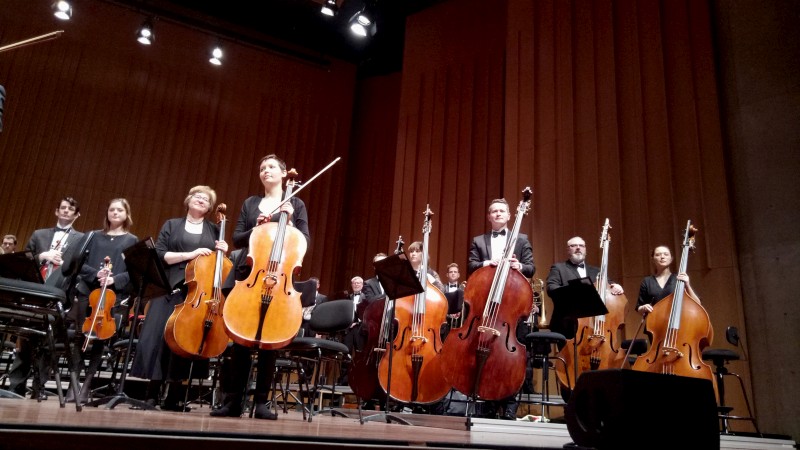
It's a work of art and myth but I find it difficult to think of the planets other than in a sense of astronomy, that being a hobby of mine in the past, and in doing so, Holst Planets also reveals its age.  It was written 1914-1917, the time of WW1 and after Jules Verne War of the Worlds, that novel of an invasion of Earth by Martians.  So the military 5/4 theme of Mars, which is the first planet pictured, is relevant, and the title Mars: the bringer of war.  But then Venus: the bringer of peace seems a bit odd given its impossible hot, cloudy, thunderous surface.  Famously Venera 9 finally landed on Venus, took the first photos of the surface and operated for 53 minutes.  Not that we could live free on the surface of Mars, but it's a bit more forgivable.  Mercury the winged messenger speaks of the Roman God with flighty flute, glock and harp.  Then out to Jupiter and jollity, Saturn and old age, Uranus the magician, Neptune the mystic and no Pluto which was not discovered until 1930 but then maybe here Holst is up-to-date, given that Pluto is now considered only a dwarf planet, not the real thing.  But this is art and the music was a pleasure.  The dynamics from the CSO were massive and hugely effective if there were some very minor issues otherwise, but this was a mighty performance and mightily well received by a full-house crowd.  Amusingly, I'd passed the crowd the night before and only just then remembered our booking, given an auto entry in a wrong calendar and seemingly limited options making me use Google Wallet for the first time.  What do you do if you drop a phone these days, I wonder.  But there was more and it was all cleverly themed with the Planets.  First up, Benjamin de Murashkin Logos, all filmic and vast, from shimmering textures to violent stellar eruptions.  Benjamin was there and took to the stage to receive applause.  And Josef Strauss Music of the spheres, a collection of several waltzes depicting spinning couples orbiting a ballroom, so apt.  And it was a mighty orchestra.  I measure by basses: there were 5.  And off stage, women of the CSO chorus who appeared on stage in black for their recognition.  And lively, mobile Jessica Cottis up front to bring it all together.  Impressive and entertaining and often loud... even from the very back row upstairs...

The Canberra Symphony Orchestra and Women of the CSO Chorus performed de Murashkin, Josef Strauss and Holst the Planets under Jessica Cottis (conductor).

26 September 2025

Life and death and entropy

Don't read too much into the title.  I'm reading a book (Hovering / Rhett Davis) and this phrase appeared (p.218) and it seemed to fit CSO's Mozart Requiem concert pretty well.  They played 3 pieces.  First was Mozart Divertimento Dmaj, written at age 16 and thus the life to contrast with the final piece, Mozart Requiem, as the death.  In fact, he famously only wrote part of the work and left sketches for more and nothing for some movements.  Entropy somewhat fits with the middle piece, Australian Corrina Bonshek Dreams of the Earth I for string orchestra, all sounds of the bush and cicadas and if structured, not too obviously, although I did note repeating bass passages.  This was sounds of nature and quite authentic in its impression, concerned with nature as the impressionists were, but quite accurate unlike their take on colour and movement.  The Divertimento was a lively and relatively light piece and nicely done, although I did feel some it a bit untogether, perhaps in diverse lines in the composition, but nothing at all of the sort for the Requiem.  To my ears and closed eyes that was a stunning, hugely dynamic with the quieteest passages looming then exploding, solo voices clear and choral passages massive and touching.  The movements are from the Catholic mass.  CSO played with a choir of ~50 and 4 vocal soloists and the orchestra as scored, 2 basset horns, 2 bassoons, three trombones, timpani, violins and violas and continuo comprising cellos, basses (3) and organ.  So not huge in volume but apt.  I sat eyes closed for most of the work, stunned by the effectiveness and power and the capable performance, indulging in the immnse beauty of it all, lusting over the fugues.  How I love fugues.  CSO did themselves proud.

Canberra Symphony Orchestra performed Mozart Divertimento and Requiem and Corrina Bonshek at Llewellyn Hall. Erin Helyard (conductor) led soloist singers Sara Macliver (soprano), Ashlyn Tymms (mezzo-soprano), Louis Hurley (tenor) and Christopher Richardson (bass-baritone), Kristen Williams (violin, concertmaster) and the CSO chorus prepared by Tobias Cole (chorus master).

28 March 2025

All is well

I ran into some fellow classical players and one had just started going to CSO concerts because she was approaching 35 and that's the cutoff age for cheaper tickets and another had played in Canberra for yonks and this was his first concert.  We'd been subscribers but missed gigs too often to maintain a subscription and then had got too busy.  But I was glad we got back for this one.  The music was Charles Ives Unanswered question, Elena Kats-Chernin Night and now, a flute concerto with Sally Walker, and Tchaikovsky Symphony 6.  Observations?  We were up the back so interesting to observe the lone trumpeter injecting into Ives, as an alternative voice.  Jessica Cottis had argued this was about a staid life and the alternative.  Then Elena K-C in 3 movements.  I found the first movement pretty steady and repeating, but it enlivened for the second and third movements, even if the flute could be lost amongst the great hubble-bubble.  Then the Tchaikovsky.  Apparently Tchaiks considered it his best work.  I was his last - he died ~8 days after the first performance.  It starts quietly, then a 5/4 waltz and a march and the quieter final movement.  I can't hear Tchaiks without marvelling at his ability to create glorious melody from the simple lines, then meld and mould it.  And the CSO did a great job, nice phrasing and movement and section play, and huge dynamics.  We were in the last row upstairs and i measured volume around 88Db down to a whisper.  And Jessica Cottis virtually dances on the conductor's podium.  Interestingly, the orchestra seemed to be well off her indications, but consistently so, so it all held together, so good.  They were recording, so many mics around the stage.  We left in some elation, and not just Megan and I, but also muso friends we saw afterwards..  Plenty of smiles so all good.  Very glad we went.

Jessica Cottis (conductor) led the Canberra Symphony Orchestra at Llewellyn Hall playing Ives, Kat-Chernin and Tchaikovsky with soloist Sally Walker (flute).

PS.  The following day I had lunch with Elena Kats-Chernin and it was a very pleasant outing.  We talked of music, of course, but not just.  Meeting musicians outside the concert hall gives you a chance to talk of other things.  It's a key pleasure when we host CIMF visitors.  We talked of family, home, history,  music and musicians and previous night's concert (the encore was Eliza's aria from Wild Swans), touched on politics, national and otherwise.  Perhaps more.   Such an interesting, wide ranging discussion and a pleasant interlude.  Elena, lovely to chat.

21 October 2024

Eight seasons

It cost me a gig but it was a worthy substitute.  This was the strings from the Canberra Symphony Orchestra directed by concertmaster (sic) Kristen Williams playing the famous Vivaldi Four Seasons interleaved with Piazzolla's response.  We all know various of the themes from Vivaldi and if I heard right, the Piazzolla was a direct response to Vivaldi and anyway we know the popular tango-styled Piazzolla tunes out of Buenos Aires.  It was a popular program and obviously considered apt for lots of young ones, although the ones near us didn't seem particularly interested, but so be it.  It's good to get them along and they were old enough just to fidget rather than cry.  I was surprised that each Vivaldi season had 3 movements.  I should have known, but I wasn't the only one, with the first movement of each season getting a good applause. It was usually the feature movement anyway.  The playing was lovely, rich and full and unusually big.  This was the strings of the CSO so I guess there were more players who would normally play this piece, certainly more than baroque groups usually sport, like AHE or ACO.  I counted 8xvln1, 6xvln2, 5xvla, 4xclo, 2xbs, plus the director-cum-soloist on violin, so it was a big sound and it neatly filled Llewellyn, which can be cavernous for smaller groups.  I enjoyed the playing and was convinced by the take the Piazzolla.  CSO is doing plenty of varied programs now.  I guess this is the first strings section that I know of.  BTW, two basses on stage even if only one in the program, Kyle and Emma.

The Canberra Symphony Orchestra strings played Four seasons by Vivaldi and Piazzolla at Llewellyn under Kristen Williams (violin solo, director).  Low enders were Kyle Ramsey-Daniel and Emma Meixner (basses).

11 August 2024

Biggie B9

I've recently been living off this quote from Dave in the bass section of the CSO: "It's not that hard; it just takes a year to learn it".  He was talking of the bass part of Beethoven Symphony no.9.  I just saw them playing it and the bass section did a fabulous job, clear and present and crisply played.  The next morning I looked at the B9 bass part and I can see what he meant.  Lots of notes over 25 close pages of bass clef, but it's in Dmin so just one flat, and key changes to just 2 flats and 2 sharps at various times and pretty few accidentals, so the fast runs are scalar and mostly consistent.  There are some big intervals and the lower notes that get played on their extensions so some clumsy stuff, and the tempos are not very forgiving although pretty consistent, but it is a work of supreme genius so worth the effort.  The CSO did a great job at a decent tempo.  The singers were satisfying.  The choir was prepared by Tobias Cole and was good but I just wanted it bigger.  I guess ~100 on stage with choir of ~40.  The vocal segment only comes in the final movement, although that's the longest.  The choir sat from the start, but the feature singers entered after the second movement, I guess to allow that transition to the final thrills.  They don't sing masses, but they were lovely to hear: always the presence of the soprano, the fullness of mezzo, the bigness of bass and the humanity of tenor.  But mostly my ears were for the basses.  I did notice a revealing passage where a lines moves from bass to cello to viola to seconds to end with the firsts, not always identical but related.  For me it was a revelation for the violas.  Otherwise, Jessica Cottis was flowing and expressive in her conducting and informative with her introduction, as were the EU Ambassador to Australia, Gabriele Visentin, and CSO CEO, Rachel Thomas, who introduced the concert.  The Ode to joy is the EU's anthem, of course.  And not to forget composer Miriama Young who wrote the introductory piece, a brooding and fairly short Daughters of Elysium, who appeared on stage to applause after.  But it's hard to share with B9.  It was given as 71min duration but it felt nothing like that.  I guess it's a function of how well it's known, although I did notice the repeated themes a few times, especially in the third movement.  But the explosive styles and the uplifting power and the thrilling fugues just take you over.  Perhaps not apt for a classical concert but my head was often nodding and my mouth a grin.  Just so fabulous.  I just hope to play this great work one day.  Congrats to our local orchestra and great to see so many local faces on stage and off.  Bravo and thanks!

The Canberra Symphony Orchestra performed Beethoven Symphony no.9 and Miriam Young in Llewellyn under Jessica Cottis (musical director, conductor).  Kristen Williams (violin) was concertmaster.  Solo singers were Emma Pearson (soprano), Ashlyn Tymms (mezzo soprano), James Eagglesone (tenor) and Adrian Tamburini (bass).  Tobias Cole (chorus master) prepared the CSO Chorus.  The bass section comprised Max McBride (principal), Kyle Ramsay-Daniel, David Flynn and Muhamed Mahmedbasic.

30 April 2023

How to live happily ever after

It's our local orchestra and we'd got a good deal but I was not so keen on the program.  So I thought and how wrong one can be.  The program was two commissioned modern-Australian pieces and a Scriabin piano concerto and Rimsky-Korsakov Scheherazade.  We'd heard Scheherazade several times, even by the Berlin Phil, and I'd listened to some of the Scriabin in the afternoon and I wasn't so taken.  Maybe it's the live effect but, in the end, I loved this all deeply (when I could ignore the immensely offensive plot).  Scheherazade was all the lyrical beauty that it is expected and the storyline, assisted by a rear projection, was clear and gave order to the whole.  Early on I wished for more dynamics, those pp passages that have you leaning in your seats, but then the ff passages worked and the dynamics became stronger and the lyricism leaped forward and Jessica Cottis' urgings fell into place and the main work was a huge pleasure.  But not the first for the night.  The Scriabin presented some busy and expansive piano and was a real pleasure, even if occasionally lost amongst the 55 players of the orchestra.  It's an easy slip up, that.  But nonetheless, a telling performance by orchestra and soloist.  The two commissioned pieces seemed to share some aspects, both ~8 mins, both with busy bows playing big crescendoes although one with more than the other.  Miriama Young's piece was called Kinds of blue.  I expected references to Miles, but rather it referred to various shade of blue in found Rothko paintings.  Interesting but odd for a jazzer given the Miles relationship.  Sine Winther played piano.  The other commission was Harry Sdraulig Beyond the ridge, the ranges far, dedicated to a very recently deceased wife with a pic of her walking amongst mountain peaks.  What a wonderful memorial.  Again, some sort of repetition, with each peak followed by another valley and another peak.  Jessica Cottis programmed the night called Electric Blue and spoke of synaesthesia, in which music is experienced in colours.  At least Rimsky-Korsakov had it and Wikipedia says so does JC, so it's relevant.  I wonder how she funds the CSO after all her Euro experiences.  It's a fine orchestra but I wonder if it's a little comfortable as Australians can be.  It wasn't by the end of the night; it was a blast.  Good on ya, CSO and JC.  Well done.

The Canberra Symphony Orchestra played Young, Scriabin, Sdraulig and Rimsky-Korsakov in Llewellyn under Jessica Cottis (musical director, conductor) with soloist Sine Winther (piano) and concertmaster Kirsten Williams (violin).

10 July 2022

Christmas in July

Chrissy in July is not a thing for me but Handel Messiah is usually something we hear at Christmas but this was winter, unseasonably cold outside.  Canberra Symphony Orchestra put on Messiah with its Messiah Chorus auditioned and convened by Tobias Cole.  The numbers were not huge, ~35 instrumentalists and ~40 chorus and four soloists.  The program didn't say, but the solo singers were Chloe Lankshear and Andrew Goodwin and Adrian Tamburini along with Tobias.  The basses were old mates Kyle and David and Hayley but only Kyle and Hayley on the night.  Kyle played most as solo when the front lines played.  The work is a dream, of course, and well known and loved and it's deserved.  Quite a few fugues (I love a fugue) and plenty of rich choral passages and those soloists with harpsichord or organ or solo violin or often a smaller ensemble, but the extravagance and delirium of the choral passages and full orchestras are what really does it for me and most.  We duly stood for the Hallelujah chorus, but we had to be goaded / invited.  I was not the only one who'd forgotten that rite of passage.  And the choir was good.  First up I thought the women were good, but the lower voices are always less appreciated or obvious but they showed their colours and impressed.  So impressive all round.  The trumpet passage (aptly in The trumpet shall sound) was lovely; the solo violin was satisfying, the parts were convincing.  I felt just a little discomfort in timing or perhaps some rushing in the tricky bits early on but that settled.  As for the bass, I was surprised by some tricky parts and look forward to printing the part for a gander. Anthony Hunt from State Opera of SA was upfront and led comfortably.  And that lovely scalar semiquaver stuff by voice (paralleled by instruments, too, of course), is demanding and tricky and a real test.  I was surprised how capably the chorus carried this out.  We expect it from the soloists, but it seems more difficult for massed voices who are perhaps less trained.  So we all left with joy and excitement and satisfaction after 2 hours and interval for a pretty long night of music.  Just such a pleasure: nicely done and such joyous music.

Canberra Symphony Orchestra with the CSO Messiah Choir under Anthony Hunt (conductor) with soloists Chloe Lankshear (soprano), Tobias Cole (countertenor), Andrew Goodwin (tenor) and Adrian Tamburini (bass).  Kyle Ramsey-Daniel and Hayley Manning (bass) played the low end.

15 April 2022

Chuckles

Jessica Cottis is our local orchestra's chief conductor and musical director but she didn't make this concert.  She was isolating for Covid.  So our sit-in was Fabian Russell and he complemented the CSO and did a wonderful job up front despite only learning of some of the music in recent days.  And his complements were deserved in my book.  The CSO was big, ~65 players, and they filled Llewellyn and played well, neat intonation, great dynamics, convincing renditions.  Maybe the best I've heard form them.  And it was no slouch program.  Wagner Tristan and Isolde Prelude; Margaret Sutherland violin concerto, Bernard Hermann Vertigo suite (very convincing and obviously different as so filmic) and Mendelssohn symphony no.5 Reformation.  Having said I liked the playing and enjoyed the concert, I did have favourites.  Wagner, yeah, and the violin concerto, if mainly for the playing.  Courtney Cleary played the solo and did it with confidence and commitment; nice.  But otherwise, it sounded marchy to me, perhaps apt given her experience of wartimes; the concerto is from 1960. Then the second half, and Vertigo, as in the film.  Just great and convincing.  I enjoyed this one for its drama and tension.  Then Mendelssohn.  Not a great fave.  It was written early with all melody and little vertical, harmonic complexity (except maybe later in the third of four movements).  But I'm a bassist and I couldn't be anything but impressed with this quick phrasings demanded of the five bottom enders, I think in unison with the cellos. Exhilarating, if mostly scalar.  But I enjoyed that and the basses did it was admirable clarity and no hesitation.  I could only leave with chuckle.  Nice outing, this one.

Canberra Symphony Orchestra played Wagner, Sutherland, Hermann and Mendelssohn under replacement Fabian Russell (conductor) and with soloist Courtney Cleary (violin) and five basses.

15 July 2020

The other side of the stream

We've been stuck inside and doing streams and webinars. Here's something that's a little more active and quite fun: playing together by streams. You can do this as a jam session or live performance, but that has issues of internet lag and I am yet to achieve that. But I have done a few home recordings that are assembled later as a performance. One was with Bernard Duc, a composer in Switzerland, who put out a call for bassists to support a choral performance of Amazing grace on FB. The other followed an invitation emailed around Canberra, for community musicians to play a few tunes with Canberra Symphony Orchestra and Canberra School of Music students. Both provided an audio download to listen to while reading a part. It's much easier to play with the volume and excitement of an orchestra around you, but I managed them. I also tried to record a tenor part for a huge choir with Eric Whitacre (2,000+ singers) but I wasn't comfortable with my solo voice so that one bit the dust. All amusing pastimes. Links below; perhaps more coming.

  • Amazing grace / Bernard Duc
  • CSO Community special (1) Jamaican rhumba
  • CSO Community special (2) Can can
  • 09 September 2018

    Everyone loves Bolero

    Except musicians. And supposedly Ravel. It is involving but tedious. The basses play two notes then stand ready to miss the quick end. There's a joke on the Net that has the whole bass line (all 20 minutes or so) expressed in 2 bars. On the other hand, I still can't sing that oddly unexpected melody without a slipup. Even after hearing it numerous times. The CSO did it justice and I thought the alto sax soloist played it more convincingly than some others. He also played solos on Debussy Rhapsody for alto sax and orchestra and Milhaud Scaramouche suite. Apparently they are both standards of the alto classical repertoire (I guess it's not so big). He'd played the Debussy in various chamber combinations but never with a full orchestra. That was an interesting revelation. Then there was Copland Fanfare for the common man and the very substantial Berlioz Symphonie fantastique that was long, seemingly endless, with 6 movements. It seemed an odd piece to my ear and I was hugely surprised when Megan said it had been written just after Beethoven. So early; so inventive and different. And with some devilish playing requirements. The CSO did it with considerable panache. I was impressed. The latest in the CSO series.

    Canberra Symphony Orchestra performed at Llewellyn under Nicholas Milton (conductor) with soloist Nick Russoniello (alto sax).

    20 July 2018

    What a blast


    Another Canberra Symphony Orchestra concert but special. The music was accessible and well known and not too challenging, but it was special, at least for me. It was the first time I'd attended a concert where I'd played all the pieces before. I find my appreciation of a piece is immeasurably deeper when I've played it before: the structure becomes more visible; the lines (most prominently the bass lines) are expected and the harmonies and melodic and rhythmic plays with other parts are at front of mind. Nothing too surprising in that, but it's a revelation. The program was Brahms Academic Festival overture, Beethoven Triple concerto for violin cello piano and Elgar Enigma variations which I've played over time with Maruki and NCO. I'd played the Brahms twice, with Maruki and Brindabella. All exciting. And the soloists were Dimity Hall, Julian Smiles and Piers Lane. I'd played with Dimity and Julian at Llewellyn with NCO. All very exciting. The second half was on the program as just Enigma variations, so short, but the CSO encored with that English soul stirrer, Elgar Pomp & circumstance march no.1, also known for its lyricisation as Land of Hope and Glory. I'd played that too, with Maruki, one December. It took all my willpower not to stand and squat in rhythm as the upper class twits do in (London's) Albert Hall for the final night of the Proms (see YouTube). I was beaming and singing as I left. But what of the orchestra? BJ Gilby was missing from her seat and Maria Lindsay took that spot with Pop Thompson to her side. Lots of common faces but a few new and young ones too. Five basses this time, led by Kyle and Dave in the core of the back line. Nicholas Milton up front. I loved the program; I loved the playing. The Brahms is lively and fun; the Beethoven couldn't be by anyone else and Julian's cello playing was a revelation (my take of this was BJ Glby, David Pereira and Edward Neeman but I was too busy playing and too far from the sightlines to appreciate it like this night); the Elgar was really nicely done, dynamics, relaxation, intensity, variation, good all round. Then the final Elgar Pomp&Circ was just nicely played and is such an infectious blast. I just sat nodding time and grinning. So, suffice to say I really enjoyed this concert, not for intellect or adventurousness so much as for affinity and simple pleasure.


    The Canberra Symphony Orchestra under Nicholas Milton (conductor) performed Brahms, Beethoven, Elgar and Elgar at Llewellyn with soloists Dimity Hall (violin), Julian Smiles (cello) and Piers Lane (piano).

    05 May 2018

    Beyond basics


    This was a favourite concert from the CSO and not just because of the double bass concerto, but it had an array of musics. Beethoven Symphony no.2. Beethoven is always good and this was a blow out. Nicely played, tight, neat, together, with some prodigiously fast lines in bass. The Ninth has its moments but perhaps this has more. I'll have to revisit the 9th to check. Beethoven was the last thing for the night. First up was Vaughan Williams Fantasia on a theme by Thomas Tallis. Again neat and thoughtful playing. I noticed the four string principals playing a string quartet role but the orchestra also entered as well as a reduced orchestra of first desks. The Tallis theme is played three times and a secondary theme appears on solo viola and forms the climax. Prior to Beethoven was a short work in three movements by Paul Stanhope called Morning Star written as his response to Indigenous music in Arnhem Land. The double bass concerto was a star for me, obviously. Phoebe Russell played Vanhal Double bass concerto Dmaj. PR is trained in Victoria, VYO, ANAM and two years on a scholarship associated with the Berlin Phil, no less. Only 24 and she's returned, seasoned, as the Principal bass in the Queenland Symphony. A modicum of both talent and hard work, no doubt. I unavoidably missed her recent solo concert but was in the front row for this one. Some technical matters: a very small double bass from 1700 with large F-holes and 40" scale (I'm told), just less than 3/4; flat back; narrow neck that suggested to me a conversion from 3 strings; classical bow; Belcanto strings? (orange wrapping). I loved her technique, too: flexible and apt to the phrasing; thumb and some freer techniques up high; harmonics beyond the neck; third finger used on some vibrato; neat finger changes to hold notes or continue phrases. A pleasant and gentle tone with form if not too loud. Seriously intriguing playing throughout. Long practice and some serious training shows, and I think a preparedness for technique to be flexible subject to notes and phrasing. Not sure I'm saying much, but a great pleasure for me with a great view. And an attractive piece. Perhaps I'm coming around to double bass as a solo instrument, at least in hands like these. A great pleasure as was the concert itself: a great pleasure all round.

    Canberra Symphony Orchestra performed Beethoven, Vaughan Williams, Vanhal and Paul Stanhope. Johannes Fritzsch (conductor) conducted and Phoebe Russell (double bass) soloed on the Vanhal Double Bass concerto in D major.

    11 November 2017

    Stirring


    I found the latest CSO concert hugely satisfying. First up, Glinka Ruslan and Lyudmila overture. It a lively thing and joyous thing with plenty of fast runs and the five basses handled it with ease, as did the other parts. I've played it, but it couldn't have been so fast. The next up was the feature, soloist Harry Bennetts playing Tchaikovsky Violin concerto Dmaj Op.35. HB is ridiculously young, early 20s, but scholarship material at the Berlin Philharmonic Academy, so no slouch. This was fiery with huge technical demands, harmonics into the stratosphere and the rest. It was a hugely impressive outing by a very young but capable player. I've played that, too, with John Gould as soloist in Maruki. Apparently Maruki had done the other, too, although I haven't. Sibelius Symphony no.2 D maj. It's a sprawling work with beastly timing for all, some stunning long, fast walks in the cellos, rich and vibrant and emotive, pastoral and melancholic and stirring. I loved this one not least for its exhilaration and the orchestra did it proud. So a hugely pleasurable evening.

    The Canberra Symphony Orchestra performed Glinka, Tchaikovsky and Sibelius under Nicholas Milton (conductor). The soloist was Harry Bennett (violin).

    19 August 2017

    War out the door


    It was the Canberra Symphony Orchestra playing another Llewellyn concert, this one nominated Horn and it was just a series of pleasures. First up was the crowd-pleaser, Borodin Polovtsian Dances from Prince Igor. Well, it's a rollicking thing with memorable themes, enough to make it into the popular repertoire as Strangers in paradise and it's got particular relevance for me. I'd heard it played very capably by choir and orchestra of the combined Canberra Grammar Schools in the wonderful CGGS hall when it was a revelation to me as a newcomer to classics. Easy listening, perhaps, but exciting and melodious and inviting. CSO did a great job. Then the matter of the horn. Hector McDonald played Richard Strauss Horn concerto no.1 Eb major. HM has been 27 years as a principal at the Vienna Phil amongst his illustrious career in Europe, but he started out here, in Sydney and later Canberra, playing in Llewellyn Hall and with the CSO. Some old band mates were playing behind him on this night. He's obviously not so well, as he explained later, but his playing is sweet and pure, so another pleasure. He encored with a bit of Vienna, playing Johann Strauss Sweet tears with harp accompaniment. Then the final pleasure, not at all a frivolous thing: Prokofiev Symphony no.5. Apparently it was written with WW2 outside the door, first performed with cannon in the background. It's big, unrelenting, mobile and flexible and tactical as war is and battles are. An overwhelming experience only enhanced by taking a seat in the front row, under the cello, in Dave's line of sight, not too successfully trying to follow Nicholas Milton. But what a work! I'd listened to some that morning and it seemed heavy and tortured but in life it was powerful, forceful, varied and, again, unrelenting. Fabulous and capably done by the orchestra. So, a wonderful concert with all manner of styles and all manner of receptions. Great stuff.

    The Canberra Symphony Orchestra played Borodin, Strauss and Prokofiev, under Nicholas Milton (conductor) with soloist Hector McDonald (horn).

    20 May 2017

    Come in Torino, Berlin


    It's our CSO again and there were some interesting twists in this concert. It's the Cello concert of the subscription series. The cello featured Italian (Torino-born) cellist, Umberto Clerici, now principal at SSO and lecturer at the Sydney Con. He played Schumann Cello concerto Amin Op.129. Nice, all from memory as is done. Some impressive playing, especially the encore which he introduced as a modern Italian/Australian crossover (if I understood correctly - we couldn't hear his patter too well) with a rocky second half. That was exciting and challenging and everyone was talking of it, at interval and after. Haydn's overture to L'isola disabitata preceded that. Then, after interval, the most Australian and the most intriguing piece of the night for me, Sculthorpe String sonata no.3 Jabiru dreaming. It's clearly an evocation of the outback - specifically Kakadu - and how true it was! I first noticed with bussing insects that were so true to aural life, then later with a few bird flocks taking off. All with non-traditional techniques - string slides and sul ponticello and stick bowing. Stunningly true to the sounds of the bush. Then the traditional tour de force, Brahms symph no.3. I am playing no.4 in a few weeks and discovering just how good is Brahms. This one I don't particularly know, but I could recognise similar fairly simple lines and twisted rhythms but this seemed to have more virtuosic bass parts. Satisfying either way. The conductor was another invitee, Stanley Dodds. I didn't find it easy to follow some of his instructions, often broad and bar-long, but these are professionals and he is Berlin Phil material. Hmm. Obviously I have much to learn in this field! But a good night out with our much-loved local orchestra.

    The Canberra Symphony Orchestra performed Haydn, Schumann, Sculthorpe and Brahms under Stanley Dodds (conductor) with soloist Umberto Clerici (cello) at Llewellyn Hall.

    06 November 2016

    Return to our local


    It's a string of orchestras that we've seen recently but now back in Canberra and I was very pleasantly surprised by our own local CSO, Canberra Symphony Orchestra. They had tough competition: we had heard one work done by the Berlin Phil a few weeks before and the Conservatory orchestra in Singapore was very satisfying with its big size and a small space to give a massive sound. CSO held its own. They played a fascinating and attractive piece by Nigel Westlake, Shimmering blue. Lyrical, punchy, sometimes filmic. Then the Berlin Phil take (interestingly, Berlin Phil had played an Australian piece by Sculthorpe, first up for its concert), Rachmaninov Rhapsody on a theme of Paganini Op.43. They did a great job, capable, expressive, together if not so smooth and seamless as the Berlin Phil (the comparison is unfair, a casual outfit up against a professional selective world leader). I concentrated more on the variations this time, obvious enough in the early parts and towards the end. I didn't follow so easily in the middle. Then the main work, Tchaikovsky Symph no.4 Fmin Op.36. Again, a tour de force. It's a strange work, apparently with a theme of fate and self, swapping themes or overlapping. An overlaid polonaise over a waltz spells out these two ideas but I didn't catch that. I did catch immense loud, busy passages contracting with quiet lyricism. Four movements. The first is long and expansive; the final one is hard biting, starting with a single ff note and continuing with some devilish lines, not least on bass. I was proudly proclaiming our local orchestra as I left for some evident chops, considerable responsiveness and a surprising volume to fill the large Llewellyn Hall. Very well done and much enjoyed.

    The Canberra Symphony Orchestra performed Westlake, Rachmaninov and Tchaikovsky under Nicholas Milton (conductor) with Kristian Chong (piano) performing the solo part in Rhapsody on a theme of Paganini.

    20 August 2016

    Latest locals with visitors


    As I play more classical music I realise how little I know of it even as I'm getting better at playing it. But I'm enjoying the process of reading and bowing and revelling in the sound of an orchestra. Christian just confirmed this when he asked which encore piece the soloists at the CSO played on Thursday night. He suggested the Handel passacaglia arranged by Halvorsen for cello and violin and I'm sure it was. Christian joked it could almost be considered a fourth movement for the Brahms Double concerto that it followed because it's always played as the encore. I'd just noticed that the melody was familiar and enjoyed the rabid scalar runs on cello and descending chromatic harmonic accompaniment. Nice. The soloists were German husband and wife team, Indira Koch (violin) and Wolfgang Emanuel Schmidt (cello), holidaying/touring in Australia/NZ and invited by Nick Milton. I luxuriated in his cello, but as a principal violinist she was no slouch with some doubly quick descending lines. Maybe it's the nature of an orchestra, being collection of many musicians attempting to work as one, but I did feel the tutti segments of the Brahms were more indistinct, at least against the clarity of two soloists, excellent as they were. But I didn't feel that for the Dvorak Symphony 7, D minor. To my ear, that felt as if the orchestra was speaking with authority and confidence. The first piece of the night seemed an odd little one, Weber Der Freischutz overture, sometimes pastoral, sometimes ecstatic, dramatic then finally balletic. But I enjoyed it all immensely, our local orchestra with such a difficult task of infrequently pulling together for such significant concerts.

    Canberra Symphony Orchestra under Nicholas Milton (conductor) performed Weber and Dvorak and featured soloists Indira Koch (violin) and Wolfgang Emanuel Schmidt (cello) on Brahms.

    14 May 2016

    B9/3


    It was Beethoven Choral Symphony no.9 the other night at Llewellyn with the Canberra Symphony Orchestra, CSO Community Choir Canberra Choral Society including Canberra Choral Society and choirs form Canberra Girls Grammar and Radford led by Stephen Mould with soloists from Opera Australia, Emma Castelli, Brad Cooper, Anna Dowsley and Andrew Moran. B9 is always awe-inspiring, especially after a relatively anaemic Schubert Unfinished Symphony. I know it's popular, but it's nowhere near the league of Beethoven. Also a short modern piece, Cudmirrah Fanfare by Nigel Westlake. Apparently it was written for ABC RN, but despite being a daily listener, it didn't ring bells for me. Obviously it was B9 that was the high point. It's easily recognised, and not just the final movement, but every movement and several themes within movements; hugely involving; very demanding for the players (I watch the basses: there were plenty of very fast sequenced, scalar phrases with little letup); great and memorable lyricism and that incredible Beethoven ability to move you through musical changes without the jarring of many composers, virtually unnoticeably, inevitably. It's a great achievement for the CSO, if not a perfect one. To my ear, AM could have milked some passages; the soloists could have been better balanced (that could be my ears or location). A friend commented on the excellence of the choir and it was satisfying, although my attention was mostly elsewhere. But what an achievement, both for the composer and the performers. My first B9 was CSO from one of the front rows, louder and more involving if oddly balanced, but feeling like a part of it all. That was my best experience of it. Like your first ... whatever. But no B9 experience is to be dismissed. Loved it.

    Canberra Symphony Orchestra performed Beethoven, Westlake and Schubert with CSO Community Choir comprising the Canberra Choral Society, Canberra Girls Grammar Choir and Radford Choir led by Stephen Mould (conductor) with soloists Emma Castelli, Brad Cooper, Anna Dowsley and Andrew Moran.