Showing posts with label Oriana Chorale. Show all posts

13 April 2026

Ranges of uprisings

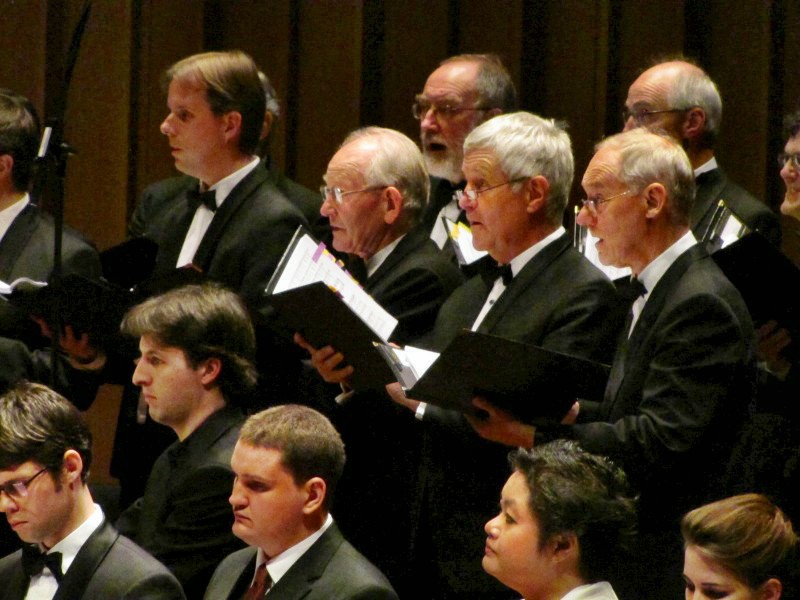
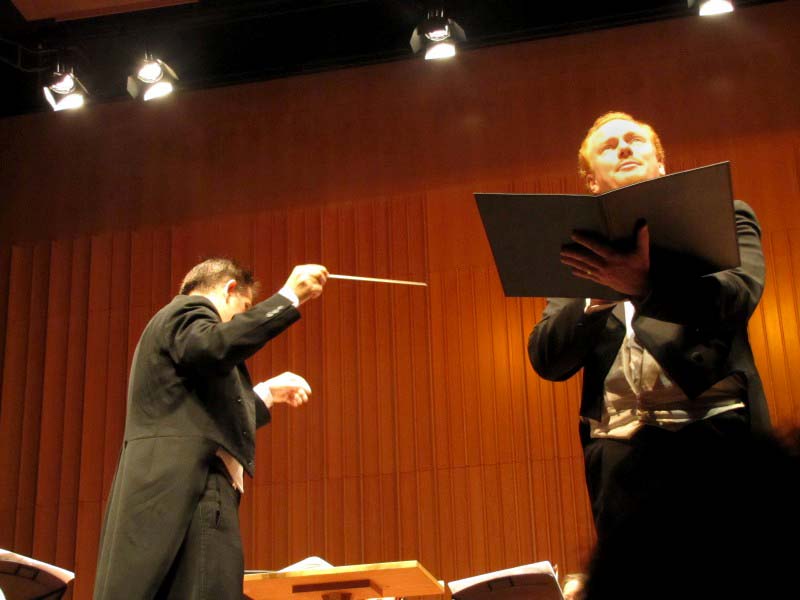
Oriana Chorale's latest concert was called Uprisings with a theme of revolutions and the texts read of uprisings but not so sure of the music.  And the revolutions were just sometimes Soviet or the like and often enough the modern takes on the personal as political.  Shostakovich appeared in four of 10 poems on texts by revolutionary poets but the others, the more moderns, were gay marriage and anti-racism and women's voices on their rebel blood and harmony in diversity by Sebastian Allen, composer-in-residence, a world premiere.  But there was also the past, with Thomas Tallis writing form within the English Reformation, a chorale of a German composer who took his life from conflict of his religion and serving the Nazi regime.  And an intriguing wok on Indigenous recognition and reconciliation with words of Oodgeroo Noonuccal and Psalm 137:4 ("How shall we sing the Lord's song in a strange land?").  So a fascinating program worthy of followed lyrics.  The modern tunes were rich in complexities of harmony, especially.  How to find those sharpened intervals with just dots on pages and a voice?  These chords could be doozies, but thus is much modern music-making.  Tallis was like a relief for a time, rich and full and relatively predictable.  Shara Nova was rich in such harmonies.  There were also a tune for the males and a tune for the females, the latter led within by Olivia Swift although with musical composition by otherwise MD Dan Walker.  Shostakovich appeared quite consonant and tame against some of the living composers.  And to end, the Perfect chord, the title of the world premiere composed by Sebastian Allen, one of a few with solo passages, here a glorious melody from soprano Jade McFaul.  So a varied and quite magnificent program from an adventurous MD and a very capable choir.  Congratulations are due.

Oriana Chorale performed at Anzac Memorial Chapel at Duntroon under Dan Walker (MD, conductor) including one World and one Australian premiere.

09 December 2025

Earth or poets

I was intrigued by the lyrics and themes of the latest Oriana Chorale concert and pleased to be asked to record it.  They always perform beautifully capable and interesting concerts and this was no exception.  I usually just listen to the music, as lyrics can be hard to decipher on stage, but lyrics are the essence of song and that's what choirs do and words have an intellectual clarity that music can only hint at with emotional soundscapes.  The concert was called Colours of the Earth and the four songs all had themes related to Earthy things: trees, lakes, minerals and the like.  But most interesting to me was that the lyrics were mostly poetry, by Sara Teasdale and snippets of Goethe, Tennyson, a Josquin chanson, and a full work by Judith Wright, and also with supplementary themes, of time and life and words to a child and faiths lost.  And containing all that, the music was fascinating.  The main work was Oche by Caroline Shaw, with movements named for various minerals, and amusingly with samples provided on the day by the Canberra Lapidary Club.  MD  Dan Walker provided the final song of the evening, To a child, to the words of Judith Wright.  The first was Luke Byrne Desert Sea followed by a world premiere from Oriana's Emerging composer in residence, Aija Draguns, with that text from Sara Teasdale, about lost leaves displaying a sky view.   The accompaniment was percussion, both tuned and not, which is unusual but felt apt in this context for the rigours of the Earth.  And the performance was again hugely inviting, rich and sweet and not too dissonant.  How I love song and the combined singing of a capable choir.  Lovely.

Oriana Chorale presented works by Luke Byrne, Aija Draguns, Caroline Shaw and Dan Walker at Wesley Church under Dan Walker MD (conductor).  Aija Draguns, Oriana's Emerging composer in residence, composed Lost leaves, presented as a World Premiere.

30 June 2025

Tastefully typical

Sally Whitwell is a Canberra resident and it was she who designed a deliciously effective description on her day.  She earlier spoke of being in a rut with choirs and finding this enlivening as a musical interpretation of our true lives: three coffees a day, breakfast, cat, veggies for lunch, emails, housekeeping, visitors for dinner and sleep with a book club thrown in.  A typical day but with wonderfully inventive music, some borrowed, some original.  So we got Michael Nyman Miserere with Three ways to vacuum your house and an indie Oxford comma and a delicious sleep from Eric Whitacre.  And such a capable choir to sing it all, a towering soprano, capable parts and harmonies and a division (interestingly at the vacuuming and later dinner) of the women's voices then the men's.  So cute nad joyful and true stories told with superbly effective choral complexities in all manner of styles, Sally herself and Nyman and Whitacre and lesser names and Indie rockers Vampire weekend and some musical theatre from Beauty and the Beast and one work by OC's emerging composer in residence Aija Draguns, with Sally's piano accompaniment and Dan Walker's direction and a clarinet in there somewhere.  Delicious, delightful and down to earth.

Sally Whitwell (piano, direction) created the program Musica Domestica : a musical diary of a remote worker ... in thirteen chapters and with Aija Draguns wrote some original music for Oriana Chorale under Dan Walker (conductor) and one clarinetist that I can't name.

22 March 2025

Loss, grief and healing

As I write this I regret that I hadn't read the generous and informative program notes before this performance.  This was Oriana Chorale performing at Wesley Church and the title/theme was We are not ready : Music of loss, of grief and of healing.  Not an easy topic and the program even came with a warning of possible emotional triggers.  The music was of various eras, several modern, several regarding a passage of the King James version of the Bible on a son's loss, several on other losses, in various wars or otherwise.  I might have listened differently.  I just noted the modern dissonances and chromatics and the comparisons with the sweet harmonies of Monteverdi.  The lyrics were not included in this program and maybe they would have guided the appreciation.  Whatever, I've recorded it so look forward to a relisten after reading the excellent program notes .  But otherwise, this is a wonderful choir, with high notes towering above with SATB males and female voices with wonderful skills and clear enunciation under two excellent directors, one having composed one piece, and the other arranged another.  The tunes were from Weelkes, Olivia Swift, Prestini, Makaroff, Monteverdi, Eric Whitacre, Ella Macens and that arranged Trad piece.  This is music of richness and complexity and variation and I feel I just touched on the experience in my first outing.

Oriana Chorale performed music of loss, grief and healing at Wesley Church under Dan Walker (director, conductor) and Olivia Swift (conductor).

26 November 2024

A shorter vigil

It should be heard in an all-night vigil while standing.  We were luckier than that.  This was Rachmaninov All-night vigil, loosely called Vespers from the main part of the work.  Actually Vespers makes up movements 1-6 of 15 with Matins 7-11, Lauds 12 and Prime 13-15 and this whole would be heard in the traditional Orthodox service from sunset finishing in the morning of the next day.  Oriana Chorale learnt and sang the Russian text a capella in the ANZAC Memorial Chapel at Duntroon, no less, under Dan Walker with soloists Maartje Seventer, Andrei Laptev and Andrew Fysh.   It was a different thing.  I had just heard complex modern harmonies with Kompactus.  This was much denser and darker, partly from the larger choir, but I guess also from many parts.  It's also SATB but each section can be split into 2 or 3 parts through the work.  It's heavier, more serious perhaps, certainly more religious.  Sometimes an introductory solo to start a movement (what is this called?) or a quiet vocal tone after a tuning fork to a skull.  After hearing this and Kompactus in one week, I remain in awe of our local choral scene.

Oriana Chorale performed Rachmaninov All-night vigil at the Anzac Memorial Chapel at Duntroon under Dan Walker (musical director) with soloists Maartje Sevenster (alto), Andrei Laptev (tenor) and Andrew Fysh (bass).

29 July 2024

Flight

Flight was the theme of the latest Oriana Choir concert and it's an apt theme for a choir, it seems to me.  it's light, flightly, swooping high and low, playful like birds, intelligent and intriguing like Leonardo and even reaches to the stars like the final tune of this concert.  The tunes were all manner, from Swans and Magpies, from calm to frenzy; Leonardo dreaming of his high flying machine by Eric Whitaker, noted as a choral tour-do-force and obviously a massively complex choral outing.  We heard various bird noises amongst the words and all manner of bird-like movements and swooshes and tweets and the like, amongst all the words with their own more obvious meanings.  I still love words for their meanings, so choirs are a huge pleasure, even if you often need to follow the program to comprehend them.  Sally Whitwell is a long-time friend and came on for several pieces and her composition Flying and a last minute world premiere that led into it.  Then a final Elton John Rocket man which spoke of space while musically and lyrically bringing us down to earth: such a clear indication of the relative simplicity of the pop tune.  All, so lovely, so well sung and managed, so interestingly programmed.  Much enjoyed.

Oriana Chorale performed with Sally Whitwell (piano) under Dan Walker (musical director) at Wesley Church.

01 July 2024

Grammy

Well that's a first: my first time to record a Grammy-award winning artist.  It was just the evening of our MdCC concert and I threw the recording gear in my car and in the end I got the gig.  The group was a touring boys' choir out of Silicon Valley called Ragazzi Boys Chorus.  They tour regularly; they total ~250 students in SF and toured with ~100: the pizza boxes on the way in just confirmed numbers.  They had just played St Patrick's, the huge Catholic Cathedral in Melbourne and they are due to perform in the Opera House in a few days.  So our diminutive Wesley Church seems a throwaway but they performed with verve and pleasure.  They sang in three combinations, the whole, the trebles, another, then a few songs from our own marvelous Oriana Chorale and an all-in.  Ragazzi had sung a range from de Victoria to Bridge over troubled water under Kent Jue with a notable number of Australian compositions.  Impressive.  One group had a series of soloists; another was presumably TTBB or maybe higher; an Ave Maria had a section in the organ loft behind; introductions were by the students.  There was a piano accompanist for most pieces and once a student conductor and djembe.  And some seriously effective singing.  (BTW, their Grammy was for a recording by the SF Symph and Chorus with Ragazzi and SF Girls' Chorus of Persephone, Best classical album 2000: impressive).  But equally impressive was our own Oriana, singing the best I've heard them, singing three quintessentially Aussie songs a capella (truly in Wesley Church) with Olivia Swift directing for this outing.  Then an all-in with boys arrayed against walls and on the altar with Oriana, singing Pemulwuy,  How Ausie can you get?  A great pleasure.

Ragazzi Boys Chorus performed under Kent Jue (MD) with Oriana Chorale under Olivia Swift (conductor) at Wesley Church.

14 April 2024

Tallis to today

Prayers and lamentations was the title of the concert by Oriana Chorale with a range of Biblical and other quotes.  The obvious one and ever popular was Thomas Tallis lamentations of Jeremiah from the a capella first half.  Interestingly the two parts of Tallis sandwiched a modern work by Roxanna Panufnik.   It was a little confusing and I thought Tallis was mightily modern at one stage but it all resolved in the end and I loved both pieces although the Panufnik was my fave.  This is stunningly dissonant complex harmony apparently  minor against major tonalities but I guess all manner of flattened notes.  My admiration to the choir for handling this one!  Fascinating (listening now on Spotify: Deus, Deus Meus from her Westminster Mass).  The second half was Stravinsky and Lili Boulander , both modern.  I've played some Stravinsky and love it but never Boulanger, Lili or Nadia.  I jokingly compared notes with Megan at the end and she was not at all surprised that my choices were Panufnik and Stravinsky.  And how well this was done!  The choir was superbly strong, complex, reliable, and the Stravinsky required serious volume at times.  The accompaniment, just piano, clarinet and violin, was just as impressive and satisfying.  This was no walk in the park.  There was complexity and volume and challenging harmonies and odd time feels to navigate and all was wonderfully present.  The Boulanger also featured a high solo male voice and that worked a treat too.  So a great pleasure but more importantly a stunningly interesting and capable presentation.  Interesting, too were the arrangements: Stravinsky by Stefan Cassomenos; Boulanger by Dan Walker.  Quite an overwhelming outing and nice to be asked to record.

Oriana Chorale performed at All Saints Ainslie under Dan Walker (MD, conductor) with accompaniment by Helena Popovic (violin), Milan Kolundzija (clarinet) and Ronan Apcar (piano).  And a few mates, including Liz from Wesley and Imogene from my recent wedding band.

04 December 2023

Choral home

I've just travelled and heard Bach's choir and more and on return recorded Wesley's Oriana Chorale and I remain dumbfounded at our local quality.  This was really very good.  Oriana Chorale is a local non-professional choir but it performed complex modern works with great authenticity and quality,  The main work was Mass for double choir by Frank Martin (pronounced as in French) and it was complex with its eight parts (SSAATTBB, I guess) with dissonant harmonies and odd intervals and there were times the entrances were a bit unsteady in some parts but there were also times, far more frequent, that the voices just rang with those odd harmonies and questioning dissonances and high sopranos and melding lower and mid parts and the beauty was quintessential.  That was eight parts and complex, but the simpler four parts could be similarly challenging if not so dense and the performance equally enthralling.  Brooke Shelley Nativity, a modern work out of Sydney, and Poulenc Found motets for Noel were thus and even the shorter C16th madrigal by Madalena Casulana were similarly adventurous, with rich inventiveness of chromaticism and conterpoint.  They were all musics pretty new to me and all performed with seriousness and dedication and mature awareness for a devouring crowd.  I was pretty stunned actually.  There's great music in Europe but we have our fair share, perhaps more than our share here in Canberra.  So I guess the message is be proud and be there. 

Dan Walker (musical director) led Oriana Chorale in a Christmas themed concert called O Magnum Mysterium at Wesley with music by Frank Martin, Poulenc, Brooke Shelley and Madalena Casulana.

17 July 2023

Voices

I reckon that voice is the most intimate and natural thus most significant instrument there is, so it's no surprise that I love a choir.  But this concert was beyond the pale.  I was stunned, touched, by Oriana Chorale singing with the Phoenix Collective (string quartet) and pianist Jem Harding under Dan Walker.  Maybe partly because it was intimate in a smallish space, us being in the effective front row at the Larry Sitsky Room, or because of the programming which was diverse and interesting but also consistsent,, from Depeche Mode and Sigur Ros to Elgar and Rach and trad, or because of the number of performers, somewhere around 45.   Not just because the singing was exemplary as was the accompaniment.  This was also the second performance of the night, and I always love a repeat performance.  They sit so much better.  I find it hard to identify a fave piece.  The pop songs by Depeche Mode and Sigur Ros were all suitable for this format and interestingly complex pop tunes with a touch of minimalist electronica interpreted by strings and piano.  A pair of pieces by Ola Gjiela, Dark/Luminous night of the soul, were gloriously hopeful.  Ella Macens Look up: The sky is glowing was long and satisfying and as all the rest deserved hearing the lyrics (which I didn't manage) and Rachmaninov Hail Gladdening Light from Vespers was classic glorious religious music.  Phoenix did a string quartet Scandi-folk number called Waltz after Lasse in Lyby and perhaps the most complex, most intense of all was Lux Aeterna from Nimrod Variations by Elgar as an unaccompanied vocal piece, presumably with multi parts beyond SATB.  This seemed the hardest of the night and the most uncomfy for Oriana.  So what.  I blissed out on the parts, the soaring sopranos and the clear harmonies in Elgar and throughout the night and the intimate accompaniment that came with little preparation as Oriana had only sung with the Phoenix that morning, but that's the way with such professionalism.  It just works like that and it did work a treat.  Beyond a treat, it worked an emotional tsunami.   One to treasure in memory.

Oriana Chorale performed under Dan Walker (director) with Phoenix Collective (string quartet) and Jem Harding (piano) in the Larry Sitsky Room at ANUSOM.  The Phoenix Collective comprise Dan Russell (violin 1), Pip Thompson (violin 2), Ella Brinch (viola) and Andrew Wilson (cello).

02 April 2022

The divine French

I got the call to record, this time for Oriana Chorale, a lovely, moderately-sized  choir in Canberra, led by Dan Walker.  I'd been fascinated that Dan had just done a concert (vocals/synth accompanied by piano) of songs by Suzanne Vega, Laurie Anderson, Paul Simon, Philip Glass and David Byrne.  Now that did sound of serious interest.  Oriana weren't singing that style, but interesting noen-the-less.  They were presenting a truncated history of Chansons Francaises, divine French choral music.  It ran from Beatritz de Dia, a troubaritz (female troubadour) from days pre-polyphony.  Interesting. Then through Janequin and Passereau and Trad. and Rameau presenting with choral music that explored nature and more.  The Janequin Chant des oiseaux was all imitations of birds.  Then to more modern times, with trois chansons each from Debussy and Ravel and huit chansons, settings of troubadour/troubaritz melodies, from Poulenc and to C20th with Edith Piaf.  Quite a journey.  Some lovely explorations, capable leadership, nice intonation and expressiveness.   What a nice recording call!

Oriana Chorale (mixed choir) sang chansons Francaises under Dan Walker (director) at the chapel of Canberra Girls Grammar school.

09 April 2012

Ending Easter

Three days later we were at it again: in Llewellyn Hall, with the Canberra Chorale and Bach’s St John Passion, this time with the ANU Chamber Choir and the ABC for a live broadcast to ABCFM radio. Perhaps it’s strange to hear a passion on Easter Sunday, but it’s a great work and satisfying either way. The concert started with the ANU Chamber Choir performing Arvo Pärt’s Magnificat. This was a delicate work of shimmering sopranos, high tenors, soft and swelling tones and gently moving harmonic colours. Wikipedia says it’s “divided into verse and tutti sections. The verse sections include one voice (often a soprano solo) which remains constantly on third-space C, as well as a lower, melodic line. The tutti sections make use of either three, four, or six voice parts. The soprano soloist joins in the tutti sections at times”*. Delicate and quite lovely. The rest of the concert comprised excerpts from the English version of St John Passion that I wrote up in my previous post. I found this a more confident performance than the world premiere of a few days earlier, but it was also the “best bits” with plenty of choral highlights and with an enlarged choir when the ANU singers joined in for the later passages. We spoke to Jesus (Paul Cambridge, bass) on the way out and he was obviously amused by having just a few lines, but so be it. Translator and Evangelist (the tenor who tells the story) Christopher Steele had been very impressive at the full concert and we thought even better here, more relaxed and vibrant (and less hard worked). Suffice to say, this was not the full work, and it suffered for that, but what there was was more confident and settled. This may have been just a minor reincarnation, but it was a gem.

The Oriana Chorale and Orchestra performed excerpts from the JS Bach St John Passion. The Evangelist and translator for this English version was Christopher Steele. The conductor was David Mackay. The ANU Chamber Choir was conducted by bengt-Olov Palmqvist and they performed the Arvo Pärt Magnificat.

* http://en.wikipedia.org/wiki/Magnificat_(Pärt), viewed 8 April 2012

08 April 2012

The centrality of the Easter message

St John Passion was our second JS Bach passion for the week. St John and St Matthew comprise all the extant Bach passions although he is reputed to have written five. Wikipedia compares them thus: “The St John Passion was described as more realistic, faster paced and more anguished than the reflective and resigned St Matthew Passion. The St John Passion is also shorter and has simpler orchestration than the St Matthew Passion”*. This verison of St John Passion is something again: this was the world premier performance of an English translation by ANU graduate Christopher Steele, who also performed the central role of Evangelist. I enjoyed that I could follow the words rather than read surtitles, although you have to accept some contorted language expressed in long rows of semiquavers in baroque style like: “You tor..men…ted spir...it”, or “Haste…to…Golgotha…””. It’s musically angular and protracted but that’s the baroque way and it’s immensely entertaining and aurally satisfying. Some lines were amusing, too. I thought “His clothes had been made very simply / from end to end without a seam” was curiously mundane for such a high theme, but maybe that’s part of the Christian story, too. We started well back in the Llewellyn Hall, but I found the ensemble was not imposing enough for this big space: the volume not intense enough; the impression not overwhleming enough; the words lost in distance. I moved to the third row for the second half and the words became clear, the echoed lines moved from right to left from basses to tenors to altos and sopranos, the renunciations of the choir when they chose Barabas became personal and the relegation of Pilate and the loss of Mary were close to hand. I expect it was like this in Bach’s church: a small ensemble in a reverberent, intimate space to ensconce the listener. But the playing and singing was wonderfully capable. I felt a tad uncomfortable with the instrumentals at the start (this is hot from the top so needs a generous warmup) and one other time (when Bach seemed more adventurous and had had my ears flumoxed), but otherwise the choir and performers were an absolute delight. The Passions are wonderful expressions of the loss of Good Friday and I can only sit back in awe at Bach’s creation and particularly in this case enjoy the imtimacy of the English text and admire the effectiveness of this performance. No need to be a believer to be entranced by music like this.

St John Passion was performed by The Oriana Chorale conducted by David Mackay, with soloists from the ANU School of Music and orchestra led by Barbara Jane Gilby. The translator, Christopher Steele, sang the main role of Evangelist.

*http://en.wikipedia.org/wiki/Passions_(Bach), viewed 7 April 2012

04 July 2010

Drama in the crypt

The Catholic mass is theatrical and the Requiem mass is passionate, but Verdi’s Requiem just didn’t click for me in expressing the earthly loss but religious hope of the occasion. I’d heard Mozart’s requiem a few months before, and it was pained and deep. This seemed theatrical: more operatic in its drama and not unexpected given Verdi’s fame as a composer of operas. But the performance by the Canberra Symphony Orchestra and combined choirs was satisfying and capable: well presented, with four decent voices up front and a confident orchestra. We had seats in the second row, so my pics are more individual than inclusive, but it does let you feel a part of the performance. You hear the pages ruffling; the charts cover the singers’ faces and muffle their voices; the instruments come from a generous stereo sound stage; the instruments become almost individual (I thought I could hear Leigh Miller’s individual bass pizzicato tone, and it was wonderful). But I wonder if I missed some of the effect of the choir because of this. They were down the back, behind rows of strings, and they didn’t seem to have a great presence. It could have been the piece: I didn’t notice many big choral segments of richly moving parts. The choir seemed to provide a support role for the more frequent solo voices up front. We were all thrilled by one loud and dramatic theme that recurred several times. Other spots I noticed were two female voices with flutes behind (at least I thought they were flutes, although the program doesn’t list any flute players) and a passage of nice runs of long intervals from the cellos and highlighted trumpets up front for another segment. Suffice to say it was lush and dramatic and emotional if not a deep work. Stereotypically Italian, as is opera itself: the musical equivalent of flailing arms (which I can say as I am one). But why no list of choral singers in the program? Verdi Requiem was presented by the Canberra Symphony Orchestra, with Nicholas Milton conducting. Tobias Cole led a combined choir made up of the Canberra Choral Society, SCUNA, Oriana Chorale and the Llewellyn Choir. The front line singers were Eva Kong (soprano), Christina Wilson (mezzo-soprano), Warren Fisher (tenor) and David Parkin (bass).