Showing posts with label Andrew Fedorovich. Show all posts

17 March 2013

APxART

Art Not Apart is back. I just read this morning a comment that art is different in Canberra – more community, arranged by the artists, less corporate than other cities. This feels rights. Certainly, ANA is like this: several weeks of contemporary arts of all types, theatre, poetry, music, discussions, more. All free. Arranged throughout Civic in various venues. I’ll attend some of the Difficult Music series, and anything else that’s opportune. Yesterday, I goaded Megan and some friends into the New Acton ANA event. It’s a full day of markets, music, arts, presumably with a bit of corporate support. It’s bustling and friendly. Along with the body painting and vintage clothes and tuned gongs and chats with visual artists, we caught freestyle dancer Alison Plevey accompanied by altoist Andrew Fedorovich. Then some Canberra referenced poetry, delivered with aplomb and full voice, by Raphael Kabo. I’m just discovering a love of poetry when performed. First were some readings at last year’s ANA. I note two poems: one of London place names melded with Canberra locations; another of reciting poets huddled in the Phoenix bar missing fire and calamity outside. We were not sure if this referred to the Canberra bushfires, so a truish story, or to a mythical revolution and retribution. We’d have to hear it again, but it was impressive and visual, musical and nicely repeated. You may see more poetry in these posts. Then Natalie Magee dropped in from Sydney with a band including at least the other Brendan Clarke, for her 500th anniversary gig (23yo to the despair of the MC). This was modern, pop music with some jazz sensibility through trumpet solos, and an unusual Indian sensibility in Natalie’s vocals. We just heard 3 tunes, originals by Natalie. I imagine this is perfect JJJ-unearthed material, so watch this space. Just a visit but a perfect day and a friendly, arty scene. Nice.

Just a pic or two of the Arboretum. This was our outing for coffee and some nature awareness-raising. It’s early days yet (give it 50 years) but this will be spectacular (provided we can still water it). At least the National Bonsai and Penjing Collection is up and running and it’s already a treat with specimens dating back 60+ years and the dear old cork plantation (planted ~1920) is a little-known delight dating back to Burley Griffin and Charles Weston.

Alison Plevey (dancer) performed with Andrew Fedorovich (alto). Raphael Kabo (poet) recited. Natalie Magee (vocals) led a band with Callum Gracie (trumpet), Peter Koopman (guitar), the other Brendan Clark (bass) and Dan Kennedy (drums). And a visit to the National Arboretum.

18 January 2013

Not really jazz, but a tightrope

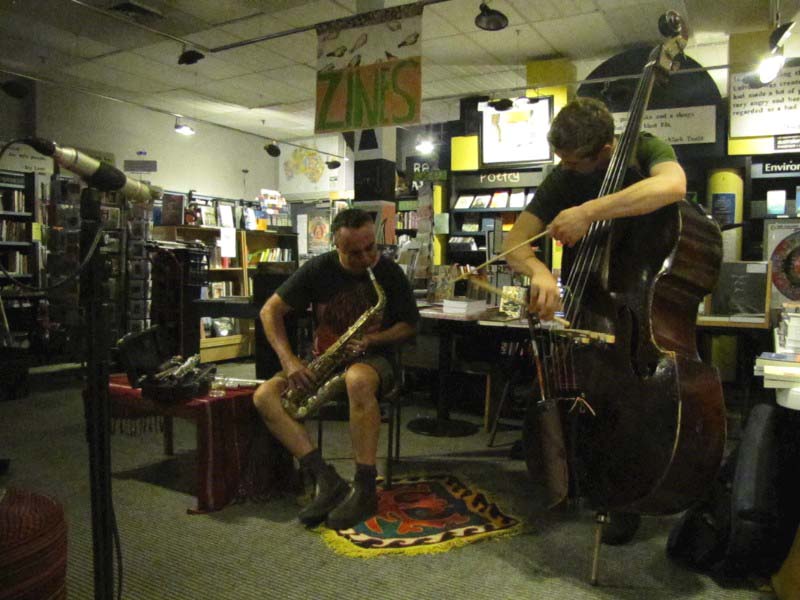
The locals do experimental, too. I’ve come to experimental music and free jazz through Richard and Shoeb and SoundOut and Smiths Bookshop and a few more connections. It’s not a popular form. It’s not even something I warmed to at first. I guess it’s got rules. It looks like it can be faked but the cognoscenti see through it. Skills make the difference and you can sometimes judge them. Some skills are just too far out of the mainstream for common recognition, like separated sax mouthpieces or playing underwater and the like. I can recognise bass technique, even if it’s unconventional, and also standard instruments played with trained technique. Similarly, I can recognise musical sensibility in the use of echo and processing and loops and electronica. It’s otherworldly but still human. And often, even without conscious recognition, but closing your eyes you can tell that something has structure or flow or harmony or tonality. This music is largely post-tonal so needs to be judged in its own context. So as I newcomer, I like to hear different approaches, different people, different skills and conceptualisations; to cover the waterfront. This night, at Smiths, before Philipe Petit, I heard three short sets and three groups: interesting and educational.

First up was Luke Pendeaux and Danny Wild. As I understand, Luke played sampler and sequencer (Roland SP404 and MC303) with Danny on laptop sequencer (Ableton live). This was rhythmic music an underlay of drone, heavy in repetition and minimal in change. Various samples were dredged up, edited and discombobulated, mixed with occasional voice that was similarly processed, the whole changing gently over time, with occasional squeals and whale calls and space ship launches and detunes and slow downs. I liked the slightly latin starting groove but wondered how we got to a shuffle swing at the end. I initially felt a sonata-like form in three parts - exposition, recapitulation - but then it seemed to continue to further parts. One thing that’s quite unique about this music is how it’s busily automated so leaving time for swig of a beer between thoughts. That’s civilised. When I go for a beer on stage, it’s usually an unholy intrusion.

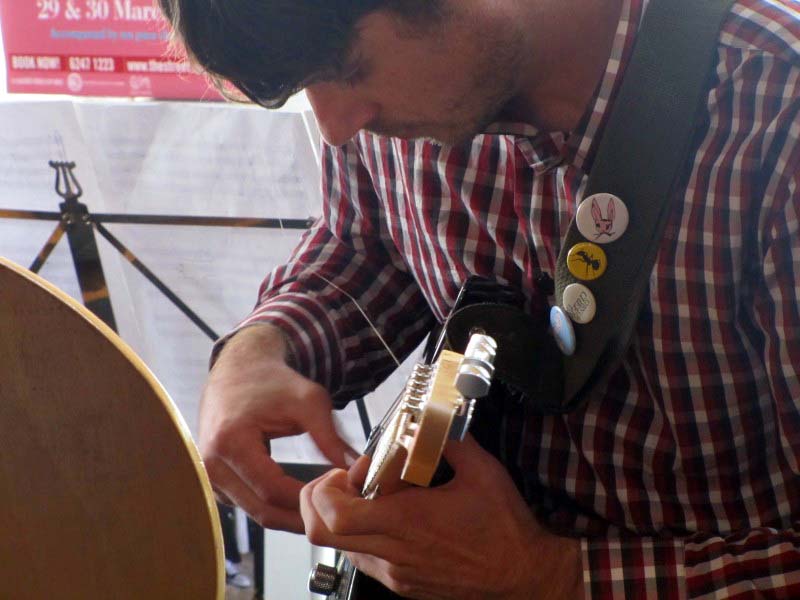
Second was Shoeb Ahmad. He would have played duo with Philipe Petit but equipment availability intervened. His key instrument is the guitar, a telecaster with single pole twang, slow arpeggios, sustained chords. This is not a music of guitar virtuosity but of watery change. He uses a string of effects and a sampler. The twang undergoes watery change. But it overlays an unrelenting noise of notes without end. It’s overwhelming, threatening, other than human, throbbing. We felt lost, threatened, rolled by a tsunami of sound. Just breathing, throbbing with heartbeat regularity. But then human sounds like clap slicks, primitive, cicada sounds, and a final crescendo of sampler then strummed chords and silence. Unsettling music, dark despite the country twang.

Third was a trio of Andrew Fedorovich, Reuben Ingall and John Wilton. Their presentation was earthy, animal. These were calls in the wild from sax mouthpiece. Rugged slaps and windblown shudders, echoing and grooving like ants and bats in the night. Then decay, an electronic drop in pitch, like a plane falling or a perhaps a crow circling, aware, calm, observant. Then night nocturnal creatures, mystery and unknowingness, Sustained twisted, bent animal tone from sax and splashed of malletted cymbals to replace the regularity of mallets on skin. Then suddenly violence leading to slow decay and some relief. Here again I noticed the automation, laptop wielding Reuben able to take a swig while sax and drums were immediate, in the moment, living as in humanity.

How else to describe this music? I close my eyes and more than other musics, its soundscape expands and its logic appears. Its direct and unconventional and even uncivilised, and that can be good in art. Whatever, I’ll be hearing more, especially with the fourth SoundOut Festival of this music coming up in just a few weeks’ time. The performers were was Luke Pendeaux (sequencer, sampler) and Danny Wild (sequencer); Shoeb Ahmad (guitar, effects, sampler); Andrew Fedorovich (alto sax), Reuben Ingall (laptop) and John Wilton (drums). The location was Smith’s Alternative Bookstore.

30 October 2012

New Action

New Acton is often a place of edgy, civilised, arty action. Last Saturday it was Art, Not Apart. It amused me that it was described as Melbourne-like. Melbourne has such a reputation these days, and as far as I’ve seen it fits. But this is Canberra, with its intimate scale and all-ages familiarity. It’s an intelligent community, if staid, and this was a perfect, sunny day. I’d gone to check out the Afrobeats of some mates in Nyash; all jazz school trained. But there were dancers aplenty, arty markets, a short film festival, poets, graffiti walls, a range of musics and more. Nyash were great fun. How can you not groove to Afrobeat. I loved it; many danced to it; this was seriously good cheer. Just one set, of two Fela Kuti numbers, one from the Skatalites, an original, maybe another. I understood the style by seeing it live: two guitars, one strummed, one funky single note lines; busy, synocapted but constant and repeated bass; drums and cross-rhythmic percussion; some yelps and hollers; and that neat horn front line of trombone, bari and alto saxes. Lively, insistent, involving music. I’d just caught the end of Goji Berry Jam. Then there was Schwa. This was intriguing, experimental art: improvisations of double bass, chalk and dance. Chalk? Yes, chalk wall and pavement painting. All to Rohan Dasica’s improvised double bass on pizz and bow. I was not wholy convinced, but maybe that’s too much swing and melody in my mind. This was experimental. The rhythms were there but hardly grooving like the soul of Nigeria. This was not the only experimental music. A quintet taken from classical players of the Canberra Symphony Orchestra played an original set in a style something like Miles fusion accompanying a story of outback travel. I wasn’t too comfortable with this. They were certainly capable players, but it’s a different awareness from dots on pages, as were the electronics at their feet. And perhaps the words might have been more image-rich and poetic. But there was a poet, too. I heard CJ Bowerbird with several poems, and I enjoyed these immensely, even if I missed some lines. He used deceptively common language but there was musicality and also lighthearted but serious intent. Much enjoyed. Otherwise, there were scantily dressed, body-painted girls dancing (one of many sights for very many oggling cameras), markets, demos, sales, films. I saw my first 3D printer at a geek table. I drooled for crepes but forgot to return to eat some. I watched the community graphics and joined in for a short film but didn’t await the delayed start. I played with tuned bells. The sun was direct but the shadows were gentle. This was a lovely afternoon, for all ages and all indugences (and all photographers – have I ever seen so many in one place at one time?). Some oddities of contemporary arts and some inculcated grooves. Very cool.

Urban dictionary tells me that Nyash are female buttocks with personality. Its also a local Afrobeat band comprising Dan Kempers (drums), Rafael Florez (percussion), Simon Milman (bass), Jack Palmer (guitar), Matt Lustri (guitar), Sophie Chapman (trombone), Andrew Fedorivich (alto sax), Nick Combe (baritone sax). The event was Art, Not Apart. CJ Bowerbird poetised, Schwa improvised and an ensemble taken from the Canberra Symphony Orchestra memorised; Alison and Jamie were were colourised then mobilised; Goji Berry Jam extemporised. Schwa comprised Rohan Dasica (double bass) with Adelina Larsson (dance) and David Keany (chalk). Everyone photographed.

29 February 2012

An Ark in a storm

The Loft is now underway for the year and I caught the Silver Spine Arkestra last night. It’s an obvious reference and tribute to Sun Ra and I locked in the date when I saw it. I found the electronica and experimentalism of the band was a reminder of Sun Ra, but his embedding in the greater jazz tradition and swing and Ellington in particular was not on show to my ears. I trust the cult-like personal demands of the original were also missing: Sun Ra was inventive but he was also a demanding and idiosyncratic leader. I’ll put it down to his background on Saturn. The SSA played two sets, each comprising a single improvisation. The first was more rhythmically and harmonically obvious. Shoeb played bass guitar here on steady quarter or eighth notes that outlined a two chord pattern. I particularly enjoyed a 2 chord bass loop that was nicely tentative and meditative and seemed to merge the bass into the group improv rather than feature it as a definer of the groove. The second was more airy, as Shoeb toyed with mixer and electronics. For me, the defining point of contact for both improvisations was Evan’s drums with his unconventional rhythmic patterns that defined feels and moved to create structure and improvisational spaces. These spaces were effectively filled by laptop-generated drones and digitally effected, refracted and refactored tones from Reuben, and long, slow contrapuntal notes or bowed sax bits from Andrew on alto. Miro provided the melody, close harmony and percussion that added detail to the whole. I heard a similarity to modal Miles of the fusion period and Miro also mentioned that. I delighted in one precisely placed trumpet harmony with Andrew’s alto that was indelibly pure. And Miro’s trumpet reappeared in processed form from Reuben’s laptop at times. He also played some fascinating African percussion instruments and whirling drones. The second improvisation featured visitor Andy on piano. This was minimalist, meditative, modulating piano taking both gentle bass and alternative rhythmical roles and using closely spaced chords with slight alterations of one note or unassertive arpeggios. Like SSA’s namesake, this is challenging and unconventional music; music for closed eyes and not for visible pleasure; music as sound that crosses into free improvisation. Nice one.

The Silver Spine Arkestra comprised Miroslav Bukovsky (trumpet, percussion), Andrew Fedorovich (alto sax), Reuben Ingall (laptop electronics), Shoeb Ahmad (bass guitar, synth) and Evan Dorrian (drums). Andy Butler (piano) sat in for the second set.

27 October 2011

Turossing it (Moruya 2011/2)

Matt Thompson has been an enigma to me, being a particularly sparse-cum-minimalist performer, but I heard him twice at Moruya and I loved it. Sparse is certainly the word. You ache for the next delayed note in a melody that’s not so much challenging as just right. And when the whole band does it together, it’s quite magical. It seems touched with blues (a blues connotation?) in its simplicity and its infectiousness and, with Josie’s words, it takes on a singer-songwriter significance. Then, given the desert-dry atmosphere, a waterfall of notes in Matt’s solo in the last tune was a stunner. I enjoyed these two sets. Matt Thompson (piano) leads a quartet with Josie Jensen (vocals), Rafael Jerjen (bass) and Henry Rasmussen (drums).

Lakeside Circus is a favourite of mine. It’s a creation of Jono Lake, but he was called back to Canberra and the band did the set without him. I listened to Sun Ra returning from the coast, and the Circus has a similarly playful and iconoclastic vigour. Trumpeter Shane Spellman took to the drumkit that Jono now leads from and Reuben Lewis sat in for Shane on trumpet. This is vibrant, fun, entertaining, even dissident music that thrives on its frolicsome composition and collective performance. Fun and refreshing. Jono Lake (piano, drums) is the leader and composer for Lakeside Circus but was not available. This day, the Circus was Andrew Fedorovich (alto), Max Williams (tenor), Patrick Langdon (trombone), Reuben Lewis (trumpet), Alec Coulson (bass) and Shane Spellman (drums).

24 March 2011

A world in a raindrop

So I was thinking while listening to the detailed but totally unconventional music being played by Jim Denley and Mike Majkowski. They performed as BLIP during their East Cost tour stopoff at Smith’s Alternative Bookshop for a small group of intense listeners. You have to be an intense listener for this music, to pick up those details in the raindrop. It’s something we forget – that there are sounds everywhere, sounds we can wring from anything. This music makes you remember. The techniques are totally unconventional, of course, so it amuses me that they use conventional instruments to do it. But the intent and the seriousness is there, and the beauty is also evident if you open your mind and ears to the detail. What’s the sound of a balloon path from mouthpiece to alto? Or drums sticks on bass strings, or vibrator in alto bell, or clappers damping bass strings? Or the more earthy and unmediated, like mouth clicks and pops or a stick swishing through the air? It’s that elemental and basic: quite beautiful but otherwise unnoticed. Like windchimes, it’s music of the environment. I’m wondering if that makes it a signature music for our age. It’s certainly not sophisticated (in the original meaning) or urban or I might even say civilised, despite the lovely tarnished alto and the dark, mysterious, rich-sounding bass. There’s technique there. I could see it in Mike’s strong and precise bass hands which he did use for occasional thumb position playing, and heard it as he warmed up on free jazz (for once more traditional and less challenging than the music they played). But abandon the conventional, all ye who enter here. I said to Jim afterwards that I had no idea what they were doing. He (perhaps jokingly) said he felt the same. It’s a world of its own, this art sound, and worthy and fascinating in its own way.

Locals Andrew Fedorovich and Luke Penders had opened the night with their takes on this style. Andrew played an alto in a mostly conventional way (with lips and no preparation) but the sounds were multiphonics and tonguings and slapping keys and solid, unexpected low notes with airy tones clouding above. This was quiet and pensive, sometimes jagged and gentle so it was occasionally interrupted by the noises of the outside street. Luke performed a piece of electronica with laptop, reference monitors and the like and, what amused me, a synthesizer in a Nintendo (!), the Korg DS-10. Funnily enough, this was the most harmonically structured piece of the night (who would’a thunk it?), with repetition of harsh heavy metallic sounds and a signature truncated rising tone mixed with clicks and pops and random noises. The cosmic background made electronic art.

Not a night to invite Megan! Jim Denley (alto sax, baritone flute, wooden flute, balloons, etc) and Mike Majkowski (bass, bells, whistles, drumsticks, etc) performed as BLIP. Andrew Fedorovich (alto sax) and Luke Penders (electronics) performed as a warmup.

This is CJBlog post no. 600.

20 March 2011

Kaoss?

Shoeb Ahmad and his digital processing was the common feature at a challenging concert I attended yesterday. Spartak played the first set with two numbers. Austin Buckett presented a work originally written for a string quartet as the second.

This was a larger, 5-piece Spartak. I’ve written here of Spartak as a duo. The essence of drums/percussion and processed instrumental sounds was still there, but this was bigger and more exploratory. The first tune was indicative of the approach and structure. Evan started by setting percussion rhythms. Tim introduced a simple melodic line on trumpet, repeating with some small variations. Andrew played mostly harmony notes. He once inserted a snippet of modern jazz (lovely) but returned to simpler harmony notes, which are a better base for Schoeb’s digital manipulations. These digital sounds formed an intense and all-encompassing background for snippets of notes and varied percussion until Tim restated his simple melody and the tune ended. Guitarist Morgan was also there with few notes but extended effects. I couldn’t identify his part, although Shoeb was obviously clear on his space. It’s music that has its own logic and art and it demands intense contemplation. I find it rewarding although the passers-by at the Street seemed a bit non-plussed. I found the clarity and strength of the trumpet was perfect to cut through the environmental noiseworks and also as a base for these manipulations. I also noticed the tunes grew and fell away (obvious enough) and interestingly it was the human sounds that made growth and the digital sounds that accompanied the decay. Not sure I can read any more into this than that the digital followed the instruments, but maybe it’s a comment on our human progress? Growth as a search for harmony, tonality, melody, structure; digital as mechanical, intervened, under human control but not human. The second piece first had me amused with shades of scifi: R2D2 and, more profoundly, Forbidden Planet. Again, the trumpet set intervals and the alto found harmonies, and the electronics bent and repeated these sounds and fed them back amongst a clatter of rhythm. These are not easy sounds, but they are satisfying.

The second set was Austin Buckett leading a performance of his piece, Stuttershine. It was originally written for a string quartet but performed here by piano, cello, viola and violin with digital manipulations. It started sparse, with rubato notes passed between piano and strings and built to end with a constant arpeggio-like single-note passage on piano that seemed to restate the sparse melodic movements of the first part. Over this was again the digital processing of strings by Shoeb. I really enjoyed the un-manufactured sounds of acoustic stringed instruments as well as the ringing acoustic piano tones. The digital reformulations seemed a bit intrusive to me although the concept of a reworked environment was good. Perhaps this was just a little too loud or edgy for the gentle stings. I found it satisfying work of composition and of performance, somewhat related to Spartak, perhaps as the distant more-upright cousin?

How great is it that we have such music here? Congratulations and thanks from CJ. BTW, my title, Kaoss, makes reference Shoeb’s principal interface for these digital manipulations, Korg’s Kaoss Pad dynamic effect processor. Shoeb was using the mini-KP with laptop and numerous other digital dongles. Spartak was Evan Dorrian (drums), Shoeb Ahmad (digital manipulations), Tim Bowyer (trumpet), Andrew Fedorovich (alto sax), Morgan McKellar (guitar, delay). Austin Buckett (piano, composer) led a quintet comprising James Larsen (cello), Xina Hawkins (viola), Elyane de Fontenay (violin) and Shoeb Ahmad (digital manipulations) playing his piece, Stuttershine.

07 August 2010

Something quirky this way comes

The Circus came to ArtSound again last night, ie, Lakeside Circus. It’s always a work of madness and extravagance, and some really interesting and searching playing. I’ve written on their last performance at the Front. Read that for more in depth comments. This time, I only caught some of the broadcast and got to the studio for part of the second set. Again I noticed those clever, Mingus-like arrangements, but was also taken by the soloing, which was not so much virtuosic as intervallically intriguing, and some strikingly contradictory piano playing at times from Jono that just clashed like the titan but resolved into new and satisfying themes. Jono is generous about his work in all this, although he takes an obvious and impish and committed leadership role while playing. His take is that he starts with an idea, and the arrangements develop from themes and lines played in practice, which he then further charts. Whatever, it’s very impressive writing. Another quirky saturnalia from Jono’s musical acrobats.

Lakeside Circus played for Friday Night Live at Artsound. The Circus is Jono Lake (piano, compositions), Shane Spellman (trumpet), Andrew Fedorovich (alto sax), Max Williams (tenor sax), Patrick Langdon (trombone), Alec Coulson (bass) and Mark Levers (drums).