Showing posts with label Clayton Thomas. Show all posts

08 February 2024

SoundOut 2024 / 6

I was mostly busy on Sunday but couldn't miss the first performance which was my final: two basses and guitar, Clayton Thomas, Helen Svoboda and Jean-Sebastian Mariage.  I've been mightily impressed and often intrigued by the playing of all these three over this festival.  They were in the smaller room, having starting early so they were playing when audience entered.  Lots of sustained floating drones, I thought around A given harmonics and open strings, contrasting harmonics harmonies, some interesting atonal melody note plays from Clayton and Jean-Sebastian, bowing from all including guitar, and some bass pizz and an end on a relative quietude and high bass harmonics.  Quite a lovely engrossing performance, unusual with those dissonant pizz lines which are somewhat a revelation after the consistent harmonies of bass harmonics.  So an end for SoundOut 2024.  This one had more relevance and meaning for me, perhaps because I got to perform, somewhat because the act of performance and preparation taught something of the approach and style.  I also better understood the nature of experimental vs free jazz.  And there were some really impressive musicians.  I will single out some favourites but this is not exhaustive and just from those I heard: Clayton Thomas, Helen Svoboda, Novak Milojlovic, Guylaine Cosseron, Maria Moles, Jean-Sebastian Mariage, Laurence Pike but, as I said, a personal list.  Congrats to all and especially to Richard Johnson who brought together the 15th instance of this fascinating, challenging and unusual gathering.  Given our political bent from Clayton, I'll add a few relevant pics from the Lyneham Shops.


Clayton Thomas (bass), Helen Svoboda (bass) and Jean-Sebastian Mariage (guitar) performed my final concert at SoundOut 2024.

07 February 2024

SoundOut 2024 / 5

Then the second half of Saturday session 2.  First up an interesting session perhaps led by Jim Denley.  Unlike others, this was a series of "tunes", each with a theme or approach, seemingly prepared to be led by one or other performer.  It had me wondering if this was a CD launch!  Performers were Elizabeth Jigalin, Helen Svoboda, Jean-Sebastien Mariage, Jim Denley and Laurence Pike.  Feels variously changed and were led by or centred on instruments and instrumental techniques.  Thus I noted: rippling piano with distorted guitar; pining feel with guitar and brushes; bowed guitar with bass harmonics and unison vocals; busy frantic distorted guitar and slammed piano; rubber mallet on bass with damped guitar notes; harmonics, guitar e-bow, mallets on cymbals, bowed bass, sparse piano, flute vibrato, build to finale.  Fascinating, unexpected and well received.  Next was mainly electronics with projections performed by Hannah de Feyter, Danny Wild (Lowflung), Yichen Wang and Nicci Hayes.  Hannah had a viola but mostly played effects and presumably loops in the effects chain.  Danny played a complex looking suitcase of a synth and Yichen a tiny but surprisingly powerful (and costly) Teenage Engineering OP-1 synth.  The whole was electronica, groove and metallics with some effective projections behind.  Nice.  Then the Clayton Thomas Large Ensemble.  Rules, structure and guidance were discussed in another post.  Clayton introduced it as a political action as any group activity is (interesting thought) and highlighted the horror of Gaza and related and committed the performance to this stand.  It was an intelligent, thoughtful, quite radical and informed presentation.  Much admiration for that.  Then we played.  I stood centre with basses right and left wing, behind Miro so I was particularly well placed to luxuriate in a glorious tone and subtle melody.  This moved into our community improvs with rules and ultimately to a drone from Helen, a piano solo from Novak (again a stunner) against a growing crescendo of moving all-in drone until it dwarfed the piano and Clayton signalled a stop.  The whole was ~30-minutes as these sets are.  The solos from Miro and Novak were stunning, I felt the improv segment was better in practice but still OK, the crescendo was a stunner and very loud at the end.  The audience was small but the reception was strong.  So a success.  Much enjoyed.

Performers for set 4 were Elizabeth Jigalin (piano), Helen Svoboda (bass), Jean-Sebastien Mariage (guitar), Jim Denley (winds) and Laurence Pike (drums).  For set 5 were Hannah de Feyter (viola), Danny Wild (Lowflung) (synth), Yichen Wang (synth) and Nicci Hayes (projections).  Set 6 was the Large Ensemble led by Clayton Thomas (bass) and featuring Miroslav Bukovsky (trumpet), Helen Svoboda (bass) and Novak Minojlovic (piano).

05 February 2024

SoundOut 2024 / 3

Next was a morning workshop featuring two bassists.  How could I not attend?  We were in the smaller performance room, bare walls and very alive, with about 20 attendees.  First part was Helen Svoboda with Maria Moles.  They first performed, then discussed their approach, how they outline their performances and guide their improvisations, how they interpret an image or theme as parameters.  Parameters was from writings of Anthony Braxton, possibly otherwise expressed as expression and relevant to the theme you wish to play, so a rolling landscape may be interpreted as long, gentle notes and Jackson Pollock would be short or staccato.  And how players perform together conceptually and musically.  I particularly enjoyed the conversation and broader aspects of musicianship and their personal journeys, like, how Helen records lots of her practice and releases an albums each year (three so far on Spotify) or how Maria also plays pop/indie and how it's all relevant.  And the group finally played together with some guidance on parameters.  This was particularly relevant because Clayton Thomas took the second half of the session to prepare us to perform later as the Large Ensemble.  He introduced a series of rules to guide our performance which were later to become a little more complex with the addition of several of the performing players for performance that night.  Some rules were: only play in space; play short notes; look up and be aware of others' playing; long notes allowed when you respond to other/s; whenever you introduce a new phrase/note, play your previous notes/phrases first, thus 1, 1, 1-2... A later prep session would expand to include a structure: Miro introduces, all play the rules above, Helen starts quiet drone, Novak solos over drone as the ensemble crescendos very, very slowly to overwhelm piano then stop on signal.  Thus is experimental music.  I understand it better now.

A workshop was in two parts with Helen Svoboda (bass) and Maria Moles (drums) then Clayton Thomas (bass, large ensemble leader).

04 February 2024

SoundOut 2024 / 2


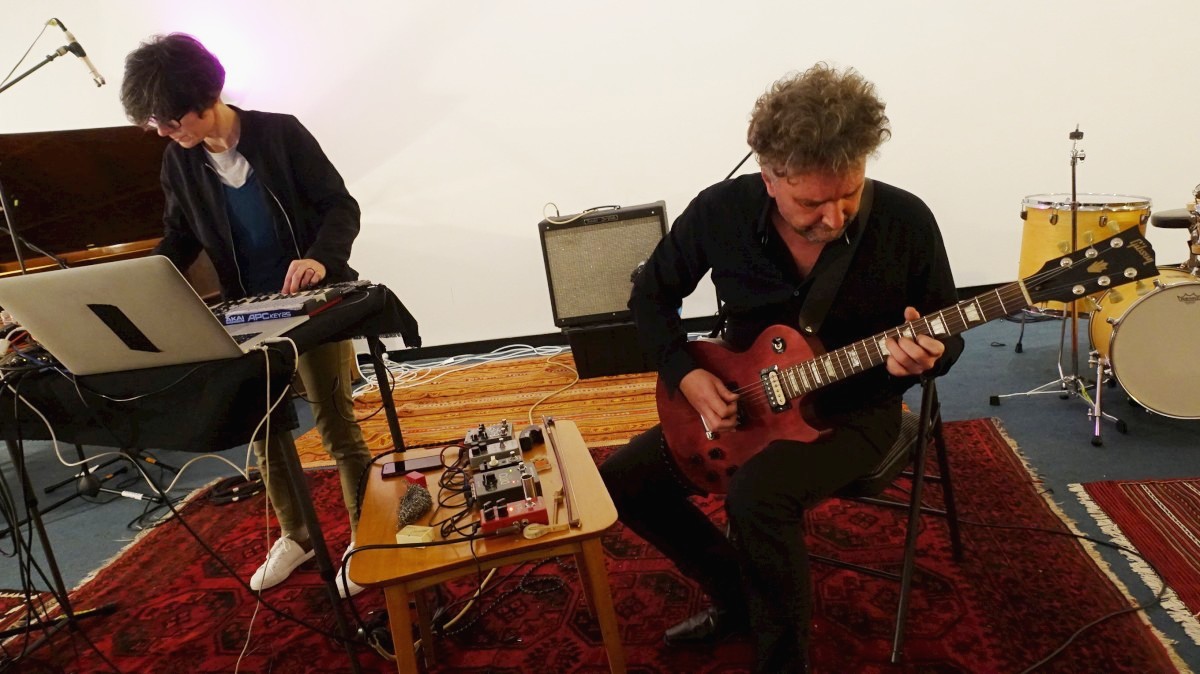
There were three more acts during the SoundOut Friday night session.  First was a very quirky outing with three performers playing occasional trumpet and flute but mostly various kids' toys.  All rattles and noises and shakers and whistles.  Backing this was a multimedia-cum-live drawing session projected behind.   The falling conga line of penguins was perhaps the peak of this experience, but an artistically quirky good time was had by all, performers and audience.  BTW, the mini amps were Marshall and Orange, although the sound was nothing like dirty rock.  Amusing.  performers were Elizabeth Jigallin, Ellen Kirkwood, Jodie Rottle and Nicci Haynes.  Then Kairos, another French international duo, this time combining electronics and oft-times nicely dirty Les Paul guitar.  Dotty punchy synth lines from a table of keyboards and one particularly strange controller, bowed guitar, some seriously nice phrasings, impressive sounds although I wondered where it was going or went.  Performers were Jean-Sebastian Mariage and Gwennaëlle Roulleau.  Then the final act, a quartet called Believe.  This was straight free jazz, fabulously articulate and expressive and informed with top skills, madly busy from the first notes but moving through a series of sections.  The performers were Clayton Thomas, Laurence Pike, Novak Manojkovic and Peter Farrer.  All great musos, but I have to single out Novak.  He's a pianist and piano is the whole orchestra in a box, but he could play it all.  I was blown out, by him and all.  And I don't always warm to free jazz.  It needs informed chops and some structure and immense listening and a love of dissonance, but then it can be exhilarating.  This was.

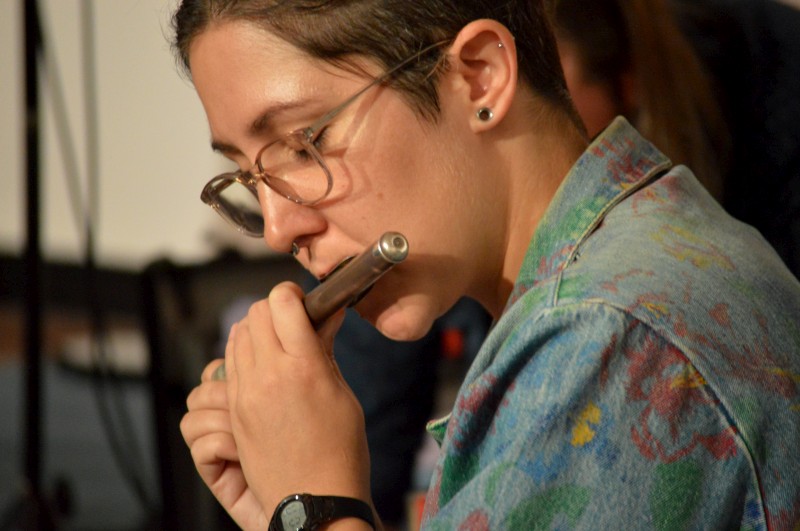
The quirky penguins outing was Elizabeth Jigallin (toys), Ellen Kirkwood (toys sometimes trumpet), Jodie Rottle (toys sometimes flute, piccolo) and Nicci Haynes (drawings, projections).  Kairos comprised  Jean-Sebastian Mariage (guitar) and Gwennaëlle Roulleau (electronics).  Believe comprised Clayton Thomas (bass), Laurence Pike (drums), Novak Manojkovic (piano) and Peter Farrer (alto, percussion).

31 January 2023

And now for music

I managed most of two sessions in addition to the Jon Rose workshop at SoundOut.  Just a touch on my impressions rather than a full list of players and collectives.  Suffice to say each performance was 20-30 mins, usually one or two numbers.  Numbers may start with agreed, even stated, intentions, usually outspoken, or perhaps just crescendo from soft noises.

Whistle Biter reintroduced me to the intensity of Hermione Johnson on prepared piano.  Or rather it reminded me of HJ as she'd attended a previous SO where I'd heard her 9 years before.  She prepares her pianos with chopsticks in the strings, and the sound is delicate and pretty, although her attacking, impulsive, vigourous style knocks them for six at times and somewhat hides the tone.  Hermione is all intense handfuls in right and left hand and occasional dropped (mostly left) arms on keyboard and then plucks under the piano lid.  Just stunning and committed, trained or not.  Her offsider, Dave Brown, was more sedate if still atonal and noise-y, so the result could be sparse, open or intense, with guitar effect hits, piano extravagance and repetition.  A nice pairing

We heard Hermione again the next day in a star trio led by Jon Rose and with bassist Clayton Thomas.  I heard communications, great chops, intent, interestingly plenty of eyes and ears open to each other, imagination, variation, it had it all.  Jon displaying years of technical exercises if not flaunting it, and similarly Clayton, mixing sounds and emotions with pizz lines, pulled strings, pizz below the bridge, strums, bows, drumstick in strings, the lot.  Just a stunning outing by this trio. 

Hermione Johnson (piano) played with Dave Brown (guitar) as Whistle Biter, and later with Jon Rose (violin) and Clayton Thomas (bass) at SoundOut.

03 February 2019

Out 1


SoundOut is in town for its 10th anniversary at the Drill Hall Gallery and I got to most of the evening session on Day 1. It's an international collaboration, as much a seminar or symposium as a concert event. There are as many musicians as performers. The performers are immensely serious yet lighthearted and the gathering itself is of great value to them. The music is new, experimental, open and unchained by techniques and yet, strangely, mostly played on standard instruments, although often with non-standard effects. I'm not sure why they use standard instruments for such non standard techniques but mostly they do, for their skills and sounds are with various noises and effects that aren't in the standard repertoire of the instrument. So flutes are dismantled and blown various ways and amusingly, I thought, a viola da gamba played a bow rather than the other way around. There are long drones and harmonics aplenty. Certainly some players don't know standard techniques (I was stunned by a pianist at a previous SO saying she didn't know of scales and chords and yet I'd enjoyed her set but I'm assured most do, and for several performers I know of, that's certainly true. We are hosting two players this year (hello Hannah and Brodie) from classical and jazz streams and they are both trained and working professionals. I'm somewhat less adventurous and like it when a few notes settle as melodies to appear amongst the drones (this day, Clayton on bass in the Astronomical Unit set and Jim Denley in another set). Maybe they consider that a copout but each was quite beautiful amongst the slower meditations and occasional sharpness. Brodie and Matthias, too, in the night-ending collective set did something approximating a horn section when they went to facing corners behind the audience and played trombone harmonies, some tonal, some otherwise. I just came in on the last notes of Col, Millie and Monika so got a pic and little else. As a set, I particularly enjoyed Astronomical Unit (great name!), a trio of trom/bass/drums played alternatively, squeaks and squeals on skins, punctuated trom and the bass just later including that lovely melodic section up high, delightfully soft and melding. Birgit played a piece that recounted chemical pollution in the Chicago river with duration linked to concentrations of various pollutants. Clayton did a solo bass thing, partly seated, partly standing, with two bows (German) and a few sticks and a slidy end pin. Jim, Melanie and Pierre-Yves did various things, dismantling a flute, blowing mini harmonicas, playing a bow with a viola da gamba, blowing tuning pipes, lots of harmonics and bowed high notes. The end-night collective was numerous and spread widely. Much listening in big numbers and perhaps fewer departures for it, although the troms did physically depart to reappear down the back. It's a time for meditation and for deep listening and for considerable technical rule-breaking. Certainly it's fresh and intriguing sounds that value closed eyes and open ears.

SoundOut 2019 runs for two days at the Drill Hall Gallery. I heard sessions from Astronomical Unit featuring Christien Marien (drums), Matthias Muller (trombone), Clayton Thomas (bass), Birgit Uhler (trumpet) solo, Clayton Thomas (bass) solo, a trio of Jim Denley (flute), Melanie Herbert (violin) and Pierre-Yves Martel (viola da gamba), and the SoundOut Collective. Staying with me are the very convivial Hannah Reardon-Smith (flute) and Brodie McAlister (trombone).

28 January 2014

SoundOut2014/2 (Saturday afternoon)

It's the most glorious of sunny days and I wonder why I'm going inside to listen to music. This will be recognised later in the afternoon session with some music in the Art School garden, but in the meantime, it's into theatre dark.

The first performer is setting up a complex piece of kit as I arrive. Ross seems to keep adjusting it throughout the performance, because he doesn't really play this, the gear plays itself, but he moves and adjusts and mixes to allow and then manipulate the sounds. There's a loose spinning string forming sine-like curves when it doesn't hit an object in its path. Ross has placed various objects in its path and these seem to have pickups which transfer to a few little mixers and at least one foot pedal. The objects are a zither and various home-built timber panels with nail-like protrusions, and later a set of cow bells. It's a complex sound of percussion and drone, changing pitches with zither movements, various rings and springs and the like. Visually it's strange and aurally, too, but mesmeric. Home-made instruments making intriguing sounds.

The basses are back, this time in two separate outfits, and that's influenced the sessions I attended. Firstly Slawek with John alto and Dave guitar. Dave started with sparse notes, but it's Slawek who bores into this music and leads with prodigious energy. He's a big man with impressive mane. He rocks searching for inspiration before he so much as plays a note, then pizz, bow, thumps, slides, always forceful, unrelenting. Guitar goes through single notes, eBow, feedback and tenor through tonguing and flaps. Slawek stopped for the feedback, loud and simple, still rolling on his feet, then strong notes, heavy vibrato, 5th, 6th intervals, strong German bowing. This is powerful bass. I was not surprised when he told me of a background in punk. Unrelenting and overwhelmingly assertive bass.

Next was bassist Clayton playing a free jazz set with pianist Cor and drummer Evan. Evan is Evan Dorrian well known to the local modern jazz community. He's delved considerably into free and new musics for years, but a strong drummer in jazz and presumably other fields. Cor is from the Netherlands, but apparently now resident in Sydney. Clayton is ex-Sydney recently Berlin. More traditional, if you can say this of free jazz (I think you can). They warmed up, jokingly, with another fast swing although hardly a standard. Then into a delicious set of hard swing, recogisable but malleable harmonies (I found the chords refreshing) that moved in symmetrical steps, diminished or whole tone, piano played with the felt over the keys (strange, this), piano played by directly manipulating the hammers, deliriously free keyboard. Bass moved through swing and walks and tapping and bows to a fabulously effective section as a percussion instrument with drums (sticks placed between strings, other stick tapping, flapping first stick). Stunningly in confluence with Evan. And Evan, explosive, riding, following with body and eyes. These were stares through that percussion passage, and there was close contact here, although not with Cor whose piano was positioned so he couldn't easily glance. A fabulously effective free jazz set and my favourite for this SoundOut.

The three picked up instruments (Cor took a guitar; Evan one tom) and they moved with audience to the garden outside. Some playing with background birds, then a merge into Radio Celeste and her laptop and turntable created musical environment. Earthy sounds; seemingly of the garden we sat in. Pretty and involving and of nature, although perhaps less of a sunny day like that one.

So, that's what I heard of SoundOut 2014, other than one last appearance. I was listening to ABC FM after 11pm, listening to some fascinating modern classical recordings. The I recognised Julian Day's voice, then later SoundOut. He played two tracks from the Friday evening session, Psithurism Trio + (Richard, Rhys, John, Krista, Rosalind) then the trio set of Viv, Melanie and filmist Lousie. More in mid-Feb.

Ross Manning (string instrument) played the first set. Then a trio of Slawek Janicki (bass), John Porter (tenor) and Sean Baxter (guitar). Then another trio of Cor Fuhler (piano, guitar), Clayton Thomas (bass) and Evan Dorrian (drums). An end in the garden with Radio Celeste (radiophonics).

27 January 2014

SoundOut2014/1 (Friday night) continues...

Continues ...

I was particularly interested in the paired bassists, especially given one was playing my bass. Slawek and Clayton, both bass, with Cor piano and Sean drums. This was a more conventional format, and the masculine side of the night. Strong from the start, then into tortured, pressured, intense, manic playing. Piano was punctuated and with some harmony; the basses were bowed, pizzed, explored, tapped, loud and intense; the drums were sometimes rabid, never steady, all fills and explosions and space and just some quieter passages. I was interested in the tones and the aggression of it all while somewhat fretfull for what the instruments were enduring, respectful for the search for newness, aware of the excessiveness and volume of it all, dismissive of some of the techniques. (This was an early and wrong impression. I was pleasantly surprised by the bass chops I heard next day from both bassists. But as I've found before, manic intensity at this level drives out the staid traditions and correct techniques of many arts; often, but not always, with justification). If these guys were playing their own basses, I may have relaxed and warmed to it, but as it was, I didn't relax enough to enjoy in this performance. (BTW, the bass was perfectly OK, as promised).

It still perplexes me that new music is so often played on old instruments. Given the traditional instrumentation, I warm to a musician who displays impressive traditional technique or knowledge. I noticed this with bassist Clayton when he was warming up for the end-of-session jam with a very steady and nicely developed bass groove, and also with his traditionally-styled pizz and ostinatoes during that jam. The harmonies and feels may have been new, but the techniques and groove were of long established. The group development was more unitonal and textured and atmospheric, but here was a family or historical connection with other music. So too, Richard's baritone sax in this set, that picked up on the groove and permuted it. The first set had Richard on soprano sax and drum playing with clarinet, two altos and one tenor sax. The whole merged in my ears into a melange of tonguings and tones and drones, but in openings I could pick out some wonderful ostinato lines from Richard, fast, clear, nicely structured around a quick passage and a long note, with slow minimalist change. This was impressive chops and lovely, understated accompaniment. It was not always obvious and sometimes hidden in the mix, but impressive when it appears. So too, with bass clarinetist Krista in this session. She had classical tone, toyed with varying lengthy intervals that sat so intriguingly and gloriously, even contrapuntally, in this busy mix. The distinct tone helps. In another set, Kim's guitar was somewhat a crossover in technical matters. I felt it held its session together with sweet fingerpicking and regular strumming, although only sometimes of chords; othertimes it was open strings or harmonics, so undefined harmonies. But this worked, especially interspersed with a similar-sounding zither-like instrument. It worked also due to clarity of the instrumental mix. Richard on gourdaphone and Reuben on trumpet and these are distinct sounds. This is also where I appreciated the skilled techniques in much new music. I know Reuben as both a bopper and a more experimental musician. Here it was all breath and tongue and unformed notes and mutes. It's a technique requiring competence and training, although not traditional. Not surprisingly, it can take knowledge of the instrument and the form to understand its complexities. Knowing a crossover artist can help.

SoundOut is our local incarnation of this worldwide branch of new music. Not easy, always a test to these ears, but a worthy wakeup call to your own conservative tendencies. Looking forward to another session. ABC FM were recording, Julian Day was MC-ing. You can hear SO performances over coming weeks on Julian's New Music Up Late.

Psithurism Trio + played the first set, Richard Johnson (soprano sax), Rhys Butler (alto sax), John Porter (tenor sax), Krista Martynes (bass clarinet) and Rosalind Hall (alto sax). Second set was Slawek Janicki (double bass), Sean Baxter (drums), Cor Fuhler (piano) and Clayton Thomas (double bass). Last set was Kim Myhr (guitar), Reuben Lewis (trumpet) and Richard Johnson (gourdophone, drum, soprano sax). The end-of-night collective improvisation comprised Richard Johnson (baritone sax), Rhys Butler (alto sax), John Porter (tenor sax), Clayton Thomas (double bass), Cor Fuhler (guitar) and Reuben Lewis (trumpet).