Showing posts with label Mike Nock. Show all posts

19 June 2022

OWJF2022-8

Next up was Andy Nelson playing singer-songwriter rootsy music with a cast of characters, guitar/vocals with violin, viola, e-guitar and bass.  An interesting sound with authenticity. 

Then This world again.  They were in the Holy Trinity Church with touchy sound, so not as enjoyable as the previous outing, but this is quality stuff with some drop dead gorgeous solos all round, especially sax and bass. 

Then a touch of Persian/jazz crossover with Eishan Ensemble.  The core player seems to be Hamed, playing Tar and composing.  Of course, these are different sounds to my ears and that was intriguing.  First up was a solo Tar piece, then into an ensemble piece with very simple chord structure and pretty simple melodies.  BTW, the Tar a lute-like stringed instrument from Iran with three pair of strings tuned unison C,G,C and a single bass string tuned G.  I need to hear more before I understand.  Nice to see Max getting around. 

Andy Nelson, This World and Eishan Ensemble played at the inaugural Orange Winter Jazz Festival.  Andy Nelson (guitar, vocals) was joined by a string of accompanists.  This World comprises Mike Nock (piano), Julien Wilson (sax), Jonathan Zwartz (bass) and Hamish Stuart (drums).  Eishan Ensemble comprised Hamed Sadeghi (tar), Michael Avgenicos (sax), Pedram Layegh (guitar), Adem Yilmaz (drums, percussion) and Maximillian Alduca (bass).

15 June 2022

OWJF2022-4


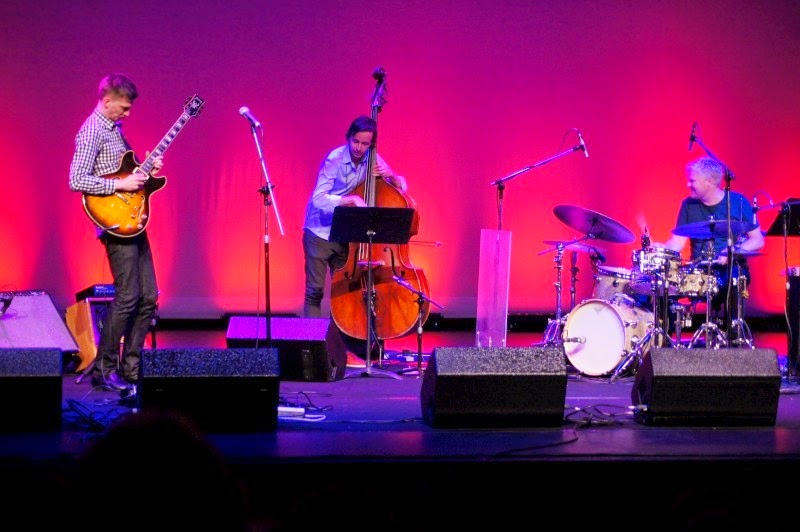
Then some of the senior masters, This World.  Mike Nock, Julien Wilson, Jonathon Zwartz, Hamish Stuart: need I say more?  I'd missed them in Canberra and this was a key reason to attend OWJF.  Not disappointed.  This was glorious playing and hugely understated.  Jonathon floored me at times, seemingly pretty simple, then devastating, quick, expressive, always beautifullly toned.  So too with Julien, easy going and humourous and a powerhouse of casually stated blazing lines that tell stories and lay down phrases and melodies that just feel sweet and totally nice.  That's a great skill.  nothing strained, just right, but at the same time blazingly quick, that is, if needed.  What I particularly interested me was their self-description as a composers' collective, so all provided tunes  which were perused for performance.  Even Hamish, drums, with something that flowed beautifully with a simple melody and expressive rhythms and some unexpected longer bars.  Or Jonathon's dedication to Mike called Winter that started with a breathtaking bass solo (mmm, Jullien commented on someone starting their own tune with their own solo...but Julien was joshing).  But overally, this was all immense earthiness, sincerity, maturity and plain chops.  Fabulous.  Just one other comment is on my mind from Julien.  He was thinking all and the festival and made the comment "Lots of churches in orange ... not many pubs".  It came back to haunt me later that night.  I hope I don't end up missing one band by waking by the pub they were playing in!

For me, festivals have been an opportunity to play or a chance to survey respected, invited participants.  This is turning out to be a survey of the Sydney jazz field, I guess, perhaps with some ring-ins and hopefully an occasional bluesy/rootsy/folky performer who I should know.  I was amused to hear the expression "jazz coma" on a YouTube video to describe that all-embracing commitment to the intellectual and artistic heights which is jazz.  But it can also limit horizons so now I enjoy seeing people with projects that spread over styles.

So I went to Mahalia Barnes.  I know the connection to Jimmy, great singer and honost and outspoken person that he is.  And I have another connection there, too.  Not that anyone knows of it it but me.  So what to expect?  I actually walked in with Hamish Stuart and Jonathan Zwartz.  Mahalia was playing with just piano and apparently they'd offered ot drop in for a rhythm section.  Amusingly, I heard vocals/piano while they were setting up, then a full band.  You'd die for such a band.  For that matter, you'd die for some R7B/Soul/gospel as Mahalia belts out.  Belt can be the word, but that's alsp the role.  Great personality, talking to the audience, getting singalongs on I am woman.  Song favourites from Aretha Franklin, Rene Geyer and others.  She recounted a story of Rene Geyer before she sand her glorious Heading in the right direction.  What an album that was!  The church probably had its greatest attendance in yonks and they walked out singing to themselves.  Not jazz but that gospel exhuberance; fabulous.

This World and Mahalia Barnes played at the inaugural Orange Winter Jazz Festival.  This World comprised Mike Nock (piano), Julien Wilson (tenor), Jonathon Zwartz (bass) and Hamish Stuart (drums).  Mahalia Barnes (vocals) was supported by Clayton Doley (piano); Jonathan Zwartz (bass) and Hamish Stuart (drums) sat in during the set.

04 December 2019

Nothing to prove

Some people have nothing to prove and it's lovely to see and hear them. Mike Nock has earned that position with his long term influence here and overseas. He's joyous, capable, relaxed, knowing and apt in his interpretations. It's easy, never forced, not uncomfortable, but that's not to say it's not challenging, for it often is, or not interesting, for it certainly is. He's playing with younger offsiders these days, as could be expected. He's not so young now, although light of heart. Those offsiders are Brett Hirst and James Waples and they are easily with him, respectful of his lead but also adventurous and virtuosic while understated. All that sounds like a blissful gig and it was. The tunes had a few lesser knowns but featured a string of standards. Bernie McGann appeared in Spirit song. They started with Lady be good and Lollypops and roses and finished on Poinciana, which only became evident as the song itself after some time. Moanin' got in there. A few I didn't know were Golden earrings and Fresh water. He led with a piece that he called Curl that turned out to be a baroque piece of ~1600. I didn't catch the original title, but it sounded eminently modern as they did it. They also merged Summertime with So what and that worked a treat. What I noticed, though, was an immense respect for melody. It seemed to be present throughout his playing and to some degree from the others. It's not the thing of bebop, which takes the chords after using the melody just for a starter. This was more a consideration throughout. That interested me. And he was just a nice, chatty, jokey presence on stage, too. Again, nothing to prove except to play the music and display jazz. Great stuff and a lovely trio.

Mike Nock (piano) played with Brett Hirst (bass) and James Waples (drums) at Smiths.

05 November 2014

Mike and the awards


I caught Mike Nock as a performer but he's also the chair of the judging panel for the National Jazz Awards. The awards were for guitar this year and the judges were Mike with James Muller and Steve Magnusson.

Mike Nock is a senior Sydney figure noted for his support for a new generation. At Wang, his band was called Trio+2, the extra two being younger sit-ins Carl Morgan and Karl Laskowski: younger maybe but not unknown. This was unrushed, well developed modern jazz with a feel of rock grooves, often developing some power, with plenty of space for solo development: Outcast, Brett Hirst's Changeling, Perspectives, even This dude abides (written by Mike to a quip in the movie, The Big Lebowski). The rest of the trio was Brett Hirst and James Waples.

I was at Wang for the last guitar awards, and Carl Morgan, ex-ANU Jazz School and well known locally at the time, was on the shortlist. He didn't make the final that time, but he returned victorious. I only attended the final (given program clashes; I would love to have attended the heats). The final contestants were Hugh Stuckey (Adelaide, now Melbourne), Peter Koopman (NZ, now Sydney) and Carl Morgan (South Coast, as I remember, then Canberra, now Sydney). Carl played last and was a clear winner: confident, communicating, interesting and thrilling. He played Scofield's You bet,m Joe Henderson's Isotope and Coltrane's Naima (in a heavy rock-influenced take that worked). Hugh played first with a clear, traditional sounding guitar. His tunes were You're changed, Schofiled's Don't shoot the messenger and Rollin's Tenor madness. Peter played second, more driving and modern. His tunes were Larry Young Backup, Isfahan form Ellington's Far East suite and Scofield's Loose canon. Backing was from Des White and Ben Vanderwal. It's always a game to pick the winners. I've only listened to the finals a few times but never exactly matched the 1-2-3 order. This is art with subjectivity and personal preferences. Congrats to all; they are all worthy players.

Mike Nock (piano) led his trio with Brett Hirst (bass) and James Waples (drums) with visitors Carl Morgan (guitar) and Karl Laskowski (tenor). The National Jazz Awards 2014 final was for guitar and contended by Carl Morgan, Hugh Stuckey and Peter Koopman with accompaniment by Des White (bass) and Ben Vanderwal (drdums).

08 February 2013

Being there

Mike Nock’s Quintet, his trio with two friends, was an interesting gig. Right from the top it felt like comfortable old times. The lines and melodies and grooves were old family: jazz rock, Miles, Herbie and the like. I could hear the same piano accompaniment. I could feel the mildly mutating rhythm section as it settled behind the front line with a choppy ocean busy-ness. The chords flowed by slowly, perhaps 4 bars to one chord, regularly changing and gently paced, leaving the soloist plenty of time to feel the changes. These were post-hippy times, still gentle and emotionally committed. This feels good to my ears. I think of Buster Williams and some favourite albums. Nick Garbett’s new to the band, smiling, enjoying the outing and playing wonderfully structured solos, a cry, a pause, a volley of falling notes. Miles again, space and notes that crawl against the backing. Karl fills the space more, but does a similar take with falling lines although somewhat more blues infected. Mike is adventurous, taking an idea and extending it over long ranges, or stopping and finding some unexpected and obtuse take on the chords before reimagining lines into contrary scalar movements. There was a blues starting with a bass solo that could have started a Mingus tune and leading into a slow, deep Southern langour. Here, Karl’s solos are all bends and blues and Nick’s are wakeup calls of sudden high staccato and some florid, some languid fills. Then TBA, a bouncy contemporary feel with concurrent solos from the horns and clavinet from Mike. Somewhere, James had taken a solo against a piano/bass phrase. This was all punchy with neat rudiment-induced divisions of the beat and triplets that delay the feel and rolls tat explode into cymbals. Explosive for a jazz solo; Nick smiled some more. The second set started with the band settling into a D minor bass groove and settling into a slow funk for the solos. Slow news day was more story telling, with a floating intro and pensive melody: portraying a lazy news room or perhaps some personal relief at a benign nightly news. Not surprisingly, the first solo was from bass then sax, the softer horn. Last tune of the night was Colours, long with feverish walks and rabid collective improv and slips into free jazz. Nice gig. Mike Nock (piano) led a quintet with Nick Garbett (trumpet), Karl Laskowski (tenor), Brett Hirst (bass) and James Waples (drums).

  • Cyberhalides Jazz Photos by Brian Stewart
  • 17 February 2010

    Mainstream with edge

    I was wondering just what to expect from Mike Nock’s CET (Creative Electronic Trio). They played last night for the first Gods session for 2010 last night. I thought maybe e-bass and several keyboards, but it was a more limited excursion into electronics than that. Mike was playing a Nord, with its identifiable piano sounds and retro synthesisers, and I guess that’s what gave the label Electronic, and there was one funky tune that benefited well from synth bends and the like. But otherwise, it was frequent brushes on the drums and even gut strings on the double bass, so that instrumentation was quite conventional, even traditional. I’ve seen several more electronica-style bands recently, but so what? Mike played a style I love and I enjoyed it immensely. I heard it as a modern, challenging ‘60s performance, playing mostly standards-type tunes (and one funky jazz-rock number), but with verve and excitement and high skills and always challenging and on edge, with some dabbling in electronic timbres and washes. The grunts and facial contortions and singing with solo lines and the sheer exuberance confirmed to me that this was not an easy, relaxed outing, but one that the band played with awful seriousness. As serious as your life, to borrow a famous jazz expression.

    Mike led the band, although with clear respect for his fellow performers. He’s known as generous and supportive and as a mentor for many young musicians in Australia. This trio has been playing together for many years. The ease with which they threw around the decision of what tune to play showed that. They obviously had no formal set list. Their familiarity and informality was evident in Mike’s chats, where he asked the audience about the sound or briefly mentioned his history with a tune. As for playing, you could hear the long experience and skills as he took on a tune, worked over the chords, took ideas and retained them as long sequences through dissonance and back to consonance. Long solos of skill and edgy challenge and essentially pianistic techniques. But with an obvious melodic sense and references to the mainstream history of jazz.

    I felt that Ben responded similarly, with a good solid tone and a strongly melodic conception. After the gig, he told me about a buzz in his bass (it’s an old German bass that suffers from the dry air of Canberra) and explained the gut strings don’t speak as quickly as steel strings. But I still heard long, hammering solos well into the thumb positions, and rapid movements through the fingerboard. And a melodic approach that was embroidered with challenging rhythmic patterns. There was also one fully French-bowed solo with reliable intonation (bowing is far less forgiving of intonation than pizzicato). It was a big role on the night, with frequent and long solos, and a deadly serious look on his face while playing versus an open smile between tunes. Brother James seemed more modest in performance. Openly looking on to Mike and Ben, drums faced in to his colleagues, sideways to the audience. He took a few solos: I especially noticed his last, long solo that was a more funky or rocky style. But mostly I heard softly responsive brushes and sparse, open playing that spoke with the melody. It was open and respectful playing that nonetheless seemed to lead each solo to build in intensity. More evidence of that era of jazz: the solo as the core exploration and purpose.

    They started with an easy blues, House of blue lights by GiGi Gryce, all comfy swing and melodies that oozed over the bar lines. Then Ellington and a melody played unison by piano and bass, and particularly impressively on the bass. Then Cry me a river as a slow waltz and a “burner” in bop style that had some luscious contrary motion and counterpoint on piano that said classical to my ears. Also Armstrong/Fitzgerald tune (I would be friends?), another waltz, a funky original, and a few others.

    It was a wonderfully intense study of modern mainstream jazz as I heard it, and I enjoyed it immensely: on edge, and challenging for both audience and performers. Hot. Mike Nock’s CET (Creative Electronic Trio) featured Mike Nock (piano) with brothers Ben Waples (bass) and James Waples (drums).

    03 November 2009

    Tolliver (Wangaratta 2009)

    Charles Tolliver is not a household name in jazz, but he’s a living connection to a great era of hard bop from the sixties, having played in small and larger ensembles with the likes of Jackie McLean and Max Roach. I’d heard a few albums of his, and enjoyed the infectious tunes and lively playing in the smaller bands, and the outspoken energy and thrills of the larger formats. Charles led the Jazzgroove Mothership Orchestra for two concerts of his music, then a small band for a final performance.

    The big band concerts were brash and loud and exciting, as they should be. Charles presents quite a forceful personality as a leader, with incisive gestures and clear indications. The horns responded well and played admirably in ensemble. Charles likes the effect of high trumpet notes, so these were not easy charts. I found Evan Mannell a powerhouse on drums, playing wonderfully apt fills and pushing the energy levels. This music demands commitment and lively outlandish involvement, and Evan fitted the bill perfectly, even at the second performance which was early Saturday when he seemed a little the worse for the previous evening’s wear. I felt the piano and guitar were too cool and didn’t really work in this context. I couldn’t hear the bass. The horns seemed to be working hard on the solos, but the mix was such that we missed the effort, at least on the first night. It was better on the Saturday morning. So these were two worthy gigs, although with some problems for me.

    Charles played a small ensemble set for his third performance. It was as much a blow as a performance. It wasn’t a particularly well rehearsed outfit and the charts were Tolliver originals but they were good musicians and they carried it off perfectly well. Charles again led the band with instructions all round, especially to drummer Tommy Crane who normally plays a more fluid, coloured style than hard-bop. Linda Oh blew everyone away with wonderful solos and eminent concentration, but eventually relaxed and had some chuckles with Charles. Mike Nock gave a modern, modal twist to the performance. It was outside the tradition, but it fitted well and was a revelation. I remembered several charts from Paper man, a small band album Charles recorded in 1968 with Herbie Hancock, Ron Carter, Gary Bartz and Joe Chambers. Charles is not in his earliest days, and there was some struggling on the fast lines, but the performance still lifted the room and thrilled. These are certainly infectious tunes.

    Charles Tolliver is a real link to hard bop in its prime, and was a pleasure to hear in the flesh. Charles Tolliver (trumpet) led the Jazzgroove Mothership Orchestra in two performances. He also led a small band with Mike Nock (piano), Linda Oh (bass) and Tommy Crane (drums).

    Pleasures (Wangaratta 2009)

    There are pleasures that are unexpected at a festival. You may know a renowned name, but you don’t know what to expect. Even when you do know what to expect, it’s just the right thing for the right time, and so a thing of pleasure. These were my unexpected pleasures.

    The Carsten Daerr Trio was a surprise for everyone. Carsten leads a piano trio in a new German jazz. I laughed when I read the writeup that said Carsten can read between the 88 keys. But seriously, this was an interesting modern band, playing rock and jazz rhythms, sometimes bordering on ambient, sometimes heavy 4/4 or 3/4 with busy snare rudiments and crossed rhythms and capable bass solos. And some oddities including little gongs and a pair of melodians. But they were enchanting and delightful in a way that serious Australian bands aren’t. These guys were obviously tickled pink to be touring. They smiled and joked and played on their lack of English (better than my German, of course), and brought the house down. Lovely to see such joy. Here’s an example. “You’ve heard us now, so there’s no need to buy the CD … but we played the wrong notes here … we picked them [so you should buy the CD]”. It doesn’t work in print quite the same, but believe me, they were treated as stars. Some good entertainment and personality goes a long way, even in a serious form like jazz.

    I knew what to expect from Kristin Berardi, but it still surprised me as fresh and honest and individual and wonderfully swinging amongst the heavier or freer sounds around. The delight of good swing struck me like a mallet. Kristen is wonderfully mobile with her voice, but also her songs tell of personal stories. I often wonder what it takes for a singer to share such intimate thoughts: her meeting with old Mr Johnson, the eyes of her baby son, the story of when she was dumped at University. But it was not just Kristen. She had a wonderful rhythm section and soloists with relaxation but class: James Sherlock, Mike Nock, Tim Firth, David Theak and some lovely duets: bass/vocal and guitar/vocal. This was invigorating and fresh swing, and reminded me of this staple of the jazz form.

    Ish Ish was a discovery to me. I’d heard the name, and knew the player’s names, but not the sound. And it was blissful! Bass, drums, and a horn front line of trumpet, tenor and trombone; no chordal instrument. They played wonderful solos and grooves, but the standout was the supporting horns. Melodies with accurately intoned three part harmony or unison lines. Then a solo from one or other of the horns, and sharp snaps or counterpoint lines contrasting the solo and building with its intensity. There was a humour amongst the players, but a deadly serious musicality, which is a disarming combination. A big band in 5-piece guise, and alive with vigour and anticipation. I wished there was more. Loved it.

    Carsten Daerr (piano) led a trio with Oliver Portratz (bass) and Eric Schaeffer (drums). Kristin Berardi (vocals) led a sextet with Mike Nock (piano), James Sherlock (guitar), David Theak (sax), Alex Boneham (bass) and Tim Firth (drums). Ish Ish was Eugene Ball (trumpet), Jordan Murray (trombone), Julien Wilson (tenor), Mark Shepherd (bass) and Ronny Ferella (drums).