Showing posts with label Carl Morgan. Show all posts

23 December 2023

Women and men

We'll I don't warm to identity arguments.  The second wave feminism that I easily supported fifty years ago was a claim to equal treatment where it was missing, like women being required to leave some employment on marriage and pay that was different for the same job, and it was a recovery of the first wave with its trivially obvious demand for the vote and the like, but listening to Matilda Abraham I feel that intense comprehension and response to personal matters and I recognise it often enough from women and I wonder where I hear it from men.  Maybe it's there and I don't come across it.  It's certainly not in my rants (as Megan calls them!) as The Pots.  She was at Matilda too and admired it and just said people are different.  There's strength in that openness to people and experience without too much ideology.  Whatever, I admire Matilda's awareness and I was entranced to catch the emotionally charged lyrics.  The backing was pretty minimal, just simple piano accompaniment (apparently her first piano accompanied solo gig) and sometimes an aged drum machine (amusingly recovered from her Dad's shed) with very simple grooves.  The complexity was in the truth of the lyrics and at least one that I noticed with an intricate melody of divergent intervals and comfortable leading notes and assorted note lengths.  That one was Tender lament and its melody was a stunner.  She played a few covers, too, form Minnie Ripperton and Sade and even Kylie, but Matilda's presence remained central.  Matilda was playing for family and friends on a late-announced Smiths gig so it was an intimate gathering, coming from Berlin with Carl and young Abe for Christmas.  Carl sat in for the final number with a devastating solo.  What with a family and this musical prowess all round, Berlin must be doing them good.  It would.  It's renowned and I'm not surprised.  Check out Matilda's string of songs, EPs and an album on the streaming sites.

Matilda Abraham (keys, vocals, compositions) performed at Smiths.  Carl Morgan (guitar) sat in for the final tune.

24 April 2022

Do

There are various thoughts I have with our Smiths visit by Matilda and Carl.  It's a return from Berlin, so international, probably somewhat delayed by Covid.  And a tour from throughout Australia, with input from Sydney and Perth.  It's a blast from the past, as I remember Carl and Matilda as students here at the ANU.  It puts a local and informal tinge on a devastating concert.  The immense skills but also the careful expression of them, so nothing seemed showy even as it was virtuosic.  I got taken aback or just amused by some overwhelming fills or licks from Carl or Hugh or that kick-heavy thump with complexity but inevitability from Ben.  And the wonderful richness of jazz applied to emotionally-rich lyrics from Matilda's first set, and even the raunchy and one somewhat comical expletive-laden rant (humour with a cutting edge, think Carl even if Matilda sang).  That last is one for an E-symbol in Spotify.  Hard to miss!  But I dearly love this interplay of pop and jazz with the breathtaking jazz-informed solos and the words to spread further, to speak to a newer listening cohort.  I remain in awe the next morning.  Just breathtaking.

Matilda Abraham (vocals, midi) led one set with Carl Morgan (guitar, bass, vocals), Hugh Barrett (keys, synth bass) and Ben Vanderwal  (drums, midi, vocals) at Smiths.  Carl led the second set with the same players as Dodo.


19 January 2020

Great players on a great day


I caught Trio Klein Ahnung in Sydney, at Lazy Bones in Marrickville after missing their gig at Molly's in Canberra. They were a fabulously modern, lithe, expressive band, understated at times, explosive at others, all powerful musicians in their own rights but all ready to lay low when the music called. I chatted after the gig with some of the Canberra contingent, now mostly out of town, in Sydney or even as far off as Berlin. Brian Blade and ambience were mentioned as similar or stylistically influential. Yes, but. Carl is so strong and, being the guitar, the front liner in a guitar trio and he was the patter of the band on stage. I heard current Manhattan guitar but wasn't sure which one. A quick survey identified Kurt Rosenwinkel as the closest to my ear. Strong and defined notes, devastating runs, softly overdriven with some reverb or echo or both (my guess). Sam was at his expressive best, often understated, hugely expressive in lines and just nicely explosive with his own devastating runs, just sometimes. Raj was hugely understated, soft and delicate, taking just a few solos, demanding us to listen carefully to follow his delicacy. They were releasing a CD on this tour with some tracks including Sean Wayland. So this is Aussies in the world: NYC, Berlin and home. Suffice to say I was enamoured by the gig in Marrickville. They played tunes from the album but also a few standards: How deep the ocean and Without a song. I tried to count How deep... at Marrickville but failed. I noted "oddly timed", thinking they'd changed time signatures from the swung 4/4. So what a surprise when I saw a video of this same tune from the Molly gig and hearing it as a clear four. My guess is this was time implied, held in the musicians' minds but far from clearly stated, rather than formally rewritten passages. I feel it in our trio at its best, usually when we're playing pretty frequently. Time dissolves but doesn't: it's there but not evident; ready to resolve occasionally. What appeared as time rehashed was an improvised interaction. Wonderful, exemplary and a statement of the contemporary in jazz. At least to my ears. (Carl, have I got it right?) So, a great gig at a lovely, dark, seductive venue (worth a visit for the design ambience alone). Thankfully, I didn't miss this one. BTW, klein ahnung translates as "little idea".

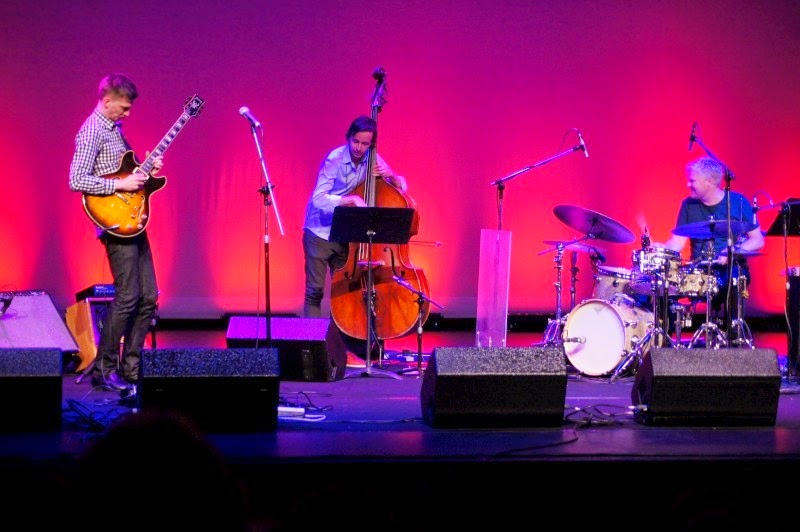
Trio Klein Ahnung are Carl Morgan (guitar), Sam Anning (bass) and Rajiv Jayaweera (drums). They performed at Lazy Bones, Marrickville (and Molly's) while touring their new album.

29 July 2018

Milano and more


Eamon Dilworth led his band in the new, larger room at Smiths. It's a good room. The music was good, too. I was thinking of Smalls in NYC and when I visited and when I watch on their video stream. No way this would have been any lesser. The room was great and just in its early days. The compositions, the playing, the authenticity were first class. I could hear that strain of NYC guitar in Carl's driven lines and Hugh was relentless and Mark only met Eamon that day but sat in easily as sideman and Hannah laying solid lines while absorbed with ceiling tiles and Eamon himself having written most of the music, clean and purposeful in composition and performance. He introduced his new album, Viata (=life, Romanian), speaking of purpose in music, relevance not mere cleverness. There's a maturity in his purpose even if joviality in presentation. Nice guy, Eamon, and easy on the mic between tunes. I could hear Miles often enough with his 70s jazz rock grooves, but also odd times and neat melody and written accompaniments, like Hannah's in Milano, a record of his year spent in Italy, or Carl's unisons on melodies. This was seriously satisfying music, wonderfully played, well written, with raison d'etre. I've talked of good music and musicians being everywhere and this night was just confirmation Great gig, intimate and capable and with purpose. A blow out.

And walking out, past PJ O'Reilly's, what did I see? Aron Lyon and mates playing an R+B jam session. It's a different world but it's fun; few chords but deep funky grooves. And Rachael Thoms singing made for a fabulous front line. I've since discoverd the Thurs eve R+B jam sessions as PJ O'Reilly's and some new names to listen to (Allen Stone and, of course, Pino Palladino) and an opportunity for some seriously funky grooves.

Eamon Dilworth (trumpet) led his (Canberra) band comprising Hugh Barrett (piano), Carl Morgan (guitar), Hannah James (bass) and Mark Sutton (drums) at Smiths. He was on tour to launch his new album, Viata.

21 December 2015

Enabling the indie song


These guys are all jazz trained but I had no expectation to hear Jazz. That's how things are these days. I like it like that. There's a catholicity in music and especially amongst young trained jazzers and it shows. This was Matilda Abraham with Carl Morgan and, at the last moment, as he was in town from Berlin and his other gig was called off, Aidan Lowe. I also like this like that. Jazz trained performers are, well, trained, so Aidan could get called in to do an indie-pop set with complex written syncopations, some of which he'd have to introduce, and do a perfectly capable job. But this was Matilda's show. They were mainly her originals, in a Triple-J style that I call indie or maybe experimental pop. This was underlying sequenced instrumentation and even harmonies with voice and additional keys and bass or guitar and drums overlaid for the immediacy that make live music live. Matilda's writing is personal, often venting emotions, clear in intent although I didn't catch all the lyrics. One told of annoyance after a bad party; another a feminist line against Abbott as Minister for Women; (aside: Abbott's gone so recently but I can hardly frame the ignorance of slogans and attacks on the weak that he represented - and his complete lack of self-awareness suggested by his recent claims to good government; a dangerous man beyond an idiotic manliness); another feminist song entitled Fill the sink; an intimate love song to a Monk tune (I wonder how singers can so expose themselves through the intimacy of love songs). There were some more complex tunes, some covers - The Bird and the Bee Lifespan of a fly, Nate Wood Ocean floor, Julia Holtor When the sea calls me home (nice line this: "I can't swim, it's lucidity / so clear"). There's both an evenness and honesty in the music that Matilda writes and also in the covers she selects. There were odd times and odd beats and time changes and even a few slowish disco grooves. There was some great playing in accompaniment and just one solo each from Carl and Tom Fell, who sat in for a fat bluesy solo on the final tune. Both solos were beautifully stated, superbly developed and neatly released at the end. Aidan was just stunning to take on just a task at such short notice. And Matilda spoke to us with truth and purpose and some great song-making and an even, clear voice. A poorly tuned piano was a disappointment, but she soldiered through this. I'm enamoured by the moves of well trained jazzers into popular fields, with indie like this the most authentic. This was short songs of the 3 minute variety with intelligence and purpose and deeply attractive beats and some refreshingly twisted melodies. I may stick to RN and BBC for my radio but I loved this live.

Matilda Abraham (voice, piano, compositions) led a trio with Carl Morgan (guitar, bass, keyboard bass) and Aidan Lowe (drums) at the Ainslie Arts Centre for the Confluence jazz series. Tom Fell (tenor) sat in for a solo on the final tune. BTW, Confluence Jazz returns in 2016 monthly from 14 January.

05 November 2014

Mike and the awards


I caught Mike Nock as a performer but he's also the chair of the judging panel for the National Jazz Awards. The awards were for guitar this year and the judges were Mike with James Muller and Steve Magnusson.

Mike Nock is a senior Sydney figure noted for his support for a new generation. At Wang, his band was called Trio+2, the extra two being younger sit-ins Carl Morgan and Karl Laskowski: younger maybe but not unknown. This was unrushed, well developed modern jazz with a feel of rock grooves, often developing some power, with plenty of space for solo development: Outcast, Brett Hirst's Changeling, Perspectives, even This dude abides (written by Mike to a quip in the movie, The Big Lebowski). The rest of the trio was Brett Hirst and James Waples.

I was at Wang for the last guitar awards, and Carl Morgan, ex-ANU Jazz School and well known locally at the time, was on the shortlist. He didn't make the final that time, but he returned victorious. I only attended the final (given program clashes; I would love to have attended the heats). The final contestants were Hugh Stuckey (Adelaide, now Melbourne), Peter Koopman (NZ, now Sydney) and Carl Morgan (South Coast, as I remember, then Canberra, now Sydney). Carl played last and was a clear winner: confident, communicating, interesting and thrilling. He played Scofield's You bet,m Joe Henderson's Isotope and Coltrane's Naima (in a heavy rock-influenced take that worked). Hugh played first with a clear, traditional sounding guitar. His tunes were You're changed, Schofiled's Don't shoot the messenger and Rollin's Tenor madness. Peter played second, more driving and modern. His tunes were Larry Young Backup, Isfahan form Ellington's Far East suite and Scofield's Loose canon. Backing was from Des White and Ben Vanderwal. It's always a game to pick the winners. I've only listened to the finals a few times but never exactly matched the 1-2-3 order. This is art with subjectivity and personal preferences. Congrats to all; they are all worthy players.

Mike Nock (piano) led his trio with Brett Hirst (bass) and James Waples (drums) with visitors Carl Morgan (guitar) and Karl Laskowski (tenor). The National Jazz Awards 2014 final was for guitar and contended by Carl Morgan, Hugh Stuckey and Peter Koopman with accompaniment by Des White (bass) and Ben Vanderwal (drdums).

01 February 2014

Not the nine-o'clock news

It's an eclectic scene at Smith's. Thursday night is jazz night but even that's indeterminate or a malleable definition. Mixes in musics is a good and (post-) modern thing and musical styles all have common elements anyway, but you can strike the unexpected. This night was that way. Two acts: Carl Morgan / Matilda Abraham and Kerbside Collection.

Firstly Matilda and Carl. They visited from Sydney. Both are well known and respected locally but it seems the audience was more family than the jazz crowd. That's nice. I like these family events. (I discovered that even I had a distant family-ish connection). So this was personal, less performed, more intimate. The music was a duo format with sequencing. More JJJ than DigJazz, but informed by their jazz training, so clever, rich and complex. No hot solos from Carl in this incarnation. He mostly played chordal accompaniment to synth basses and washes and organ tones. There was little percussion here. It was only later in the set I realised there were no drums, and I wondered if I'd heard any earlier. (Listening back to the recordings, 2 of 7 had distinct percussion/drum lines). So this was floating music with occasional choppy grooves. Matilda sang Bjork and Lewis Cole and but mostly her own songs with themes like the excitement of new love, physical entropy and life metaphors and female companionships, so worthy of a listen. These meaningful, if electronically presented, messages remind me of '60 folk authenticity and recent singer-songwriter indie artists, but with that much modernised underlying sound. I particularly liked Matilda's voice on a more poppy tune where she sang firmer and stronger, but the night was mostly less emphatic tones. A fascinating duo set indicating an alternative indie path for this pair. Looking forward to my sons discovering them on JJJ.

The family cleared out, the people of the street and the chatter arrived, Kerbside Collection took to stage. KC were a guitar trio (they seem to also play with organ as a quartet) from Brisbane with some jazz background. I only managed the first set, so I missed their funkier incarnation. This jazz set was touched by tradition. The repertoire was there - Summertime, Blues for Alice, Coltrane's Impressions - but this music was very reformulated in their style. That's good. I heard arrangement, solid and unrelenting bass (apparently with an authentic 1963 Hofner Beatles bass), steady and authoritative drums, and guitar and solos. I heard rimshots on 1-3 and rock and funk feels and a touch of Afro influence. Essentially this was a rock-funk guitar trio with danceable, reliable steadiness. Entertaining, tight, ordered and with solos but without the all-in improvised complexity of the jazz world.

Matilda Abraham (voice, sequencing) and Carl Morgan (guitar, sequencing) played the first set and Kerbside Collection played the next two sets at Smiths.

08 September 2012

One woman’s songs

I asked Matilda Abraham about her songwriting after the gig. The words and concerns impressed but didn’t surprise me. Matilda’s a mature woman and her interests are those of a mature woman. But I was impressed by the rich complexity of the music. She told me she plays some piano and some guitar chords, and songs start with melody and sometimes with chords. I thought maybe I heard the source in a few bits of her wordless singing or improvisations. They were not scatting in an Ella-sense. The Jazz School commonly used voices (I find I’m already writing in the past tense about the Jazz School) as instruments in larger ensembles, singing with the horns, usually trumpets as I remember. This must impart a sense of instrumental jazz melody and harmonic awareness and I think it this I heard here. It’s melody that’s interesting in phrasing and in intervals. It’s a powerful mix when you include the strength of ideas that words impart. The words weren’t always so easy to catch. Martin was about idealism in relationships. Reubens was inspired by renowned guitarist Kurt Rosenwinkel and was interesting for its intimacy and also for Carl’s guitar which sounded markedly different from earlier tunes on the night: more legato but also more insistent and impatient. There were quite a few other originals: Enough; Entropy, in slow ¾; Breath of warm air; Are you on my side; Keeping up; another in 7/4, interestingly split as 5-2. She sang a few covers, too: Monk’s Reflections, with words she wrote about love and distance; a duo with Carl called Cloud flies (“Do you sit in your office cubicle / Thinking about how life is beautiful”) which ably cut a line at office work; Beyoncé (“You are my temporary high / Sweet dream or a beautiful nightmare / I don’t want to wake from you”); Bjork’s Virus (“Like a virus / Patient hunter / I’m waiting for you / Hunting for you”). These were interesting songs performed in Matilda’s style and voice, which I heard as a firm soprano, high and delicate at times, then dropping to a sure-footed middle register, not flashy but ably dealing both with complex intervallic compositions and sharing a message.

Matilda had a nice little band, too. I know Carl well and he was exciting and lifting as expected. His tone is often chopped but he also played legato for some tunes, more driven and sustained. Either way, his solos lines and structural development are thrilling as he swings from low to high registers in a blink, and I guess it’s pentatonics that give him those essential guitar lines. It’s here I noticed drummer James lifting in busyness and intensity. He’s richly embroidered and assertive on the skins anyway, but the accented snare became snappier and the rolling fills tighter in response to Carl’s solos. Pianist Henry had a different manner. I found his playing obtuse, unexpected, adventurous, cerebral rather than combustible, as he invented responses that flowed one to another and yet departed easily and distantly from the tune. This was more dramatic, rolling, mutating full-handed chords than single note playing, but playing the orchestra is the piano’s forte. Tom was the essential bassist: clear, Velvet toned; carefully selected and formed notes; precise time; ears.

The gig could have done with a decent mix (vocals and PA make much more demand on the mix) but the playing and the writing were both very satisfying and the band’s presence was easy but serious. It’s a pleasure to watch players move through the Jazz School and return as mature performers, and this was one such gig. Too bad there won’t be many more. Matilda Abraham (vocals) led a quintet with Carl Morgan (guitar), Henry Sutherland (piano), Thomas Botting (bass) and James Waples (drums).

25 April 2012

Walking bass(less)

There was no bass but I think I heard more walking bass at Eamon Dilworth’s gig at the Loft than I’ve heard in some time. I sometimes think swing is almost becoming a lost art in modern jazz but Eamon and his mates obviously enjoy it and so do I. This was a lovely little concert.

Some hot playing, some organ grooves with those muffled organ bass lines, post-bop trumpet and clear guitar and driving ride defined it for me. That’s not to say this was out of time. Carl’s guitar was crisp and clean in the ’50s style, but his lines were long and tortuous and spanned some impressive ranges. I was wondering how he builds his lines. I thought perhaps on fourths in one tune, but another had clear thirds. Eamon was more scalar in a recognisable post-bop style, so a Kenny Wheeler tune to end the night was not out of place. Steve’s organ was perhaps the defining sound. An organ-based band is unique in presentation and sound: soft and malleable but nevertheless hard swinging. It’s a busy job for the organist, thinking left hand walks and right hand solos or choppy C3 accompaniment. Steve did it with aplomb and also joy, which is fitting, because it is a carefree sound. I heard his solos as more bluesy, against more delightfully contorted yet tonal solos of Carl. And I enjoyed Carl’s comping: modal, busy and wonderfully colourful. And what of drums. James (aka ‘Pug’: I must ask him about that sometime) swung with a very promiment and heavily syncopated kick drum and sharp and precise rolls and rudiments. Nicely fitting for this style, with several generous solos and swapped eights and fours. It’s an old custom but was perfectly apt in this context. This was swinging, lively, joyous music with space for individual solos statements. Old-school but there were also several more worldy tunes. Not so much swing but not out of place. These were originals by Eamon, dedications after a year in Europe and in context of good times and friendships. It’s not surprising that this swinging goodwill continues into his originals. From Bucharest with love switched from a lengthy mutating quarter note arpeggio intro in 4/4 to melody and solos in 5/4 with a funky 3-2 groove then back to the 4/4 as outro. Vienna was a slow, airy jazz tune. Milano was a more modern, funky 8-feel which fits the city of famed and capricious architecture. But you can’t keep a swinger down so one original was a straightahead swing, a university exercise called Starting point. The rest of the repertoire comprised a few less common standards, I love you and East of the sun west of the moon, and an end on post-bop heaven, Kenny Barron’s Voyage. What a lively, joyous and skilled concert. I revelled in it and left with a smile on my face, as you should.

Eamon Dilworth (trumpet) led a quartet with Carl Morgan (guitar), Steve Barry (organ) and James ‘Pug’ Waples (drums) at the Loft.

20 April 2011

Carl's back

Carl Morgan and his band returned to Canberra and the Loft last night for a reiteration of their gig of last November. I’ve just reread that writeup and it’s mostly relevant to this gig with its very complex, rhythmically varied pieces. Like the sweeping melodies of five note runs that mutated in minimalist style as they crossed triplets in 15/8 bars. All that with written bass lines that were richly syncopated, sometimes sounded in unison by a piano left hand that was otherwise playing charted voicings. This is not easy music to write or to perform and it’s no surprise that the repertoire was much the same as the last visit. There’s a lot of detail here and presumably development over time. I certainly overheard Mike saying he needed to do more work on one, and it was already pretty well scripted.

But the feel of the band was hotter this time. Partly because they were on tour. Partly because they are readying for a recording over Easter. But I think mostly because they were playing with master drummer Ben Vanderwal. Ben is a fabulously strong player in many styles. In this case, he was nuclear-powered (what a coincidence: Carl’s Jazz school nickname was Nuke), reading charts but also energising them with hard and fast playing that was nonetheless subtle. I’d heard some of those drum effects on record, but this was an eye-opener. I particularly noticed rolling fills across the set that were so smooth and must have taken much practice to perfect. This was easy technique with purpose and endless power.

The others are no slouches, of course. I heard more of pianist Steve Barry this time. He did plenty of rhythmic accompaniment but that tended to get lost a little amongst drums and amplifiers. But his solos were clearer: lovely exploratory and angular outings in a bop style of right hand solo and left hand chords with a modern sensibility of disjunction and freedom across barlines. Carl was the same. I thought his guitar could have screamed more in the first set (old rock habits die hard), but the second set was louder and the tone was fuller and more sustained. I caught a few glitches but I love the way he plays with melodies that say hectic big-city. Mike was more boppy to my ears, running chords in more scalar style, but again easy and fluent. Alex was fabulous, bent over his bass, syncopating like hell and sitting nice octave fills into a line to hold the band together. He was chatting with audience after the gig and said how he gets simpler when things go out and how he sees his main tasks as to play the tonic and elucidate rhythms with drums and piano.

This was a great night of sophisticated jazz well on the road to virtuosity. A stunner. Carl Morgan (guitar) played challenging original compositions with Mike Rivett (tenor sax), Steve Barry (piano), Alex Boneham (bass) and Ben Vanderwal (drums). Keep an eye on Carl’s site for the CD.