Showing posts with label Kompactus. Show all posts

01 December 2025

A calendar and more

Kompactus performed a 1.25 hour work in 24 parts with huge complexity and obviously considerable emotional depth at Wesley.  I got to record it and the quiet passages were almost inaudible and the loud passages forthright and often dissonant and there were even passages where the audience was invited to take part by following repeated lines from the choir.  The lines give away the quiet desperation of the piece and involve the public in the hopeful response: "Let us believe in the resurrection fo the Earth", "Is it impossible to plant change?", "How can we let it all slip through our fingers?", How can we believe these dayes will end?", perhaps one or two others. There's a quiet religiosity to the text, too, and an inverted year of summer and winter which shows this a northern hemisphere and I look later, southern California.  The work was Dale Trumbore A calendar of light with libretto by Barbara Crooker.  Not sure if it's been performed before locally, but it was a challenge, with dynamics aplenty, very edging harmonies in at least a standard 4 parts, perhaps more.  But Kompactus with Olivia were up to it.  This was a totally convincing performance and deeply touching, somewhat beyond the expectations of just a choral work.  This comes from composers with current relevance and this has that in spades.  Just fabulous that Kompactus would take it on, and they did it worthy justice.

Kompactus Youth Choir performed Dale Trumbore A calendar of light at Wesley under Olivia Swift (MD, conductor).

09 December 2024

Many happy returns


It was just a few weeks ago that I'd heard Kompactus at a Wesley Wednesday lunchtime session.  It was obviously a prep for their end-of-year concert, also at Wesley, but seeing it again was no loss.  I'd been entranced the first time enjoyed it massively again.  The one main difference was the accompaniment - this time: there was none.  I prefer a choir singing a capella, so no issue there.  There were one or two additions to the repertoire, six Joshua Shank Colour madrigals rather than two, an original by chorister Jesse Hill, a second tune by MD Olivia Swift, maybe one or two other changes.  And I've written similar comments in my notes, strong and certain dynamics, washes of harmonic colour, interweaving lines and the like.  I was amused that Olivia had checked the technical correctness of one song, Comet, with the resident astrophysicist and was fascinated by the melding of Eric Whitaker Sleep with Olivia Swift Sleepless.  It worked a treat.  Enough to say I enjoyed this one immensely like the last.  What a lovely and capable choir.

Kompactus Youth Choir performed at Wesley under MD Olivia Swift (conductor).

22 November 2024

Wed 1

Wednesdays is a regular recording outing at Wesley lunchtimes and the performance this week was Kompactus, our local notable Youth Choir.  From the first notes I was entranced.  Firstly, because the human voice is a glorious, intimate thing and probably the best instrument of them all, at least to us humans.  But also because this is a very sophisticated and hugely capable choir led by a friendly but committed MD.  The music stunned from the start with complex chords of rich colours and demanding intervals and various pitches.  And the precise dynamics from good listeners aware of the unity of the whole.  And a large range of pitch, deep presences through to ecstatic and extended soprano highs.  And the moves of singers between tunes that highlighted the stereo spread, perhaps individuals of one section singing left or right.   And just the fact this was so alive, gentle, delicate, precise.  And those fascinating compositions from Australia and Finland and Malaysia and the inenvitable Eric Whitacre.  And one song from Olivia Swift, MD and conductor.  And a final encore from Tracy Wong with a jazzier feel and an accompaniment of odd syncopations of foot taps, finger clicks, leg slaps, claps, shouts, unexpected triplets and perhaps more.  Intriguing and satisfying and really lovely.

Kompactus Youth Choir performed at Wesley under Olivia Swift (conductor, musical director).

21 July 2024

Long time coming

Funny to drive for 2 days to attend and record a concert but that's what I just did.  I'd been in Adelaide visiting family and other than the rain, the 2-day trip was pretty comfy.  The concert was Kompactus Youth Choir celebrating their 15th anniversary at Wesley.  The first  numbers were by the current youth choir under MD and conductor Olivia Swift and the last 5 tunes included older alumni and variously  David Yardley, once Kompactus MD, and Olivia conducting.  Olivia also provided two songs, David one, and Kompactus  alumnus Patrick Baker another.  It was hard not to notice how varied were the songs presented, as well as how challenging and well performed.  This was seriously satisfying a cappella singing.  Olivia was beautifully in control of a choir that responded with delicacy and care and joy at times.  Especially for a few amusing pieces, like time with its tongue clicks for clock beats and I'm a train with all manner of trainy noises and of course a more complex take of the well known What shall we do with the drunken sailor.  There was a song on Turing which referenced his sexuality and well as thinking machines, and a song that was all the world like an instrumental, with foot taps and thumb clicks (Olivia called it body percussion) laying down a groove and singing providing a synth-like overlay.  And the two tunes by Olivia, something touching and complex called Soldier's grave, and another on creativity from hard work called Sleepless.  Interestingly, the lyrics for many tunes were poems; I guess that's the/a way in many choral works.  David Yardley led an early Kompactus tune called Butterfly, on the short life of the animal, and one of his original musical overlays for mediaeval lyrics missing music, A doomsday we schull ysee.  Then something that seems local, Rachel by Idea of North singer Trish Delaney-Brown, which seemed to be a call to Rachel, slow and pensive, then another amusing number called How to reach the Sun which detailed paper folding kites ultimately to the distance of the Sun (?!?), I think, and a final contemporary madrigal, Orange from Mounts of more soft ascent.  The tunes and lyrics were from all manner of countries and local and from some Kompacti.  The singing was dreamily good or amusingly playful.  I went away realising how much I love the human voice, at least when well done like this.  OK not perfect, but so bloody good.  So glad too that I could record this and worthy of the 12-hour drive to the gig.

Kompactus Youth Choir and Kompactus alumni celebrated the Kompactus 15th anniversary with a concert at Wesley.  Olivia Swift (musical director) and David Yardley (past musical director) conducted and Patrick Baker (alumnus), Olivia Swift, David Yardley and many others provided the compositions.

29 October 2013

In their many shoes


Sally Whitwell talks of keeping classical music friendly and she certainly did this at her concert at All Saints. That’s not to say there’s not considerable weight to the presentation. It was friendly and chatty but also political and social. Its title was In her shoes : music by women composers. Sally performed with Soprano Nadia Piave and Kompactus choir to present her own compositions and others by a range form Hildegard von Bingen through to contemporary women. These were mostly songs, often putting poems to music, so there was also a clearer message to much of the music (as against the abstraction of instrumental music). Not that I caught too many lyrics., of even concentrated on them. Classical sopranos are not so easy to understand and the best of times, despite their musical beauty and intensity.

Sally and Nadia started with an unexpected intro of stomping, clapping and singing the theme: “Before you judge a woman, walk a mile in her shoes. After that, who cares? She’s a mile away and you’ve got her shoes” / Bill Connolly freely adapted in the manner of Percy Grainer by Sally Whitwell. I’m still mulling over that one. It’s a strangely chosen intro, especially with the lost shoes, but intriguing and humourous. I was entranced from this start. Then some weirdly apt cowboy songs by Libby Larsen and some posme put to song by Sally. Christina Rosetti is a favourite poet of Sally’s and she reappeared through the concert. Then Cecile Chaminade, a composer of 1890s, Salon-era France, with a reference to her favourite sweets. Both Sally and Nadia informed us of composers and histories leavened with references to the cakes and afternoon tea which was to follow. You might see this as feminine, not at all in a demeaning way, but as inviting, nourishing, personal and life-sustaining, and with a touch of girls’ humour. For me, it’s a visit to a female world, but easy and inviting. [Strangely, at dinner that night, our middle aged female companions were joking of SWALK (and its MONA incarnation), something I know nothing of. SWALK = Sealed With A Loving Kiss. Apparently young girls, in the days of paper and stamps, would seal letters with heavily lipsticked lips, thus SWALK. New both to me and my son’s girlfiend, she of the email era.] Then an improvisation on Hildegard von Bingen and several piano solo pieces by Miriam Hyde, Cecile Chaminade and Lisa Cheney. Three of five songs by Margaret Sutherland, several more poems from Sally, and a strangely mythical story about women changing to seals, called Seal man, by Rebecca Clarke. I didn’t catch the full story but this was intriguing. Then an end with three tunes by Sally, performed with the Kompactus choir and the last including Nadia. I particularly enjoyed Miriam Hyde’s Forest stream, although it was one of the more traditional pieces. I liked the delicacy of the poetry although I seldom tried to fathom the words. I enjoyed Nadia’s strength of voice and theatrical presence and Sally’s capable but unpretentious accompaniment. I was impressed by the delicacy and precision of Kompactus and I was very satisfied by the range of compositions by the women presented. Women don’t have a large place in the repertoire, and I guess there are historical reasons for this, but they can no longerbe allowed to stand. These tunes and songs easily deserved this outing and more. Sally returns in a few weeks for the next Shoe session, this time with cello.

Sally Whitwell (piano, compositions) presented a program of compositions by women with Nadia Piave (soprano) and the Kompactus choir at All Saints.

24 June 2013

Triumphs of the blessed


I was going to take this quote from Handel’s Theodora, “Pity suing / Mercy wooing” but Triumphs… seemed to fit. When I checked the libretto I found it’s actually “Triumph o’er her boasted chastity” but I’ll use Triumphs … anyway. I like it.

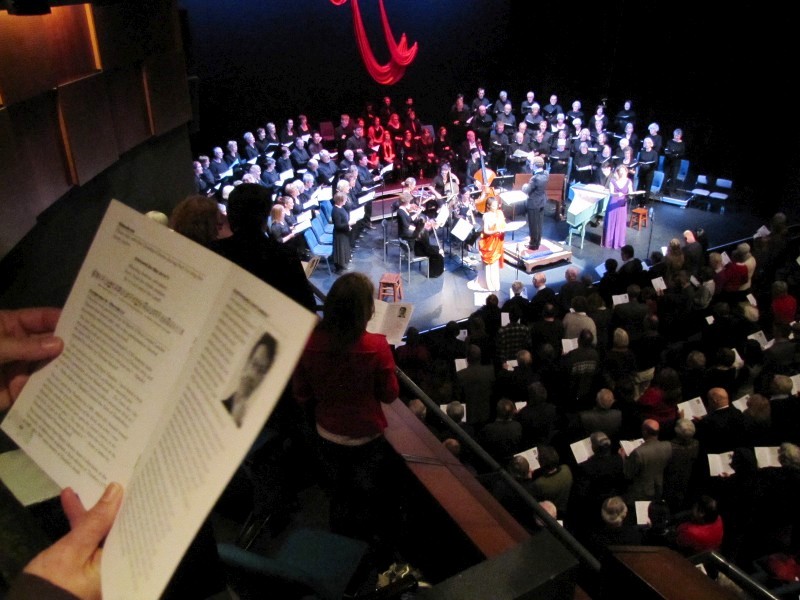
We saw a performance of Handel’s Theodora by the Canberra Choral Society with various guests and with period instruments. It’s dignified and neat and even touching later in the work, when the Theodora and Didymus, the Christian couple, are sentenced to death by Valens, President of Antioch. Didymus is a Roman soldier who’s fought with friend Septimius, but he’s fallen for the beauty of Theodora and converted for her purity. Valens has declared that all citizens should offer sacrifice to some Roman goddesses to honour Diocletian's birthday. Theodora refuses and is sentenced to a brothel. Didymus goes to Theodora and allows her to escape in his uniform and helmet. Didymus is sentenced to death. Theodora returns, they each offer their own death to save the other and of course they are both sentenced. It’s all strange classical stories which mean so little to us these days and stories of saints and worthy Christians suffering at the hands of heathens and that goes over my head. This performance was a one-off. It felt it started a bit unsteadily, although it was comfortable by the end. The voices were very satisfying, and I could follow most of the story other than Theodora’s words. Soprano training is like that and it’s a weakness when there’s a story like this to follow. I loved the CCS when they sang, all rich and full and smooth, but they were the Christian chorus, after all. Kampactus was the chorus of heathens who chuckled at the promised rape of the pure Theodora and they seemed to have some more intricate lines to sing. I lost a few. I also didn’t particularly notice the period instruments other than the baroque oboe and harpsichord and chamber organ. I assume the strings were gut and perhaps the violins were milder, but I didn’t find it particularly noticeable. I particularly watched cello and bass, partly for the different physical approaches to the instruments: cello is more lightly strung and Anthea attacked it with raised fingers; Helen on double bass was smoother and seemed to be natively conserving her strength given its heftier demands. I admired both their playing. The whole ensemble was warmed up by the end and the end also has some of the best music: the final duo of the lovers and a choral segment that finishes it off. A worthy and satisfying finale.

The musicians did a great job, even if I would have preferred to hear it after half-a-dozen more performances. Oh, and the audience sang. CCS apparently has a habit of introducing singalongs. This time is was three lines of a hymn over four bars that were repeated. The words and music were in the program; the lights came up, we stood and sang, everyone smiled, and we sat down. Nice twist and nice work.

Handel’s Theodora was performed at the Playhouse by Canberra Choral Society with Brett Weymark (conductor), Greta Bradman (Theodora), Tobias Cole (Didymus), Christina Wilson (Irene), Paul McMahon (Septimius), Stephen Barnett (Valens), Kompactus Choir (Heathen chorus), Canberra Choral Society Chorus (Christian chorus) and Evan Kirby (messenger). The ensemble on baroque instruments were Bianca Porcheddu (violin, leader), Lorraine Moxey (violin), Heather Lloyd (viola), Anthea Cottee (continuo cello), Helen Cosgrove (double bass), Kirsten Barry (oboe), Peter Young (chamber organ), James Huntingford (harpsichord).

18 March 2013

From the mouths of youth

David Yardley is going overseas for work so this is the last time he’s conducting Kompactus Choir for a while. Kompactus were performing at the High Court for the C100 Musical Offering. They are a youth choir formed out of the Canberra Youth Music Chamber Choir and SCUNA in 2008/9 when they enlisted David Yardley as musical director. This concert was called Best of Kompactus and covered a range of musics from Monteverdi through Vaughan Williams to recent Canberra visitors, the Finnish choir, Rajaton. They sang quietly, sometime almost lost behind the airconditioning, but their dynamics were generous and they’d then swell to a nice firm volume, although never very loud. I lost the male voices a little, being outnumbered at 5 to 7 females, but the interplay was clean and the harmonies were accurate and there were some lovely lines of polyphony that moved between parts, and some lovely voices htat worled together with admirable care and sense of unity. Perhaps some high notes were strained, but this was neat and capable and satisfying. They sang a varied program of quite short songs, starting back around 1450s, then through Linden Lea by Vaughan Williams that reminisces on English countryside and mourns the coming of the industrialisation. Then Monteverdi, a spiritual, Lauridsen’s C20th take on O magnum mysteriosum and a David Yardley arrangement of a song from C15th. Then a lamentation and Abide by me, and oddly, a song of daffodils, flowers that growing beautiful, flourish and die as a metaphor for life, and a song of a butterfly, sandwiching another Monteverdi, Crudel perche me fuggi. This was a lovely concert of delicacy and contemplation and I look forward to another.

Kompactus was directed by David Yardley with Rachel Cowley, Briana Hillman, Freya Howarth, Hannah Richardson and Veronica Milroy (sopranos), Alexandra Morris, Elizabeth Morris, Katy Pullen and Olivia Smith (altos), Cody Christopher, Michael Gill and Thomas Liu (tenors) and Christopher Bentley, Robin Dalton, Cameron Gill, Israel Marsh and Richard Pywell (basses).