Showing posts with label Hugh Stuckey. Show all posts

27 July 2016

A treat on a cold Sunday arvo


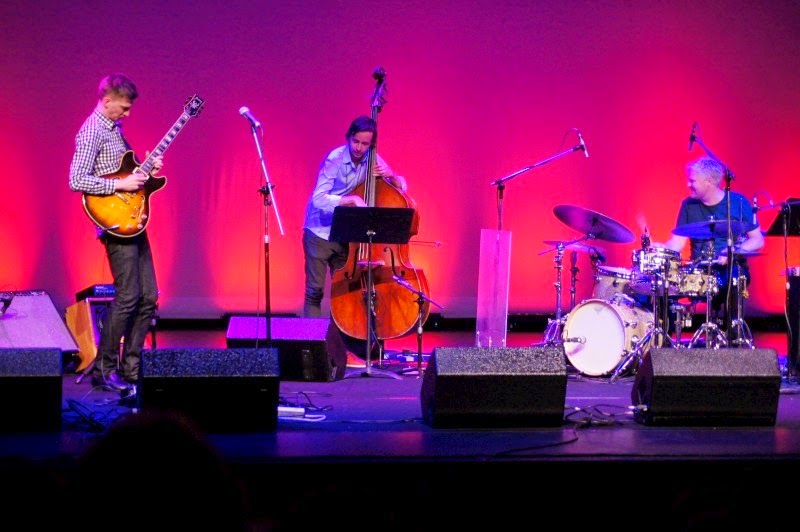
The recording and an accompanying YouTube video feature John Patitucci, no less, but this performance left me feeling not the slightest bit harking for the big smoke of NYC. Matthew Sheens played with a quintet of Australian musicians to launch his new CD at Ainslie Arts Centre and it was a musical triumph. The compositions were fabulous, complex, purposeful things with twists and development and lovely interplays; frequently intense, sometimes even dark. The first tune spoke of a deceased friend and the second quoted the last poem of Auschwitz inmate; Names was a recitation and vocal layering of names of (some) blacks killed by US police over a few days of recording; another detailed the feeling of a lack of place as expressed in French. And, somewhat strangely, two dealt with clouds (Cloud Appreciation Society and Cumulo-numbus society). Amusingly, Matt told us of an actual Cloud Appreciation society attending the Melbourne concert. And, just one standard for history, Like someone in love. And the performance was stunning. Why would we think "just locals" when locals play like this. I've been listening to the Smalls video feed recently, and it's good to very good but seldom a match for this beautifully formed and developed and blended group. So tight, so powered when call for, or detailed and light when required, all dynamic and crisp and precise. Hugh's guitar solos were expressive blasts, not overly busy but sometimes quick, clear with an echo trail, speaking as the new wave of jazz guitars. Tim Firth was a stunner, not that I expect any less from him at any time; he's always so in touch and ready to drive at a moment's notice and sharp as a tack and he was all that to perfection this day. Lyndon's bass was firm and clear, sitting beautifully in the mix: earlier I thought understated, but there were some easy and wonderfully effective quick fills but the purpose and drive of the bass was never forgotten. Matt's piano was all harmonic richness that spelt out his compositions and led his band and fairly frequent solos alternating with Hugh. Gian, the true local, being a Canberra product, sang as words but also as tones, layering those names through a Boss RC-30 looper, singing pitched lines that not once spiraled into the stratosphere sounding every bit like a pure-toned analog synth. Massively effective. Not a long concert, at a strange time, being mid Canberra afternoon with a bitter cold outside. This concert was a stunner! To some degree any such statement is a personal preference, but I found this as good as it comes, for composition and for performance. A rare treat.

Matthew Sheens (piano, compositions) led his quintet to launch his new album, Cloud Appreciation Society, at Ainslie Arts Centre. The band comprised Matthew with Gian Slater (vocals), Hugh Stuckey (guitar), Lyndon Gray (bass) and Tim Firth (drums)

05 November 2014

Mike and the awards


I caught Mike Nock as a performer but he's also the chair of the judging panel for the National Jazz Awards. The awards were for guitar this year and the judges were Mike with James Muller and Steve Magnusson.

Mike Nock is a senior Sydney figure noted for his support for a new generation. At Wang, his band was called Trio+2, the extra two being younger sit-ins Carl Morgan and Karl Laskowski: younger maybe but not unknown. This was unrushed, well developed modern jazz with a feel of rock grooves, often developing some power, with plenty of space for solo development: Outcast, Brett Hirst's Changeling, Perspectives, even This dude abides (written by Mike to a quip in the movie, The Big Lebowski). The rest of the trio was Brett Hirst and James Waples.

I was at Wang for the last guitar awards, and Carl Morgan, ex-ANU Jazz School and well known locally at the time, was on the shortlist. He didn't make the final that time, but he returned victorious. I only attended the final (given program clashes; I would love to have attended the heats). The final contestants were Hugh Stuckey (Adelaide, now Melbourne), Peter Koopman (NZ, now Sydney) and Carl Morgan (South Coast, as I remember, then Canberra, now Sydney). Carl played last and was a clear winner: confident, communicating, interesting and thrilling. He played Scofield's You bet,m Joe Henderson's Isotope and Coltrane's Naima (in a heavy rock-influenced take that worked). Hugh played first with a clear, traditional sounding guitar. His tunes were You're changed, Schofiled's Don't shoot the messenger and Rollin's Tenor madness. Peter played second, more driving and modern. His tunes were Larry Young Backup, Isfahan form Ellington's Far East suite and Scofield's Loose canon. Backing was from Des White and Ben Vanderwal. It's always a game to pick the winners. I've only listened to the finals a few times but never exactly matched the 1-2-3 order. This is art with subjectivity and personal preferences. Congrats to all; they are all worthy players.

Mike Nock (piano) led his trio with Brett Hirst (bass) and James Waples (drums) with visitors Carl Morgan (guitar) and Karl Laskowski (tenor). The National Jazz Awards 2014 final was for guitar and contended by Carl Morgan, Hugh Stuckey and Peter Koopman with accompaniment by Des White (bass) and Ben Vanderwal (drdums).

07 December 2011

Cocktails

Bands are unique as each player is unique. I noticed this particularly with James Annesley’s band when it played at the Gods. The second tune was the lovely old Bye bye blackbird and it started with Tom on bass accompanying James on soprano sax. I could hear the strains of an authentic ‘50s jazz bar here. More Shorter than Coltrane (although I heard strains of Trane in other tunes) and a simple but nicely taut bass. Then Hugh came in on drums, maintaining the feel of the era, even visually as he sat over the kit, toms forming a pretty flat surface with the snare and the cymbals laid low. This feel faded but the individuality of the band firmed when Other Hugh came in. Other Hugh is Hugh Stuckey on a guitar that sounds more recent with searing fusion solos of long lines softened with digital echo. So I heard mixed eras but what else is music these days? The tunes, too, varied over eras. The first set had several covers: early and modern standards like Bye bye blackbird and Impressions and a funky Tutu to end the set. The second set was heavy with originals and these floated with colour and landscape: mostly single chord grooves, some with odd times or contorted turnarounds. The band played through these charts, almost as a medley. I caught few titles when listed later. I think one original was called Erin’s enthusiasm and I could really feel a kid’s enthusiasm in the 7/4 groove and occasional contortions and endless inquisitiveness in the sax solo. I liked the way the band was busy but gentle: busy with Other Hugh’s forthright guitar against Tom’s doggedly solid bass but there was also obvious Coltranesque spirituality from James on soprano. I enjoyed the drum solos, too. First Hugh cut time into triplet feels and rolls that just dropped out of the rhythm. There was colour in the choice of drums, but mostly this feeling of falling through the skins and through the tempo. The overall feel of the night for me was modern with delicious band dynamics: often quiet, reserved, moving with colours and landscapes, but also outspoken with that forceful guitar and its broad sweeping arpeggios and dissonant sequences. This was comfortable and inventive playing with a really solid, steady underlay. Modern, occasionally brash sounds that spoke also with the language of a swing era. Somewhat like the cocktail of this title.

James Annesley (tenor, soprano saxes) led a quartet with Hugh Stuckey (guitar), Tom Lee (bass) and Hugh Harvey (drums).

  • Cyberhalides Jazz Photos by Brian Stewart
  • 09 October 2008

    Moody giraffe

    Text by John Baczynski, pics by John & Neal Gowan

    In direct contrast to the frosty weather outside, the James Annesley Quartet from Melbourne delivered a warm and thoroughly entertaining performance to the delight of a very appreciative audience. The physical layout of the Gods Café also encouraged a fabulous intimacy, often lost in larger venues, making the night even more enjoyable.

    Opening with a Bob Dylan cover, "Girl from the North Country", Annesley (tenor and soprano sax) calmly and confidently played evocative floating solos. The rest of the night consisted mostly of originals, with a couple of standards thrown in (Tutu and You Don't know what Love is) all played in an expressive modern jazz style. A stand out was the original "Idle hands do the Devils Work" which not only showcased many of Annesley's abilities on the saxophone, including circular breathing to extend a trill, but also gave Hugh Stuckey the chance to demonstrate his great talent on guitar. Stuckey clearly enjoys his playing and is a delight to listen to as he constructs clean, precise, and fast expressions throughout his solos. Rhythmically, Hugh Harvey (drums) provided a solid foundation to all of the pieces. Hugh created a particularly trance-like mood during his solo for "Giraffe" in which he effortlessly produced an array of fascinating sounds from his cymbals and then shifted back to a organic feel by playing his kit bare-handed. Tom Lee on Bass was flawless throughout the night and his playing was given prominence during the sax and bass duo "Claustrophobia".

    As a whole, the quartet displayed an intimate understanding of each others musical vocabulary and technical ability which resulted in a lush, layered and varied sound that was interesting, considered and precisely executed. It was also great to see a group clearly enjoying what they do. Well worth seeing next time they come back to Canberra (hopefully soon).

    03 October 2008

    Teen spirit

    It was a quiet night at Folkus and not too well attended, but the music was mostly original and the playing capable and interesting all round. James Annesley was visiting Canberra on tour from Melbourne and he was supported by a local student band led by Andy Campbell.

    Firstly Andy. I hadn’t heard his band before, but I knew they’d been performing recently. The music turned out to be all original material penned by Andy himself. Sometimes meditative, often restrained; mostly straight eight feels although there was a rapid walk in there which was more boisterous; deliberate and dynamic rhythm playing by Hugh on drums and Chris on bass, constantly responsive to long melodic and solo lines. Again, we hear current students playing interesting, complex, original tunes: it bodes well. Andy Campbell (guitar) played with Austin Benjamin (piano), Chris Pound (bass) and Hugh Deacon (drums).

    The James Annesley Quartet was the feature band on tour from Melbourne. From the top, they were louder than Andy’s band, and more confident with a brasher style of music and some terrific playing. Again, the tunes were mainly original, other than the Marcus Miller/Miles Davis Tutu, and the last tune of the set, the one they didn’t introduce, Nirvana’s Smells like teen spirit. Teen spirit has a strongly insinuating melody line that just clicks in the jazz idiom, and they did it justice. James played tenor and soprano saxes, but was more commonly on soprano. His playing was clear and incisive and fluent throughout. Hugh Stuckey was also a blast. He reached the finals of the National Jazz Awards for guitar at the last Wangaratta Festival, so it was not unexpected. He was fluent, subtle, elusive. It was fast playing with a lush background echo, so modern sounding. Rapid lines often merged with chords; generously spaced; open and searching for a response to the surroundings; resting between passages with a flourish of his left hand. Tom Lee played a strong and regular line on bass. He moved with his bass lines: more than anyone else I remember seeing. It’s interesting to see how musos respond to what they hear: variously cool and unmoving or mobile and expressive. Hugh Harvey combined with Tom for the steady, go-ahead bedrock rhythm, and played some nice solos of his own. I doubt my description does them justice. I thoroughly enjoyed the confident, capable performance in a modern post-bop style. There’s still a chance to catch them at the Gods next Tuesday. Well worth the outing. James Annesley (tenor, soprano sax) played with Hugh Stuckey (guitar), Tom Lee (bass) and Hugh Harvey (drums).

    And remember to support music like this! Folkus is increasingly providing the venue for comfortable, intelligent, listening jazz. Use it or lose it.

    06 November 2007

    The guitars have it (Wang 2)

  • Wang 1

  • Guitars were a big theme at this year’s Wangaratta Jazz Festival. Firstly, and most obviously, because it was this year’s instrument for the National Jazz Awards. Secondly, because of the visit of the renowned New York guitarist, Kurt Rosenwinkel. Thirdly, due to the presence of those Australian masters of the instrument, James Muller and Stephen Magnusson.

    The Awards were a fascinatingly attractive thing for me. I attended late on the first day of the semi-finals to hear the two Canberra entries: Ben Hauptman and Carl Morgan. But the sessions were strangely addictive, so I was back next morning to catch the five remaining players. The ten semi-finalists were chosen blind from CDs sent by applicants, so these were all worthy entrants. Each player performs three tunes (a blues, a ballad, a composition by Bird or Scofield) with common accompaniment. Three entrants are chosen to perform on Sunday for the final. Strangely, the finalists performed the same three tunes for both performances. Not strangely, given it was the final, in the main hall, and going live to ABC Radio, they each looked pretty nervous, and clearly all made some minor fluffs. But it was capable playing all round and a fascinating few days.

    What got me most was the diversity of the entrants. There was straight-ahead jazz, fast and slow, post-modern, blues and rock influences, clean and effected. It was all there. I didn’t envy the judges, although the criteria would have helped markedly. I didn’t always share the decisions of the judges, but that’s part of the game, and a common topic for conversation on the streets.

    The winner was Aaron Flower who performed two simple, blues/rockabilly tunes with notable accuracy and a superbly lyrical version of the lovely ballad, You don’t know what love is. My guess is the ballad won it for him: it was truly sumptuous. Second place went to Ben Hauptman. Ben’s Canberra born and bred and a product of the jazz school and now resident in Sydney, along with his talented siblings, Zoe (bass) and James (drums). He played a more rock-influenced set. I loved his starter on Ellington’s Caravan. Then an original ballad in a trad vein, Unity Hall, and a highly effected Billie’s Bounce. I had missed Hugh Stuckey of Adelaide at the semis, but he was the talk of the streets before the final. He played a straight-ahead clean jazz style with panache, so he was also a good chance.

    I also heard several other semi-finalists of note. Carl Morgan is our local flash at the jazz school (viz, his nickname is Nuke as in nuclear bomb). Carl played a Scofield tune, It is written, along with My foolish heart and an original blues tune in the fast, flashy style that we know him for. Carl was the youngest of the semi-finalists (only 19 and only in his second year of tertiary jazz studies). The relative lack of experience showed, but he’s likely to be around for the next guitar awards and should be a force to be reckoned with. I also enjoyed Nashua Lee’s highly effected and blues-rock influenced set, Matt Smith’s sweet and stylish modern jazz playing and his choice of tunes (including a lovely Charlie Haden ballad, Spanish love song), and the confident, otherworldly sound and approach of the Japanese born, Brisbane-based Yusuke Akai. I didn’t hear all performers, but I sympathise with the judges.

    For me, perhaps the stars of the whole show were the rhythm section accompanists: Sam Anning (bass) and Ben Vanderwal (drums). I’ve written of each of them several times on CJ, and they are both excellent. Here, they accompanied in numerous, radically different styles both appropriately and supportively and soloed freely and on command. Admittedly they had the advantage of being continually warmed up, and not having the spotlight on them, but nonetheless they were superb. Theirs were stunning performances in their own rights.

    The panel comprised the venerable Mike Nock and the two guitarists who shared the Award in 2000: James Muller and Stephen Magnusson. These are a very different pair. I have heard James numerous times, and several times at this festival. He’s cool, sharp, professional and controlled in his playing, but his lines are fast and clear and rise with massive passion and often huge denouement. James may be a local, but he’s clearly a world-class exponent of the instrument. I’ve only heard Stephen at this festival, and don’t really know him, but what I heard seemed more fluid, soft and sweet. Definitely his presence is very different. Usually we think of Sydney as brash and Melbourne as cultured. This pair presents a challenge to those stereotypes.

    The other guitar highlight was the highly regarded New York exponent of the axe, Kurt Rosenwinkel. He’s renowned as perhaps one of the greats of the present time. My guitarist friends seem lost in description and comparison, so he’s got a unique approach. I didn’t attend his solo concert, which got some very positive comments, but I heard him in two performances with Barney McAll’s band. The PA sound was abysmal for the first and only reasonable for the second, although I felt his first performance was the more interesting. It was obviously competent, interesting and sometimes searing, but I need more time and better sound to form my personal opinion (with a world great, my expectations are more demanding). But it seems I missed something, given this reference from Scofield: “one of the finest and most creative jazz guitarists playing today”. I’ll just blame the lousy PA mix!

  • Wang 3
  •