Showing posts with label John Burgess. Show all posts

06 May 2019

In a variety of ways


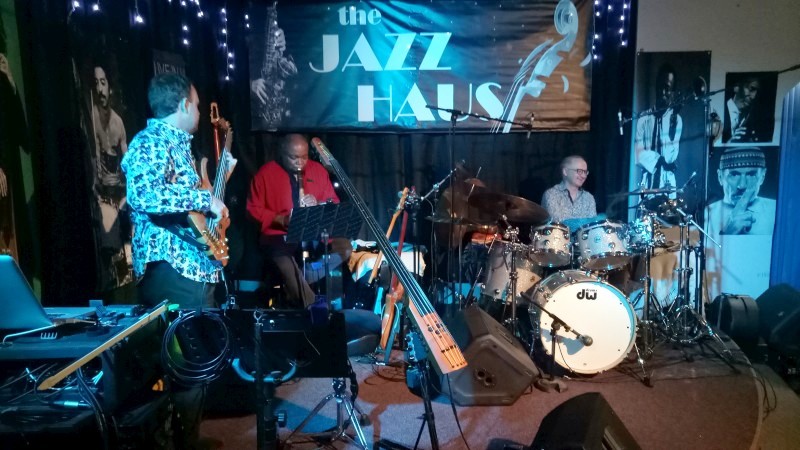
It must be the era of odd combinations and I was intrigued. This time it was drums and two basses: our local bassists Eric Ajaye and John Burgess with visiting Melbourne drummer David Jones. There's history aplenty here. David and Eric played together in Melbourne twenty years back, presumably before Eric's move to Canberra and ANU and Eric taught John at ANU. They are all strong, inventive players and this was the opportunity to improvise. Improvisation it was: John and David had just met in person that afternoon. But that's jazz. But even so, the traditions appear in some shared musical themes. I think Footprints emerged twice and the funk of Freedom Jazz Dance featured and the opening was In a silent way. And amongst the open, free improv, there was written music, David's Ancient echo and Eric's words, you'd probably say rap, written by him as a schoolkid to Freedom Jazz Dance. We got to sing along a phrase with that. The variety of basses, too, was fascinating. Eric's smooth, lithe, sliding, often funky lines on two e-basses and an NS stick. John's sharply clear grooves and melodies on his two e-basses and the electronics on his bowed NS stick and more. Against this, David's immensely satisfying, sharp rhythms and virtuosic, unexpected three- and four-feel fills and interjected tones from various bells the percussion. How sharp! A few drum solos that floored the audience and a tunes played on kalimba then expanded to the two basses. There were two sets of this, knowns and unknowns, all immediate and personal and exploratory. Intriguing with that edge of adventure from the unusually deep tonal blend and the electronic extrapolations. Another rare instrumental combination and a great pleasure.

Freeflight were Eric Ajaye (bass), David Jones (drums) and John Burgess (bass, electronics). Simon Mitchell (art) was sketching but the pic didn't catch his art.). Thanks to jazz regular Bob Howe for the pic of authentic Jazz Haus illumination.

11 April 2017

Family affairs


This was great fun, like a family get-together. Elise Walsh out front, releasing her new Bella Groove album. With her regular band of Victor, John and Steve. With various guests invited for her CD and to play at the release, John, Miro, Eric, Hugh and backing singers Francine and Juanita and Sharon who doubled on vocals and keys. A big performance of a series of tunes from Elise's CD including some originals. Should we (dance) was a love song; City of yes was an ode to politcal involvement; Open your mind was an affirmation; City lights celebrated city life. Also original lyrics to modern jazz tunes and some borrowings from Mike Murphy and even some funky Motown originally from the Messengers. Eric apparently grew up listening to that one on the radio. Nice to hear an old favourite that's not too common, Coltrane's Naima. But this was like family. Everyone knew someone or many others, so some good cheer. So much so, the red wine expired and the local pub was mentioned for afters. And a lovely twist: included with entry was a copy of the CD. What a great idea to get your work out. There was some seriously good playing, too, from some seriously good players. There was good sound and a video recording, but mostly the good cheer of Elise and her wide jazz family having a good time. I'm looking forward to sitting down with the CD. Until then, good cheers and some very nice music.

Elise Walsh (vocals, flute) released an album under her band name, Bella Groove, at Ainslie Arts Centre. With here were her normal band, Victor Rufus (guitar), John Burgess (bass) and Steve Fitzgerald (drums) and guests John Mackey (tenor), Miroslav Bukovsky (trumpet, flugelhorn), Eric Ajaye (bass), Hugh Barrett (piano), Francine Minjoy and Juanita Cucinotta (vocals) and Sharon Robinson (vocals, keyboard).

17 January 2015

Temptation


Bella Groove have been playing around Canberra frequently of late. I finally got a gig to find the band is a string of mates from the jazz scene, fronted by singer Elise. Elise, at least, was new to me. Bella Groove play the jazz standards and more with a funky, rocky, electric twist. Take standards and some favourite rock and pop tunes, add electric bass and choppy guitar, drums and tenor, and a voice over with flute for a softer colour. It's a good night out and these are nice players. John sounded all fat and punchy, very satisfying, improvising and walking and taking plenty of solos. Stew cut through all choppy and clear and edgy with sharp comping chords and blues-tinged solos. Noddy was just plain effective, soloing at will; not needing to read this stuff, although they tell me he can read fly specks on the wall when he needs to. Joe on tenor was the most adventurous, but that's a sax trait: starting his solos with melodic interpretations but soon vearing out in harmony and rhythm; his solos were also the longest. And Elise, firm voiced singer and comfortable leader, stood the front line when not taking flute melodies or solos. I'd missed Beatrice, but I heard Tom Waits' Temptation, CC Rider, Dindi, Old devil moon and Stolen moments. I was sorry to have to leave early. I was bopping. A comfy band playing great tunes making for a night out and a few drinks.

Bella Groove are Elise Walsh (vocals, flute) with Joseph Taylor (tenor), Stewart King (guitar), John Burgess (bass) and Noddy Brassington (drums) and they were playing at Hippo.

28 May 2012

All new and mice

Canberra New Art Music. It’s a challenging concept. It arose after the Australia Youth Orchestra summer camp in January. A few members discussed how to maintain an interest and audience for contemporary, original music. So this. It was just a little event and the musos almost outnumbered the audience. I didn’t think it all worked, but it shouldn’t. This is experimental, an opportunity to explore and present to an inquiring audience. It wasn’t long, either. Ninety minutes to present about 10 compositions. But there’s detail and complexity in 10 fine music charts so this represented massive work. I was honoured to have been invited.

The show started with John Burgess (electric double bass) performing his tune, Searching finding, solo with and without bow, without and without effects. It reminded me of Jaco and Corea. Very fluid, and I expect considerably improvised, and with some impressive technique on an instrument with action set to zero. Amusingly, John complained of larger shoes clicking the wrong pedals, but, not knowing the piece, it still worked for me. Next was Quartet no. 4 by Nigel Poole, performed by Sarah Hewat (flute), Rosemary Shepherd (flute), Marlene CP Radice (clarinet) and John Burgess (bass). This had elements of a round that passed sometimes jolly lines between instruments against flutes playing crochets in 4/4. Next was Robbie Mann (piano) playing a Larry Sitsky composition, Nocturne magique, on a questionable piano. It’s constructed from a tone row with notes representing letters of a name, and accidentals placed irregularly. I liked this, especially for the time delays between hands, an effect I also noticed when Larry Sitsky played Dvorak at the SOS concert earlier in the week. Then Hayley Bullock (violin) played Zara 1 for violin by Paul Witney. This was a work based on a three note motif, with triplets, slides, double stops and more, and with occasional hints of hillbilly to my ears. String quartet no. 3 by Lulu Huang followed. I found this very satisfying. It was played by the String Theory Quartet comprising Erin Patrick, Sabrina Tiong, Rosy Davidson and Darsha Kumar. I counted 7/4 at one time and triplet feels and 4/4 at others. I heard it as a slightly dissonant take on Mozartian sweetness: melody with a contemporary quizzical take. Are you out there? was written by hostess Thea Zimpell and performed by Marlene CP Radice (clarinet). It was a dedication to Thea’s mentor, Stephen Stanfield, now deceased. It was solo clarinet, pure, sometimes harsh, often cutting, sometimes meandering and mostly questing. Then Lucia Gonzales (flute) played a solo piece by Marlene CP Radice called There’s no one here, there never was. It’s based on words of a Leonard Cohen poem. Sometimes sparse, sometimes lively, it reminded me of sprites in the words. Then Playing with shadows, piano trio no. 3 by Sandra France performed by Hayley Bullock (violin), William Tu (cello) and Thea Zimpel (piano). This was the second movement of a CD, Fluctuating states of calm. The name fits: this was open and pensive and questioning. Last was a humourous finale called Mouse by Michael Sollis. We were amused by Sarah Pettigrove, Megan Billing and Kirstie Raffan (oboe, oboe, english horn) arriving in black with mouse ears. We were more amused by a four note motif with varying often lengthy rests between repeats, frequent unisons, occasional sidesteps and infrequent harmonies. All with simple sudden choreographed movements. It was much more intriguing than you would imagine and a great way to end a night of considerable inquisitiveness. John Burgess encored with an another solo bass piece to satisfy his concern over his mistepped effects. This one was more pulsingly rhythmic and featured some e-bass techniques on his very lowly strung axe: tapping, chords, slides, harmonics.

This was an intriguing and discursive concert of new music. It’s great to see we have this scene here and let’s hope we still have it after the ANU changes are put in place. Canberra New Art Music, Thea Zimpell, Nigel Poole, Larry Sitsky, Paul Witney, Marlene CP Radice, Sandra France, Michael Sollis, John Burgess, String Theory Quartet

29 August 2009

Just one corner of one school

It was Universities Open Day today. No. 2 son visited ANU, but I just lurked at the Music School (which is also ANU, of course). There were masses of events there. I caught much of the jazz, and just touched the classical. It’s invigorating to realise just how much was available. This is just one university (although a renowned one), and I was overwhelmed with just one corner of one school. We live in such a time of richness, if only people will go out and find it. Here’s just a quick visit. Excuse the pics, but I dropped my normal camera today, and I’m back to a very, very basic model for the interim.

I caught all three of the large jazz ensembles: Recording Ensemble, Commercial Band and Big Band. The BB was an earlier jazz style, less challenging and a bit less exciting than the others, perhaps more of a training ensemble with newer students (although there’s a batch of mature students there too) but entertaining. The Recording Ensemble features original compositions by members. This is interesting and often blissful with varied tempos and rich harmonies and complex orchestrations. Interesting also for the double drum seats that are featuring this year. The Commercials are the funky outfit: lively, exciting, variety. They have some student arrangements, but mainly professional-level charts from the best arrangers. This is hot and sweaty grooves and just plain fun.

The Open Days also feature workshops by faculty. I missed the bass & drums workshop this year, but managed the piano trio workshop. Actually, this was a first performance of a new trio of Matt Thompson (piano), Eric Ajaye (bass) and Mark Sutton (drums) with some chats and Q&As between tunes. It’s in its very earliest days, but it’s quite a cerebral outfit. Eric spoke of refraining from dropping into swing. Mark talked of playing colours rather than his normal grooves. I imagine it’s especially demanding with eminently swingable tunes like Nardis, Solar and All the things you are. On the other hand, I felt this cool was Matt’s natural approach (given the limited times I’ve hear him play). Matt was sparse, single note right hand solos developing into considerable melodic complexity, and few, or long delayed, chords. Mark expressed some discomfort maintaining this colours role, feeling a desire to drop into something more clearly swung. Eric seemed to enjoy it, with bass chord comping, or repeated rapid accompaniment riffs, or solos alone or in conjunction with the others. It will be interesting to watch developments here.

I actually got drawn away from this trio by the siren song of a soprano wafting from Llewellyn Hall. Some highly pitched, plaintive, vibratoed notes with orchestral backing, and I was Odysseus unbound. Typical of sirens, though, the soprano had departed by the time I got there. The replacement was a good humoured rehearsal of the ANUSM Orchestra playing Bizet. They were playing a bouncing waltz as I entered, and some booming chords a little later. There were so many players on stage, so informal. In fact, the brass players seemed quite underemployed as they counted out the bars until they came in again. (I wondered if the Productivity Commission would see this as unproductive, inefficient? Probably not. I expect they attend). It was a lovely interlude, and evidence that there’s life beyond jazz.

But back to jazz, and John Mackey’s improvisation masterclass. It was more a chat and workshop, and an awareness-raiser for anyone who was considering the commitment that is jazz. John enjoys his practice, and it shows in great technique, incredible fluidity and huge tone. John takes a rational approach to learning the instrument, in order to “forget it all and just play” (Charlie Parker). Indications of his approach: any four notes can be played (without repeating a note) in 24 patterns; there are thousands of scales, but his students should practice 276 scales every day (23 scales in 12 keys); transcriptions are essential and his students are required to learn their chosen solos in 6 keys (he used to expect 12 keys, but he’s relented!). You get the message. He demonstrated several times: playing solos against an Aebersold recording of Have you met Miss Jones; later playing a transcribed solo, then playing the same, identical solo. A few quotes will give the feel: “If you have to think about the notes in a chord sequence, it’s over”, “Perfect your craft”, “Practice slowly all the time”. John represents intellect and commitment combined to support true and expansive expression: always inspiring.

I also visited the ANUSM Recording studio and mixing/mastering suite. Nevin Stines had recorded a Jazz School band earlier, and was doing a rough mix. Great gear, wonderful chatter about recording matters, and some hugely clear recorded sounds in the studio. Lastly, I caught John Burgess playing a solo EUB (Electric Upright Bass) set in the ANUSM Level 5 Café. This was loops and delays and tunes including Stella by starlight. Solo bass – nice one.
27 July 2009

Browsing

It was a pleasant Sunday afternoon of browsing and listening when the Sienna Aguilar Quartet was playing at the Beyond Q Bookshop. The bookshop has a little café surrounded by a decent collection of second hand books. You can sit in the café for an intimate concert experience, or grab a comfy chair amongst the shelves and catch up on reading with a live musical ambience. Sienna presented a lovely collection of standards, latins and ballads, sung with a rich and rounded voice. It was a tempered few sets, perfectly suitable to the surroundings. John’s soft and observant drumming provided a steady pulse to support some occasional scatting by Sienna, and solos by Andy and John. John’s were more tonal, as bass is wont to be, which fitted well with his clearly stated walks and accompaniments. Nice tone, too, on an NS 5-string EUB, and good hands that suit bass, although the thumb positions look strange on the long neck with no body to reach over. Andy was on piano, which provides far more opportunities for adventurousness. His solos were slim and lithe, nicely phrased and well considered, frequently chromatic and atonal. I was glad to hear several favourites: Sam Rivers’ Beatrice, Benny Golson’s Whisper not, Jobim’s Dindi, Billy Holiday’s Don’t explain, and Luiz Bonfa’s Manhã de Carnaval/A day in the life of a fool. ADITLOAF started with a bass line that just said James Bond to me. Sienna told me it’s on the original. Otherwise, I remember Alone together, Green Dolphin Street, Like someone in love, Corcovado, a blues. It’s a common, but satisfying, repertoire. We know the standards well, but they are superb tunes, and support frequent performance and sustained listening, and they are essential in the development of a jazz player. This was one pleasant and satisfying outing for these great tunes.

Sienna Aguilar (vocals) led a quartet with Andy Butler (piano), John Burgess (bass) and John Milton (drums) at the beyond Q Bookshop.