Showing posts with label Peter Farrer. Show all posts

06 February 2024

SoundOut 2024 / 4

I feel more informed in this SoundOut festival and maybe understand it better.  I peruse the program and realise (I think I'm correct) that day 1 has the performers playing in their normal combinations and later session mix and match for more new combinations.  And like people who have played together for a time, you see the comfort of the known and the challenge of the new.  All interesting.  I often find I prefer the known, but I respect and the new.  Next session for me was Saturday session 2.  First up was Ellen Kirkwood, Guylaine Cosseron, Maria Moles, Mark Cauvin and Richard Johnson. This started with voice and voice remained a major lead throughout.  Guylaine is seriously expressive and capable with her voice, so numerous sounds, vowels, groans, whistles even multi-pitch harmonised, running through highs, climaxes, recoveries.  Then nice ears for harmonies from bass and sax, even with surprisingly similar solo concepts, occasional percussion then trumpet tones later on and a final note that sounded of air raid sirens.  Whoah.  Next up was Bonnie Stewart, Guillaume Gargaud, Novak Manojlovic, Rhys Butler and sit-in vocals form Tony Osborne.  An immediate start from piano and vocals, leading to guitar with even country twangs.  Then waves of intensity, sudden explosions, with perhaps percussion or gentle alto or vox in between, rolling strings from piano and damped guitar plucks through extensive solos.  Another discovery?  That this music is more about dynamics than harmony let alone melody or even rhythm.   Then Jodie Rottle, Josephine Macken, Jamie Lambert and Peter Farrer.  Opening with a bell, then more mild, meditative, pensive, flautic (is there such a word?) with flutes of various sizes from Jodie and Josephine, bell-like guitar and bowed and even some violin from Jamie and alto and percussion from Peter.

Peformers for set 1 were Ellen Kirkwood (trumpet), Guylaine Cosseron (voice), Maria Moles (drums), Mark Cauvin (bass) and Richard Johnson (tenor).  For set 2 were Bonnie Stewart (drums), Guillaume Gargaud (guitar), Novak Manojlovic (piano), Rhys Butler (alto) and Tony Osborne (vocals).  For set 3 were Jodie Rottle (flute), Josephine Macken (flute), Jamie Lambert (guitar) and Peter Farrer (alto).

04 February 2024

SoundOut 2024 / 2


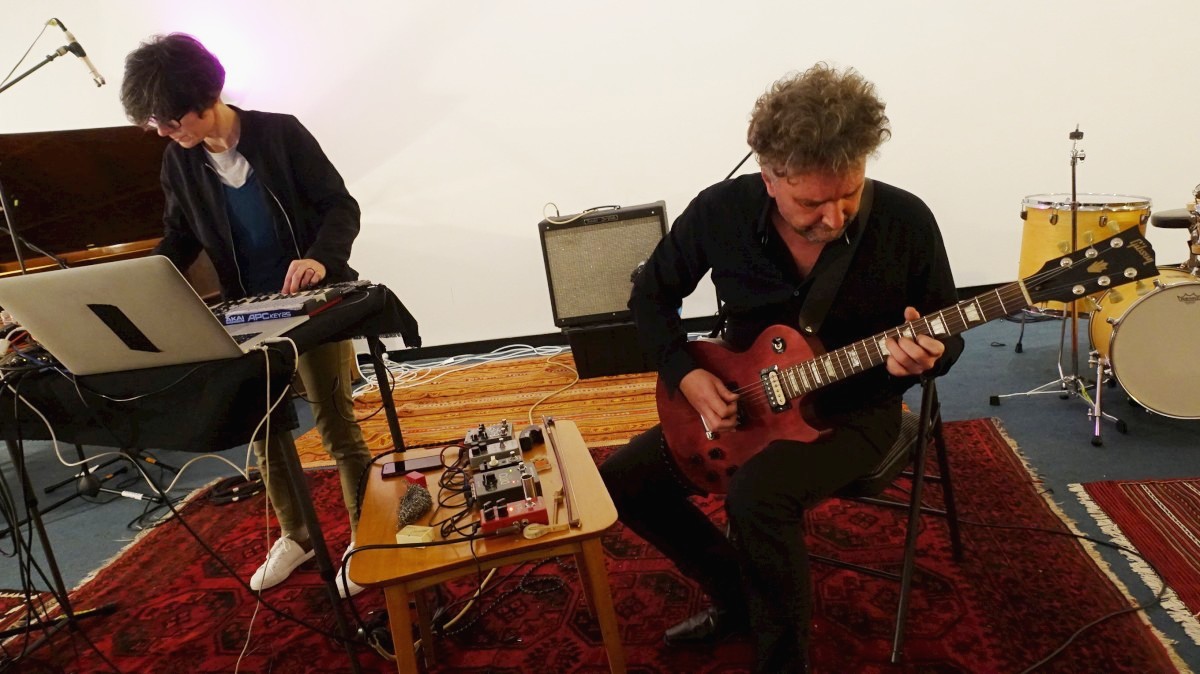
There were three more acts during the SoundOut Friday night session.  First was a very quirky outing with three performers playing occasional trumpet and flute but mostly various kids' toys.  All rattles and noises and shakers and whistles.  Backing this was a multimedia-cum-live drawing session projected behind.   The falling conga line of penguins was perhaps the peak of this experience, but an artistically quirky good time was had by all, performers and audience.  BTW, the mini amps were Marshall and Orange, although the sound was nothing like dirty rock.  Amusing.  performers were Elizabeth Jigallin, Ellen Kirkwood, Jodie Rottle and Nicci Haynes.  Then Kairos, another French international duo, this time combining electronics and oft-times nicely dirty Les Paul guitar.  Dotty punchy synth lines from a table of keyboards and one particularly strange controller, bowed guitar, some seriously nice phrasings, impressive sounds although I wondered where it was going or went.  Performers were Jean-Sebastian Mariage and Gwennaëlle Roulleau.  Then the final act, a quartet called Believe.  This was straight free jazz, fabulously articulate and expressive and informed with top skills, madly busy from the first notes but moving through a series of sections.  The performers were Clayton Thomas, Laurence Pike, Novak Manojkovic and Peter Farrer.  All great musos, but I have to single out Novak.  He's a pianist and piano is the whole orchestra in a box, but he could play it all.  I was blown out, by him and all.  And I don't always warm to free jazz.  It needs informed chops and some structure and immense listening and a love of dissonance, but then it can be exhilarating.  This was.

The quirky penguins outing was Elizabeth Jigallin (toys), Ellen Kirkwood (toys sometimes trumpet), Jodie Rottle (toys sometimes flute, piccolo) and Nicci Haynes (drawings, projections).  Kairos comprised  Jean-Sebastian Mariage (guitar) and Gwennaëlle Roulleau (electronics).  Believe comprised Clayton Thomas (bass), Laurence Pike (drums), Novak Manojkovic (piano) and Peter Farrer (alto, percussion).

02 February 2023

Plus three

It was the last flourish from Carmen Chan Schoenborn on vibes that gave me a chuckle.  This virtuosic little upward flowing line on the vibraphone borrowed from the CSO and then the look up to find ... the end.  This happens, of course.  Then set had vibes/piano with erhu and Gail's synth with floating tones and Jasmine's bowed erhu (what a lovely sound it can make) and like harmonies and synth and bells and cymbals and some other smaller percussion but it was coming to closure then this lively, perhaps hopeful flourish that had the three players looking at each other and chuckling. Thus is improv, of course.

Carmen had played earlier, too, this time with another bassist, Sam and Joe on drums and Gemma on trumpet and some vocals.  We'd heard bowed cymbals as well as bowed bass and harmonics, plastic bag noises , plucked piano strings and bass and various drones and percussive seed pods (Toca) into a finale of octave vibes, blown trumpet mute and a final bass pizz and bowed cymbals.  I found some a little airy but the bass/drums combination had purpose and power at times to satisfy my less developed ear.

Then another bassist, Chloe Sobek, or at least a somewhat busetto-shaped baroque violone.  That was odd to see.  Chloe also played a set on violin, but I didn't see that.  I can't imagine anyone with a six-string violone  and baroque bow and gut strings and gut frets who doesn't play mediaeval/renaissance/baroque music, so I guess that's Chloe's background.  Here, she played slides and pizz and odd intervals to sounds from around the piano, under the lid, piano-related noises but not from the keyboard with an accompaniment of alto sax with water bottle mute moving to hisses and bubbles of water boiling on hotplate with handheld condenser mic, if I got it right.  Not common in Llewellyn hall, but quite fascinating sounds that we all know but don't think about too often.  Here we can.

Variously, the musicians were Carmen Chan Schoenborn (vibes, piano), Gail Priest (electronics), Jasmin Wing-Yin Leung (erhu), Gemma Horbury (trumpet, vocals), Joe Talia (drums), Samuel Pankhurst (bass), Chloe Sobek (violone), Elizabeth Jigalin (piano, percussion) and Peter Farrer (alto, electronics).  They played at SoundOut at the Drill Hall Gallery.

03 August 2011

Many Prophets as one

When I saw pics of The Prophets, before they performed at the Gods, I naturally thought of Sun Ra. It’s an obvious connection given the zany presence and the madcap costumes that make both bands such unique theatrical shows. But I’ve seen Sun Ra at Villa Celimontana many years back, and the music is quite different. And I’m not sure that The Prophets lay any claim to outlandish origins, although they did mention connections to Mali and Ethiopia and the music clearly talks with a language out of Africa. There’s also jazz and rock there, so this is exotic and international but not extraterrestrial.

The individual components of their performance are not unique, but the whole is clearly unconventional: two drummers; four alto saxes (actually 3 altos and a C-melody sax - a new one on me and apparently an instrument that hasn’t been produced for many years); no bass (although I think they sometime use one); occasional vibes; invitations to the audience to join in on homemade wind instruments; no clearly defined, individualistic solos; occasional duets or smaller ensembles, including a drum duet). And the costumes, of course. As I said, the music spoke of Africa. Apparently some of the band had travelled to Mali and one tune was Ethiopian. So the music was riff-like passages that morphed in a minimalist way over time, with moving contrapuntal lines from various saxes and polyrhythms from drums and others. I thought I counted lots of threes (triplet feels and lines in 6s or 12s) and lots of riffs that seemed front-loaded (is there a musical term for this?) with shorter notes on the beat and on the accent, and longer notes following. This all made it not swing and not relaxed, more jumpy and perhaps African. But then I remember fours from drums so there were polyrhythms happening and gently changing. There were solos, but they were not obvious, singular, ecstatic events. These were squeaks and squeals, unimposing, flittering over the grooves. The one piece with vibes just confirmed the African connections with the lilting grooves of tuned percussion. It got a little odder with the invitational piece. This was three melodicas, a fog-like wooden horn, two drums and about 10 wind instruments made with holey hose, straws, balloons and rubber bands that were played by invited audience. Congrats to Jono Lake who took to his instrument with considerable rhythmic confidence, which is what the piece needed. In the spirit of Prophetic anonymity, I’ve nothing particularly to say about the individual musicians. The masks created the anonymity and the music confirmed it. This was a zany presentation and rough around the edges, but lively and fresh and I loved it.

Given the masks and the instrumentation it’s hard to know who’s who, but The Prophets were Peter Farrer (C-melody sax), Dale Gorfinkel (alto, vibes), Marcus Whale (alto, sitting in for Sam Dobson), Laura Altman (alto), Finn Ryan (drums) and James Waples (drums).