Showing posts with label Paul Eldon. Show all posts

23 December 2014

Get it while you can


That great philosopher, Janis Joplin, once sang Get it while you can. It's like that at Christmas, with a string of concerts, before the lull of Boxing day and January. From the High Court, it was a short walk to the National Portrait Gallery for Tobias Cole's choral quartet, Clarion, performing for Evensong. Just a little concert and only for the most hard-core audience who survived Helen's long show. But this was a thing of great perfection, of satisfying beauty. Just four voices, in skilled harmony, sometimes close and edgy, singing in a quiet space. Something to treasure. The concert started in front of a portrait of James Morrison in Gallery 6, but the music was wildly different, perhaps more commensurate with the works of Paul Grabowski, whose portrait hung just nearby. I guess this was SATB with female soprano and males performing the other parts. They sang three tunes, then journeyed to the foyer for a few (I missed these) then returned for some more and a final move to the foyer. The final foyer piece was with a mostly-children's quartet. [Thinking back afterwards, I think this was Katie Cole and kids / Ed.] There was a harp, so I expect Meriel Owen played for the first foyer outing. The first piece was modern and religious, close harmonies and chromatic bass lines. Then In the bleak midwinter, slow and sweet and rural feeling. Then a stunning Sculthorpe, starting with dotted bass and line and a coloured patch then dissonant melody. Then a break. On return I recognised Byrd's Lullaby my sweet little baby in three parts, then a piece on the notorious Genesis apple and There is no rose of such virtue with interleaved lines. Finally a move to the foyer and Hodie Christus natus est, all of dignified, cathedral-worthy latin adoration, performed by eight singers in two choirs. A worthy and very satisfying Christmas outing sung with great precision.

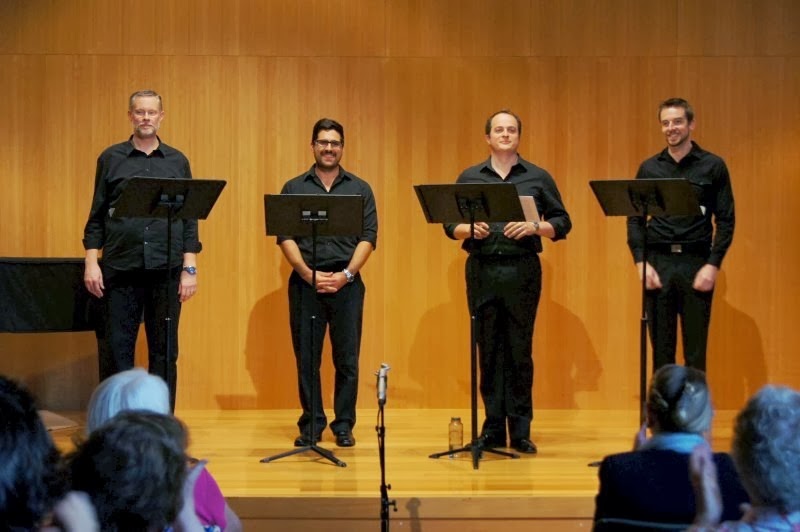
Clarion was led by Tobias Cole (presumably alto in this outing) with Nathalie O'Toole (soprano), Paul Eldon (tenor) and Peter Tregear (bass).

20 December 2014

Carols are for Christmas


This was just a quickie for Coro; a concert at Christmas with one rehearsal. But these guys are good. They sang in the Grand Stairwell at Hotel Hotel. All cool and woody and earthy. Hip. But both Coro and this hotel have depth and quality. They started with a favourite, Ding dong merrily on high which is a classic Christmas carol and one of my favourites for that endlessly falling chorus, Gloria ... Hosanna in excelsis. Then a few more obscure pieces and a few better known ones: Poulenc's Videntes Stellam, Byrd's Lullaby my sweet little baby, Orff, Charles Ives, Silent night, finally Irving Berlin's White Christmas. There were just two singers per part, so 8 performers; just 7 while a bass had to go off to collect his wife (Christmas is a busy time, after all; this was Saturday; perhaps she was shopping). But 8 singers made the parts clear. I particularly noticed some very high but easy tenor lines. And those sopranos that always ring in the heavens. And the more complex harmonies sung by the altos and the basses that undergird all this. It was somewhat of a throwaway concert, but these are quality singers so any performance is worthy. Just carols at Christmas, but I left blissed out. Capable voices, diverse repertoire, unique environment, relaxed atmosphere: a winner all round.

Coro sang carols at the Grand Staircase at Hotel Hotel in New Acton. Just eight singers this day: Hannah Bleby, Gemma Dashwood (sopranos), Rebecca Alexander, Maartje Sevenster (altos), Paul Eldon, Ian Mills (tenors), Adam Coin, Daniel Sanderson (basses).

09 July 2014

Singing with Coro


Coro are a great local choir, so it’s a thrill to sing with them … even if only for a sing-along. Coro staged a party-cum-concert for Christmas in July, complete with gambolling kids, mulled wine and fruit mince pies. All lovely. The singing was great, too, and not just from the choir. The audience was the best I’ve heard at a sing-along: confident, well pitched and timed. Such is an audience that attends a Coro concert, it seems. It was a mix of music that they performed, in style if not in theme. There were some carols which demanded considerable attention - more than was available from the littlest kids. Perhaps this was optimistic, singing restrained songs like Bethlehem down or Corpus Christi Carol or Little road to Bethlehem. I made a recording with coo-ing kids, but it seems strangely apt for a Christmas event. On the other hand, I was impressed by some older kids sitting legs crossed and concentrated. Other songs were more forceful, unaffected by playing kids. The Twelve days of Christmas with that humourous patter of unsuccessfully exchanged gifts brought a great laugh and those several sing-alongs were louder than any little kids: Good king Wenceslas and Deck the hall and Hark the Herald angels sing and Come all ye faithful. These are all old favourites. I enjoyed this more than most Christmas singalongs for two reasons: firstly the decent fellow singers, but secondly because the keys just seemed so right. I've sung carols where I strain to reach high notes, but not this time. These were just right; only one strained note for my limited voice. Also interesting was the take on Good King Wenceslas with the combined and male and female choruses. How different these lines sound, just unison, but high and pure for the females and solid and corporeal for the males. Quite a realisation. Then a piece of musical intellectual playfulness with pianist Anthony Smith playing Good King Wenceslas in the style of Bartok. There was mingling and conversation and three choral sets and voices that never seemed to stress on the high notes and some featured compositions and the inevitable Bach. It may be just a local church hall and some wine and song and the spirit of Christmas. But it was a wonderful pleasure and a beautiful choral performance and a decent sing-along to boot. Coro's next performance is a blend of Bach and Part Magnificats. What a town that has such people in't!

Coro were Hannah Bleby, Gemma Dashwood, Brenda Gill, Evelyn Graham, Emma Griffiths and Jo Johnstone (sopranos), Jane Haycock, Alanna Mackay, Veronica Thwaites-Brown and Rachel Walker (altos), David Mackay and Ian Mills (tenors), Paul Eldon, Daniel Sanderson and Rohan Thatcher (basses) with accompaniment by Anthony Smith (piano) for several tunes and John Smiles (baroque flute) for the Bach Christmas Oratorio aria.

27 May 2014

Jubilate SCUNA


This was one big gig and the best that I've heard from SCUNA. A big choir; lots of music; a fascinating series of takes on common themes. We heard two versions of Psalm 100, Jauchzet dem Herrn by Schütz and Jubilate Deo by Gabrieli. We heard a pair of Magnificats from Anerio and Anon and four Cantate Dominos from Monteverdi, Pitoni, Croce and Hassler. Two masses, Symphoniae Sacrae a 12 and Missa Brevis in F, both by Gabrieli and a Renaissance bracket with four songs of des Pres, Arcadelt, di Lasso and Parsons. To top it off, we heard an original piece by a member of the choir, in the style of all this, Domine, quid est homo? by Mark Chapman. I was speaking to a few of the choir before the performance and they were insistent on this. So they should be. What a link of past to present, that we have early music written today at ANU.

This was the best I've seen SCUNA, the most confident and the most hard working. The space was big and wet and the sound was full and rounded with voices merged to one. Just as the choristers like it (although too wet for many other styles). I thought I could identify the difference of Italian and northern - the Italian as more exultant and gregarious and the German as less ornate, more respectful, but I didn't convince myself from this collection, mainly because he balance was too Italian so statistically unreliable. Also one piece (the Cantate Domino of Giovanni Croce?) seemed to change in national character, firstly slow and devout, then more independent and outgoing, so what value that judgement? A Monteverdi Cantate Domino had me thinking of pop embellishments and how nothing is new. I enjoyed following a few sounds. The Allen organ was dramatic when it let go those low notes, deep and space filling and persistent, and it was ever present, more so than a little baroque pipe organ. The voice of Paul Eldon, visiting tenor, stood out a mile. The majesty of the baroque trumpets that sounded for several tunes. There was variation, too. Full choir or small choir, or full choir with semi-chorus, two small orchestras and that organ. St Christopher's doesn't have the presence of a mediaeval stone buttressed cathedral, but it's an apt place for all this religious joy and exultation. So this was a wonderful concert, much enjoyed and very extensive and intellectually challenging with its revisitations of common works.

The ANU Choral Society (SCUNA) was conducted by Andrew Koll (musical director) with cantor Paul Eldon (tenor), Anthony Smith (organ) and Charis Messalina (concert director, soprano). Too many others to mention, but suffice to say about 70 singers in two choirs and 17 instrumentalists in two orchestras.

18 December 2013

What a role has man


I was at the Lords of misrule / Christes Maesse concert of the Pocket Score Company when I started wondering about men in mediaeval days. These are four dignified and beautiful voices joined in complex interlinking lines, singing with the absolute belief of the time, with voices from manly bass to proud counter-tenor. For male choirs, I think Rugby or Wales, not these fine and exquisite part-singing monkish types. I place this choir in early European music, around mediaeval/renaissance, mainly due to David Yardley’s influence, but David Mackay spoke of his pull towards baroque and Bach so I guess there’s some productive tension here. But it’s all exquisite and dignified either way … at least when it’s not lusty. The concert had two brackets, each of three or four grouped songs. The first was early, plainchant and religious music. I noticed the gentle attacks, the clear voices, complex harmonic movements and one song with an organ-like vocal pedal: all very unmodern and reminiscent of stone and European cathedrals. The next set was introduced with jokey comments about a tune “not performed for 200 years … until people got a sense of humour”. This was renaissance with spikey rhythms and crochets bouncing with quavers and new harmonies of 3rds and 6ths. There was a short Bear’s Head carol which was particularly relevant as Boar’s Head ale (spiced, dark) was served after the gig, courtesy of a local brewer. [That’s another interesting thing about Canberra. We have a fine brewers’ club which has won around half of the National Championships]. Then some originals by Davids Yardley and Mackay. DY’s was arranged from his original for three female voices and DM’s was a combined unison exposition with parallel harmony and overarching counter-tenor in response. There was more, including a song by Loyset Compère which was trawled from history by DY, and, for encore, a modern song sharing the Christmas / Marian theme, Lamb by recently deceased John Tavener, another with unisons leading to devilishly difficult dissonant harmonies. This was only their second concert of 2013 given DY’s overseas posting, but they are promising more gigs next year. I’ll look forward to more otherworldly music from pretty-deep history sung by these wonderfully commingled male voices. On the day, Pocket Score Company were David Yardley (countertenor), Daivd Mackay (tenor), Paul Eldon (tenor) and Andrew Fysh (bass).

25 March 2013

Contacting the pre-modern


The pre-modern era remains with us. The turnout for the Pocket Score Company at the High Court just confirms it. Not that it means we really understand it. We see the beautiful and aged buildings in Europe; we hear the glorious music and associate it with cathedrals. It’s a trivial example of our lack of understanding, but I remember the disappointment when Michelangelo’s Sistine ceiling was restored as vivid colours.
It was similar with some of the music the PSC sang. We think of towering cathedrals and monks singing religious themes, but at least one equally beautiful song was downright bawdy and there was a love song from Abelard to Heloise. There was a song that depicted Parisian street with three parts that spoke over and above each other while musically entwined. Another song comprised lurid hints of debauchery with the male, a fine oarsman, singing his exploits and the female fretting about the size of the barge. But they were sung in various languages in various olde forms, so we could just ignore the words and luxuriate in the male voices. Which is what I mostly did: enjoying Ian’s deep bass with David’s countertenor and Paul and other David’s two tenors. Maybe it was just in some songs, but I loved it when the two tenors ranged high, so we had three males up high which just accentuated the pure and deep bass below. Otherwise, I couldn’t help but relish the intertwining lines of melody. They sometimes echoed between voices like in a round; other times they were sung like layered harmony with matching phrasing. For one tune, Ian accompanied with a gentle and billowing hand drum. And they presented well. They had started by walking the ramps into the performance area for Abelard’s chant, then the French street scene had singers moving from backstage to congregate at centre. Nice informative introductions, too. These are confident blokes singing olde music and it’s popular. I like it that we have this touch of mediaeval / renaissance Europe here in Canberra and it even fits the modern, concrete brutalist cathedral which is the High Court. Pocket Score Company are David Yardley (countertenor), David Mackay (tenor), Paul Eldon (tenor) and Ian Blake (bass). They performed at the High Court for the Canberra 100 Musical Offering.

07 January 2013

A short history of Western music

So said David Mackay. He was welcoming a generous audience to a performance by the Coro chamber choir in the High Court foyer. It was another free concert for the Canberra 100 Musical Offerings series. Coro is a relatively new chamber choir formed by David and Paul Eldon. David mentioned there were some gaps in this history – 200 years and Bach and Handel missing in the Baroque years – but this was certainly a broad sweep of styles and beautifully performed. The voices merged mellifluously with gentle attacks for each note, the choristers were obviously listening with care and there were some particularly satisfying and identifiable voices. You heard individual voices in solos or feature lines, but also when the voice was aimed in your direction. This was not a large choir (11 on the day and fewer for several pieces) and it was laid out in a curved line fronting the audience. The space was generous. The High Court foyer is tall: cubic in form with intrusions of concrete stairways and ramps and some adjacent low ceilings, so the space is modern and irregular and clean and quite dry. It’s also spacious and dignified and sparsely decorated. Perfect for a modern chamber choir.

The concert started with Caritas abundant by Hildegard von Bingen: calm, meditative chant sung by male countertenor and four women. Then an original setting by David Yardley for an olde English lullaby with harp called Lullay, lullay litel child; Nigra sum sedis formosa by Tomas Luios de Victoria, sounding of classic cathedral choirs; an amorous love song from Jon Dowland called Come away, come, sweet love; and the interwoven melody of Zefira torna by Monteverdi. Then a jump from late-Renassance / early Baroque to classical. First Mozart’s Piu non si travano with counterpoint, then Mendelssohn’s Auf ihrem Grab with richer, bigger chords, and Vaughan-Williams sounding of sweet English country. Then into the twentieth century. Nils Lindberg’s settgign for Shakespeare’s connet, Shall I compare thee to a summer’s day, introduced some chromatic movements and harmonies and sweeping melodic movements rather than contrapuntal interplay. Edward Higginbotham’s arrangement for O Waly, Waly was more individualist, starting with featured tenor then soprano voices. I particularly enjoyed the following tune by Eric Whiteacre and strained to catch the lyrics. This marriage was a tender and thoughtful but optimistic lyric, obviously written to be sung at a wedding. This was lovely and touching and contemporary. Then a final song by David Mackay, Mary-darkness, which was lightly dissonant with moving tones and dedicated to his wife.

It was a broad spectrum and I particularly enjoyed the more modern songs, I think because they have been less common at the choral concerts that I’ve attended. What a satisfying concert and competent choir. I’ll look forward to catching more from Coro. On the day, Coro were Gabriel Bieniek, Jane Haycock, Jo Johnstone (sopranos), Maartje Sevenster, David Yardley (altos), Paul Eldon, David Mackay, John Virgoe (tenors), Ian Blake, Andrew Fysh, Daniel Sanderson (basses).

13 November 2012

Bawdy Chaucer

I had expected David Yardley and his male vocal quartet called Pocket Score Company to be on stage for the launch of his new CD, so I was taken aback when a stream of twenty of so singers entered from the back of the delightfully pure-sounding Wesley Music Centre singing away in bawdy, rowdy mediaeval style. The CD is a collection of songs from the era of Chaucer called New carols and songs for Chaucer’s pilgrims. As David explained, we still have the words of these songs, but we no longer have the music. So David wrote it, and it is grand. Those earthy, muscular sounds of mediaeval voices in full flight. Those dutiful, faithful sounds of mediaeval believers. Those bawdy, joyful sounds of them rousing in inns. Those half-understood sounds of olde English. All accompanied by naught but a bodhrán played with fingers. David walked us through the tunes, through the background, through his experiences studying with Tobias Cole and singing in Jesus College, Cambridge, as well as several Sydney choirs. The music is true to the era although not an attempt at recreation. The words are original, selected from The early English carols / Richard Leighton Greene (Oxford : Clarendon, 1935). We heard a selection. The first and last were sung in ambulation by the Pocket Score Co with visitors and the Canberra Youth Choir. They were a doomsday carol and a drinking song: suitable matters for walking. The others were sung by smaller groups of about 6 singers. They were two Christmas carols and a wartime/political carol. They were variously uplifting or bawdy but always lively with the immediate humanity of this era (as we imagine it). We all followed the ambulating singers out to purchase our CDs and imbibe mead and ale (brewed specially in a style of the era by the Baines Brewery). This was loud and proud music very convincingly sung, both live and on CD. I’m listening to it now. What a Canberra gem!

David Yardley (countertenor, composer) wrote sympathetic music to the original words of mediaeval songs for his new CD. He performed several at the CD’s launch at the Wesley Music Centre. Singers included the Pocket Score Company with David Yardley (countertenor), David Mackay (tenor), Paul Eldon (tenor) and Ian Blake (bass), some invited singers (that I can’t name) and the Canberra Youth Choir.