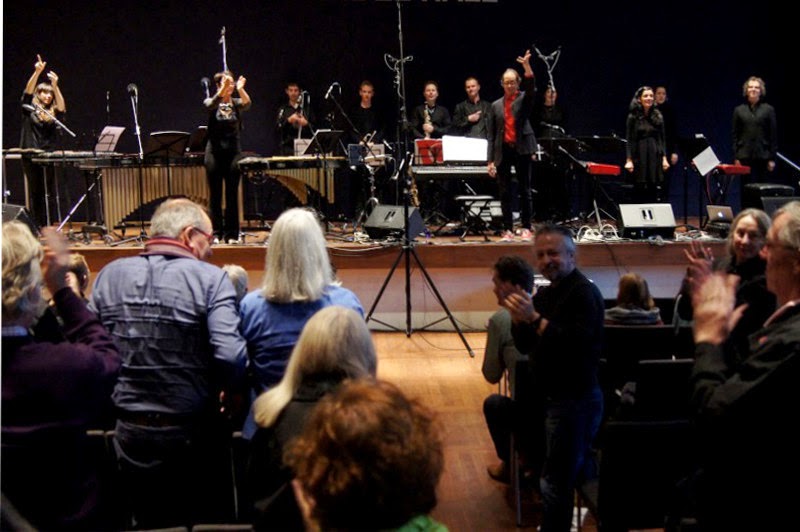

 It was an afternoon of (Philip) Glass. We were in the Gandel Hall at the National Gallery, not at the Fitters Workshop, next to the Glassworks. This was a mammoth outing. Three hours of Philip Glass. Ensemble Offspring and associates were playing a string of formative works by Philip Glass. He's somewhat notorious for his minimalism and apparently caused considerable stirs when his works were first presented at various locations in NYC. While listening, I became aware of how we are now acclimatised to this approach, even if I've had some questioning comments since. But it's fifty years back now. The works were dated 1968 to 1976 so the early ones are from the Summer of Love, 1968, high Hippy, but this is not Hawkwind or psychedelia. They are out of the fine music tradition (Glass studied with Nadia Boulanger in Paris) even if they are outside it. This is music reduced to a minimum, based on repetition and alternation of melodic cells. I wondered if it's prefigured by change ringing with its permutations of bell rings. The effect of the moving cells has a similar effect. But references are more to India and drumming and that fabulous percussion singing called Konnakol. Glass' music is intense, unforgiving, unrelenting, fairly loud; then it stops. The introduction suggested those in the know were the ones at the back lying on pillows, but then this is no longer the '60s (and the audience was no longer in its 20s). Audience could come and go through the performance. All very much of the period. The beats were intense and satisfying and the crossing rhythms were fascinating and forming their own mutating sub-rhythms. In one piece that I consciously tapped, I felt 6/8, noted three-note patterns and also quaver pairs (quaver pairs in 6/8?) but I couldn't easily tap to 5. I wondered about how it's written, then realised (again for this one piece but the approach seemed common) there was a cell pattern separating varying repeats of another pattern. I could guess how that might be written. The performers often nodded heads, no doubt identifying changes. There were a few slipups where someone stopped to await another nod.
We heard a string of works of varying degrees of complexity. Claire Edwards started with 1+1, a very simple work tapping a timber board. It reminded me of rhythm exercises I used to practice with a drummer mate. This was very early. Then Music in similar motion, played on two vibes and keyboard containing only ~6 notes. They played Music in contrary motion later, on two vibes, e-piano and 2 keyboards. The contrary motion was more complex and demanding of concentration but just as devoid of respite. I thought there was a drone there, too. Tough on the musos: have a moment's doubt or flinch and you're lost. The percussive pitch of vibes and the organ tones of keyboards were key, but Glass later expanded with instruments for overlaid pitches and alternative rhythmic patterns. Music for fifths was played on e-percussion, keyboard, clarinet and soprano sax but here the wind instruments just seemed to add tonal variation, playing the same unyielding lines. Knee plays 1-5, from Einstein on the beach, was the latest work (1976) and it's a big departure. A single simple three note line on e-piano, a string of singers with simple, beautifully enunciated voices singing 1-2-3-4/1-2-3-4-5-6/1-2-3-4-5-6-7-8 sometimes missing a number and a violin that is Einstein playing a devilishly difficult extended solo line, then again later. Just glorious, uplifting, fascinating. It must have been a devil of a work to play. Graeme Jennings (a CIMF2013 houseguest!) took it on, but I think it's something you'd have to live with for considerable time: no break, wild bowing and totally unforgiving. I was deliriously loving this all, although at 2 hours I was flagging. But then the finale, another highly developed work, Music with changing parts, dated 1970. The style was like the early ones, but beyond. I'm not absolutely sure of this (some musos were obscured in the back line) but I think this was played by 2 keyboards, e-piano, vibes, marimba/percussion, trumpet, alto/soprano sax, piccolo, bass clarinet and two female singers. The repetition of cells was there, but accompanied by long tones and various rapid repeated melody snippets. Someone said after that it was a NYC soundscape: ships on the Hudson, taxis, police sirens and the rest. I could believe this. This performance was limited to just 45 minutes (it can go on for hours) and I could have enjoyed more.
I loved this gig. I'd been bathed in beats and crossing rhythms of few, repetitive notes and tapped my foot dry (most just sat still, this being a classical audience, but how could you not move to those deliciously abstruse beats), absorbed some beautiful tone and voices and meditated on this all. And put tissues in my ear for the unrelenting volume: the volume wasn't so loud, but it came constantly. Great gig and another CIMF revelation.
A World of Glass was performed by Ensemble Offspring and associates. EO are Claire Edwardes and Bree van Reyk (vibes, percussion), Jason Noble (clarinet, keyboard) and Jim Nightingale (saxes). Their friends were Graeme Jennings (violin), Gabi Sultana, Alister Spence and Roland Peelman (keyboards), David Shaw (flute) and the Song Company with YAFF vocalists.


