Showing posts with label Chris Uhlmann. Show all posts

09 October 2014

Truth and fiction


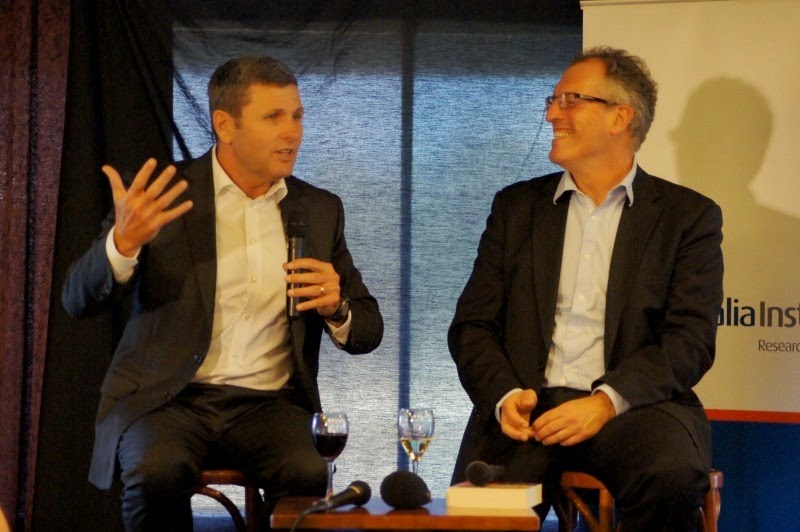
The obvious question is whether truth is stranger than fiction. It was asked and journalist/authors Chris Uhlmann and Steve Lewis cogitated and offered some examples and pretty much agreed that few would accept some of the true stories out of Australian Parliament if they were presented as works of fiction. Chris and Steve were presenting their second novel, The Mandarin Code, at the Australia Institute's Politics in the Pub. It's second of a trilogy and more a thriller than its satire predecessor, The Marmalade Files. There are characters you may imagine are thinly disguised, but this is fiction. Certainly. Our law doesn't allow otherwise (This surprised me. Copyright law allows for satire, but recognised characters can sue authors, presumably under defamation law, and it was mentioned that two lawyers were looking into the Marmalade Files). This is an opportunity for two major Australian political journalists to explore and to some degree expose our politics in ways that journalistic conventions disallow. A range of issues, both local and international, were mentioned. They were mostly in the daily press for the observant, although I wasn't always totally clear on what was and was not being spoken of as fiction. The Chinese Embassy building black site was in our papers. The Information Dominance Center at Fort Mead MD is real (I just risked NSA perusal by Googling it) but is the design like the bridge of the Starship Enterprise and the head's parking space being numbered 007 true? Apparently the transgender security analyst is real. Sending a US Carrier Strike group through the Taiwan Straights apparently remains possible. But is it art? It's certainly useful way to view the world, especially given political spin and control of public perceptions. It's also a "more entertaining read". It's been called "dickhead lit" (it's "fast paced" and there's a bondage scene in the latest book) but Chris is quite happy for it to sell well as airport lit and it's planned as a TV series. There was discussion of how the two write together. Also of whether panties is a valid term these days (Annabel Crabb queried it, but what of VPL?). An audience member questioned their take on the Greens, but the reply was that all parties get some ridicule and that most were concerned about being left out (and it's only Greens that raise this question). Jokingly, Chris and Steve both noted they'd been accused of writing fiction in their day jobs, too. So, worth the read? They noted Canberra as a place of interest and intrigue, especially for those working close, in Parliament, embassies, senior public service, defence, lobbyists and the like. Any capital city must be like this, and those that are built for the purpose are probably more concentrated. I've never been quite close enough, so I have reading to do.

Steve Lewis and Chris Uhlmann presented their latest novel, The Mandarin Code, at Politics in the Pub for the Australia Institute. Their first novel was The Marmalade Files.

11 August 2014

It does not explain everything, nor does it explain nothing


At Julia Gillard's first speech after losing the Labor leadership and the Prime Ministership, I was particularly taken by these words: "... the reaction to being the first female prime minister does not explain everything about my prime ministership, nor does it explain nothing". I think we will think much more highly of Gillard in future than we did a year or so ago. I didn't agree with all her policies (she was often too conservative for me) but she did good work and instigated decent legislation from well founded policy in an incredibly difficult situation, dealing with two oppositions (one within her own party) along the way. I fretted about her communication and it seemed to me that she failed as PM for that is perhaps the key skill, to bring the Australian public with her. But I recognise how strong and brave she was, and how difficult were her circumstances. So with this in mind and intrigued by other views, I attended a book launch of Gravity by Mary Delahunty in conversation with Chris Uhlmann at Paperchain Bookshop.

Mary worked in Gillard's office for a year and has been a politician (State, Labor, Victoria) and journalist. She first talked of Gillard's last day, and how, even on her last day, she had asked of Joan Kirner, who then had serious health issues. Also, how the tone of her office, calm, working, told of her leadership. She considered how, as Deputy PM, she was seen as the most effective in Parliament, but how this had so quickly changed with her accession to PM, so she lost legitimacy and was reviled ("nice girls don't wield knives"). She recognised mistakes, but noted Gillard's strength and competence despite the personal attacks. She observed that "Australians are comfortable with the notion of female power" (think early female suffrage) but Gillard experienced a breakdown of decency (Ju-liar, Bob Brown's bitch, etc) that left the field open for the "nutters". Think Alan Jones' notorious remark that her father "died of shame" (not to forget the "Chaff bag", carbon tax "borders on the treasonous" and "Bring back the guillotine!" comments). Mary observed that Malcolm Turnbull was one of the few who came out against this "vicious and destructive public discourse". Mary thinks this all got to Gillard (not surprisingly; she is human) and at Joan Child's funeral, a few weeks after her father's death, Gillard appeared to be "shrinking". Then that famous Misogyny speech. The strength of that, and the meek response from Abbott and crew were one point of real, emotive, informed communication with the Australia people, and internationally with women. I'd forgotten this, but Mary recounted that it followed a line from Abbott making veiled reference to Jones, that "This Government should have died of shame". I just wonder how Keating would have responded over time to the bitter personal attacks that Gillard received. Mary suggested the three requirements for a good politician are Policy, Purpose and PR. There was talk of that lovely photo of Gillard, taken by 12 year old Sophie with new camera and Down Syndrome, and how it showed her humanity. And talk of more viciousness. Apparently there have still been no apologies over the obnoxious Quail menu. And of the tweets on her 50th birthday, where some rugby league player (Robbie Farah, who's he?) suggested "a noose" for a birthday present and later tweeted that he was not talking of suicide and that people should "lighten up". Again, think licence to nutters. At least he has apologised. Then discussion of the effectiveness of some policy implementation (education as "sector blind / needs based"; I also think climate policy). But also of some failures, like Conway and his media reforms and the State of Palestine vote. Mary reminded us of Gillard's quip that there are 3 people in this marriage (meaning Gillard, Abbott and Rudd). Mary again, that Rudd was "pretty shocking" (and more that I won't quote here) and that Abbott was the most "pugilist" opposition leader in recent history. Questions were about whether the 9 month announcement of the election was wise: "No, I don't think so". Why did her communication change so spectacularly when she became PM: a "great tragedy" but that's not to deny some political errors. Is there less respect for PMs here (vs USA, UK, etc) and what's the role of media and Australian culture: amongst discussion, Mary noted that Gillard "parked her gender" but that her opponents used it. In this gender context, Mary said Julie Bishop has done an excellent job recently on MH-17 but that she is a "protected species" as the one woman in Cabinet: a Liberal members told her "we can't touch her, she's a shiela". Caringly, the last question was about how Gillard is faring now: she's heavily involved in a Global Education project and frequently in Washington DC and Geneva; she has "ups and downs", is sensitive to writings about her and misses policy work and colleagues (there was some mirth and incredulity following the mention of missing colleagues).

This is a complex story and much more will be written of it all and it's too early to see what views the historians take in the end. It's just one policy, but I can only imagine that Gillard's climate policies will be praised and Abbott's removal will be pilloried. As it should be. She had her weaknesses and made mistakes, but, as happens with many women, she was quietly capable beyond many men of her times, but too quietly.

Mary Delahunty was in conversation with Chris Uhlmann at Paperchain for the launch of her new book: Gravity : Inside the PM's office during her last year and final days / Mary Delahunty. Richmond, Vic. : Hardie Grant Books, 2014.