Showing posts with label Australian Youth Orchestra. Show all posts

21 April 2025

The kids are alright

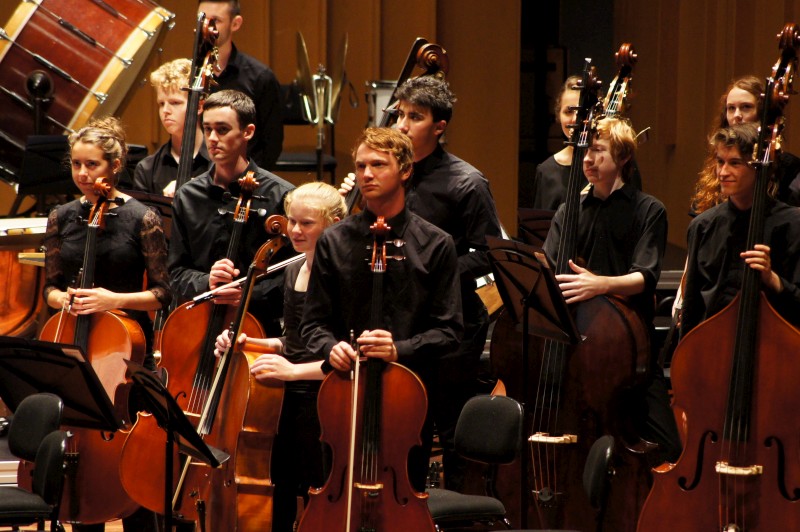
Today was a free gig by the Australian Youth Orchestra just down the road at Snow and it was just a wonderful outing and a decent and popular program.  Jessica Wells Uplift putting take off and flight to music.  Then Ann Carr-Boyd Look at the stars with short movements from Mars to galaxies and specifically the Sombrero to the Sun and Mercury and Saturn and out again to star clusters.  My faves were Mercury, a jovial wind trio, and the generic star clusters with all manner of stars slashing by through gravitational fields.  Then some comfy and popular classics.  J Strauss II with on the Beautiful Blue Danube, all waltz melodies, apparently 5 melodies each played twice, and Mussorgsky Pictures at an exhibition which is ever popular and it's obvious why, fascinating and varied and expressive as it is.  I loved the huge crescendo in whatever and the superquick bass lines later on, but much more is hugely exciting.  I've played this but can't quote the prices they appear in.  And they played it well.  Not professional but very good and these are kids, although our AYO accepts to age 27 so could include music school graduates.  None-the-less, hugely impressive and a great free afternoon out.  And nice to see reams of kids, teens and younger, avidly enjoying this music.  Great outing and thanks to AYO.  This is the second year of an AYO camp at Canberra Grammar School and Snow concert hall.  Keeping it local.

Australian Youth Orchestra performed at Snow Concert hall under Luke Dollman (conductor).

23 January 2016

Man interrupted

I was distracted by family matters for this final AYO concert. I heard CPE Bach and William Walton by TV from the foyer. The Bach sounded lovely in its dignified way, if nothing like the real thing, but the Walton didn't come over so successfully on these little speakers. Perhaps the audio should be better in the foyer, but then TV is standard. I got in for Genevieve Lacey playing three Bach reinventions by Elena Kats-Chernin and they were both convincing with truly impressive recorder playing and a joyous and respectful revision by Katz-Chernin. Alexander Orchestra under Brad Cohen played Stravinsky Suites for small orchestra no.1,2 and they were variously restrained and riotous so very satisfying. Then the ultimate major work of the night and of the Camp, the huge Bishop Orchestra under Erik Nielsen playing Schoenberg Pelleas and Melisande. I remained distracted but caught a huge work of grand scope and strangely not split into movements. One to revisit under different circumstances.

Genevieve Lacey (recorder) performed with the Smalley Chamber Orchestra. The Bishop Orchestra under Brad Cohen performed Stravinsky. The Alexander Orchestra under Erik Nielsen performed Schoenberg. Both performed at Llewellyn Hall for the Australian Youth Orchestra National Music Camp 2016.

21 January 2016

Penultimate

This was the third orchestral concert of the AYO National Music Camp and the penultimate concert for the series. It was a beauty and much anticipated, for the Beethoven 7 and the John Adams. The Carl VIne was less anticipated. In the end, I enjoyed John Adams, played by the Smalley Chamber Orchestra with a conductor. I was intrigued by the loops and the minimal but continuing changes, mulled over the history of the concept of loops given their ubiquity in much contemporary electronic music (and my recent desire to purchase a looper), although I did feel the piece carried on somewhat. Not so all minimalism, but this was quite early and new. But how well played it was, and clearly conducted by Monica Curro. Then Carl Vine Tempest Suite. This was unanticipated because I/we did not know what to expect, other than Australian composer, but how much I enjoyed it. Luscious, balletic music with romantic flourish and expanse. An unexpected gem played by the Alexander Orchestra under Brad Cohen. I followed the conducting and had no idea where his 1 was, but his flourishes seemed to draw nice dynamics from the orchestra and it sounded great. Then the Beethoven symphony no.7 after the interval. I was floored. Typical Beethoven, which I am now coming to recognise from playing a few. Dogged, always moving, never clumsy, incisive starts, canons, quick scherzo and the rest with some dastardly difficult lines for bass and presumably equally so for the other parts. Pretty much scalar, but long scales over the whole neck and back again, and again. Congrats to these kids who can perform such a feat at this true speed. I stand in awe.

The Smalley Chamber Orchestra performed Adams under Monica Curro (conductor). The Alexander Orchestra performed Vine and Beethoven under Brad Cohen (conductor). Both performed at Llewellyn Hall for the Australian Youth Orchestra National Music Camp 2016.

19 January 2016

Having all the fun

We tend to think of the big bertha orchestral concerts as the peak and they are the best attended and best timed and the ones that get broadcast from AYO to ABCFM, but the Brass/Percussion concert was a thing of great joy and great beauty in its own right (and rite). The first notes were from the large brass ensemble and they glowed with bell-like clarity and corporeal rotundity. This band was trumpets, trombones, horns with a few drums in support. They were playing Strauss Vienna Philharmonic fanfare. What's not to like about a fanfare? Dignified, projected, joyous, warm, full. We were told it was written following his divorce from his second wife. Amusing, too, if true. And so it continued. The percussionists got up for a traditional African drum chant from Burundi. This reminded me of jazz drum solos and not the only time in the night. Then a smaller mix of brass for Rimsky-Korsakov Mlada Procession of the nobles and a string of horns for a Wagner prelude (Act 3) from the Mastersingers of Nuremberg. I felt this last one could be maudlin at times and the tone of the horns lends itself to this. The horns then snuck in an off-program rendition Bernstein Magnificent seven theme. Great. As the compere reminded those old enough to remember, "As a matter of fact, I've got it now". A smaller group of brass with harp and two percussion played the three movements of Shostakovich Jazz suite. That felt at home, especially with the jazz waltz first movement. Then a drum nonet playing Michael Colgrass Three brothers. Nice; reminders of jazz drum solos, again, and some lovely sharp and even sticked bongos that stood out a mile. A trombone ensemble came next. Trombone must be the most luscious and pure of the brass instruments. They played three renaissance dances from Holborne, then a lovely harmony-rich rendition of Gershwin Someone to watch over me. Such melodic sentimentality can never be out of place. Then the larger brass ensemble with the delicate to insanely heavy Prokofiev Romeo and Juliet suite and a cute Love of three oranges march, again Prokofiev. And to finish? I didn't quite catch the intro, but this turned out to be a huge medley of classical and pop themes collected by the percussion ensemble itself. This was truly fabulous and entertaining and worthy of the standing ovation. Sandwiched by intro and finis of 2001 (=Also sprach Zarathustra) with everything from Mozart and Bach and Ravel and Beethoven and Katchaturian to tango and La Marseillaise and West Side Story and Sinatra. All held together with cool jazz feels, some great kit drumming, plenty of marimbas and vibes and glocks and a cavorting conductor and even a ballroom dance accompaniment from two performers to [I did it] My way. This concert was joyous and beauteous but not just that. If I get the chance, I think I'd like to come back as percussion or brass. As long as they count right, their jobs are not too busy and very prominent. They have all the fun (tongue clearly in cheek).

Various AYO Brass and Percussion ensembles played a range of musics with and without various conductors at Llewellyn Hall.

17 January 2016

Coffee and 500 and the one shot

There were just four of them at this year's National Music Camp and they only get to come to one camp and at that camp they only perform, if that's the word for it, for their one allocated spot at the Composition concert, so the composers may be thought to have a tough time of it. But they are hugely important and central to this whole endeavour and they get to control and guide the whole, and in this case they got to lead the tutors, because it is the tutors who perform the new compositions. It must be a different experience. They all talked of peripheral entertainment, playing 500 or billiards or late night coffees. They could also all talk of the intense work, the development, the ideas that formed or guided or led to a piece. Stephen de Filippo was inspired by a painting of someone peeling a boiled egg for an invalid to create Meal for a convalescent. He had split the group into a trio of percussion, clarinet and viola (perhaps violin?) who led the piece then interacted with the rest of the ensemble, starting quiet and delicate then through tutto passages to a trio ending. Michael Mathieson-Sandars presented Got no coal. This had a political edge, merging melodies from Mozart with an old Union song, music of aristocratic and worker traditions, all treated microtonally and otherwise so the origins weren't too obvious. Unlike the previous, this one started big and receded. Mmm, there's thought here of the modern world, of the 1% and the rest. Then Josiah Padmanabham presented Karin. This was an exploration of characters from the Bergman film, Through the past darkly. This seemed more sparse, hammered piano notes, isolated other notes. Then Daniel Riley with Gravitations. He admitted a nerdy interest in physics and a non-nerdy practice in billiards. Gravitations investigated the idea of kinetic motion, velocity imparted from one ball to another, energy dissipated in collisions, missed pockets even, and a parallel of ideas combining, reflecting. Metric modulation was mentioned. This was bigger, more symphonic and my favourite of the afternoon, but all were intellectually satisfying and musically investigative. Four composers appearing from the low lights of coffee and cards. Interesting.

Composers Stephen de Filippo, Michael Mathieson-Sandars, Josiah Padmanabham and Daniel Riley presented new works that were written at the NMC. Elliott Gyger conducted tutor ensembles and interviewed the composers.

12 January 2016

AYO(NMC2016)2

James Crabb commented on the energy backstage before the gig, that all concerts should be so alive. It's something that I've noticed before and that makes the AYO's National Music Camp something special. These girls and guys are young and committed, working hard and having a ball. They are also very capable and well trained and it's all obvious and a key to the pleasure which is this series. The second concert was another orchestral outing, again with the chamber and two large symphony orchestras. The Alexander Orchestra under Erik Nielsen opened with Weber's Oberon overture. I've played it so could follow closely and I admired the series of rapid bass lines. Megan asked had I played all that. Yes. Perhaps not quite so fast; I'll have to return to the recordings to confirm that. What got me was the clarity of lines at that speed. Playing fast is not so difficult, but fast and clearly with no faking is the test. These notes were all there and distinct. Then the Smalley Chamber Orchestra playing Elgar Introduction and Allegro. I liked the composition and the performance. I found the piece superbly attractive for strings and can only hope to play it sometime. James Crabb joined both symphony orchestras to lead and feature on Piazzolla Acongagua. This is a concerto for bandoneon and orchestra, played here on chromatic accordion. Typical Piazzolla, enhanced tangos, simple harmonic movements, attractive and mobile. JC did a nice job leading and a very impressive job on the accordion (much enjoyed for delicacy and speed and phrasing). Strangely, the Bishop Orch played the first movement, then gave way to Alexander for the next two. Weird and interrupted but it worked well enough. Then, after interval, the Bishop returned under Brad Cohen for the exhilaration of John Adams Short ride on a fast machine (apt given Summernats is on just up Northbourne Ave) and Ravel Daphne and Chloe which was, to me, feeble after the excitement of Adams. I guess it deserves another listen in a different environment. The whole went out live on ABC Classic FM and the other orchestral concerts will also be broadcast over coming weeks. All lively and capable and exciting and a great first afternoon and evening for the AYO.

The second concert of the Australian Youth Orchestra National Music Camp 2016 was orchestral, with the Smalley Chamber Orchestra, Bishop Orchestra under Brad Cohen (conductor) and Alexander Orchestra under Erik Nielsen (conductor). They played Webern, Elgar, Piazzolla, Adams and Ravel.