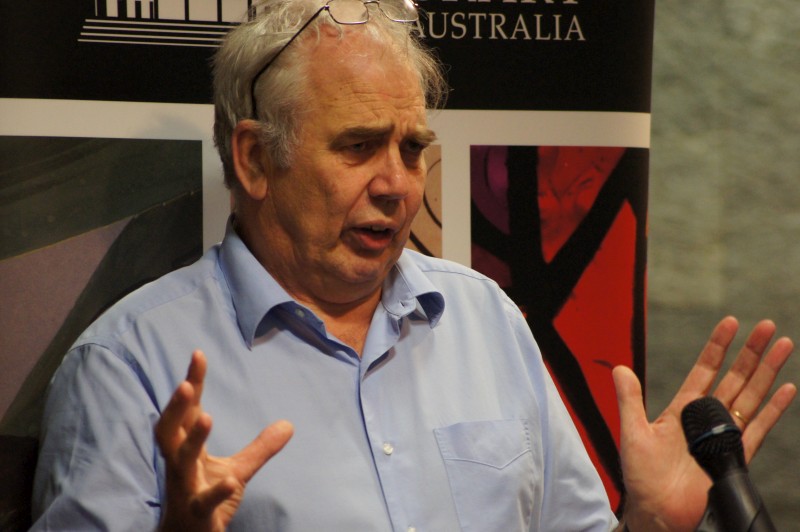
Allan Anforth (barrister, academic, author) was in conversation with Jack Waterford (journalist, opinion writer) at the launch of his book 'The role of rhetoric in politics and the media' at Paperchain bookshop, Manuka.
Showing posts with label Jack Waterford. Show all posts
30 May 2025
When much new is old
Labels:
Allan Anforth,
Jack Waterford,
politics,
rhetoric
16 April 2016
Tale of two elections (spoken of one)

It's only a local election (with city-state-level consequences) but they say all politics is local (not in my book) and being informed is a citizenly sort of thing to do. And I'm annoyed with tram and Manuka Green and more and wanted to see the fireworks (there were none). The event was another conversation held in the Theo Notaras Centre called by Jon Stanhope and the Institute for Governance and Policy Analysis (IGPA) at UCAN. I enjoy these sorts of things and this was a particularly impressive gathering. Virginia Haussegger chaired a panel of four: Jack Waterford, Kirsten Lawson, John Warhurst and Ian Miekle. Suffice to say any local news junkie will knows these names. The topic was the election, or elections, coming up this year: ACT in October; Federal perhaps a double dissolution on 2 July, otherwise August/September. Lots spoken over the hour or so, but here are a few gems or themes. This ACT election will be different, newly expanded from 3 to 5 electorates, 17 to 25 MLAs, each seat with 5 members (no seat of 7 members as previously), each seat representing a clearly defined region. All this effects likely outcomes. KL suggested a likely outcome as 12Lab/12Lib/1Green; others concurred as far as possible for now. Dominating issues should be health and education, but trams (perhaps Manuka Green) are divisive. An "It's time" factor is possible, but complacency may reign. Labor's transitioning and Liberal's right wing may be issues. JW just expects different rents seekers to appear with different governments (he's been here, seen that). Panelists expressed concerns about short-term thinking, in voters and parties, and lack of vision. Jeremy Hanson was quizzed on social matters and didn't show as so right wing, but his backbench may be different ("fairly extreme"). There's possible punishment of Labor/Greens for allying, but this is a Green-leaning town. Panelists saw no particular personality factors. One wondered if a tram would be a chosen option now, with changes in technology in the air, and, given the cost and other problems with this one line, would any more ever be built. Interestingly, one identified the tram as a means of maintaining Labor support with younger Gunghalin voters (but it could also turn bad). Once again, 35yo+ white males are being categorised for anti-tram sentiment (I find this line tiresome) even though the panel, too, sounded none too convinced of light rail. Me-too-ism was identified in the Libs in the context that governments lose elections, oppositions don't win. Interestingly, one observation (Jack Waterford, I think) was that "politicians without belief get repudiated", to which IM responded, what of Abbott, with the obvious rejoinder that the belief "must be what people believe in". There was a mention of the Unions ACT campaign that seeks pledges to vote Labor. There's no way I'd do that and KL was similarly reticent. There was discussion on how to influence politics (the path is through parties), but how hard it is, and the level of powerlessness expressed by the public (90% federally; 70% locally). Then talk of social activism and vibrant communities and the fact Howard still went into Iraq despite widespread social action. Bob Douglas' Sea Change group was raised, but seen as a possible long-term influence. JW (Warhurst) suggested voters "must be brave" to change votes for issues or be ignored. Also that parties are not controlled by members, but by suits, so strong views don't change things, actions do (think Tea Party, Obama dems, etc). The Federal election was touched on but mainly only in passing. Perhaps there was more but that's the drift.
The Institute for Governance and Policy Analysis at University of Canberra staged a commuity discussion on the election(s) with Virginia Haussegger (chair) and panelists Jack Waterford, Kirsten Lawson, John Warhurst and Ian Miekle.
19 April 2013
One year in a town
Despite the best of intentions, I never manage to attend Geoff Page’s poetry sessions at the Gods. But at least I got to the launch of a new book by Geoff the other night at the National Library Bookshop. Geoff is not just a jazz aficionado, promoter of the Gods jazz series and author of Bernie McGann’s biography. He’s also a renowned poet. I know nothing of poetry but I’ve felt an interest of late, and Geoff’s poetry is particularly easy to warm to. My understanding is that he writes long-form verse. What I hear and read is easy and appealing and respectful and broadminded. The book he was launching is called “1953” and is portrait in verse of a country town in that year.
Jack Waterford of the Canberra Times introduced the work. I read Jack’s articles with much pleasure. I find him informed but also calm and humane and sensible. Jack was an obvious choice for this job. He grew up in a country town, often speaks of mid-20th Century Australian rural life and is obviously influenced by it in matters of ethics, community, aboriginal relations and more. So he spoke here: of the war (WW2), the polio scare and the floods; of barber, publican and the woman running the phone exchange; of secrets, layers of history, of adulteries and infidelities; of relationships of Euros and Aborigines. He mentioned Dennis O’Rourke’s film Cunnamulla and the instantly recognisable characters in bush towns. He noted parallels with suburbs of the time, with their own networks of known characters. It’s different now (although there are some hangouts, like Ernie at out local post office). We are more secure, more comfortable and there’s less risk, but we lack that “rich tapestry” of characters and the “conscious[ness] that we were alive”. Geoff’s characters in 1953 may be fictional, but they are not caricatures. They lead rich and complex lives.Geoff offered some of those characters in readings. The two girls who talk of a third. The gunshop owner who muses on the metal and the skill and the touch of wooden butt to cheek. Auntie Mary, the aboriginal mother, whose son was taken and who now drinks in sympathy with the community. I was struck by the image of a stolen aboriginal girl who could live in the white community “passing as Italian” and by the sense of otherness that was portrayed. And to finish, Geoff’s partner Allison, read “Me”, a rhyming verse of her own childhood of the time. Then another wine, a copy of the book to sign and home. An interesting and thought provoking outing. Geoff Page read poetry; partner Allison read verse; Jack Waterford introduced.
Subscribe to:
Posts (Atom)