Showing posts with label Haydn. Show all posts

24 March 2015

Existential


It's a challenge to an atheist in the 21st century that this music of Haydn, written in the seventeenth century and a recitation of the words of Christ on the cross may be amongst the best music ever written. Certainly I thought that as I was listening to this thing of immense beauty, but I think it often enough for other music, too, so confusion can be just be put down to existential angst. Whatever, this was beautiful. The work is called Seven last words. Haydn composed it for string quartet on commission from Cádiz in 1786 and it was initially performed, unexpectedly for Haydn, in a small, bare chapel. The seven phrases were initially spoken between the sonatas, but eventually got written into an oratorio version. This performance was a rare one by four voices individually singing parts with string quartet on period instruments. The performers were stunning: an instrumental quartet from Australian Haydn Ensemble with a vocal quartet from the Song Company. First class. The movements are Introduction, seven sonatas and an ending Terremoto (earthquake). The words (=phrases) are: Father, forgive them, for they know not what they do; Today you will be with me in Paradise; Woman, behold your son; My God, my God, why have you forsaken me?; I thirst; It is finished; Into your hands, Father, I commend my spirit. The sonatas move through various major and minor keys in various tempos, from Largo and grave to maestoso, adagio and presto con tutta la forza (Terremoto). Just stunning and immensely beautiful in a way that bridges the baroque. The whole lasted about 90 minutes. Projected text located the listener. The text was sung in German. I thrilled at Anna's carrying soprano; enjoyed the high tenor voice and lusty bass and harmonising alto. Skye took most melody lines on first violin, with viola and second violin accompanying and giving presence; Anthony's period cello spelt crochets or counterpoint. There's a perfection in this small ensemble of one voice per part. Apparently it hasn't been recorded in this format and someone suggested that they might. I hope they do. In a studio, with no coughs and the perfection it deserves. Stunning.

The Australian Haydn Ensemble and the Song Company performed Haydn's Seven last words (of Christ). The instrumentalists were Skye McIntosh (first violin), Catherine Shugg (second violin), James Eccles (viola) and Anthony Albrecht (cello). The singers were Anna Fraser (soprano), Hannah Fraser (alto), Richard Black (tenor) and Andrew O'Connor (bass).

21 December 2014

AHE swells


I'd seen the stage set up, but I was still surprised when the augmented Australian Haydn Ensemble entered from the rear of the Sitsky room. This was 21 musicians; far larger than I'd seen before from this group. They just kept coming. This was not the only surprise. The 2 keyboards, plucked and hammered, at centre and the version of Haydn that seemed not to have been recorded before. Then straight into that unrecorded work: the Vernier version of Haydn Symphony no.22 The Philosopher in Ebmajor, apparently rearranged in the vibrant Paris of the time, using flutes in place of cor anglais. My recording may be a world premiere; that's exciting. The rest of the program comprised 3 works by CPE Bach to end the AHE's celebration of his 300th anniversary year. Firstly, his Concerto for harpsichord and fortepiano, utilising the two keyboards again, also in Ebmajor. After the interval, two pieces without accidentals (near enough), his Sinfonia in C major and Cello concerto in A minor featuring cello soloist Daniel Yeadon. The AHE has established itself in remarkably short time: this is only its second year. Proof is their welcoming of significant names in period music and their role as ensemble in residence at ANU this year. As well as Erin Helyard conducting from the harpsichord, Daniel Yeadon and Neal Peres Da Costa on the fortepiano, this concert featured Catherine Mackintosh (of Orchestra of the Age of Enlightenment, Royal College of Music, and much more) as guest leader. Many AHE guests are new names to me, but the discoveries are a pleasure. This is all courtly, dignified music, although with its share of humour and pleasure and even profundity, although it's never too obviously displayed. THis was just a wildly successful performance. There were a few slips but all was welcomed with joy and verve and this is of so much more importance in my book. This is not at all staid. Erin was vibrant and mobile; Neal was all eyes, to Erin and Catherine and further; I think it was Simone who was buoyant with joy at the pleasure of it all; AHE stands, so there's constant movement. I noticed myself moving with this music: it's alive, vibrant, it invites movement so you squirm in your seat. The pleasure was evident as the musicians left and in their joy after. A wonderful, musically populated, enlivening concert.

The Australian Haydn Ensemble finished its year at ANU with a CPE Bach 300th anniversary concert in the Larry Sitsky room. Erin Helyard (director, harpsichord) led 21 musicians: Catherine Mackintosh, Matthew Greco, Stephen Freeman, Mayee Clohessy, Anna McMichael, Skye McIntosh, Simone Slattery, Raphael Font, Cath Shugg (violins), James Eccles, Heather Lloyd (violas), Daniel Yeadon, Anthea Cottee, Anthony Albrecht (cellos), Jacqueline Dossor (bass), Melissa Farrow, Mikaela Oberg (flutes), Darryl Poulsen, Doree Dixon (horns), Neal Peres Da Costa (fortepiano). Daniel Yeadon performed the cello solo; Catherine Mackintosh was quest leader.

25 April 2014

A program for Easter and Anzac


The ANU Chamber Choir and Chamber Orchestra performed on stage at Llewellyn. I've done it before, but it's strange to join the performers on a massive stage and look out at 1330 empty seats. But nice. It's intimate, it seems acoustically quite live, boxed in by timber, and it's a decent sized space. This was a sellout, with performers and audience sitting on a flat surface, so sightlines were difficult, but so be it. There were two works on the program: Buxtehude and Haydn. Peter Tregear introduced them as selected for this Easter / Anzac week.

Firstly, Buxtehude's Membra Jesu nostri, a series of 7 cantatas each contemplating a part of Christ's dead body (feet, knees, hands, side, breast, heart and head). It's a strange concept, but this is early music, pre-Enlightenment. They thought differently then, and they were in touch with death. Buxtehude composed this in 1680 but to stanzas of a mediaeval hymn from a poem of the high mediaeval period. The ANU Chamber Choir comprised about 30 performers, with some members coming out to solo. They were accompanied by a small chamber orchestra of 2 x violin (or violin and viola?), 1 x viola da gamba (sometimes 2), cello and organ. Peter Tregear conducted. The strings were using baroque bows. It was sung in Latin. The programs had Latin text with English translation. I followed the text and found it rewarding, giving the meaning and worldview, but also making the counterpoint and baroque embellishments obvious. Body of Christ; I kept thinking of that ghostly Mantenga painting, Lamentation over the Dead Christ, that resides at the Brera in Milan. This was truly another era.

The second work of the night was performed by the ANU Chamber Orchestra with conductor David Irving. This is much larger orchestra but about half the size of the CSO (two basses) with a full suite of horns and brass and woodwinds and timpani using modern instruments. This was much closer is style to our era, being early modern, early classical. Peter introduced the work as immediately post-French Revolution, but it felt light and attractive and the program quoted Haydn's pleasure at its inaugural performance: "... packed audience ... I took in this evening 4,000 guilden. One can make as much as this only in England". Music for a market but lovely none-the-less. This was Op.104, London Symphony, the last of 12 symphonies he composed for visits to London. Four movements, attractive and lively, very pleasurable, just a touch of the idyll, sometimes danceable, often grand and joyous and wonderfully pretty. Again, nicely played and delightful music.

  • Thanks to Wikimedia Commons for the Mantegna
  • 14 January 2014

    AYO2014/2 (Orch 2)

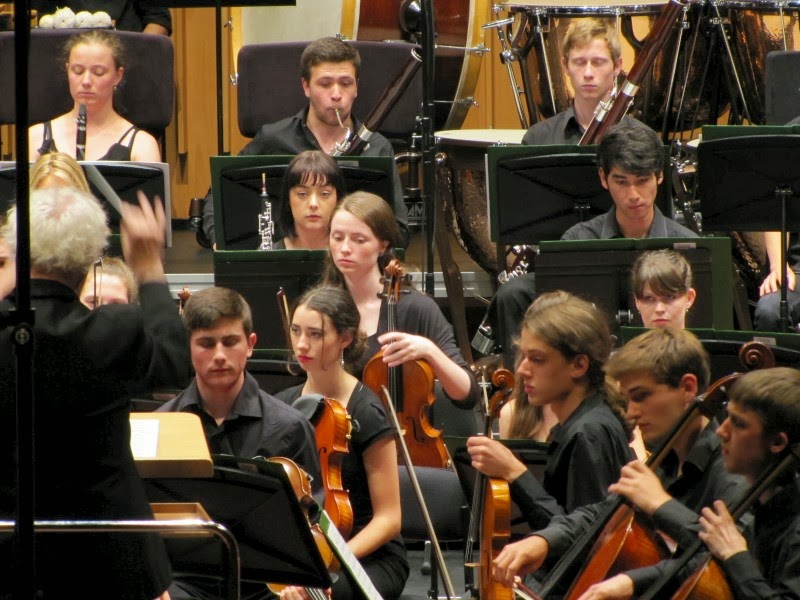
    Later that evening, after a picnic dinner. The AYO reconvenes for orchestral concert no.2 for the day and for the week. Same three orchestras. This time the Bishop Orchestra under Alexandre Bloch goes first, performing Tchaikovsky Romeo and Juliet Fantasy-overture. I'd read in preparation for this and the others, so I was waiting for the characters and scenes of Shakespeare's love tragedy. The love scenes of Romeo and Juliet and the fights of Capulets and Montagues were obvious; the death scenes with the heart-beating tuba was a stunner; I missed Friar Lawrence. How accurate is this as a portrayal of young love, and enveloping passion, pure and melodious! Are we too cynical in our times to accept this, or too grown-up? Musing further, do we confuse cynicism with maturity? The orchestra performed with panache, although I felt dynamics were a bit tight a few times. Here's where professionalism and confidence and constant performance make all the difference. Even more impressive after hearing that 80% of the Music camp participants are new this year. I expect there's a turnover revolving around the triennial international tours. Second was the Hopkins Chamber Orchestra under Geoffrey Lancaster playing Haydn Symphony no.104 in D, the London Symphony. This was the last of 12 symphonies he wrote in London, but the one with the "London" nomenclature, and the work of a mature composer. Majestic and stately but very cerebral after the romanticism of Tchaikovsky. Sadly, a mic stand collapsed in the last movement, first onto the conductor and then to the floor, which must have come over live ABC-FM as a knock and subsequent unbalanced orchestra. Too bad for the performers who will lose a good memory. Then to Copland Third Symphony by the Alexander Orchestra under Richard Gill. It's got the memorable Fanfare for the Common Man. A wit said it had the fanfare in 5 keys. Certainly, the later movement is permutations on this theme, but it's an impressive theme. The earlier part, though, seemed aimless to me and Megan and Grissoula and Geoff. I thought of the movies and the choppiness of their scenes and camera angles. This is a work devised in the era of movies. Has frame and scene flipping changed our musical conceptualisation and even our intelligence and awareness? Maybe it was just the end of a lengthy session and we were a bit wrung out and concentrating less. Two wonderful concerts in one day and several more coming over the week with another two orchestral outings this coming Saturday. Great. And you can't get better value. Truly excellent entertainment: committed, intelligent, attractive and youthfully vibrant. Fabulous. Hanging out for the rest.