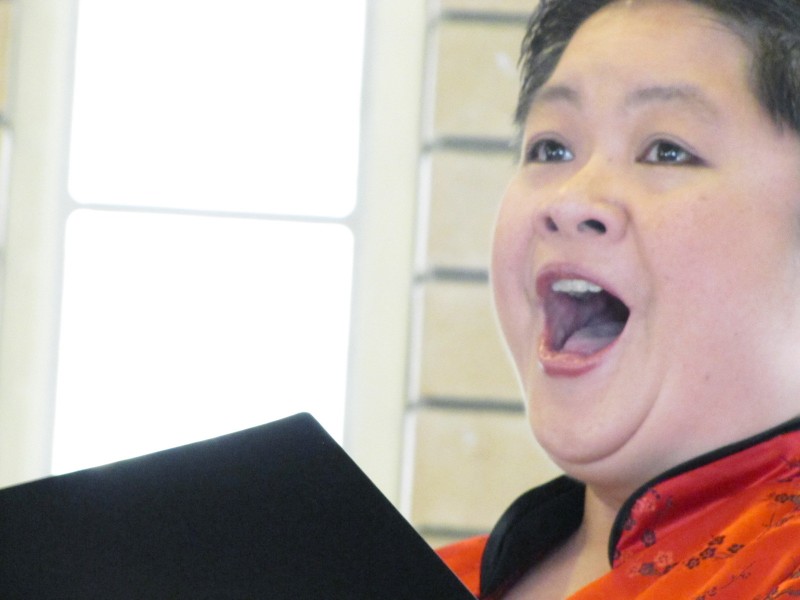
It’s Christmas and that spells carols. They are lovely in their serenity or profundity or frivolity or sheer joy, and singing them is an annual treat. I caught a concert by Louise Page at lunchtime at St Albans Anglican Church, and she was joined at various points by a sweetness of sopranos, both students and ex-students. So this was both pleasing to hear as entertainment and intellectually satisfying as an exploration of diverse voices. The classical soprano is a unique voice. Strong and high, cutting easily through choirs and orchestras, it’s something special. It’s almost instrumental rather than human, proud like the violin, haughty, swelling and unstoppable, beautiful and pure, frequently unintelligible and otherwordly, but glorious and overwhelming. (This becomes literal in the film, The Fifth Element, when Sarah Brightman’s voice merges with synthesizer and soars to an impossible pitch as an alien soprano). Soprano is not a voice of jazz. Jazzers are far more rooted to the earth. Soprano is a cultural peak product, something that demands and rewards time and understanding. The immense vibrato, too, is a thing of beauty but unreality which it shares it with modern classical strings, and increasingly with jazz that’s rediscovering vibrato after Miles’ rejection in the ‘50s. But I diverge.


This was quite a range of songs. Louise started with Joy to the world. Piano accompanist, Phillipa Candy, had arranged this with screeds of diatonic chords that rippled up and down the keyboard. I liked this, as I liked her accompaniment for the whole concert: capable and responsive, while obviously reading the charts. By the end of the session, I noticed, too, how rich and relatively deep and mature was Louise’s voice. All these voices could fill this small room with power and volume, but Louise’s was that much more even and purposeful in her interpretations. I chuckled that the words (Italian or English) remained unintelligible, but the quality was undeniable. Then on through a range of songs: some Australian carols including Wilfred Holland’s Bethlehem that I know from choir days; the common but delicious Bach/Gounod Ave Maria that Louise dedicated to birthing mothers; even pop hits like O come all ye faithful. And through several other, very differently sounding soprano voices. I particularly liked the tune No lullaby need Mary sing, by Joseph Clockey, that displayed unexpected modern melody. Katherine Warren sang that one. O Holy night, by Adolphe Adam, has to be my favourite carol. Julia Wee sang that one. There were humourous ones, like the rejigged lyrics of My true love gave to me, which Louise introduced wryly “for all the mercenary habits we’ve come to accept”. Louise claimed one of her favourites was Robert MacGimsey’s Sweet little Jesus boy, which is written as a black American spiritual with blue notes. There were also songs I think I’ve never heard, perhaps not surprising given the paucity of carolling in my life. I doubt I’ve ever heard Little road to Bethlehem, by Michael Head, which Pamela Andrews sang. I loved it when when we heard some harmonies. First was The silver stars, by William James, where Louise and Sarah Campbell sang together. Then the audience singalong led by pairs of singers with raised voices throughout the chapel. Everyone has to know these superhits: The first Noel; Hark the herald angels sing; O come all ye faithful. That was fun all round. Complete with Louise authoritatively singing a complex counterpoint that had me striving to hold the tune.
What a lovely and satisfying way to while away a lunchtime. Immensely better than … ugh … Christmas shopping. Louise Page (soprano) led various combinations of the sopranos Katherine Warren, Pamela Andrews, Julia Wee, Sarah Campbell and Petra Lindsay with the accompaniment of Phillipa Candy (piano).
 I am not surprised by volume in soprano voices - they even tower over orchestras - but I was surprised by the volume of Tegan Peemoeller’s harp when she played with the soprano Katherine Warren.

 This concert restarted the so-pleasant lunchtime series for 2012 that I’ve discovered at St Alban’s Church in Woden. It’s a small chapel in the round, with a timber ceiling that directs the sound and carpeted floor and brick to give it some control, but even so the volume took me back. Then I noticed the similarity in tone to a classical guitar and the piano-like range, down to 3 octaves below middle-C (that’s double bass range). I spoke to Tegan after. The higher octaves are nylon strung, and the lower ones are variously gut and steel round-wound synthetic, so that low G she played was not the same tone. We also discussed tuning. Pity the poor harpist: subject to heat and humidity and lights, each string requiring individual tuning, all 7 octaves or so (~84 strings; the open strings are the piano’s white notes, and pedals sharpen or flatten for the full chromatic scale). The harp was loud but also gentle despite the twang of the pluck. And it was perfectly lovely with the high, pure singing of Katherine’s soprano. These were songs – they performed 11 in one set – and the songs were both short and distilled. They have a story but I didn’t easily catch the lyrics, so the voice becomes abstracted as pure intervals, twilling vibratos and swelling crescendos. The pair played a popular tune, Dream a little dream of me, and I found the earthiness and groove was missing to my ears. Classical performers don’t have the same sense as jazz or pop players about where to place the beat. I didn’t catch the words much either, but then they are trivial and sentimental so perhaps it’s not much loss. But the classical songs were a delight: richly structured melody; easy but effective harmonies; clarity of purpose; and a sense of timing that worked for the style. A song by Fauré recounted sailors leaving on ships and their wives in tears and you could hear the rolling of the seas in the rising and falling arpeggios in 3/4 and the bereft wives in the slow voice line above. These songs were prepared for a Sleep & Dreams concert, but most songs are love songs under the cover. Handel’s Oh sleep don’t you leave me was the starter, then a pair on the same poem, Come sleep. My guess is these were both mid-20th century. There were lullabies, including Brahm’s famous one, and another easily identifiable tune in I dreamt I dwelt in marble halls. There was one particularly touching lullaby where an escaping soldier, left with a discarded baby, sings the child to sleep. This is clear and calm and pensive melodies and quite lovely. Tegan Peemoeller (harp) performed songs with Katherine Warren (soprano) at St Albans Church.