Showing posts with label Jennifer Groom. Show all posts

05 June 2023

Confounder factor

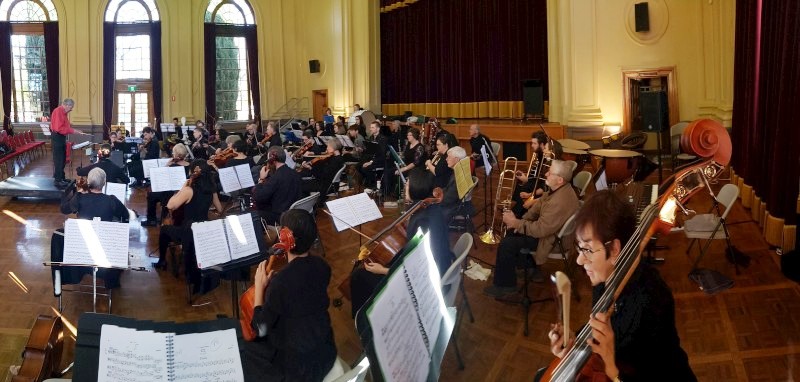
I've probably said it before but this was perhaps the most difficult piece I've played (until next time?).  Maruki does the repertoire and doesn't flinch on the programs, eg, next concert includes two Russian symphonies.  But this time, it was the standard format, an overture, a concerto and a symphony.  First half was Rossini L'Italiana in Algieri and a to-die-for lovely clarinet concerto by Mozart.  They went well although of very different styles.  Rossini is all operatic Italian flair and Mozart is dignified, super-pretty and downright touching.  Both done pretty well and Beth doing a great job on the solo clarinet.  But the second half was Sibelius Symphony 2.  Variously delicate, demanding, noisy, unrelenting, with huge changes of tempo throughout, the longest bass solo I've played and the strangest score that just seemed to express itself through various unrelated parts adding to make up one story.  Strange, that; confounding at times.  A huge count demander.  Mozart was never thus.  I wish we could have played it again in performance the next day.  It would have been so much more settled on day 2.  Like the professional orchestras who get to play a repertoire regularly.  There's so much more closeness and comfort then.  But no, this was just a single outing and we did not perfect but not bad.  Another to add to my list.

Maruki Orchestra performed under Kristen Simpson (conductor) at Albert Hall.  Beth Bantrick (clarinet) soloed in the Mozart.  The bass end was Jennifer Groom and Eric Pozza (basses). 

02 April 2023

Haydn's Canberra Seasons

The concert was on 1 April so our practice in the morning, somewhat stilted and desperate, must have been a trick played on us, because the 3pm concert was an absolute blast.  This was NCO's annual get-together in Llewellyn Hall with CCS and a few singers out front and the music was Haydn The Seasons.  Now, this is a big work (a CSO member suggested "massive") and the orchestra practiced it for perhaps 8 weeks and only met with two of the singers on the Monday before the Saturday, and the other singer and choir only on the Friday night.  The arias and choral pieces were pretty much all there, but the repetitives were mostly removed, I guess to relieve the singers of such a massive task in preparation, and in a nifty and local way, they were replaced by a series of Canberra-related spoken word introductions form no other than Laura Tingle, ABC TV journo but also a member of CCS (I've seen her singing before).  I couldn't hear Laura from my location, but the proxy was well received and a very clever local innovation talking of magpies and trips to the coast and possums the like.  As for the performance, I'm not the only believer in the "she'll be right on the night" line, and the performance just proved the proposition.  It was a blast.  The were some moments of indecision or missed lines (Haydn is full of explosive and hugely challenging phrases, not just for the winds and others, but even for the basses) but the performance was thrilling and the exhilaration from choir and orchestra and singers on song was ever present.  And there were several fugues (3?), one at truly breakneck speed, all thrilling and structurally complex.  I love these things. And the gloriously delicate start to, what, winter?  And plenty more of interest.  Talk of massive, it was 2 hours playing with the repetitives removed!  Massive indeed.  But we did it and, as is the way, we partied and chuckled about it all after.  Just a blast, again, from our NCO/CCS collaboration.

National Capital Orchestra and Canberra Choral Society gather for their annual performance at Llewellyn Hall to play Haydn The Seasons.  Sarahlouise Owens (soprano), Ryan O'Donnell (tenor) and Sitiveni Talei (bass) sang.   Laura Tingle (narrator) replaced the repetitives with a Canberra Seasons theme.  Louis Sharpe (conductor) conducted and Dan Walker (chorus master) prepared the choir.  Our bottom end comprised Juliet Flook, Jennifer Groom and Eric Pozza (basses).

This is CJBlog post no. 2,600

06 September 2022

Busy times

I play in a few groups and they tend to group their concerts together, four times pa.  Thus, a week after the Opera Gala, I played with Maruki at Albert Hall.  Now Maruki is just great for playing the repertoire.  This is not a light-on orchestra.   For proof, the program for Sunday was Handel Water Music, Holst St Paul's Suite, Dvorak violin concerto and Beethoven Symphony 6.  Certainly not a lightweight program!  The intonation wasn't perfect and there was a little uncertainty in one B6 movement, but overall it went well and we have certainly learnt something of these works.  There is no substitute for playing them in concert.  The preparation and performance  is something special, drilling your part into your being, unlike any intense listening.  This is a total body experience and an entry into a the mind of a genius.  I liked them all for different reasons, but I'll especially remember the Beethoven for unexpected and tricky intervals (4ths when expecting 3rds) and more.  A pleasure and an education. 

Maruki Orchestra performed at Albert Hall.  John Gould (conductor, violin soloist) led for most of the concert and played violin for the Dvorak concerto; Kristen Simpson (conductor) led the Dvorak.  The bass end comprised Jeremy Tsuei, Jennifer Groom and Eric Pozza.

15 March 2021

Finding the lost year

Finding the lost year was the theme, and title, of the Maruki Covid-return concert of last Sunday.  Still Albert Hall.  Still much the same repertoire as we expected to play before the arrival of Covid scotched music in Canberra.  Strangely, despite the time we've had it, it was a difficult concert.  The concerto was changed (the other to reappear in a few months) due to lack of a ready pair of clarinets.  It was replaced by Sibelius Violin concerto played by our ex-LSO master and musical director, John Gould, but it was a strange and fluid thing which challenged us no end.  It's described as a concerto for violin and orchestra, so presumably orchestral parts have their own expression.  Whatever, it's strangely indefinite at times and the parts are oddly unrelatable at other times.  Not that it's unpleasant, but it's willowy or liquid and thus a challenge.  Otherwise, we played a world premier from Alan Hinde, a symphonic poem called In search of lost land which portrays an ocean voyage of discovery with considerable wave-like clarity.  Nice one!  Also Beethoven Egmont overture.  Beethoven is always a winner.  And Schumann Symphony no4 Dmin, the earlier version from 1841.  This had its demands, but ended hugely with exhilaration so a great pleasure to play.  From a jazz POV, I was amused by a pizz bass line that drove the orchestra, in every way a walking bass line.  I could only feel at home in that part.  Even if we are returned, it remains Covid time with a limitation on numbers (thus an easy full house!) and various other demands and no afternoon tea.  But it was fun and demanding, as Maruki outings are.  Maruki doesn't shirk on its programs and this is just one clear example.  Next concert is Beethoven Symphony no.7 (!) and that missing Krommer Double clarinet concerto and Mussorgsky Pictures at an exhibition.  Just a another normal program for this community orchestra! 

Maruki Orchestra performed Beethoven, Hinde, Sibelius and Schumann at Albert Hall under John Gould (conductor).  For the violin concerto, Jennifer Groom (conductor) led and  John Gould (violin) soloed.  Alan Hinde (composer) provided the world premiere.

03 December 2018

Family matters


And great matters they were: Vaughan Williams and Beethoven; Lark ascending and Emperor concerto. The theme of our latest Maruki concert was Keeping it in the family. The solos were played by daughter Georgina Chan on violin for Lark ascending and her father George Chan on piano for the Emperor concerto. They both did wonderfully well. Georgina is studying music at UQ so expected, but fabulous none-the-less. George is a doctor, so this is a hobby, but again this was wonderfully convincing. But that's not all. Maruki concerts can feel like steak knives in their extent: that's why I enjoy them. John Gould has us playing the repertoire: all the names and seriously demanding stuff. The added works for this concert were Brahms symphony no.3 and Borodin Polovtsian dances. It would be a demanding program for a professional orchestra let alone a community orchestra, but Maruki takes it on. Yes, there were times our intonation and timing could have been better, but we've learned four major pieces and playing them is so much more instructive than just hearing them, however many times you do that. So, congrats to George and Georgina who truly did themselves proud, and thanks to John and the orchestra for expanding my experience of the repertoire. And to add, the story of the basses. We were four on the day so satisfyingly present in the mix. Jennifer had been around for the term so she was a mainstay. I only returned from Europe shortly before and arrived with Melissa, of CYO and ANU, for the final two practices. Then once-Maruki bassist, Naomi, literally arrived unexpected on the day to play (!) . And yet the basses sounded and sounded well. Congrats to a capable crew!


Maruki Orchestra performed Beethoven, Brahms, Vaughan Williams and Borodin at the Albert Hall under John Gould (conductor) and Melvyn Cann (concertmaster). Soloist Georgina Chan (violin) played Lark ascending and her father, George Chan (piano) played Beethoven piano concerto no.5 Emperor. The bottom end coagulated over the weeks and days leading up to the concert: they were Jennifer Groom, Melissa Fung, Naomi Barber and Eric Pozza (basses).

22 May 2018

Not shirking, waving


You can't say Maruki Orchestra shirks at challenges. After all, it's a local, community orchestra but it takes on the big, real works and gathers them into intimidating programs. This concert was a star example. First set was Mussorgsky Night on Bald Mountain, a demanding, often virtuosic tone poem with all manner of feels throughout. Apparently telling a story of a gathering of witches: the assembly; chatter and gossip; Satan's cortege; Black mass; Sabbath. Then a symphony, no less, before interval. This was a little cutie, Bizet Symphony in C major, written when he was aged 17 and only performed after his death. It's a lively thing, pretty, reminiscent at times of horse riding. I thought little of it early on, but it grew on me. Then interval and afternoon tea. Then the continuation of an unusually built program. Bach Concerto for Oboe d'amore BMV1055r played by Ben Stewart. Bach is deceptive, sounding lithe and light and bouncy so apparently easy, but it never lets up and there are always some tricky phrases. No less here, especially in the quick first movement. The second is lovely; the third quick again but more malleable. Ben did a great job on his first concerto outing on this relatively rare instrument. Then, to finish, the most challenging piece of the day, Elgar Enigma variations. Everyone knows Nimrod, of course, and it's deliciously inviting. Enigma is a work of 14 variations on a simple theme that's outlined first up with each movement is dedicated or influenced by someone known to Elgar. Some are hugely tricky or quick or varied. There are accelerandoes to cause fear and polyrhythms and all manner of intricacies appearing to just disappear with another variation. Not easy but well known. The orchestra always rises to performance, playing remarkably better on stage. Not professional, of course, but presentable. The feels were solid and time didn't drag although some intonation wasn't quite perfect. But a worthy outing and an excellent immersion in a huge classical program. Thanks to John and all.

Maruki Community Orchestra performed Mussorgsky, Bizet, Bach and Elgar under John Gould (conductor) at the Albert Hall. Ben Stewart (oboe d'amore) soloed in the Bach concerto.

06 June 2017

Weekend 2


One big weekend. It continued on Sunday with setup in Albert Hall at noon, warmup at 1pm and concert at 3pm. This is Maruki Community Orchestra, a keen mob of ~50 players who take on the serious repertoire that musical director, John Gould, likes. This is mainly classical to romantic, but some baroque sneaks in occasionally. This concert was a big presentation. Mendelssohn Midsummer night's dream overture, Quantz Flute concerto Gmaj, Ravel Bolero and Brahms Symph no.4. Big. The Mendelssohn was lively and theatrical. Everyone loves Bolero except the performers, as John joked, but it's something to have performed: for the basses, it's 2 notes to have performed very many times. The Quantz was the surprise, relatively unknown, hit. It's a lovely baroque piece written by a prolific composer of works for flute and played by with real and infectious musicianship by Rebecca Carpenter. Then after interval, the major work, Brahms Symph no.4. It was a revelation to me, a piece of ever-changing beauty and movement, soft but mobile, infectious in its upending times and beautiful, unforced melodies. And that assertive third movement. I loved this piece to death, even if it deserved more justice. But this is an orchestra that takes on the full deal, not just a movement or so, but the full work, the challenge, and I like it for that. A big program to take on and a solid response by a community orchestra.

Maruki Community Orchestra was led by John Gould (conductor) with Elisha Adams (concertmaster) playing Mendelssohn, Quantz, Ravel and Brahms. Rebecca Carpenter (flute) soloed in the Quantz. The bass section comprised Jennifer Groom and Eric Pozza.

19 November 2016

Aussies can can


The Merry Widow of Bluegum Creek had me thinking of the difference between musicals and opera. I looked it up, and the distinctions were pretty indeterminate: opera is more centred on music, trained voices, traditional; musicals include more dance and acting and use popular musical styles and are always in the language of the audience. All pretty indefinite: I expect some operas were using popular music and stories and singing styles of their days. Given the popularity of the original Merry Widow (Vienna, 1905, as Die lustige Witwe), I expect the distinctions remain unclear. This take of the MW was performed by the Queanbeyan Players at TheQ with a recent Australianised libretto. It's 1901, Australia is just federated and the first Australian Embassy opens in Paris. The newly widowed wife of a mega-rich grazier/industrialist is expected. The PM has instructed that this widow must not marry a Frenchman because the wealth must stay in Australia. An old boyfriend of the widow works in the Embassy and likes the high life: bawdy bars, Maxim's, chorus girls and the like. I won't give away the rest of the story but it's light and fun and includes the can can. Louise Keast was Anna Gladstone, the widow, and she did a fabulous job, with an excellent soprano and some wide-eyed, playful acting. Likewise a string of others with some very impressive voices. It's a big operation, including a small orchestra in the pits and a big cast on stage (professional musicals are seldom so generous: they have to pay). There were various comedy parts (if rather droll) and they went down well. The chorus singing was very good. The feature singers were very impressive. I particularly liked Michelin and the Viscount and Danny and Lady Valerie. In one joke, Michelin knew all the backstreets and Anna offered to fund the publication of a guide when he wrote it. The embassy wives and staff were humourous (not least in a final can can dance); the two real dancers did a nice job; the orchestra too, accompanied and overtured with responsiveness and skill. The music is unchanged from the popular operetta original; just the story and characters and lyrics are changed. This was a fun night with a Aussie theme but opera voices. Well done all.

The Queanbeyan Players presented The Merry Widow of Bluegum Creek at TheQ. Key performers were Louise Keast (Ann Gladstone, the widow), Charles Hudson (ex-boyfriend Danny Macquarie), Robert Grice (Ambassador), Stephanie McAlister (Valerie, the Ambasssador's wife), Matt Greenwood (Michelin) and Kenneth Goodge (the Viscount). Key roles were Peter Smith (director and the Marquis of Cascada), Jennifer Groom (musical director) and Belinda Hassall (choreographer).

02 May 2016

Basses loaded


Excuse the baseball analogy, but this is the first time I've played with a full bass section of four bases (some sections are bigger, but 4 is a standard). This was Maruki in rehearsal for its concert on 5 June playing Tchaikovsky, Mendelssohn and Dvorak. The sound was great, not least from Matt's contribution with chops and new bass and bow for big volume. Sadly, we will only be in three for the concert proper. From left, bassists are Matthew Gambrill, Eric Pozza, Jennifer Groom and Geoff Prime.

08 December 2015

3gt5


The Fifth had its difficulties but it was nothing like the Third. Maruki played its final concert for the year and the main work was Beethoven Symphony no.3 Eroica, the one dedicated to Napoleon then renounced. It's a mammoth work, revolutionary in its time and full of plenty of fast and tricky passages all round, not least for the basses. Little rest here. And some neat diminisheds runs. It's great to be able to claim a performance but I would need to work on it for some time to satisfy myself that it was mastered. All part of the thrill and spills. We were three basses for this performance, Jennifer and me joined by eminently capable CYO player Matthew a few weeks before the performance. Maruki grows for a performance, presumably from CYO or other ringins, perhaps to provide an instrument we don't have (eg, harp) or to fill out a section. Maruki was 59 players for this performance. And what a program to join into; not for the feint hearted. Beethoven 3 plus an unrelenting Bach Orchestral suite no.3, a lively and humourous Brahms Academic Festival overture (interestingly also on the recent program for Brindabella) and the race-horse tempo Glinka Ruslan and Ludmilla overture. A hefty workout on the day and a demanding learning schedule over recent months. Maruki played better than in any practice - it's the way with the commitment of performance, of course - although can still improve. We are not professionals, after all, despite the program, but it's an exhilarating and music-educational experience. Much enjoyed and thanks to John and all.

Maruki Community Orchestra performed Beethoven 3, Bach, Glinka and Brahms at the Albert Hall under John Gould (conductor). The bass section comprised Jennifer Groom, Matthew Gambrill and Eric Pozza.

02 December 2014

My inaugural orchestral concert


I missed the August Brindabella Orchestra concert due to prearranged travel but I was determined to perform for the November concert. I made it despite a thong-induced trip and resultant physio and a long pop gig the night before and little practice over the previous week to rest my left hand. But it was fun. There's little musical that will match an orchestra when it's in full flight. Brindabella has about 50 players and most instruments are covered. Our first violins were down on the day and there were a few visitors sitting in for ill members. It's not auditioned, so the playing varies; there are music teachers, amateurs, returnees and the like. We can slacken during some harder passages, don't always play every note, determine that we'll do the dynamics better next time, but it's a blast. We mostly play excerpts, movements of larger works. This concert featured Beethoven Coriolan Overture, movements of Brahms and a superbly pretty movement from Schubert's little symphony in C major (no.6, 4th mvt), Carl Orff, Misty and songs and dances from Britten and Vaughan Williams. Great stuff; not too difficult but still a challenge. I fluffed a few, but there's surprising space to cover the errors amongst so many players. The basses missed a DS and were surprised when everyone kept playing, but at least we did it together. Great fun and recorded for posterity. And BTW, new members are welcome; practices Saturday mornings.

The Brindabella Orchestra was conducted by Rosalie Hannink.

14 November 2014

Inducted as Pit player

I am now inducted as a Pit Player after finishing my half of the season of Sound of Music. I'm bass, of course, sharing with Naomi Barber. We were one of about 25 players on any one night, playing the charts for this popular, touching, if sentimental work. It's not hard to read or play, but it is surprisingly effective. SoM is by Rodgers & Hammerstein, so by a well known name in the business. It's not without reason that it's popular. I've been humming the tunes for weeks now and it's one for the kids. The opening night got a good review from our local stalwart, Peter Wilkins, so most nights thereafter were sold out or close to. The pit is partly covered so some instruments (including bass and cello) were dulled. I could just play louder and I needed to as a single bass often playing pizz. I've seen the actors in rehearsal but I could see nothing from my corner of the pit, so, other than the nuns' habits, I have no idea of costumes. What are Maria's dresses like, the ones that caused such consternation for the Captain? And how daggy were those curtains? As for the grown up dance and kiss, I have no idea. [Maybe our mature PM of the grown up government could advise; but then being grown up is not a concern for adults, just for adolescents]. I could chuckle at some quips though, and it's surprising how much extra I caught after hearing the script about a dozen times. And there were some audience comments which were good natured and fun, but some things strangely missed, like the "poverty, obedience and ... chastity" line that found some laughs in rehearsals but not in the shows I played. Cheers to the orchestra and Jennifer Groom who was musical director, and also to a great cast, including two families of children. Maria was the obvious standout, strong in acting and singing. Not for nothing that Peter Wilkins wrote "[Veronica] Thwaites-Brown's performance is a triumph in a production that will move audiences to tears, evoke laughter and remind us that we can all climb mountains to follow our dream". But the cast throughout was impressive and energetic and the singing was good and sometimes surprisingly so. Judith Colquhoun as Mother Abbess could bring you to tears with her feature song, Climb Every Mountain, and the wedding march also tugged heartstrings. It's been considerable work, lots of fun and gives a feeling of achievement. Thanks to Jennifer and orchestra and cast and crew for a great run.

Sound of Music was presented by the Queanbeyan Players at TheQ. Jennifer Groom (musical director) led the orchestra.

  • Peter Wilkins' review from Canberra Times
  •