Showing posts with label Max Williams. Show all posts

22 March 2012

The sound of snow and long nights

The Reuben Lewis Quintet concert was called Scandinavian reflections and it started just as I expected: slow, meditative, rubato feels or barely implied beats, long crescendos, bass pedals, piano arpeggios, cymbals and rolls and mallets. These are the sounds of snow and chill and white to my ears, and this seems perfectly appropriate for Scandinavian jazz. This jazz sounds as you see it.
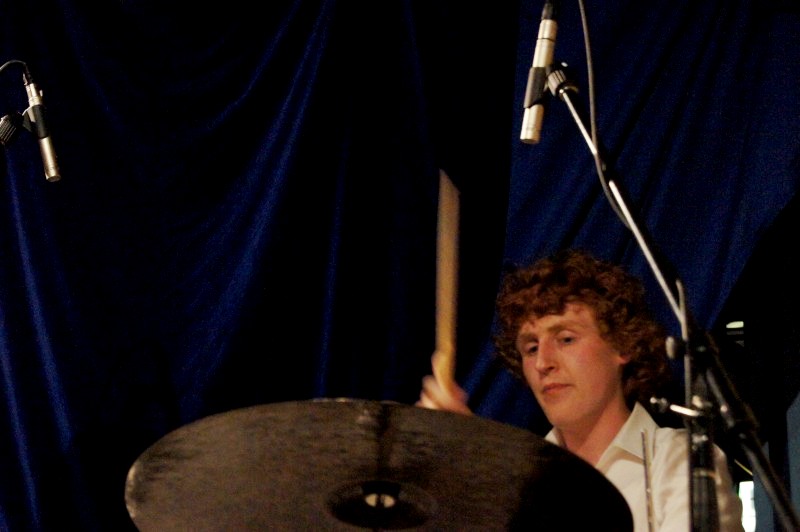
I was thinking of how this varies from US jazz, or perhaps the jazz of warmer countries. Partly, through the influence of ECM and its stable and its uncompromising recordings. But some of the tunes sounded more American to me: livelier, stronger grooves. Luke was playing a Rhodes, and although he tells me there are plenty in Europe, I hear Euro-jazz with classical (and folk) influences and played on fine grand pianos. The Rhodes is more swampy to my ears, especially when effected. And while Reuben in very influenced by this jazz (he mentioned Tomasz Stanko), I often heard bop conceptions in Max’s playing. (No problems there: I actually prefer it). But it was as I meditated on Reuben’s introduction that mentioned “melody and communication”, and as I listened to Simon’s sparse but clear and concentrated bass lines, that I felt the difference. There’s an intensity of interaction and a love of pure, unaffected tone here, along with a slow, folk-affected melodic sense. Simon was just defining one chord, but every note was a treasure and every interval was well considered. Aidan’s drumming sat the same way: sparse and melodic, story telling rather than rudimental. This was a unified whole rather than a soloist and rhythm section. It’s not such a new discovery, of course. Musicians have been concerned with this since the ’50s from the cool and modal and free eras but this style is at a high level and riddled with solitary intensity. This is the music of people thrown together for long nights. It’s not urgent or urban. It’s close to music of the very late night jazz club. But there’s also a feeling of darkness and unspoken closeness and unfilled time in this music. Slow or single chords, open rhythms, internalised thought spreading quietly. Even a pop song, when it arrived, was like this. They played Bjork’s tremulous Hyperballad, and the intriguing melody appeared occasionally amongst more obscure improvised meanderings. Nice but icy.

Anyway, that’s how I heard it. Reuben Lewis (trumpet) led a quintet at the Gods Café with Max Williams (tenor), Luke Sweeting (Rhodes piano), Simon Milman (bass) and Aidan Lowe (drums).

  • Cyberhalides Jazz Photos by Brian Stewart
  • 11 February 2012

    The cycle of musical life

    I was most surprised by the maturity when the Luke Sweeting Sextet played at the Loft. I shouldn’t have been. I’ve seen all these guys before and watched them over time do plenty of impressive gigs. But here there was a composition unity and voice that spoke to me beyond just solos. They are about to record a CD so I suppose they are well practiced (even if I caught a few bloopers) but it was beyond this. Luke’s voice has impressed me since I first noticed him playing in a large ensemble gig perhaps 5 years back. I asked him then how long he’d been playing, and was a bit taken back at his short history in jazz, perhaps a year or so. Then his compositional voice also impressed with that ensemble a year or two later. These guys are all strong as individuals but here I was most impressed how they are melded as a glorious unit with those three horns, sweet and melodious and dynamically controlled, upfront and Chris’ easily syncopated bass and Aidan’s gently stated but driving drums enlivened with Luke’s own syncopations and ostinatos. This format – several harmonising horns as sextet or thereabouts - and this music, talks to jazz that I love. The deep grooves introduced with lyrical melodies spoken with the cleanest of horn harmonies, and of course the individualist statements of the solos. (I don’t know the exact quote, but) Mingus once said that his band had to effectively perform his charts, but their solos were their own business. I hear that here too. There’s an ease with the charts: they are well understood and interpreted, the harmonies are clear and the syncopations feel right. Then the solos are extensions of the personalities of each player. Matt hit first with authority and structure and fluidity and inventiveness that stunned. It’s not just for Matt’s playing, but I’m feeling more for the higher range of the alto these days, and in my listening it seems to be more common. Reuben is fast and furious and ecstatic but carries a droll presence on stage. Max is softer in tone and more restrained in performance and a fascinating penchant for intervallic soloing. Luke covered the waterfront. Blistering runs of tonal play; rich counterpoint between hands; dissonant chordal soloing; ostinatos and comping and even synth-like swelling chords on his suitcase Rhodes. As I find with the best of music, there was intense busy-ness here, but it felt easy and unfussed: an enviable skill and the mark of the well trained and talented artist. Here’s the result of several years of good training on the best of the students: once unformed, now mature, but always searching and learning.

    Then all the fun of the jam, and it was fun. A few beers, axes shared, mixing and matching of players and those old standards. I’ll mention some older mates who joined in with the student crowd: Mike and Demetri and me. I struggled with Chris’s “beast of a bass” as described by Max. Max seemed to have no problems. I long for the strong hands that Chris and Max must both have. Mike sat in for a series of tunes, sometimes with a second pianist, either Luke or Andy. I noticed a delightful bluesy authority in Demetri’s alto and an ease when playing collective improv with other horns. Very nicely played. The jam all came to a head with Giant steps and jokingly swapped fours by all the band and some grunts where someone missed a chord. And a final bop blues to end the night. Latish, but enlivening and lots of chuckles amid the seriousness of earning respect that is a jam session.

    Luke Sweeting (piano, Rhodes) led a sextet comprising Matt Handel (alto), Max Williams (tenor), Reuben Lewis (trumpet, fluegelhorn), Chris Pound (bass) and Aidan Lowe (drums). For other than one tune by Reuben, they played compositions by Luke. This was a fundraiser to start the new year at the Loft and what a great night.

    10 December 2011

    In passing

    Canberra is not NYC or even Melbourne, but I can occasionally catch two interesting gigs in a night. After Pen Island it was Andy Campbell’s JUBB at Smith’s Bookshop. I only caught part of the set, but this was steady mid-tempo fusion with attractive melodies, often played as sweet unison by guitar and tenor, with lyrical and mostly restrained solos and several long crescendos. I wondered if the potent guitar chording defined much of the sound. Andy presented all original tunes: Led Zep (an obvious and deserved dedication); Grey ghost; PP2 (a new version of an earlier tune called Pool party). The final tune was Darcy, written about Andy’s dog, and it seemed a different composition from the others. It was something like a shuffle in 5/4 with variations. Andy volunteered that Darcy is a happy dog and you could feel canine revelry in those variations. This was satisfying fusion with attractive melody and Andy’s amiable presence. Andy Campbell (guitar, compositions) leads JUBB with Max Williams (tenor), Chris Pound (bass) and Luke Keanan-Brown (drums).

    Hear JUBB

    27 October 2011

    Turossing it (Moruya 2011/1)

    Moruya is an annual opportunity to catch up on the Jazz School, at least if you hang out at the Air Raid Tavern. The larger ensembles are mostly there. The faculty is always represented somehow. This year it was Vince Jones and Matt Thompson as leaders. Luke appeared with some prominent students as the ANU All Stars and also with his Sextet. As usual, I kept a particular eye open for the bassists. There were also the trad and mainstream communities and the festival of voice and the jazz gospel service and the St Louis-style march. The march is fun, especially if you can walk with your instrument. I’ve only seen it once and, as I remember, the tunes were A closer walk with me and When the saints go marching in. The walk is hardly the stuff of the modern or avant garde or even of the Air Raid Tavern, which is the modern jazz centre and the hangout of the Jazz School. We appeared this year as Sax & the Citizens with Mike, Richard and guest Henry Rasmussen. A nice innovation this year was a few open sessions for jams (called Blackboard Band sessions, but the jams just happened, no blackboards required). I got to play in one and another was settling in for the night when I left the Air Raid on Saturday. I saw about 20 bands over the weekend, and won’t report them all. So, what featured for me?

    Vince Jones led a quartet with Matt McMahon, Eric Ajaye and Mark Sutton. This was a concert style in a new concert venue, so it’s different from the normal intimate Moruya experience. This was gentle, politically committed and nicely flowing, as Vince’s concert are. I like the way he merges tunes and maintains an atmosphere. And I like the way he’s committed to more than just the music. It’s refreshing. I’m not so spiritually inclined but politically I enjoy the snouty right wing consternation after his concerts. No harm done there. Musically, I especially remember a beautifully detailed head that was richly improvised: detailed like scat but with words and soft and unintrusive. What is it about trumpet that produces singers like this? Vince Jones (vocals, trumpet, flugelhorn) led a quartet with Matt McMahon (keyboards), Eric Ajaye (bass) and Mark Sutton (drums).

    I can talk of the Luke Sweeting Sextet and the ANU All Stars (terrible name!) in one paragraph. They were a blast and perhaps my favourite music of the weekend. The All Stars were led by Reuben, with Luke Sweeting, Max Williams, Rohan Dasika and Aidan Lowe. They played music of Reuben and Luke and some interesting non-originals by the likes of Tomas Stanko. Luke’s Sextet added Matt Handel and played charts by Luke. Perhaps the Stars were more mesmeric and restrained, although I remember a march-like piece, while Luke’s tunes were more harmony-flavoured, charted vehicles, but both had involved and committed solos against great grooves and were truly impressive outings. The ANU All Stars was led by Reuben Lewis (trumpet) with Luke Sweeting (keys), Max Williams (tenor), Rohan Dasika (bass) and Aidan Lowe (drums). The Luke Sweeting Sextet added Matt Handel (alto, tenor).

    Crossing over with Luke and the All Stars in style and membership was Alex Raupach. He’s another band leader with original compositions in a modern style of less frequent chord changes and satisfying, floating melody. I place somewhere near the All Stars, but without the ventures into mesmeric minimalism. Alex Raupach (trumpet) led a quintet with Matt Handel (alto, tenor), Andy Butler (piano), Rohan Dasika (bass) and Aidan Low (drums).

    I’ll highlight just a few individual players although they weren’t the only ones that stood out for me. Firstly, Aidan Lowe for his hard work. He’s a wonderfully strong player and on many first call lists. On Saturday he played eight sets straight and was still playing with interest and energy in the last set, but reasonably turned down the jam afterwards. Another is bassist Rohan Dasika. I’d only heard Rohan at one jam session before where he played a steady and repetitive Footprints. He’s ready and able to maintain an unchanging groove (he’s also studying in the classical school and if you’ve seen some orchestral bass scores, you’ll understand that repetition is common there, too) but he could also lay down and improvise on strong grooves and solo with bow or pizz. I was taken aback when he played the final few bars of Donna Lee in unison with horns at bop speed. He did the same on another tune with German bow. As you’d expect from a classical cat his intonation and chops were just right, but his grooves and walks were also good. I should mention Reuben Lewis, too, for Moruya and several gigs I’ve heard him at recently. His playing these days is wonderfully sophisticated, fully-toned, vibrant and appropriate in some very different contexts. A pleasure.

    Turossing it (Moruya 2011/2)

    Matt Thompson has been an enigma to me, being a particularly sparse-cum-minimalist performer, but I heard him twice at Moruya and I loved it. Sparse is certainly the word. You ache for the next delayed note in a melody that’s not so much challenging as just right. And when the whole band does it together, it’s quite magical. It seems touched with blues (a blues connotation?) in its simplicity and its infectiousness and, with Josie’s words, it takes on a singer-songwriter significance. Then, given the desert-dry atmosphere, a waterfall of notes in Matt’s solo in the last tune was a stunner. I enjoyed these two sets. Matt Thompson (piano) leads a quartet with Josie Jensen (vocals), Rafael Jerjen (bass) and Henry Rasmussen (drums).

    Lakeside Circus is a favourite of mine. It’s a creation of Jono Lake, but he was called back to Canberra and the band did the set without him. I listened to Sun Ra returning from the coast, and the Circus has a similarly playful and iconoclastic vigour. Trumpeter Shane Spellman took to the drumkit that Jono now leads from and Reuben Lewis sat in for Shane on trumpet. This is vibrant, fun, entertaining, even dissident music that thrives on its frolicsome composition and collective performance. Fun and refreshing. Jono Lake (piano, drums) is the leader and composer for Lakeside Circus but was not available. This day, the Circus was Andrew Fedorovich (alto), Max Williams (tenor), Patrick Langdon (trombone), Reuben Lewis (trumpet), Alec Coulson (bass) and Shane Spellman (drums).

    10 August 2011

    Less jocular

    The Reuben Lewis Quintet followed Zoe and the Buttercups at Street 2 and shared a bassist (Simon Milman was unavailable on the day and Zoe Hauptmann sat in) so there was some continuity although the results were worlds apart. The Buttercups were ironic and postmodern; Reuben’s band was serious and modern. The compositions were originals, mostly by the band: by Simon in his absence, Nick Combes, Reuben and Luke. The playing was purposeful and capable: these are amongst the best recent ANU jazz students and I’ve written frequently of them before. I was particularly taken by a complex composed by Reuben and dedicated to Tomasz Stanko that they played as a bass-less quartet. I also recognised the other tunes: A bouncy tune from Reuben about a cat, Luke’s Just a minute which I’m pretty sure I’ve heard orchestrated for one of the large ensembles, Nick Combes’ Moira and that one by Simon. I wonder if this says something about Jazz School training for music as business: developing students to compose, to have a repertoire of originals, to develop working ensembles. This is just a note because I write days after the gig and I’ve recently written up this band (with Simon). Suffice to say this was very satisfying, serious playing and valid compositions.

    Reuben Lewis (trumpet) led a quintet with Max Williams (tenor), Luke Sweeting (piano), Aidan Lowe (drums) and Zoe Hauptmann (bass) sitting in for normal bassist Simon Milman.

    02 June 2011

    Boundaries of the art

    The best of the advanced students get into some very challenging music in the later years of their studies and Reuben Lewis’ band was no exception. I don’t find it at all unexpected. For all its glory, musicians can become jaded by the standards repertoire and swing. They’ve done it, heard it, and they have skills and interest to explore the wilder boundaries. The new may not be the music they’ll be making money from, but it’s intriguing and a challenge and there’s an audience that’s passed through a similar history and is there with them. It’s a small and perhaps an exclusive group but it’s willing and beguiled.

    The extremities were compositional exercises by Reuben and were mostly unnamed, as such experiments often are. There were two “fragments” (Fragments no.4 and Fragments 2 no.1) that were sketches supporting improvisation. There was an experiment in duration that had a chart a mile long and a stopwatch (timed to 6m52s, I think). Each player knew when to play (eg, play 3m42s-4m03s, play again 4m57s-6m41s) but not what to play, so listening was key. As I understood, Reuben will develop that chart with dynamics and the like, but with no indication of pitch or harmony, and document the development of the piece as his Honours thesis. Another piece sounded similarly free, but followed Reuben handing out an A4 sheet to each player, folded in 8 and obviously first seen then and there. This was all difficult and all intriguing, and it could have been a flop with unable players, but it wasn’t. It had a musical sensibility and involvement that I enjoyed as did some others I spoke to. Nicely done. But it was not all at the icy extremities. There was groove and even some intensely lyrical beauty. Simon provided a latin tune and a reggae. Both sat with long sustained bass ostinatos. The latin was nicely tense with solos that grew with long crescendos and the reggae was more steady and bouncy. I liked them both. And the beauty of the night was Luke’s Just a minute, with long harmonised horn tones, billowing but sparse bass notes, a shimmering background and a sparse melody. I found this a stunner.

    I especially noticed some solos by Reuben (sometimes quite experimental with various mutes and other times good solid post-bop lines) and by Max and very sympathetic playing from the horns in unison and harmony. Also some very modern sounding solo piano and a funky organ on the reggae from Luke, considerable percussion from Aidan (the grooves were quite gentle) and a wonderfully rounded but present tone from Simon’s bass. Reuben Lewis (trumpet) led a quintet with Max Williams (tenor sax), Luke Sweeting (piano, organ), Simon Milman (bass) and Aidan Lowe (drums, percussion).

  • Cyberhalides
  • 29 May 2011

    Loft doubler

    There were two acts at the last Loft session and quite different: Liam Budge with his intense and mellifluous vocals and a very comfy but inventive quartet, and Jono Lake playing a fusion of jazz and impressionism to launch his new solo piano CD. About as different as you could imagine, really.

    First, Liam. From the first staccato notes of Squeeze me, his music was smooth and stylish. This characterisation can be deceptive because it’s seldom associated with depth in our too-commercial society, but this music was rich with invention and deep with feeling. Liam appeared in great style with a nonchalant but imposing presence. The band sat beautifully and appropriately behind him. The swings oozed groove: Luke’s piano sitting well behind the beat and Raf’s bass right over the top for a wave of swing that was ever breaking over the audience. Liam’s voice weaved through and toyed with the lines, delaying melody then breaking with quick passages, perhaps high whistles or dropping into scat. Luke’s solos moved within chords and through dissonances and Raf’s bass solos were long and lyrical and unforced, up the neck for extended thumb position lines then down with double stops. All the while with a steady, cool drum backing from Luke 2. Liam sang one original, a drifting 5/4 entitled Stop this train. Notable to me was the gentle and soulful version of Hendrix’ Little Wing (instantly recognised by a few of the older attendees) and a heavily insistent take on Bye bye blackbird in 7/4 (apparently thanks to Luke 1 for that one). He also did a take on Long ago and far away as a piano/vocal duo and an easy Tenor madness to finish up. It’s a nice throwaway that swung easily from the top. Max Williams sat in on tenor developing from easy hard-bop blues lines to rich substitutions. And Raf’s bass solo was a killer. This was a wonderfully entertaining and engrossing set (singers do that) and with some really satisfying depth to the playing.

    Second, Jono Lake. From the irony of jazz lyrics to the intense solidity of grand piano and the emotional involvement of solo improvisation. Jono leads and composes for his wonderfully inventive Lakeside Circus and I’ve written about them here before. This is the composer as improviser. No doubt there is composition underlying these tunes, but the effect and immediacy of improvisation is laid bare here. The first tune was pensive and later Russian in scope and mood. The piano needed a good tuning, but the seriousness of it all was clear to hear. I expected similar for later tunes so I was surprised by what was a fairly pleasant tonal piece with straightforward interpretation for the second tune, although it, too, flirted with intensity. The third was more an impressionist solo hinting of occasional jazz syncopations. The fourth was similarly impressionistic but this time developing to a heavy, contorted stride. The final was open and thoughtful and filmic and started with something like a loose left hand ostinato but developing as mohttp://www.blogger.com/img/blank.gifre indeterminate. I lost myself in the solidity of a solo grand piano with the piercing probing of dissonant impressionism. This is compositional inquest as improvisational immediacy and I enjoyed it immensely.

    Liam Budge (vocals) led a quartet with Luke Sweeting (piano), Rafael Jerjen (bass) and Luke Keanan-Brown (drums). Max Williams (tenor) sat in for two tunes. Jono Lake (piano) followed with a solo set to launch his new CD.

  • Cyberhalides
  • 14 May 2011

    Sweet composition

    What I really noticed was the compositions when Jared Plane led his quartet at the Band Room for the Student Jazz series. The playing was great too, but it was the very neat and smooth compositions that caught my attention. It’s not that they were unlike anything I’d heard before (musicians are by nature magpies) but the chords just sat nicely and moved with melodies in unobtrusive ways and the harmonies supported interesting solos and the styles were varied. I hate rhythm changes was authentic bop; Reverence was devout; Passing time was laid back; Bridges was latin; Pichushkin was a free and unrestrained tune about a murderer. They all worked for me and I felt I could easily hear them in a commercial setting like a TV series. These were a set of mainstream tunes that were unforced despite changing time signatures and added bars. That was nice. It’s no surprise that Jared composes on a piano. These are not groove-based tunes written on bass. Guitarist Andy Campbell also provided a few tunes, and I was interested to hear the difference. My guess is that Andy composes on guitar, because his were rapid and flowing scalar melodies that fell easily under a guitarist’s hands and which featured some angular plays on time. Nice composing all round.

    And the musos were enjoying their performance and playing well. Jared was comfortable and interesting in accompaniment and obviously enjoyed his solos: nice melodic things, varied in speed and plenty fast when required, extending right up to the highest thumb positions (I thought C thumb on G-string). Andy is more urban-chaotic in his solos: fast lines than bend and permute and stop and start; clear but iconoclastic. Max is lyrical and purposeful. He can easily drop into dissonance and flourishes, but his playing is always thoughtful and with musical intent. And Aidan is playing so solidly these days: busy but nhttp://www.blogger.com/img/blank.gifever overplayed; simple but sharp percussive statements with clear tone and deceptive ease. He took a few solos and they just sat so easily, moving through rhythmic colours and washes with relaxed skills. He’s a drummer who’s just easy to play with. Another pleasure.

    Jared Plane (bass) led a quartet playing very satisfying original compositions with Andy Campbell (guitar), Max Williams (tenor) and Aidan Lowe (drums) at the ANUSM band Room.

  • Cyberhalides pics
  • 07 August 2010

    Something quirky this way comes

    The Circus came to ArtSound again last night, ie, Lakeside Circus. It’s always a work of madness and extravagance, and some really interesting and searching playing. I’ve written on their last performance at the Front. Read that for more in depth comments. This time, I only caught some of the broadcast and got to the studio for part of the second set. Again I noticed those clever, Mingus-like arrangements, but was also taken by the soloing, which was not so much virtuosic as intervallically intriguing, and some strikingly contradictory piano playing at times from Jono that just clashed like the titan but resolved into new and satisfying themes. Jono is generous about his work in all this, although he takes an obvious and impish and committed leadership role while playing. His take is that he starts with an idea, and the arrangements develop from themes and lines played in practice, which he then further charts. Whatever, it’s very impressive writing. Another quirky saturnalia from Jono’s musical acrobats.

    Lakeside Circus played for Friday Night Live at Artsound. The Circus is Jono Lake (piano, compositions), Shane Spellman (trumpet), Andrew Fedorovich (alto sax), Max Williams (tenor sax), Patrick Langdon (trombone), Alec Coulson (bass) and Mark Levers (drums).

    08 June 2010

    Tranquil Lakeside, not

    There’s always a touch of bent genius in the circus and often enough in composers. A challenge to the designed surroundings of Canberra and a rational APS. I was thinking this as I listened to Jono Lake’s Lakeside Circus. The music was all circus exuberance and jovial rhythms and riffs and bass lines, merged and manipulated and toyed with. Absurd, varied, jokey, malleable and entertaining. Entertaining: that word that musicians often forget at their own expense. Even between tunes it was a rollicking show. One tune was Candy Berry, obviously named for Canberra. Shouts of “I love Valium” and offers of solos “How ‘bout you … solos … [pointing]“ “Ready .. 1,2,1234”. This was loony tunes of the discordant harmonies. The out-of-tunality might sound like poor playing to uninformed ears, but it’s not like that at all. This is purposeful, but irony is the purpose. This is on the beat and square, boxy and tonally clashing, with just the odd touch of swing and sweet soloing to lighten the effect. This is not music to highlight performers, but music of composition. Jono’s the composer and concertmaster and performer out front (every circus needs performers). All excitement and urgent invention that dismays and constantly pushes his Circus. I noticed quotes from All the things you are and even Giant steps, but these are just that, quotes. The bebop as stride was more indicative of his style. There were mainstream solos from Max and Shane and John and Andrew, and some quite fitful but exploratory ones from Jono. But always that challenge to the comfortable and the overtly serious. Well practised to be rough as guts and hot as hell. I loved it. I tired a bit as the night wore on, so maybe it could have some more contrasting, tuneful interludes. I found the occasional break into a capable swing solo was a joyful release. But this was Mingus-like in the passion of the playing, and demands (even Mingal shouts) of the leader, the roughness and bluesy urgency and the playfulness. Refreshing, despite the demands it places on the listener. Lakeside Circus is Jono Lake (piano, compositions), Shane Spellman (trumpet), Andrew Fedorovich (alto sax), Max Williams (tenor sax), Patrick Langdon (trombone), Alec Coulson (bass) and Mark Levers (drums).